Health
What is Type 1 vWD?
The mildest, most common form of von Willebrand's disease, involving a partial factor deficiency.

Quick answer
What is Type 1 vWD?
The mildest, most common form of von Willebrand's disease, involving a partial factor deficiency.
Having a specific genetic test for this exact subtype means owners and breeders can get a precise answer — carrier, affected, or clear — rather than a general uncertainty about clotting risk.
This is most relevant to breeders and prospective puppy buyers who want to use available genetic testing to make informed decisions, as well as owners preparing for a dog's first major surgery who want to understand their specific risk level.
This guide is not medical advice. If your dog shows pain, sudden behavior change, or worsening symptoms, consult a licensed veterinarian.
Some links may be affiliate links. We may earn a commission at no extra cost to you. We only suggest products we believe are helpful for dog owners.
We research and check what we publish, but we do not warrant that any figure, date, price, or statement is accurate, complete, or current, and we accept no liability for any loss, cost, injury, or other harm arising from the use of this site. Use it as one reference among several. You remain responsible for your own decisions and for your dog's care - confirm anything that matters with a licensed veterinarian or another qualified professional before you act on it. Full disclaimer.
Von Willebrand's disease Type 1 is the mildest and most commonly diagnosed form of this inherited clotting disorder, involving a partial reduction in von Willebrand factor rather than a complete absence or structural defect. A specific genetic test for this variant allows for precise clear, carrier, or affected status determination, offering more actionable information than a general clotting factor test alone, particularly for breeding decisions.
Type 1 is documented as the most common form of von Willebrand's disease across affected breeds generally, including French Bulldogs, making it the form most owners and breeders are likely to encounter through screening or genetic testing.
This specific genetic variant causing Type 1 von Willebrand's disease has been identified within French Bulldog lines, and its presence reflects inherited genetics passed down through breeding rather than anything related to the breed's structural or airway anatomy.
There's no environmental trigger for the underlying genetic deficiency; as with the broader condition, the practical risk is entirely tied to specific bleeding-risk events like surgery or significant injury rather than anything in daily environment or lifestyle.
Discuss genetic testing options with your vet if considering breeding, and mention a known or suspected diagnosis before any planned surgery so appropriate precautions can be taken.
Because a specific test exists for this variant, a few common gaps in using it fully can mean missing out on genuinely useful, actionable information.
See all French Bulldog health problems, which breeds are prone to von willebrands disease vwd1, or the full French Bulldog breed guide for temperament, exercise needs and ownership costs.
Genetic testing typically returns results within a few weeks of sample submission. Managing the condition day to day is largely about precaution around specific events like surgery rather than an ongoing routine.
Success means having clear, specific genetic information available well before it's needed, whether for an individual dog's surgical planning or for informed breeding decisions that reduce the trait's prevalence in future litters.
Type 1 von Willebrand's disease involves a partial reduction in the amount of von Willebrand factor circulating in the blood, rather than a complete absence or a structural defect in the protein itself, which is what characterizes the rarer, more severe Type 2 and Type 3 forms.
Because of this partial nature, many dogs with Type 1 have only mildly prolonged bleeding, if any noticeable issue at all, in contrast to Type 3, where a near-complete absence of the factor can cause much more severe, spontaneous bleeding even without significant injury.
Genetic testing for the specific mutation associated with Type 1 provides a level of clarity beyond a general clotting factor blood test, identifying clear, carrier, or affected status even in a dog that hasn't yet had any bleeding event to reveal the condition clinically, which is particularly useful for breeding decisions.

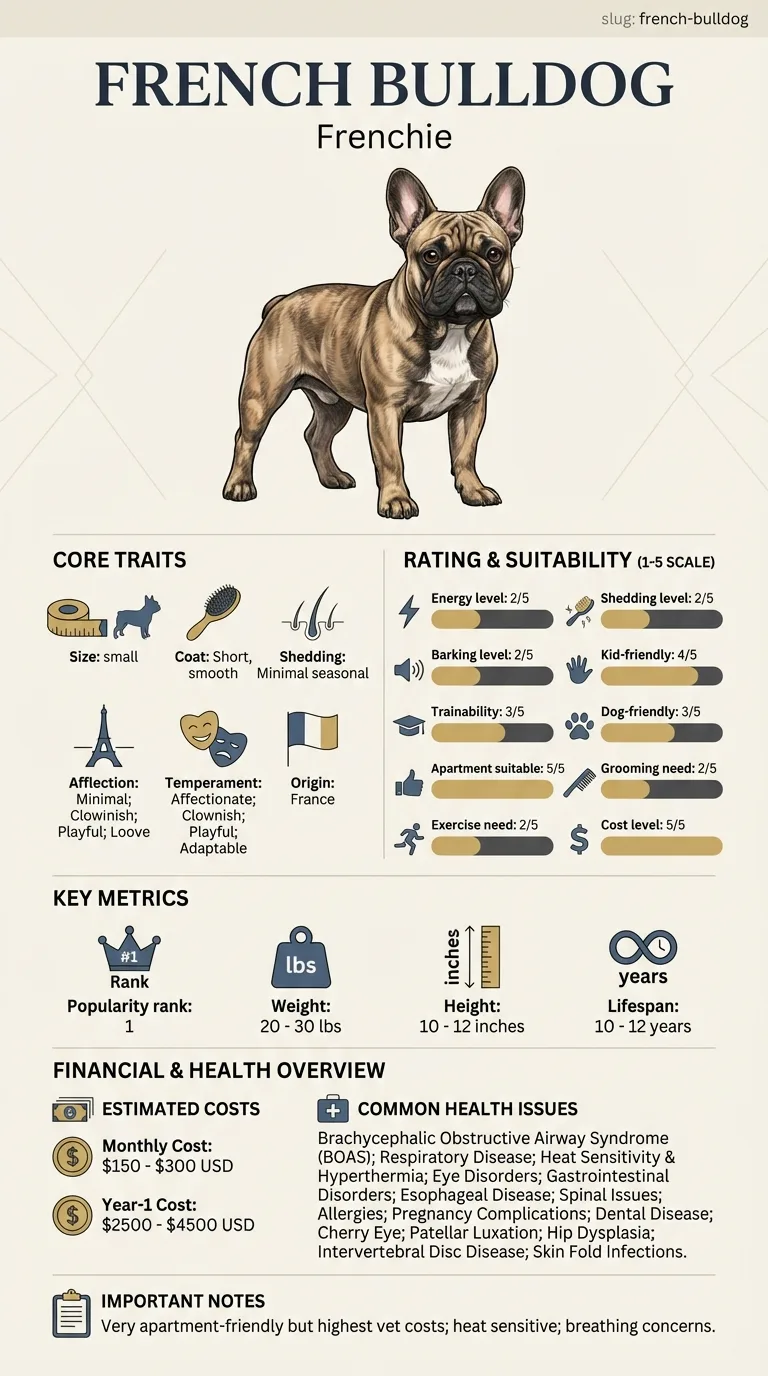
If you think your Frenchie has von willebrand's disease (vwd1), the plan is three steps: write down what you have seen and when it started, book a veterinary appointment rather than waiting for the next flare, and take video of the behaviour or symptom before you go — the thing you are worried about rarely happens in the consulting room. Screening in the parents covers brachycephalic obstructive airway syndrome (boas), respiratory disease, heat sensitivity & hyperthermia.
What the vet visit should produce is a diagnosis and a written plan, not just reassurance: what is being ruled out, what the monitoring interval is, and which signs mean you come back sooner. Ask what the treatment costs across a year rather than per visit, because that is the number that decides whether you are managing this condition or reacting to it.
Between appointments, keep a short log — dates, what you saw, what changed. It is the single most useful thing an owner brings to a follow-up, and for von willebrand's disease (vwd1) it is often what separates a clear pattern from a guess.
A breeder considering a specific pairing for her French Bulldog, Petra, used the available Type 1 vWD genetic test on both potential parents before committing to the breeding. Petra came back as a carrier, while the prospective stud tested clear. Given the inheritance pattern for this variant, the breeder proceeded with the pairing, understanding that some puppies might be carriers but none should be more significantly affected given that only one parent carried the trait, and she planned to test the resulting litter to confirm.
Key takeaway: Having a precise genetic test, rather than just a general concern about clotting risk, let this breeder make a fully informed pairing decision with a clear understanding of the actual risk to the litter.
The mildest and most common form of von Willebrand's disease, involving a partial reduction in circulating von Willebrand factor rather than a complete absence or structural protein defect.
Type 1 is a partial quantitative deficiency and generally the mildest form; Type 2 involves a structural defect in the protein, and Type 3 is a near-complete absence, both generally causing more severe bleeding risk than Type 1.
Yes, a DNA test for the specific mutation associated with this variant is commercially available, offering more precise information than a general clotting factor blood test alone.
Not necessarily — many dogs with Type 1 have only mild reductions in clotting factor and may never experience a clinically significant bleeding issue, though risk is still elevated compared to an unaffected dog, particularly during surgery.
Yes, testing both potential parents allows for informed pairing decisions that can avoid producing puppies with more significant clotting deficiency, making this one of the more actionable genetic tests available for this condition.
Not necessarily — carrier status and clinical severity can differ, and a vet or genetic counselor can help interpret what a specific test result means for your individual dog's actual bleeding risk.
General clotting screening before surgery remains a reasonable precaution regardless of a specific genetic test result, since it provides direct, current information about clotting function.
The mildest, most common form of von Willebrand's disease, involving a partial factor deficiency.
Types 2 and 3 involve more severe protein defects or near-complete deficiency and generally carry higher bleeding risk.
Yes, a specific DNA test identifies clear, carrier, or affected status for this variant.
Not necessarily — many affected dogs have only mild or no noticeable bleeding problems.
Yes, testing both parents helps avoid producing puppies with more significant clotting deficiency.
A one-page prep sheet for this condition: the signs, the questions to ask, what to get priced. Unlocks here.
You get: Vet visit prep sheet
No spam. One-click unsubscribe. See our privacy policy.
Preview page 1 before you decide.