Living
Which is the better small-space dog?
The Corgi, rated 4/5 for apartment suitability against the GSP's 1/5 - a case where the herding breed adapts better than the sporting breed to close quarters.

Quick answer
Which is the better small-space dog?
The Corgi, rated 4/5 for apartment suitability against the GSP's 1/5 - a case where the herding breed adapts better than the sporting breed to close quarters.
Choosing between a German Shorthaired Pointer and a Pembroke Welsh Corgi can be tough. Both breeds offer unique traits that cater to different lifestyles. Let’s break down their characteristics to help you decide!
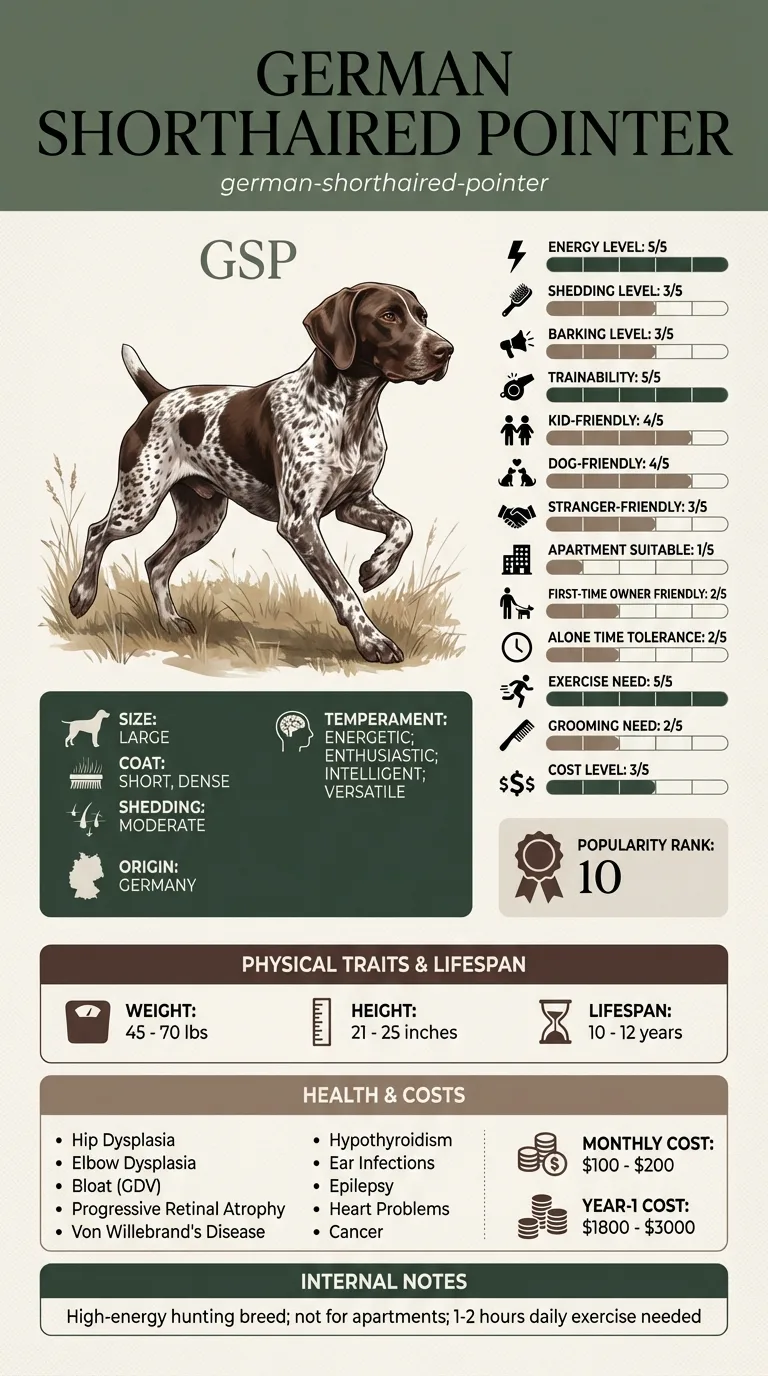
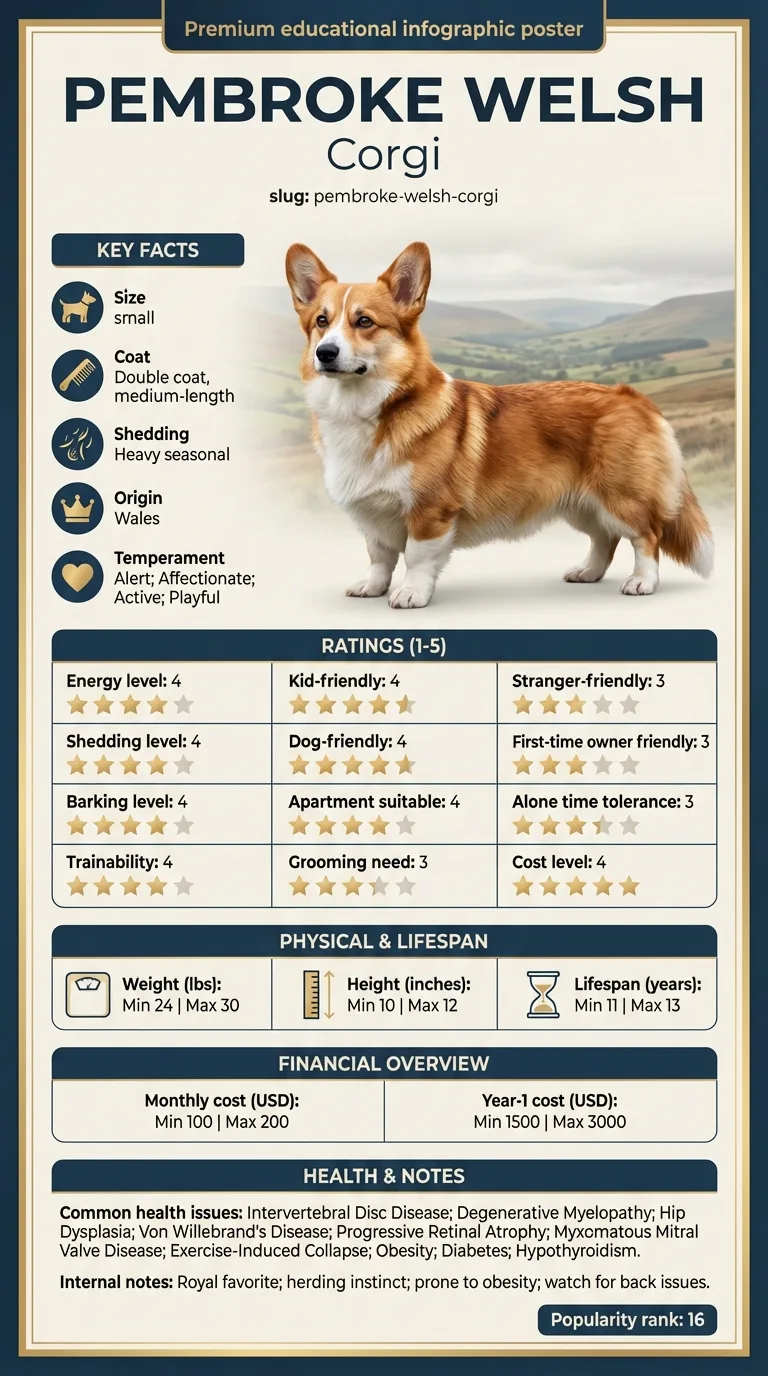
This comparison is for dog lovers who are contemplating adding a new furry friend to their family. It’s perfect for busy families, singles in apartments, or anyone wanting to know how each breed aligns with their lifestyle. If you're trying to weigh the differences in energy levels, grooming needs, or how they fit into family life, you've come to the right place!
If you’re active and have space, the German Shorthaired Pointer is an excellent choice; for a more adaptable companion, go with the Pembroke Welsh Corgi.
Choose the German Shorthaired Pointer if you have an active lifestyle, enjoy outdoor activities, and can provide plenty of exercise and training.
Opt for the Pembroke Welsh Corgi if you prefer a smaller, more adaptable dog that can thrive in an apartment and requires slightly less exercise.
| Feature | german shorthaired pointer | pembroke welsh corgi | Winner |
|---|---|---|---|
| Size class | large | small | Equal |
| Weight | 45–70 lbs | 24–30 lbs | Equal |
| Height | 21–25 in | 10–12 in | Equal |
| Lifespan | 10–12 years | 11–13 years | pembroke welsh corgi |
| Exercise need | Very high (5/5) | High (4/5) | pembroke welsh corgi |
| Grooming need | Low (2/5) | Moderate (3/5) | german shorthaired pointer |
| Shedding | Moderate (3/5) | High (4/5) | german shorthaired pointer |
| Energy level | Very high (5/5) | High (4/5) | Equal |
| Barking | Moderate (3/5) | High (4/5) | german shorthaired pointer |
| Apartment suitability | Very low (1/5) | High (4/5) | pembroke welsh corgi |
| Good for first-time owners | Low (2/5) | Moderate (3/5) | pembroke welsh corgi |
| Tolerates being alone | Low (2/5) | Moderate (3/5) | pembroke welsh corgi |
| Trainability | Very high (5/5) | High (4/5) | german shorthaired pointer |
| Good with kids | High (4/5) | High (4/5) | Equal |
| Good with other dogs | High (4/5) | High (4/5) | Equal |
| Friendly to strangers | Moderate (3/5) | Moderate (3/5) | Equal |
| Cost level | Moderate (3/5) | High (4/5) | german shorthaired pointer |
| Coat | Short, dense | Double coat, medium-length | Equal |
| Origin | Germany | Wales | Equal |
| Typical monthly cost | $100–$200 | $100–$200 | Equal |
| Typical first-year cost | $1,800–$3,000 | $1,500–$3,000 | Equal |
A Pembroke Corgi weighs 24-30 lbs on 10-12 inch legs - a long body and short stature packed with personality. The GSP is more than double the weight (45-70 lbs) and nearly twice as tall (21-25 in). The Corgi's low center of gravity was built for herding cattle at ankle height; the GSP's long legs were built for covering open ground.
Don't let the stubby legs fool you - the Corgi rates high (4/5) on exercise need, just one notch below the GSP's very high (5/5). Both are working breeds at heart. The difference is duration and intensity: the GSP wants sustained running, the Corgi wants brisk, varied activity in shorter bursts.
The GSP's coat stays low-maintenance (2/5 grooming) with moderate shedding (3/5). The Corgi needs more brushing (3/5 grooming) to manage its double coat, and sheds more heavily too (4/5) - expect fur in the corners twice a year during coat blow.
Barking runs higher for the Corgi (4/5 vs the GSP's 3/5) - herding instincts translate into vocal alerting. But apartment suitability flips the script: Corgi rates high (4/5), GSP very low (1/5). The Corgi adapts to smaller spaces far more readily despite being the noisier of the two.
The GSP edges out on trainability (5/5 vs 4/5), but the Corgi is the friendlier choice for someone new to dog ownership - moderate (3/5) versus the GSP's low (2/5) - and tolerates alone time better too (3/5 vs 2/5).
Both breeds score identically with kids and other dogs (4/5 each) and rate the same moderate (3/5) with strangers. This is one of the more evenly matched pairs on temperament - the deciding factor is really size and space, not sociability.
Lifespan favors the Corgi slightly (11-13 years vs 10-12). Health overlap is substantial: both breeds' lists include Hip Dysplasia, Von Willebrand's Disease, Progressive Retinal Atrophy, and Hypothyroidism. The Corgi carries its own risk on top of that - Intervertebral Disc Disease and Degenerative Myelopathy, tied to that long spine.
Monthly costs tie at $100-200 for both. First-year costs run close too ($1,800-3,000 GSP vs $1,500-3,000 Corgi), though the Corgi's overall cost level rates a notch higher (4/5 vs 3/5 moderate) - grooming and potential spinal-care costs add up.


Yes, rated high (4/5) - identical to the GSP's score. Both breeds handle children well according to the data.
The GSP, rated moderate (3/5) barking against the Corgi's high (4/5). Herding breeds tend to vocalize more when alerting.
Somewhat - moderate (3/5) for first-time owners versus the GSP's low (2/5), plus better tolerance for alone time (3/5 vs 2/5).
No, the Corgi sheds more - high (4/5) versus the GSP's moderate (3/5), driven by that double coat blowing out seasonally.
Four conditions appear on both lists: Hip Dysplasia, Von Willebrand's Disease, Progressive Retinal Atrophy, and Hypothyroidism. Budget for screening both breeds for these.
They tie at $100-200 monthly, though the Corgi's overall cost rating runs one point higher (4/5 vs 3/5).
The Corgi by a wide margin - high (4/5) apartment suitability against the GSP's very low (1/5), a rare case of the smaller-class breed actually needing less space than its size class would suggest.
The Corgi, rated 4/5 for apartment suitability against the GSP's 1/5 - a case where the herding breed adapts better than the sporting breed to close quarters.
Close - $1,800-3,000 for the GSP versus $1,500-3,000 for the Corgi, with the Corgi's higher-end estimate matching the GSP's.
The GSP, rated very high (5/5) versus the Corgi's high (4/5) - both are working breeds, but the GSP wants more volume.
The Corgi, at 11-13 years versus the GSP's 10-12 - a modest edge, not a dramatic one.
Secure checkout on Stripe. We never see your card.
7-day money-back guarantee. Instant access.
This guide is not medical advice. If your dog shows pain, sudden behavior change, or worsening symptoms, consult a licensed veterinarian.
Some links may be affiliate links. We may earn a commission at no extra cost to you. We only suggest products we believe are helpful for dog owners.
We research and check what we publish, but we do not warrant that any figure, date, price, or statement is accurate, complete, or current, and we accept no liability for any loss, cost, injury, or other harm arising from the use of this site. Use it as one reference among several. You remain responsible for your own decisions and for your dog's care - confirm anything that matters with a licensed veterinarian or another qualified professional before you act on it. Full disclaimer.
Match your lifestyle to the right dog.
Take quizNot sure which breed is right for you? Take our 2-minute quiz to find out.
Take the quiz