Behavior
Which is more apartment-suitable?
The Welsh Springer Spaniel, at low (2/5), versus the GSP's very low (1/5) — though neither is genuinely apartment-friendly.

Quick answer
Which is more apartment-suitable?
The Welsh Springer Spaniel, at low (2/5), versus the GSP's very low (1/5) — though neither is genuinely apartment-friendly.
German Shorthaired Pointer or Welsh Springer Spaniel? On paper they differ most on exercise need, and on the scales German Shorthaired Pointer is the heavier at 45–70 lbs. Here is how the two compare on everything that shapes an ordinary week.
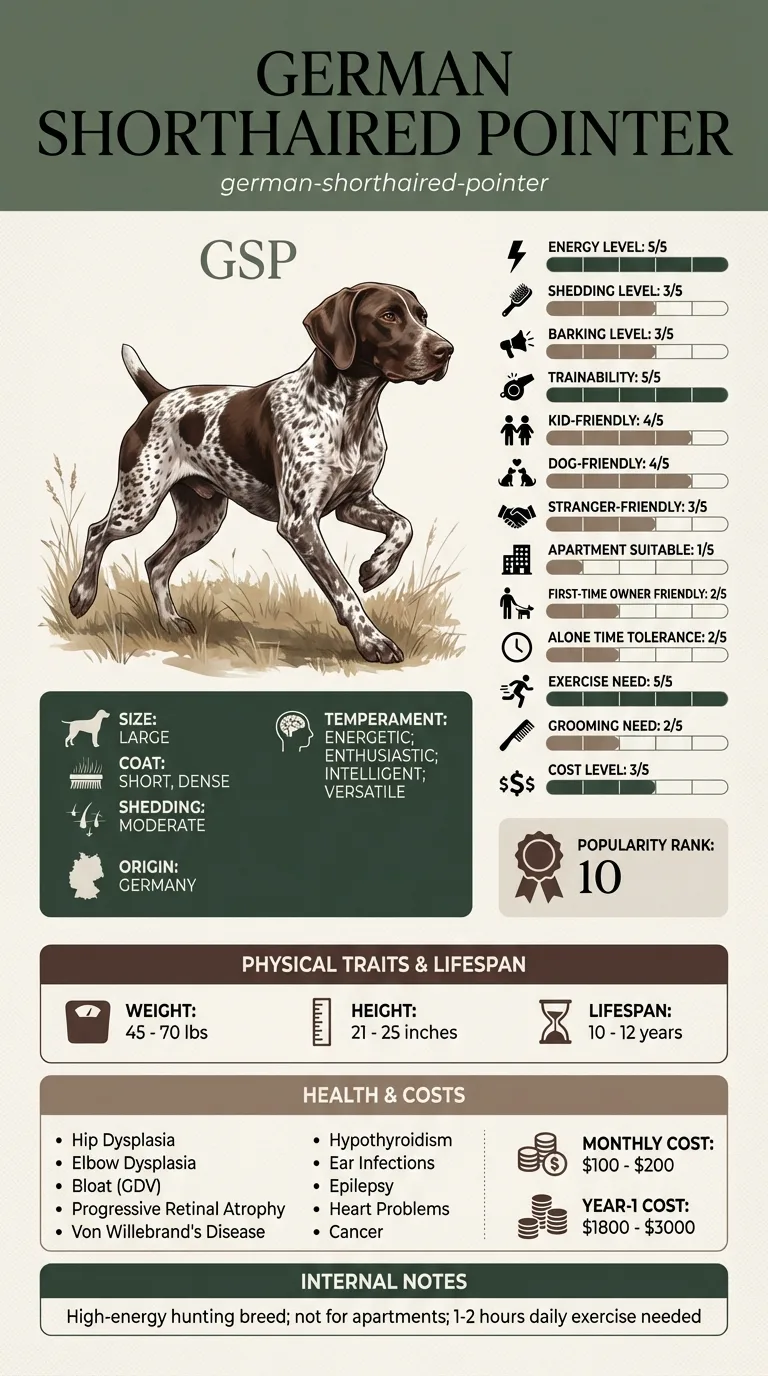
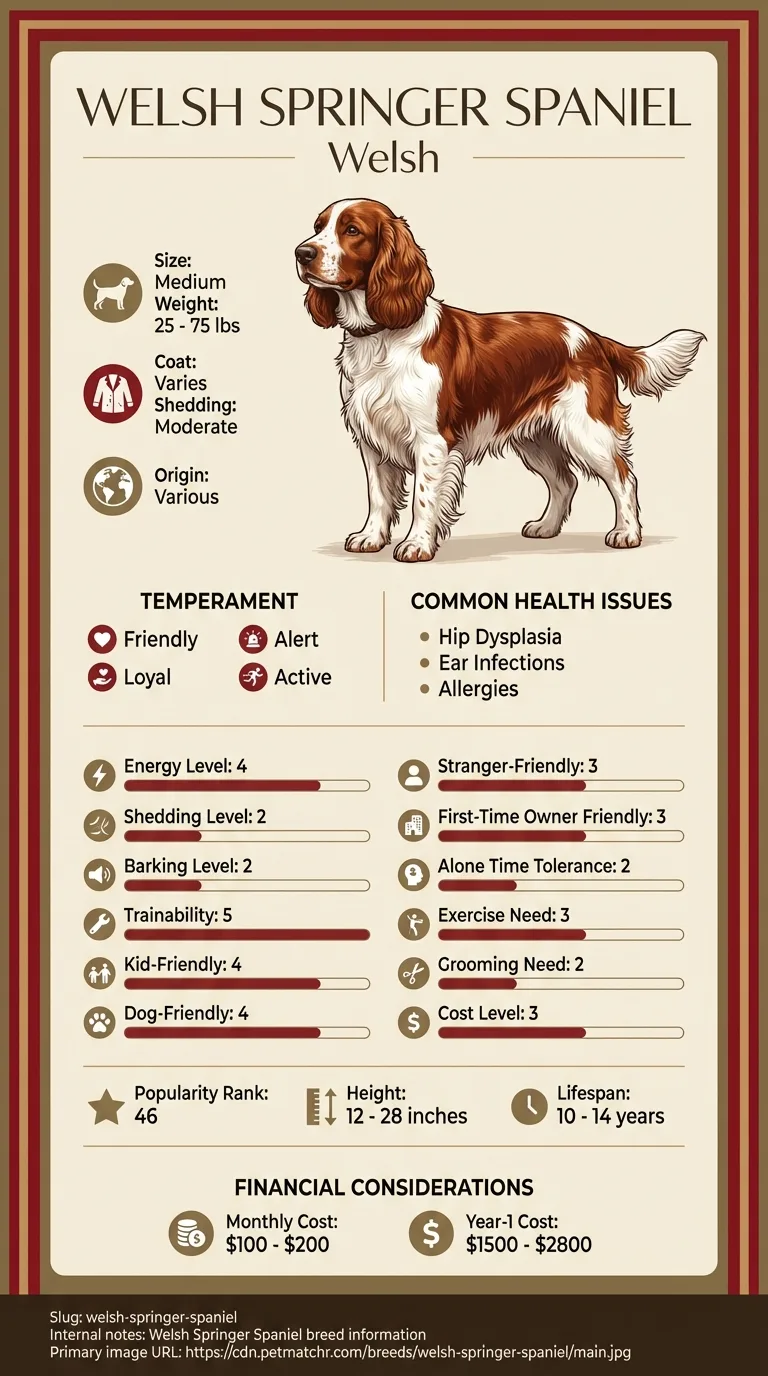
This is for someone already down to German Shorthaired Pointer and Welsh Springer Spaniel and deciding between them. Because the two are so evenly matched, the page works through every axis rather than leading with one. Anyone choosing from a flat has a clear answer here: Welsh Springer Spaniel rates 2/5 against 1/5. Breed history is left out; what follows is what you will actually live with.
Between German Shorthaired Pointer and Welsh Springer Spaniel, they are closer than most pairings, and the choice comes down to temperament, and Welsh Springer Spaniel is the lower-effort dog of the two to keep.
Choose German Shorthaired Pointer if you do not want a standing grooming appointment, you want a dog that picks up training quickly and you want a dog that can keep up with an active routine.
Choose Welsh Springer Spaniel if this is your first dog, your walking routine is modest and a smaller dog suits your car, your home or your back.
| Feature | german shorthaired pointer | welsh springer spaniel | Winner |
|---|---|---|---|
| Size class | large | medium | Equal |
| Weight | 45–70 lbs | 35–55 lbs | Equal |
| Height | 21–25 in | 17–19 in | Equal |
| Lifespan | 10–12 years | 12–15 years | welsh springer spaniel |
| Exercise need | Very high (5/5) | High (4/5) | welsh springer spaniel |
| Grooming need | Low (2/5) | Moderate (3/5) | german shorthaired pointer |
| Shedding | Moderate (3/5) | Moderate (3/5) | Equal |
| Energy level | Very high (5/5) | High (4/5) | Equal |
| Barking | Moderate (3/5) | Moderate (3/5) | Equal |
| Apartment suitability | Very low (1/5) | Low (2/5) | welsh springer spaniel |
| Good for first-time owners | Low (2/5) | Moderate (3/5) | welsh springer spaniel |
| Tolerates being alone | Low (2/5) | Low (2/5) | Equal |
| Trainability | Very high (5/5) | High (4/5) | german shorthaired pointer |
| Good with kids | High (4/5) | High (4/5) | Equal |
| Good with other dogs | High (4/5) | High (4/5) | Equal |
| Friendly to strangers | Moderate (3/5) | Moderate (3/5) | Equal |
| Cost level | Moderate (3/5) | Moderate (3/5) | Equal |
| Coat | Short, dense | Medium, straight and water-resistant | Equal |
| Origin | Germany | Various | Equal |
| Typical monthly cost | $100–$200 | $100–$200 | Equal |
| Typical first-year cost | $1,800–$3,000 | $1,400–$2,900 | Equal |
A Welsh Springer Spaniel sits solidly in the medium class — 35-55 lbs, 17-19 inches — noticeably smaller than the GSP's large 45-70 lbs and 21-25 inches, though the gap here is less dramatic than with many of the GSP's smaller comparison breeds. Both dogs carry sporting-breed proportions, but the Welsh Springer's medium, straight, water-resistant coat and slightly stockier build set it apart from the GSP's leaner, shorter-coated frame. That water-resistant coat is a functional clue to its background as a flushing spaniel worked in wet cover, not just a cosmetic difference from the GSP's field-and-point styling.
The GSP edges out the Welsh Springer on exercise need, very high (5/5) against high (4/5), though both breeds carry real stamina from their sporting-dog origins. Energy level scores show the same one-point gap — very high for the GSP, high for the Welsh Springer — meaning the difference is real but not dramatic. A Welsh Springer owner giving a solid hour of activity daily is generally in good shape; the GSP typically wants more, and owners coming from a lower-energy breed background often underestimate how much daily commitment either dog actually needs before adopting.
Grooming tips slightly toward the GSP, low (2/5) against the Welsh Springer's moderate (3/5), since that medium, water-resistant coat needs more regular brushing to prevent tangling, especially around the feathering on the legs and ears. Shedding, though, ties evenly at moderate (3/5) for both breeds — so the grooming gap here is about time spent brushing rather than volume of loose hair around the house.
Neither breed suits small-space living well, but the GSP fares worse: very low (1/5) apartment suitability against the Welsh Springer's still-poor but better low (2/5). Barking ties at moderate (3/5) for both, and so does alone-time tolerance, at low (2/5) each. The practical takeaway is that this pair mostly needs a house with a yard regardless of which breed you choose — the differences here are matters of degree, not kind, and a condo owner shopping this comparison should really be weighing other breeds entirely rather than picking between these two on apartment fit alone.
The GSP rates very high (5/5) for trainability, the Welsh Springer just one step behind at high (4/5). First-time-owner suitability flips the advantage to the Welsh Springer, though — moderate (3/5) against the GSP's low (2/5) — which fits its even-tempered description compared to the GSP's more enthusiastic, harder-to-channel drive.
Kids, other dogs, and strangers all tie between these two breeds: high (4/5) with kids, high (4/5) with other dogs, moderate (3/5) with strangers, for both. That's an unusually even household-fit profile — the main behavioral distinction worth noting is the Welsh Springer's listed temperament trait of being reserved with strangers, which doesn't show up as a lower number here but is worth knowing about as a first-meeting tendency even if the numeric score matches the GSP's. Families that entertain often may still notice the Welsh Springer taking longer to warm up to new faces than the score alone suggests.
The Welsh Springer's health list is notably shorter — five named conditions (hip dysplasia, ear infections, epilepsy, glaucoma and hypothyroidism) against the GSP's ten, though hip dysplasia, ear infections and epilepsy overlap between the two. Lifespan favors the Welsh Springer too, at 12-15 years compared to the GSP's 10-12, a two-to-three-year edge that combined with the shorter condition list makes it the somewhat lower-risk pick on paper. That said, a shorter published list isn't a guarantee of a healthier individual dog, so routine screening for the shared conditions still matters regardless of which breed a household chooses.
Monthly cost ties exactly at $100-$200 for both breeds, and both carry a moderate (3/5) overall cost rating. First-year totals lean slightly toward the Welsh Springer being cheaper — $1,400-$2,900 against the GSP's $1,800-$3,000 — though the ranges overlap enough that actual spending will likely depend more on individual breeder pricing and local vet costs than on any structural difference between the breeds.
German Shorthaired Pointer weighs 45–70 lbs and lives 10–12 years; Welsh Springer Spaniel weighs 35–55 lbs and lives 12–15 years. No rated axis separates them by more than a single point, which makes this one of the closer pairings on the site. They are level on tolerates being alone, barking and cost level, so those cannot decide it. The comparison marks an easier option only where one exists. Facts like weight and country of origin are not scored. Both dogs are rated from the same dataset, which is what makes the numbers comparable with each other even though any individual dog sits somewhere inside its breed's range.

The Welsh Springer, at 35-55 lbs and 17-19 inches, compared to the GSP's 45-70 lbs and 21-25 inches.
The Welsh Springer Spaniel, rated high (4/5) versus the GSP's very high (5/5) — a modest but real gap.
Somewhat — it rates moderate (3/5) for first-time owners against the GSP's low (2/5), likely reflecting its more even-tempered nature.
The Welsh Springer Spaniel, typically 12-15 years compared to the GSP's 10-12 years.
Yes, that's a listed temperament trait for the breed, even though its numeric score for friendliness to strangers (moderate, 3/5) ties with the GSP's.
The GSP, with ten commonly flagged conditions including bloat, von Willebrand's disease and cancer, versus the Welsh Springer's shorter list of five.
The Welsh Springer Spaniel, typically $1,400-$2,900, versus the GSP's $1,800-$3,000.
The Welsh Springer Spaniel, at low (2/5), versus the GSP's very low (1/5) — though neither is genuinely apartment-friendly.
The GSP, at low (2/5) versus the Welsh Springer's moderate (3/5).
The German Shorthaired Pointer, rated very high (5/5) versus the Welsh Springer's high (4/5).
The Welsh Springer Spaniel, with five commonly flagged conditions versus the GSP's ten.
Secure checkout on Stripe. We never see your card.
7-day money-back guarantee. Instant access.
Health information here is general and is not veterinary advice. If your dog shows pain, sudden behaviour change, or worsening symptoms, consult a licensed veterinarian.
Some links on this site are affiliate links. We may earn a commission at no extra cost to you, and we only suggest products we believe are helpful for dog owners.
We research and check what we publish, but we do not warrant that any figure, date, price, or statement is accurate, complete, or current, and we accept no liability for any loss, cost, injury, or other harm arising from the use of this site. Use it as one reference among several. You remain responsible for your own decisions and for your dog's care - confirm anything that matters with a licensed veterinarian or another qualified professional before you act on it. Full disclaimer.
Match your lifestyle to the right dog.
Take quizNot sure which breed is right for you? Take our 2-minute quiz to find out.
Take the quiz