Costs
Which breed costs less to keep?
The German Shorthaired Pointer, rated moderate (3/5) on cost level against the Saint Bernard's very high (5/5).

Quick answer
Which breed costs less to keep?
The German Shorthaired Pointer, rated moderate (3/5) on cost level against the Saint Bernard's very high (5/5).
German Shorthaired Pointer or Saint Bernard? On paper they differ most on exercise need, and on the scales Saint Bernard is the heavier at 120–180 lbs. Here is how the two compare on everything that shapes an ordinary week.
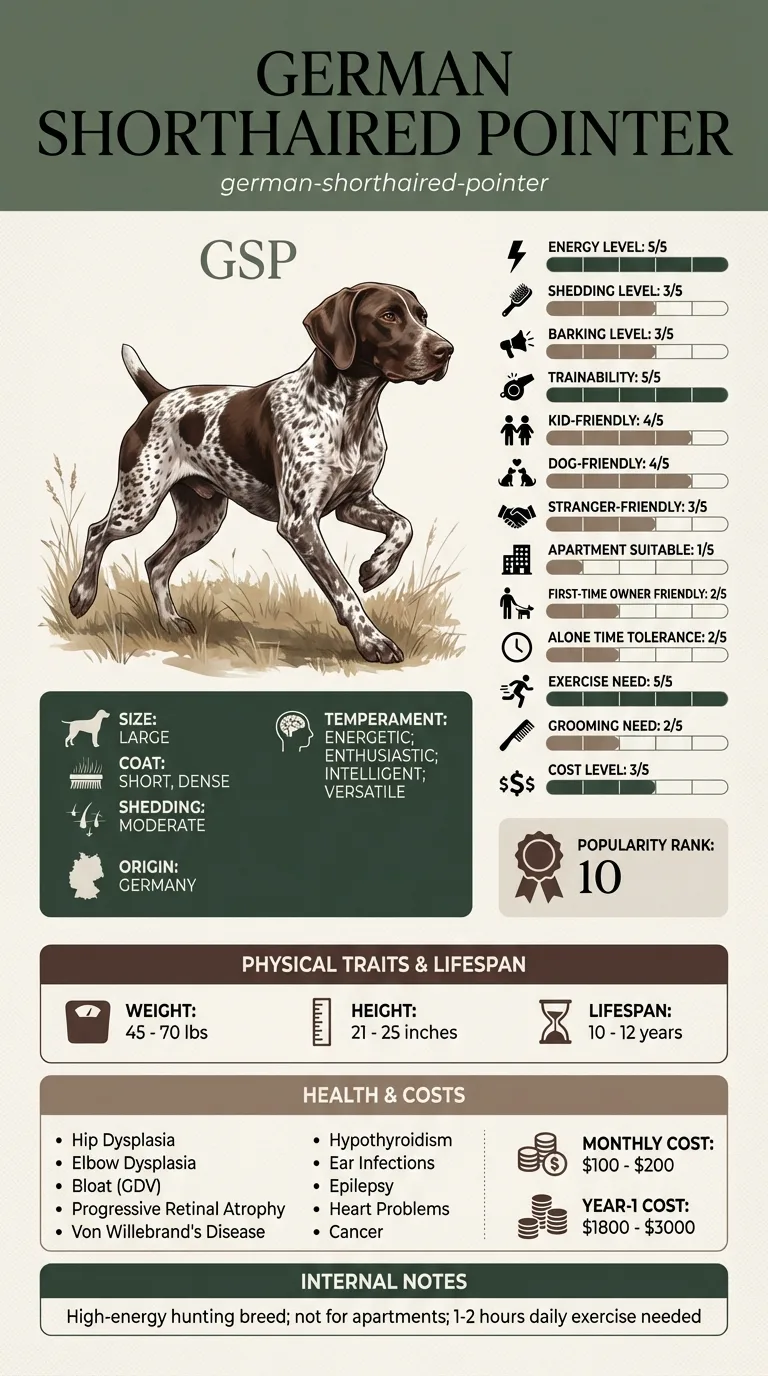
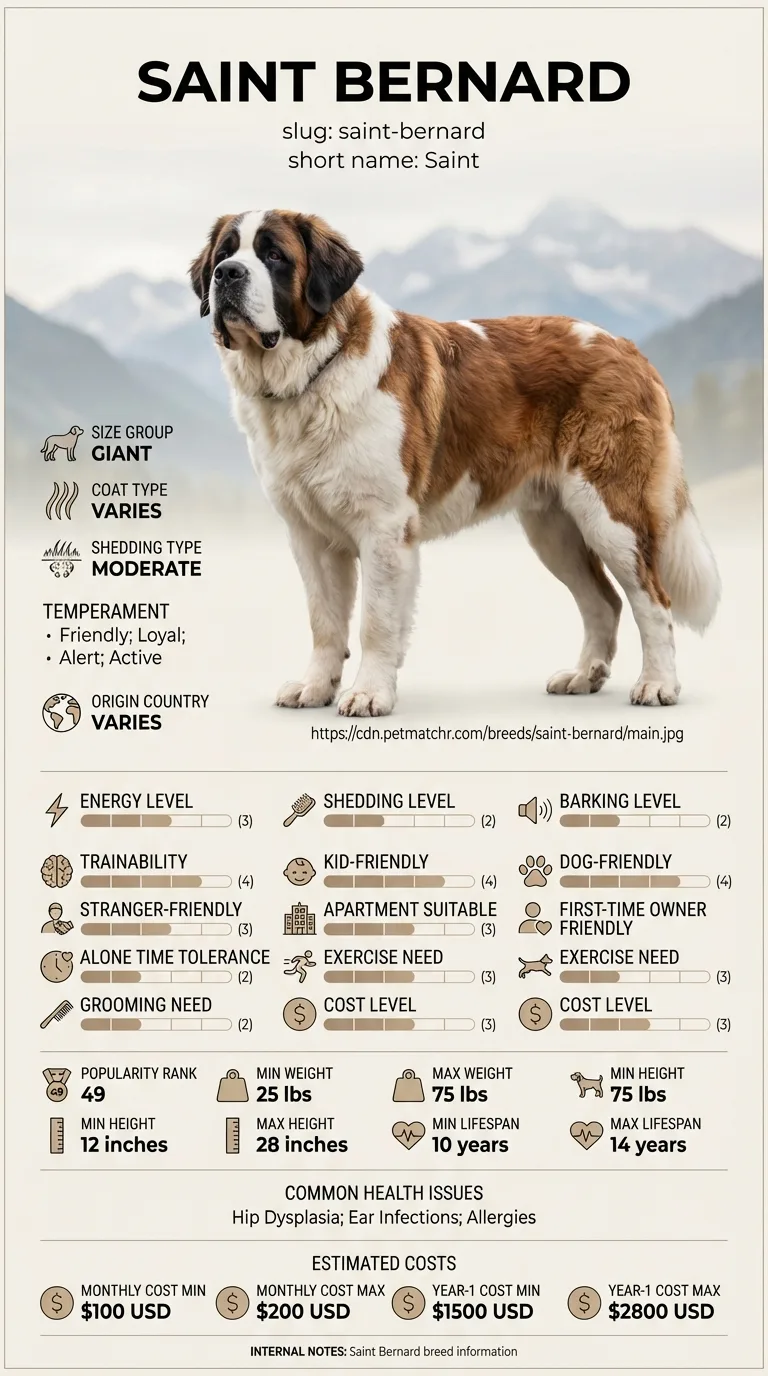
This is for someone already down to German Shorthaired Pointer and Saint Bernard and deciding between them. For this pair the decision usually turns on exercise need and energy level, so those are covered first and in most detail. Both rate 1/5 for flats, so housing does not settle this one. There is no origin story here — only what changes about your week.
Between German Shorthaired Pointer and Saint Bernard, exercise need is what separates them, and Saint Bernard is the lower-effort dog of the two to keep.
Choose German Shorthaired Pointer if you do not want a standing grooming appointment, shedding is a problem in your house and you want a dog that picks up training quickly.
Choose Saint Bernard if this is your first dog, your walking routine is modest and the dog will be alone during the working day.
| Feature | german shorthaired pointer | saint bernard | Winner |
|---|---|---|---|
| Size class | large | giant | Equal |
| Weight | 45–70 lbs | 120–180 lbs | Equal |
| Height | 21–25 in | 26–30 in | Equal |
| Lifespan | 10–12 years | 8–10 years | german shorthaired pointer |
| Exercise need | Very high (5/5) | Low (2/5) | saint bernard |
| Grooming need | Low (2/5) | Moderate (3/5) | german shorthaired pointer |
| Shedding | Moderate (3/5) | High (4/5) | german shorthaired pointer |
| Energy level | Very high (5/5) | Low (2/5) | Equal |
| Barking | Moderate (3/5) | Low (2/5) | saint bernard |
| Apartment suitability | Very low (1/5) | Very low (1/5) | Equal |
| Good for first-time owners | Low (2/5) | Moderate (3/5) | saint bernard |
| Tolerates being alone | Low (2/5) | Moderate (3/5) | saint bernard |
| Trainability | Very high (5/5) | Moderate (3/5) | german shorthaired pointer |
| Good with kids | High (4/5) | Very high (5/5) | saint bernard |
| Good with other dogs | High (4/5) | High (4/5) | Equal |
| Friendly to strangers | Moderate (3/5) | High (4/5) | saint bernard |
| Cost level | Moderate (3/5) | Very high (5/5) | german shorthaired pointer |
| Coat | Short, dense | Short or long double coat | Equal |
| Origin | Germany | Various | Equal |
| Typical monthly cost | $100–$200 | $150–$310 | Equal |
| Typical first-year cost | $1,800–$3,000 | $2,200–$4,200 | Equal |
Stack a Saint Bernard's upper weight of 180 pounds against a German Shorthaired Pointer's lower weight of 45, and you get roughly a fourfold difference on the scale, even though the height spread — 26 to 30 inches against 21 to 25 — looks far less dramatic. That mismatch between height and weight is the giveaway: the Saint Bernard is built wide and deep, with heavy bone structure suited to mountain rescue work, while the GSP is a lean, wiry sporting dog designed to cover open field at speed. Coat length adds another layer of contrast, since the Saint Bernard comes in short or long double-coat varieties while the GSP wears a single short, dense coat year-round.
Exercise need couldn't split much further apart: very high (5/5) for the German Shorthaired Pointer, low (2/5) for the Saint Bernard. A GSP's energetic, enthusiastic temperament isn't satisfied by a walk around the block — it wants field time, retrieving drills, or genuine off-leash running most days, and it will find its own outlet, usually an unwelcome one, if that need goes unmet. The Saint Bernard sits at the calm opposite end, content with short strolls and largely indifferent to vigorous play, partly because its size and heavy coat make exertion in warm weather genuinely risky. Matching either breed to the wrong household's activity level tends to produce trouble fast — restlessness on one side, overheating on the other.
Low (2/5) grooming and moderate (3/5) shedding for the GSP sit comfortably below the Saint Bernard's moderate (3/5) grooming and high (4/5) shedding, though the practical gap is bigger than the numbers alone suggest. A GSP's short coat wipes down and dries fast after a muddy field session. A Saint Bernard's dense double coat, whichever length variety, sheds heavily twice a year and needs regular brushing to keep loose undercoat from taking over furniture, plus routine attention to drool around the mouth and jowls that a GSP owner never has to think about. Choosing the GSP trades field-ready practicality for a coat that needs almost no specialized care at all.
Apartment suitability actually ties here, both breeds landing at very low (1/5), so neither is a natural fit for compact city living regardless of which one seems calmer on paper. Barking splits the difference: moderate (3/5) for the GSP against low (2/5) for the Saint Bernard, whose watchful nature tends to stay quiet unless something genuinely warrants attention. Tolerating solitude favors the Saint Bernard too, moderate (3/5) versus the GSP's low (2/5) — a working gun dog's attachment to activity and company runs deeper than a breed historically stationed to wait patiently for travelers in the Alps. Space and noise tolerance both lean toward the Saint Bernard, even though its size argues against small housing just as strongly.
Trainability rates very high (5/5) for the GSP against a more middling moderate (3/5) for the Saint Bernard, and first-time-owner suitability actually runs the reverse direction — low (2/5) for the GSP, moderate (3/5) for the Saint Bernard. That combination surprises people: the more trainable dog is also the harder one for a beginner to manage well, because a GSP's intelligence and versatility come bundled with relentless drive that needs direction, while the Saint Bernard's gentle, patient nature forgives training inconsistency even though formal obedience work moves more slowly. A new owner prioritizing ease of daily management over trainability might do better with the less biddable but calmer Saint Bernard.
Good with kids tips toward the Saint Bernard, very high (5/5) against the GSP's still-strong high (4/5), and friendliness to strangers follows the same pattern — high (4/5) for the Saint Bernard, moderate (3/5) for the GSP. Good with other dogs ties at high (4/5) for both. The Saint Bernard's gentle, watchful temperament has made it a longstanding family-guardian archetype, patient with children in a way that suits a busy household with frequent visitors, while the GSP's enthusiastic, versatile drive makes it a fantastic active companion but a slightly more reserved presence with unfamiliar faces at the door until it's had time to size someone up.
Ten years is roughly where both breeds' lower bounds sit, but the ranges diverge from there — the GSP can reach 12, the Saint Bernard tops out around 10. Hip dysplasia and elbow dysplasia appear on both lists, the one real overlap. From there the Saint Bernard's remaining risks are cardiac and structural: dilated cardiomyopathy, entropion, and bloat (GDV), the last a genuine emergency risk for deep-chested giant breeds. The GSP's list runs to ten total conditions, adding progressive retinal atrophy, Von Willebrand's Disease, hypothyroidism, ear infections, epilepsy, heart problems, cancer, and bloat (GDV) as well — meaning both breeds actually share that particular emergency risk despite their very different size classes.
The dollar gap here is wide and consistent across every measure: $1,800-$3,000 first-year for the GSP against $2,200-$4,200 for the Saint Bernard, $100-$200 monthly against $150-$310, moderate cost level against very high. A 180-pound dog simply eats, medicates, and requires larger everything at a different price point than a 70-pound one, and giant-breed veterinary care — bigger anesthesia doses, larger-scale imaging, bloat (GDV) surgery if it's ever needed — adds up quickly on top of routine costs. The GSP's cardiac and neurological screening across its longer health list keeps its own costs from being trivial, but the raw scale difference between these two breeds still puts the Saint Bernard meaningfully further into the budget.
German Shorthaired Pointer weighs 45–70 lbs and lives 10–12 years; Saint Bernard weighs 120–180 lbs and lives 8–10 years. The two diverge most on exercise need, energy level and trainability and 1 other rated axes. They are level on apartment suitability and good with other dogs, so those cannot decide it. Where the table declares a winner it means less work for the owner, nothing more; descriptive rows are left as ties on purpose. The value here is in the differences between the two columns; treat any single score as approximate.

The German Shorthaired Pointer by a wide margin, rated very high (5/5) against the Saint Bernard's low (2/5).
Slightly, on paper — very high (5/5) versus the GSP's high (4/5), though both are considered good family dogs.
The German Shorthaired Pointer, typically 10 to 12 years, compared to the Saint Bernard's 8 to 10.
Yes — hip dysplasia, elbow dysplasia, and bloat (GDV) appear on both breeds' health lists despite their very different sizes.
The German Shorthaired Pointer, rated very high (5/5) for trainability against the Saint Bernard's moderate (3/5).
More so than the GSP — it rates moderate (3/5) for first-time-owner suitability versus the GSP's low (2/5), though its size still demands confident handling.
The German Shorthaired Pointer, rated moderate (3/5) on cost level against the Saint Bernard's very high (5/5).
The Saint Bernard, rated high (4/5), compared to the GSP's moderate (3/5).
The Saint Bernard, rated moderate (3/5), versus the GSP's low (2/5).
Neither does well — both tie at very low (1/5) for apartment suitability.
Secure checkout on Stripe. We never see your card.
7-day money-back guarantee. Instant access.
Health information here is general and is not veterinary advice. If your dog shows pain, sudden behaviour change, or worsening symptoms, consult a licensed veterinarian.
Some links on this site are affiliate links. We may earn a commission at no extra cost to you, and we only suggest products we believe are helpful for dog owners.
We research and check what we publish, but we do not warrant that any figure, date, price, or statement is accurate, complete, or current, and we accept no liability for any loss, cost, injury, or other harm arising from the use of this site. Use it as one reference among several. You remain responsible for your own decisions and for your dog's care - confirm anything that matters with a licensed veterinarian or another qualified professional before you act on it. Full disclaimer.
Match your lifestyle to the right dog.
Take quizNot sure which breed is right for you? Take our 2-minute quiz to find out.
Take the quiz