Health
What is the classic sign of a cruciate problem?
A hind leg suddenly carried, plus a dog that sits with that leg swung out to the side instead of tucked underneath.

Quick answer
What is the classic sign of a cruciate problem?
A hind leg suddenly carried, plus a dog that sits with that leg swung out to the side instead of tucked underneath.
It looks like an accident. Most of the time it is the end of a process that has been running quietly for a year or more, and the give-away is that so many dogs go on to do the other side.
Owners whose dog has suddenly come up lame behind after a turn at speed, and owners facing a surgical quote and trying to understand why the options differ so much in price and approach.
This guide is not medical advice. If your dog shows pain, sudden behavior change, or worsening symptoms, consult a licensed veterinarian.
Some links may be affiliate links. We may earn a commission at no extra cost to you. We only suggest products we believe are helpful for dog owners.
We research and check what we publish, but we do not warrant that any figure, date, price, or statement is accurate, complete, or current, and we accept no liability for any loss, cost, injury, or other harm arising from the use of this site. Use it as one reference among several. You remain responsible for your own decisions and for your dog's care - confirm anything that matters with a licensed veterinarian or another qualified professional before you act on it. Full disclaimer.
Cruciate ligament rupture is the failure of the main stabilising ligament inside the knee. In dogs it is usually the endpoint of gradual degeneration rather than a single traumatic tear, which is why an apparently minor movement so often causes it and why the opposite knee is frequently affected within a couple of years.
Cruciate rupture is the most frequently diagnosed orthopaedic injury in dogs generally, though it does not appear specifically on the German Shorthaired Pointer's documented health list. Risk rises with body size, body weight and activity level, all of which describe this breed, and it is most often seen in middle-aged adults.
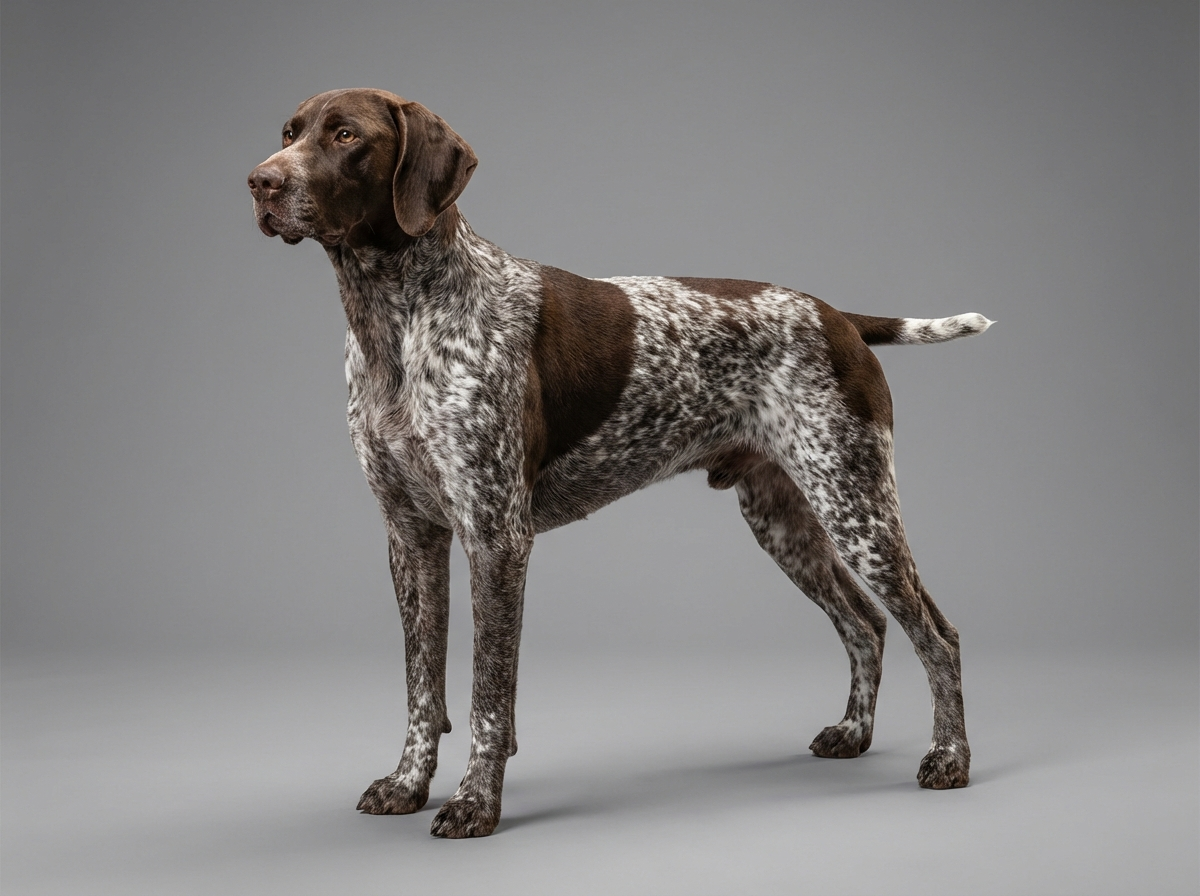
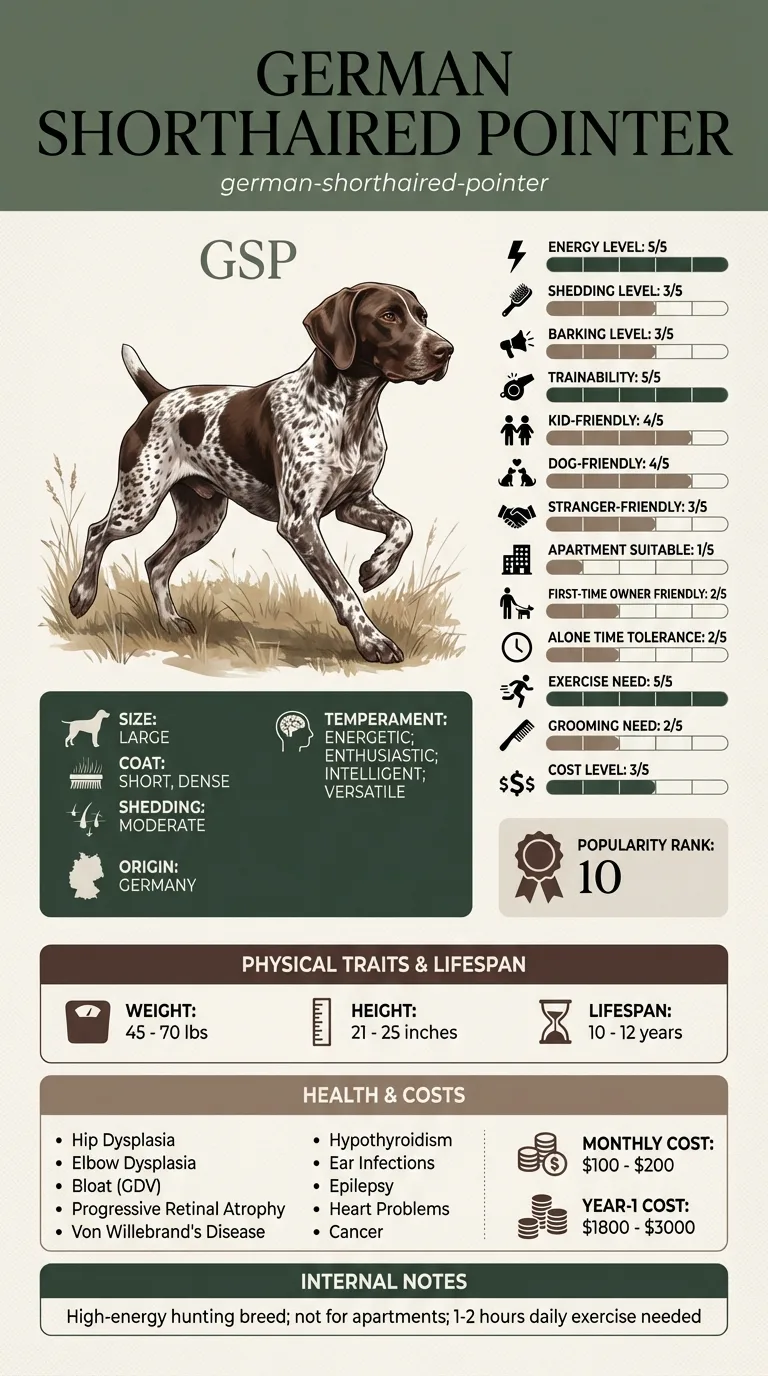
The mechanics of the breed's work do most of it. A German Shorthaired Pointer covers ground at a gallop and then brakes hard when it hits scent, which loads the knee in exactly the plane the cruciate is there to resist, and it does this hundreds of times in a working morning. At 45 to 70 pounds those forces are substantial. Hip and elbow dysplasia are also documented in the breed, and a dog subtly compensating for a sore joint elsewhere changes how it loads its knees, which may contribute over years.
Ground conditions and fitness pattern matter most. Frozen, baked or rutted ground gives inconsistent grip, and a foot that catches while the body keeps turning is a classic mechanism. Slippery indoor flooring produces the same effect at lower speed. Seasonal working patterns, where a dog is barely exercised for months and then asked for full days, mean the supporting musculature is not there when it is needed. Weight gained over an off-season compounds every one of these.
Book an appointment promptly for any hind-leg lameness lasting more than a day or two, and specifically ask that the knee be assessed rather than assuming the hips. Do the same for an intermittent lameness that keeps returning after exercise, even if the dog is sound in between. Go the same day for a dog that will not put any weight at all on a hind leg, for a knee that is hot and visibly swollen, or for a limb that looks deformed or is held at an odd angle after a fall. Sudden complete non-weight-bearing lameness can also mean a fracture, and that needs urgent assessment rather than overnight observation.
See all German Shorthaired Pointer health problems, which breeds are prone to cruciate ligament injuries, or the full German Shorthaired Pointer breed guide for temperament, exercise needs and ownership costs.
Surgery is usually followed by two weeks of very strict rest, then eight to twelve weeks of progressively increasing controlled lead exercise with rehabilitation. Most dogs are walking comfortably by six weeks and back to full working fitness at four to six months. Arthritis will develop in the joint over subsequent years regardless of how well the surgery goes, though far less than in an untreated knee.
A dog using the leg fully and symmetrically, with thigh muscle rebuilt to match the other side, back to work at close to its previous level. Success also includes an owner who kept to the restriction schedule when the dog felt ready weeks early, and who has planned for the possibility that the second knee follows.
The human comparison misleads people here. When an athlete tears a cruciate it is usually a healthy ligament destroyed by a single overwhelming force. In dogs that pattern is the exception. Far more often the ligament has been weakening for months, its fibres progressively degenerating, until an ordinary movement finishes off what is left.
That is why owners so often report something trivial: the dog turned on the lawn, or jumped off a low step, or simply spun round to come back. The event did not cause the failure; it merely arrived at the end of it.
Two consequences follow, and both matter for a German Shorthaired Pointer. The first is that a significant proportion of dogs rupture the second cruciate within a year or two of the first, because the same degenerative process has been running in both knees. Planning for that possibility from the start is more realistic than treating the second one as bad luck.
The second is that some dogs show a partial tear before the full rupture: an intermittent hind-leg lameness that comes and goes over months, often blamed on a strain or on the hips. In a breed where hip dysplasia is documented and every hind-limb problem gets attributed to it, a partial cruciate tear is regularly missed. The knee deserves examining in its own right.
The full rupture is usually unmistakable. The partial tear that precedes it is not, and it is the one worth learning to recognise.

Rowan was five, and twice that spring he had come home from a hard day with a slight hobble behind that was gone by Monday. His owner assumed a strain. It happened again in June, again in August, and each time two days of rest fixed it. In October he turned sharply after a rabbit and came up carrying the left hind leg completely. The examination found a fully ruptured cruciate, and the surgeon's view was that the intermittent lameness across the summer had been a partial tear all along. He had a bone-cutting stabilisation procedure, twelve weeks of graded rehabilitation, and was back hunting the following season. His owner also brought his weight down and kept him in year-round condition. Fourteen months later the right knee began to show the same on-off pattern, and this time it was investigated within a fortnight.
Key takeaway: The eight months of coming and going was the diagnosis, not a series of strains. A hind-leg lameness that keeps returning after exercise is a knee until someone has proved otherwise, and the second time it happens is early enough to ask.
It is not on the breed's documented health list, but cruciate rupture is the most common orthopaedic injury across all dogs and risk rises with size and activity. A 45 to 70 pound dog rated at the top of the scale for exercise need, making hard turns at speed, is a realistic candidate.
In small dogs, sometimes. In an athletic dog of this size, an unstable knee managed without surgery usually develops significant arthritis and a lasting reduction in function. Most surgeons will recommend stabilising the joint in a GSP, and your vet will explain the case for your individual dog.
Some techniques place an implant outside the joint to restrain the abnormal movement; others change the geometry of the top of the shin bone so the knee is stable without the ligament. The bone-cutting procedures cost more, are more commonly recommended for large active dogs, and generally give better long-term outcomes in that group.
There is a substantial chance of it, because the same degeneration is usually present on both sides. It is worth planning for financially and worth mentioning to your insurer, since some policies treat the second knee as related to the first.
Expect eight to twelve weeks of strictly controlled activity with a graded rehabilitation programme, and four to six months before full working fitness. Rushing the middle period is the most common reason for a poor result, and this breed makes rushing very tempting.
Not entirely, since the underlying degeneration is not fully understood. Keeping a dog lean and consistently conditioned genuinely reduces risk, and taking an intermittent hind-leg lameness seriously early gives you the chance to intervene before a partial tear becomes a full rupture.
A hind leg suddenly carried, plus a dog that sits with that leg swung out to the side instead of tucked underneath.
Yes. An on-off lameness after exercise over several months is the typical picture of a partial tear, and it is regularly misattributed to the hips.
It is one of the most common significant orthopaedic bills in dogs, with bone-cutting techniques costing more than implant-based ones. Budget for the possibility of both knees.
Plan it before surgery. Scentwork on a mat, chews, shaping games and a settled crate replace the exercise, and improvising afterwards rarely works.
A one-page prep sheet for this condition: the signs, the questions to ask, what to get priced. Unlocks here.
You get: Vet visit prep sheet
No spam. One-click unsubscribe. See our privacy policy.
Preview page 1 before you decide.