Health
What is the main congenital heart problem in large working breeds?
Narrowing of the outflow tract below the aortic valve. It forces the left ventricle to work against higher pressure and thickens the muscle wall over time.

Quick answer
What is the main congenital heart problem in large working breeds?
Narrowing of the outflow tract below the aortic valve. It forces the left ventricle to work against higher pressure and thickens the muscle wall over time.
The most consequential heart conversation a Bernese owner will ever have happens before the puppy is bought, not after.
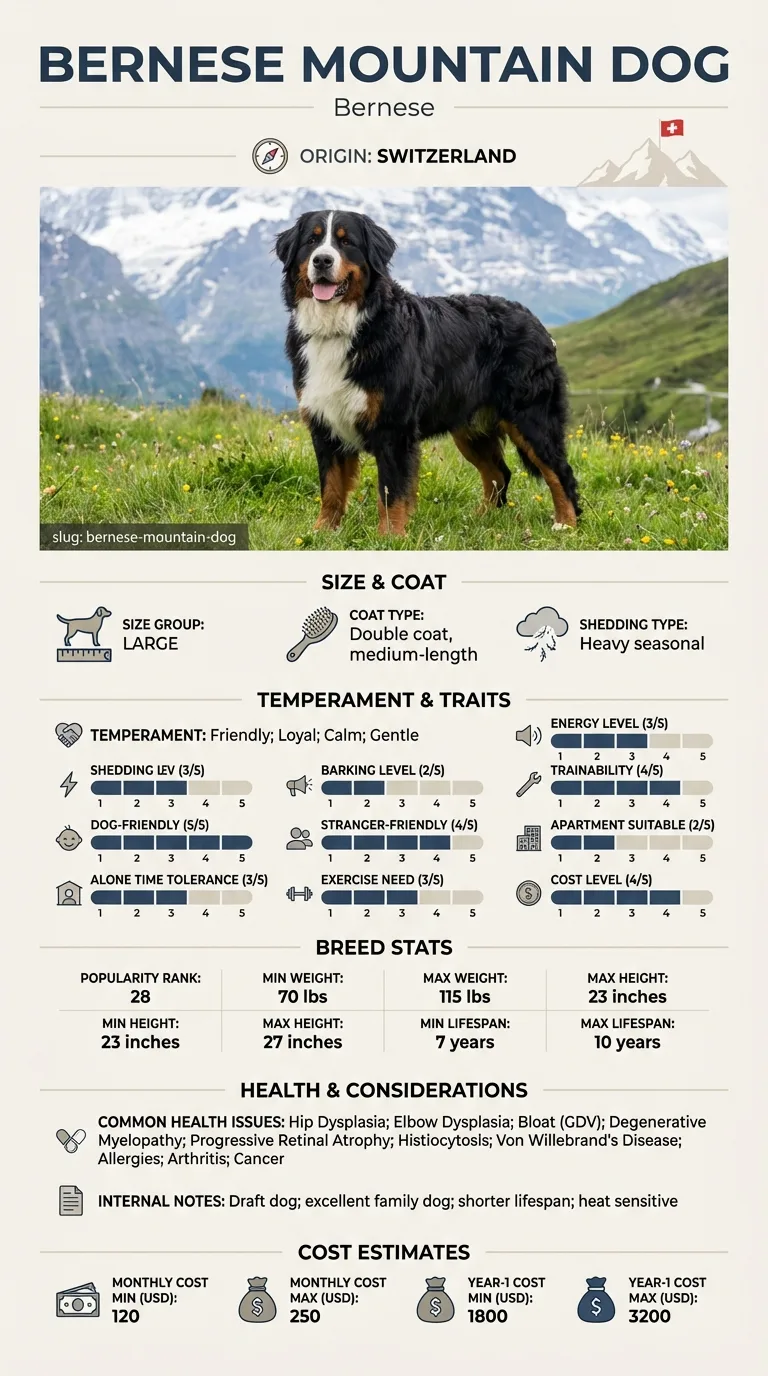
People choosing a Bernese Mountain Dog puppy who want to know what health testing to demand, and owners of a young Berner who has been diagnosed with a congenital defect and need to know what it means for exercise and life expectancy.
This guide is not medical advice. If your dog shows pain, sudden behavior change, or worsening symptoms, consult a licensed veterinarian.
Some links may be affiliate links. We may earn a commission at no extra cost to you. We only suggest products we believe are helpful for dog owners.
We research and check what we publish, but we do not warrant that any figure, date, price, or statement is accurate, complete, or current, and we accept no liability for any loss, cost, injury, or other harm arising from the use of this site. Use it as one reference among several. You remain responsible for your own decisions and for your dog's care - confirm anything that matters with a licensed veterinarian or another qualified professional before you act on it. Full disclaimer.
Congenital heart problems are structural faults present from birth. In large working breeds the most relevant is a fibrous narrowing below the aortic valve, which forces the left ventricle to pump against abnormally high resistance. Severity ranges from a lesion that never matters to one that puts a young dog at genuine risk during hard exercise, and only imaging separates the two.
Congenital cardiac defects are uncommon overall and far less likely to affect a Bernese Mountain Dog than the breed's better known problems: cancer, hip and elbow dysplasia, bloat, degenerative myelopathy and arthritis. They matter disproportionately because they affect young dogs, because they are heritable, and because they are one of the few Bernese health risks a buyer can meaningfully screen out before purchase.
Heritability is the whole story. Outflow tract narrowing is not caused by anything an owner does, and it is not caused by diet, exercise or vaccination. It arises from how the tissue below the valve forms during development, and the tendency to form it runs in bloodlines. Body size compounds the consequence rather than the cause: a dog destined to weigh 70 to 115 pounds needs high cardiac output, so the same degree of narrowing costs a Bernese more than it would a small dog.
Environment cannot create the defect but it sets the moments of danger. A heat-sensitive double-coated dog running hard on a warm day is at his highest oxygen demand and his lowest cooling margin at the same time. Households with other dogs and high-arousal play, and owners who run or cycle with their dog, create more of those peak moments than a household that walks calmly. Growth-phase overfeeding also matters, since carrying extra weight through the first year raises baseline workload.
Any collapse during or immediately after exercise in a young Bernese is an emergency and needs to be seen at once, not the next morning. The same applies to sudden weakness, staggering, or gums that look grey or blue. Book a prompt appointment rather than waiting for the annual visit if your young dog is noticeably less able to keep up with littermates or other dogs of the same age, is growing poorly, or has a murmur that has become louder between visits.
Start here: Bernese Mountain Dog Most Common Genetic Disorders
See all Bernese Mountain DOG health problems, which breeds are prone to heart problems, or the full Bernese Mountain DOG breed guide for temperament, exercise needs and ownership costs.
The diagnostic phase resolves quickly, usually within a month of the first murmur being taken seriously. After that, expect a recheck at around a year, when growth has finished and the picture stabilises. Mild cases typically move to annual monitoring and stay there for life. Moderate and severe cases settle into a six-month cardiology rhythm with medication, and the plan is reviewed each time rather than set once.
For a mild lesion, success is invisibility: a dog who lives an entirely ordinary Bernese life with an annual appointment and no restrictions. For a moderate case, success is a dog who reaches middle age without a collapse episode, on stable medication, with unchanged imaging year to year. Nobody should expect the narrowing to go away, because it does not.
Blood leaves the left side of the heart through the aorta. When a fibrous ridge forms just below the aortic valve, the opening is smaller than it should be, and the left ventricle has to generate far higher pressure to push the same volume through. That extra work thickens the muscle wall over months and years.
The consequences follow from that thickening. A thicker muscle needs more blood supply of its own, but the thickening also squeezes the vessels that feed it. In a severe case, hard exercise creates a moment where the muscle demands more oxygen than it can receive, and the electrical system misfires. This is the mechanism behind exercise-related collapse and sudden death in young dogs with severe disease.
The severity spread is enormous and it is why blanket statements are useless here. A mild lesion may never affect a dog at all and may only ever be a murmur on a chart. A moderate lesion usually means medication and sensible exercise limits with a good outlook. A severe lesion is a serious diagnosis in a young dog and is managed with a cardiologist rather than a general practice.
Crucially, this is not progressive in the way old-age heart disease is. The narrowing itself is largely set by the time the dog finishes growing, typically by around a year. That means a dog who reaches two years without problems has a much clearer picture than one still growing.
Congenital heart defects cluster in family lines. That makes the breeder conversation the single most effective screening tool available to a prospective owner, and it costs nothing but the willingness to ask.

If you think your Bernese has heart problems, the plan is three steps: write down what you have seen and when it started, book a veterinary appointment rather than waiting for the next flare, and take video of the behaviour or symptom before you go — the thing you are worried about rarely happens in the consulting room. Screening in the parents covers hip dysplasia, elbow dysplasia, bloat (gdv).
What the vet visit should produce is a diagnosis and a written plan, not just reassurance: what is being ruled out, what the monitoring interval is, and which signs mean you come back sooner. Ask what the treatment costs across a year rather than per visit, because that is the number that decides whether you are managing this condition or reacting to it.
Between appointments, keep a short log — dates, what you saw, what changed. It is the single most useful thing an owner brings to a follow-up, and for heart problems it is often what separates a clear pattern from a guess.
A Bernese litter produced two puppies with audible murmurs at their twelve week visit. Both families were referred to the same cardiologist within a fortnight of each other. The first puppy, Wren, had a mild narrowing. She needed no medication and no restrictions, and her cardiologist told the family to bring her back at a year and then annually. She is now six, hikes in cool weather, and has never had a symptom. The second puppy, Felix, had a severe lesion with early muscle thickening already visible. His family were given medication, a clear ban on sprinting and dog park play, and a six month recheck schedule. He is four, comfortable, and lives a slower life than his sister by design. The breeder retired the pairing after the results came back.
Key takeaway: The same murmur grade in two puppies from one litter meant two entirely different lives. Nothing about a congenital heart problem can be decided from the sound alone, which is why imaging is not optional.
Most are picked up as a murmur between eight and sixteen weeks, during routine puppy visits. Some mild lesions are not audible until the dog is older and more active. Because the defect is present from birth, finding it early does not mean it appeared early; it means someone listened at the right moment.
It depends entirely on severity, which only imaging can establish. Mild cases typically need no restriction at all. Moderate and severe cases usually come with real limits on strenuous exertion, because the dangerous moments are the ones of maximum demand: sprinting, rough play with other dogs, and chasing.
For dogs with severe outflow narrowing, yes, and it is the reason severity assessment matters so much. It is not a general Bernese risk and it is not something to fear in a dog with a normal cardiac workup. The honest framing is that this is a low-probability outcome confined to a specific, identifiable subgroup.
Options exist at specialist centres for some defects, including balloon procedures, but results vary by defect type and severity and they are not routine. For subvalvular narrowing specifically, medication to reduce cardiac workload is the more common approach. This is a conversation for a veterinary cardiologist, not a general practice.
Usually yes, and with two reasons. The obvious one is that the defect should not be passed on. The less obvious one is that a planned procedure at a practice that knows the cardiac status, with an adjusted anesthetic protocol, is safer than an emergency procedure later under less controlled conditions.
Often not measurably. This breed already averages seven to ten years, driven mostly by cancer risk, and a mild outflow lesion frequently never becomes the limiting factor. Moderate and severe lesions are different and should be discussed in specific terms with the cardiologist who graded them.
Narrowing of the outflow tract below the aortic valve. It forces the left ventricle to work against higher pressure and thickens the muscle wall over time.
The narrowing itself is largely fixed once growth finishes, around a year of age. Secondary muscle thickening can continue, which is why rechecks matter even after growth stops.
Written cardiac evaluations for both parents, alongside hip, elbow and eye clearances. Ask to see the documents, not just hear that they exist.
Yes. Teaching a reliable recall and a settle cue lets you interrupt the high-intensity bursts that carry the real risk, without confining the dog indoors.
A one-page prep sheet for this condition: the signs, the questions to ask, what to get priced. Unlocks here.
You get: Vet visit prep sheet
No spam. One-click unsubscribe. See our privacy policy.
Preview page 1 before you decide.