DogBreedCompass
← Back to breed profile

Cardiomyopathy in German Shorthaired Pointers

Quick answer

What is the difference between cardiomyopathy and a leaky valve?

Cardiomyopathy is the heart muscle failing to pump; valve disease is a valve failing to seal. Valve disease usually announces itself with a murmur; muscle disease often does not.

A leaking valve announces itself with a murmur years in advance. A failing muscle can be almost silent until the day it is not, which is why the two need different vigilance.

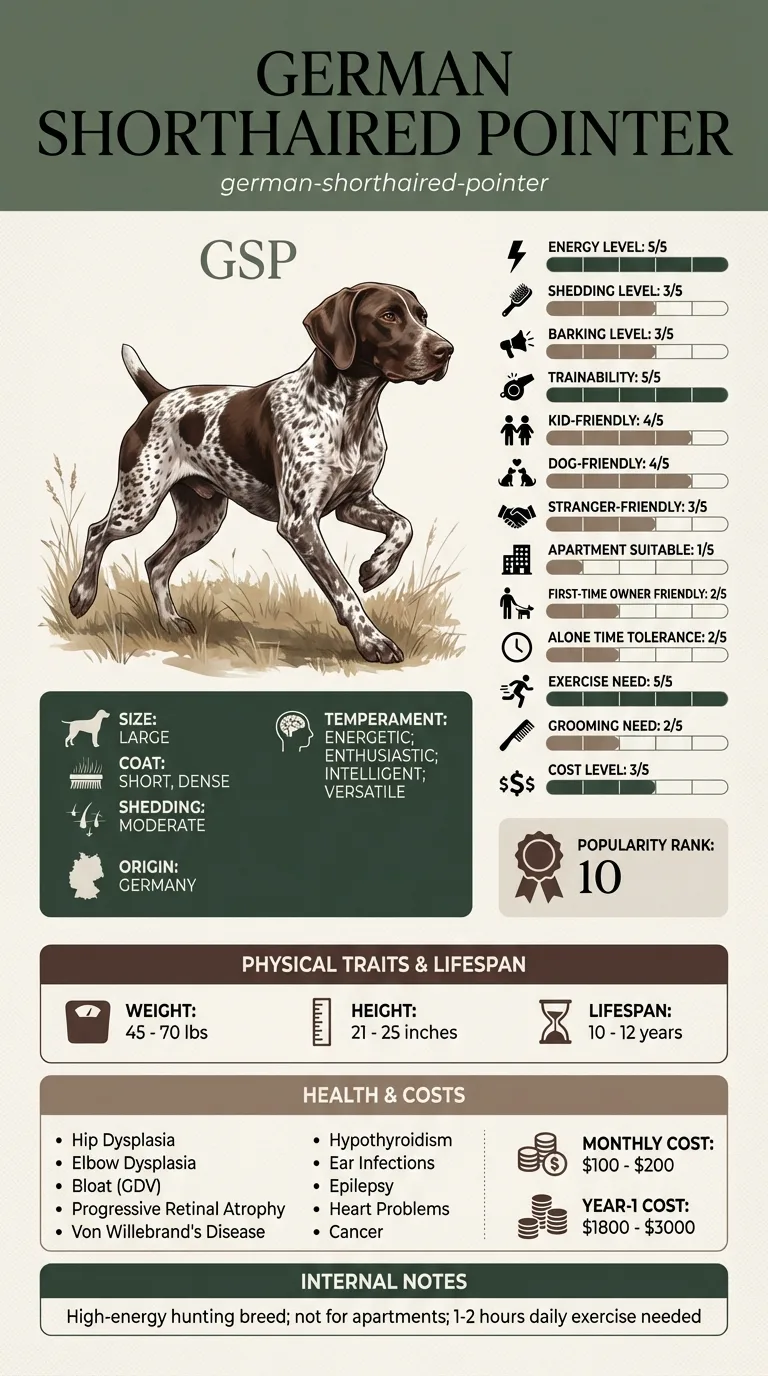
Cardiomyopathy in German Shorthaired Pointers infographic

Owners of large-breed dogs in middle age and beyond who want to understand what their vet is looking for, and anyone whose GSP has been found to have an enlarged heart or a weak pulse.

Important reminder

This guide is not medical advice. If your dog shows pain, sudden behavior change, or worsening symptoms, consult a licensed veterinarian.

Some links may be affiliate links. We may earn a commission at no extra cost to you. We only suggest products we believe are helpful for dog owners.

What this problem looks like

Cardiomyopathy is disease of the heart muscle itself. The wall weakens, the chambers enlarge, and the pump becomes progressively less effective. Unlike valve disease it often produces little or no murmur, so it is found through imaging, rhythm recording and a careful history rather than through a stethoscope alone.

Common triggers

  • An inherited tendency, which in most affected breeds is the main driver
  • Increasing age, with most cases developing in the second half of life
  • Nutritional factors, an area under active veterinary investigation
  • Thyroid disease, which is documented in this breed and affects cardiac function
  • Prolonged untreated rhythm disturbances, which can weaken the muscle over time

Not a named condition on the German Shorthaired Pointer's documented health list, which records heart problems as a general category. Cardiomyopathy is most strongly associated with a handful of other large and giant breeds. Body size alone means a GSP carries more baseline risk than a small dog, but this is not a breed hallmark.

Why this happens

Breed factors

The German Shorthaired Pointer contributes size and reserve rather than a specific genetic driver. At 45 to 70 pounds and 21 to 25 inches, it sits in the size range where muscle disease is more relevant than valve disease. Its documented health list names heart problems generally, and it also names hypothyroidism, which is worth knowing because thyroid disease alters heart rate and contractility and is one of the things a cardiologist will want excluded. The breed's enormous exercise capacity, rated at the top of the scale, hides declining pump function for longer than it would in a less athletic dog.

Environment factors

Environment does not cause cardiomyopathy, but it governs detection and consequence. A dog that is worked and whose stamina is tracked reveals a problem far earlier than one whose routine never tests it. Excess weight adds workload to an already weakened pump. And the practical danger in this breed is behavioural rather than environmental: an affected GSP allowed to choose its own effort level will push into exactly the exertion its heart can no longer support.

What you can do at home (once it is not an emergency)

When to talk to your vet

Book an appointment for exercise capacity that has fallen and not recovered, for any fainting or near-fainting episode, for a pulse that feels weak or irregular, or for a belly that is enlarging while the dog loses condition elsewhere. Go straight to an emergency clinic for laboured or rapid breathing at rest, gums that are pale, grey or blue, an inability to settle or lie down, repeated collapse, or a dog that seems suddenly weak and cold in the limbs. Fluid backing up into the lungs is life-threatening, and a dog with muscle disease can move from coping to crisis within a day.

At home, alongside your vet's plan

  • Learn to feel the femoral pulse, high on the inside of the thigh, and check that every heartbeat you feel on the chest produces one. A mismatch is worth reporting.
  • Keep a written stamina record across each season rather than relying on impressions. A number of minutes worked is evidence; a sense that he seems slower is not.
  • Count sleeping breaths monthly from middle age and record the figure, so you have a baseline to compare against if the heart is ever in question.
  • Manage body weight tightly. Reducing load is the one thing an owner can do that directly lightens the work a failing pump has to perform.

See all German Shorthaired Pointer health problems, which breeds are prone to cardiomyopathy, or the full German Shorthaired Pointer breed guide for temperament, exercise needs and ownership costs.

What to expect, and how you know it is working

Diagnosis usually takes two to four weeks from first suspicion, allowing for a specialist appointment and imaging. Where medication is started, owners often see improvement in comfort and breathing within one to two weeks. Cardiomyopathy is progressive and managed rather than cured, with rechecks typically every three to six months and adjustments as the disease evolves.

A dog that is diagnosed before fluid accumulates, is stable on medication, exercises at a defined and enforced level, and has a good quality of life for a meaningful period. Success also includes an owner who has accepted a lower exercise ceiling in a breed where that acceptance is genuinely difficult.

Why the distinction changes what you should watch for

In valve disease, usually a problem of small breeds, a valve stops sealing. Every heartbeat pushes some blood the wrong way, which is turbulent, and turbulence makes noise. That is why valve disease is typically picked up as a murmur at a routine check, often years before the dog has any symptom at all. The murmur is an early warning system.

Cardiomyopathy works differently. The muscle wall thins and stretches, the chambers dilate, and the heart's contraction weakens. Weak contraction is not necessarily turbulent, so a dog can have significant muscle disease with only a soft murmur or none at all. What it produces instead is an enlarged heart on an x-ray, an irregular or fast rhythm, a weak femoral pulse, and a dog whose exercise capacity is quietly falling.

For a German Shorthaired Pointer, that combination is awkward. Heart problems are on the breed's documented health list without a specific diagnosis named, so an owner cannot rely on one thing to look for. And a breed rated five out of five for both energy and exercise need has so much spare capacity that a meaningful loss of pump function can be absorbed for a long time before it shows. The dog does not get slower. It just stops being extraordinary, which is far harder to notice.

Signs that point at the muscle rather than a valve

None of these are proof of anything on their own. Together they build a picture worth taking to a vet with a request for imaging rather than just a listen.

Cardiomyopathy in German Shorthaired Pointers - Signs that point at the muscle rather than a valve
  • Exercise capacity that has fallen and stayed fallen, with no injury, no weather explanation and no change in routine.
  • A pulse in the femoral artery that feels weak, or that does not have a beat for every heart sound you can feel on the chest.
  • Episodes of fainting or near-fainting, especially during excitement or exertion, which reflect a rhythm the heart cannot pump through.
  • A belly that has become rounder while the dog has lost condition over the ribs and spine, which suggests fluid accumulating.
  • Restlessness at night, or a dog that has started sleeping upright or with its chest propped, which are ways of coping with fluid in the lungs.

What to do next about cardiomyopathy in GSPs

If you think your GSP has cardiomyopathy, the plan is three steps: write down what you have seen and when it started, book a veterinary appointment rather than waiting for the next flare, and take video of the behaviour or symptom before you go — the thing you are worried about rarely happens in the consulting room. Screening in the parents covers hip dysplasia, elbow dysplasia, bloat (gdv).

What the vet visit should produce is a diagnosis and a written plan, not just reassurance: what is being ruled out, what the monitoring interval is, and which signs mean you come back sooner. Ask what the treatment costs across a year rather than per visit, because that is the number that decides whether you are managing this condition or reacting to it.

Between appointments, keep a short log — dates, what you saw, what changed. It is the single most useful thing an owner brings to a follow-up, and for cardiomyopathy it is often what separates a clear pattern from a guess.

Kes, and the year he stopped being the fastest dog on the moor

Kes was eight, and his owner could not point to anything wrong. He hunted, he ate, he was cheerful. But over one season he had gone from the dog who ran the others into the ground to the dog who was merely keeping up, and by the end of it he was finishing an hour where he had once finished three. His listen was unremarkable, with only a very soft murmur. What the vet noticed was that his femoral pulse felt weaker than expected and did not match every beat. The ultrasound showed enlarged chambers and reduced contraction. Kes started medication, and his owner accepted a new ceiling of forty minutes at a steady pace with no galloping. That last part was the hardest, because Kes did not agree with it and had to be recalled and put on a lead. He stayed comfortable for eighteen months on that regime.

Key takeaway: There was never a symptom, only a comparison. In a breed defined by how much work it can do, the earliest sign of a failing pump is often that the dog is simply no longer exceptional.

Frequently asked questions

Are German Shorthaired Pointers prone to cardiomyopathy?

The breed's documented health list includes heart problems without naming cardiomyopathy specifically, and the GSP is not among the breeds in which it is classically expected. Large body size raises baseline risk relative to small breeds, which makes it worth understanding even though it is not a breed hallmark.

Can there be heart muscle disease with no murmur?

Yes, and this is the key practical difference. Murmurs come from turbulence, and a weak but smoothly contracting heart may not produce much. A dog with a normal listen and a falling exercise tolerance still deserves imaging if nothing else explains it.

How is it diagnosed?

By ultrasound, which measures chamber size and contraction directly, usually alongside a rhythm recording and chest x-rays. Bloodwork is used to look for contributing conditions such as thyroid disease, which is documented in this breed and can affect the heart.

Is diet involved?

Diet-associated heart muscle disease has been reported in dogs on certain diets, and it is a live area of veterinary investigation. If your dog is diagnosed, expect your vet to ask exactly what it eats and to consider a diet change as part of the plan. Do not change food unilaterally on the basis of internet advice.

What is the treatment?

Medication to support contraction, manage fluid and control rhythm, tailored to what the ultrasound shows. It is management rather than cure, and dogs treated before they develop fluid in the lungs generally do considerably better than those treated afterwards.

Can my dog still hunt?

That depends entirely on the severity and on your cardiologist's assessment, and it is one of the few situations where an honest answer may be no. A dog with poor pump function pushing itself to a gallop is at real risk, and this breed will not moderate itself.

Quick answers

View more answers
Health

What is the difference between cardiomyopathy and a leaky valve?

Cardiomyopathy is the heart muscle failing to pump; valve disease is a valve failing to seal. Valve disease usually announces itself with a murmur; muscle disease often does not.

Health

What is the earliest sign in a working dog?

Exercise capacity that has dropped and not come back. In a breed with this much reserve, that change means something is genuinely wrong.

Health

Is fainting an emergency?

Any fainting episode warrants an urgent appointment, and repeated fainting in one day means an emergency clinic. It signals a rhythm the heart cannot pump through.

Costs

What does diagnosis cost?

A specialist ultrasound with a rhythm recording is a substantial one-off cost, followed by ongoing medication and rechecks. Ask about a package price up front.

Related DogBreedCompass guides

Bring the right questions to the vet

A one-page prep sheet for this condition: the signs, the questions to ask, what to get priced. Unlocks here.

You get: Vet visit prep sheet

No spam. One-click unsubscribe. See our privacy policy.

Preview page 1 before you decide.

Related guides