Health
How can I tell if my Frenchie is overweight?
You should be able to feel the ribs with light pressure and see a waist from above.

Quick answer
How can I tell if my Frenchie is overweight?
You should be able to feel the ribs with light pressure and see a waist from above.
The same pounds that might be a minor inconvenience for a longer-muzzled, longer-legged dog can meaningfully worsen breathing effort, joint stress, and heat tolerance all at once in this breed.
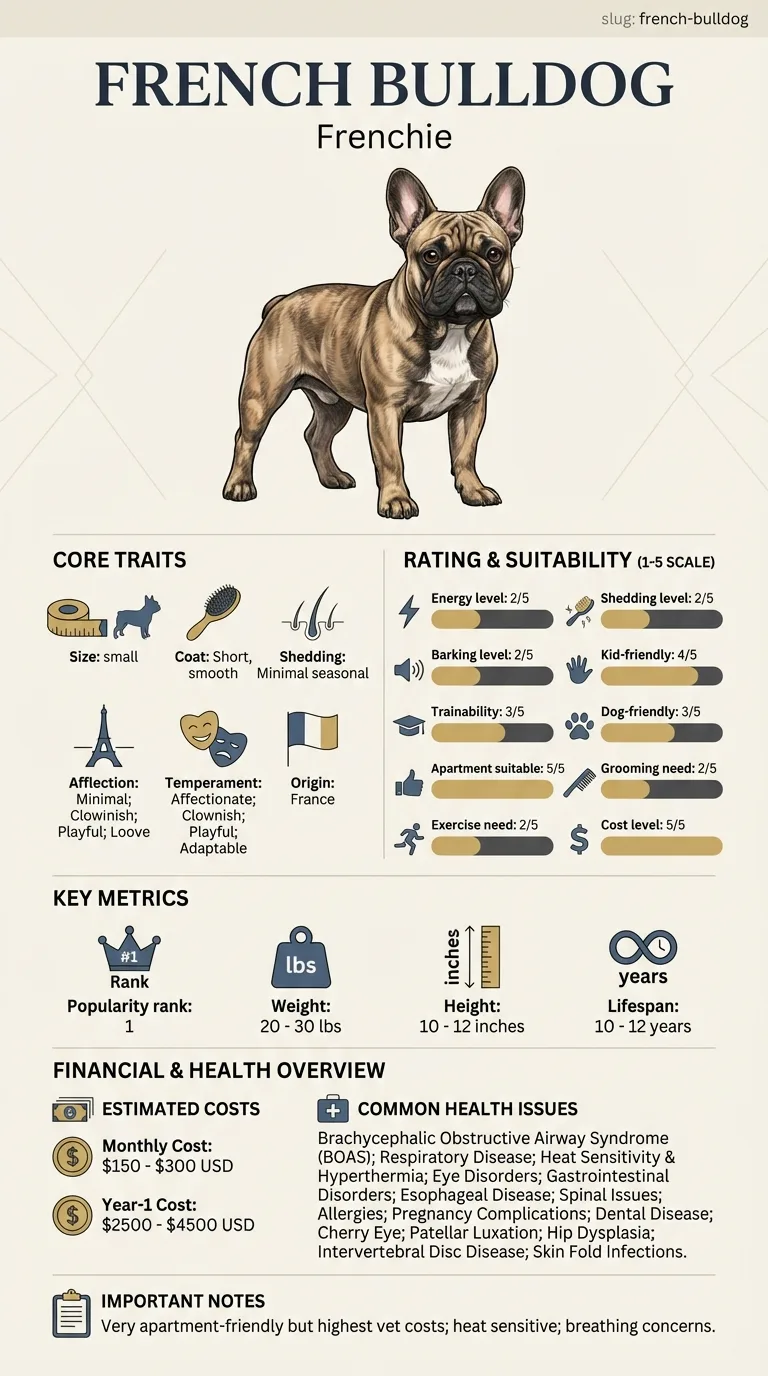
Nearly every French Bulldog owner faces this at some point, given the breed's naturally lower exercise tolerance, genuine appetite drive in some dogs, and the sheer number of ways owners show affection through food and treats.
This guide is not medical advice. If your dog shows pain, sudden behavior change, or worsening symptoms, consult a licensed veterinarian.
Some links may be affiliate links. We may earn a commission at no extra cost to you. We only suggest products we believe are helpful for dog owners.
Obesity in French Bulldogs carries outsized consequences compared to many other breeds, directly compounding the breed's already elevated risks for airway obstruction, joint disease, heart strain, and heat intolerance. Rather than an isolated cosmetic concern, weight management functions as one of the single most impactful, controllable levers across the breed's entire health profile.
Obesity is documented as a widespread challenge across the French Bulldog population, consistent with the breed's naturally lower exercise tolerance and, in some dogs, a genetic predisposition toward increased appetite, making it one of the most broadly relevant health topics for the breed as a whole.
The breed's airway-limited exercise tolerance means fewer calories are naturally burned through activity compared to a more athletic breed, while in some dogs a specific genetic appetite-regulation factor further increases hunger drive, creating a combination where weight gain is easier and weight loss requires more deliberate effort than in many other breeds.
Feeding habits are the dominant environmental factor: imprecise portions, frequent treats, and food-based affection all directly add calories, while the breed's heat and airway limitations restricting how much exercise is safely possible mean diet control carries proportionally more weight in the overall equation than it might in a more active breed.
Discuss a structured weight-management plan at your next routine visit if body condition scoring suggests excess weight, and follow up regularly to track progress and adjust the plan as needed.
Because obesity develops gradually and treats often feel harmless individually, a few common habits add up to real weight gain over time.
See all French Bulldog health problems, which breeds are prone to obesity, or the full French Bulldog breed guide for temperament, exercise needs and ownership costs.
Safe, sustainable weight loss in dogs typically targets about one to two percent of body weight per week, meaning a meaningful weight-loss journey often takes several months rather than weeks.
Success means a stable, healthy weight maintained long-term through sustainable portion control and activity, resulting in measurably easier breathing, reduced joint stress, and better overall quality of life.
Excess weight adds fatty tissue around the neck and chest, directly compounding the airway narrowing already present in this breed's brachycephalic anatomy, making breathing measurably harder even before considering exercise or heat.
The same extra pounds add mechanical stress to joints already predisposed to conditions like hip dysplasia, luxating patellas, and disc disease, meaning weight management is directly protective against several of the breed's other major health risks rather than being a separate, standalone concern.
Excess weight also worsens heat tolerance in a breed that already struggles to cool itself efficiently, and it's linked to increased risk for diabetes and pancreatitis, making this arguably the single most impactful, controllable factor across the breed's entire health profile.

If you think your Frenchie has obesity, the plan is three steps: write down what you have seen and when it started, book a veterinary appointment rather than waiting for the next flare, and take video of the behaviour or symptom before you go — the thing you are worried about rarely happens in the consulting room. Screening in the parents covers brachycephalic obstructive airway syndrome (boas), respiratory disease, heat sensitivity & hyperthermia.
What the vet visit should produce is a diagnosis and a written plan, not just reassurance: what is being ruled out, what the monitoring interval is, and which signs mean you come back sooner. Ask what the treatment costs across a year rather than per visit, because that is the number that decides whether you are managing this condition or reacting to it.
Between appointments, keep a short log — dates, what you saw, what changed. It is the single most useful thing an owner brings to a follow-up, and for obesity it is often what separates a clear pattern from a guess.
Felix, a five-year-old Frenchie, had crept up to nearly 32 pounds over a couple of years of generous treats and imprecise feeding, and his family had started noticing louder breathing and reduced stamina on walks. A vet visit set a target weight and a structured plan: precisely measured portions, treats cut to small training-sized pieces, and consistent short walks. Over about eight months, Felix lost six pounds gradually, and his family noticed his breathing was noticeably quieter and he kept pace on walks he used to struggle with.
Key takeaway: The weight loss itself took real patience, but the payoff showed up directly in Felix's breathing and stamina, not just on the scale.
You should be able to feel (though not necessarily see) the ribs with light pressure, and there should be a visible waist when viewed from above; your vet can also assess body condition score at routine visits.
Excess weight compounds the breed's already elevated risks for breathing difficulty, joint problems, heart strain, and heat intolerance simultaneously, making weight management more consequential here than in breeds without these overlapping vulnerabilities.
There's a range rather than one fixed number, generally falling between about 16 and 28 pounds depending on individual frame size, with your vet best positioned to assess what's healthy for your specific dog's build.
Precisely measured portions of an appropriate diet, reduced treat frequency, and consistent low-impact exercise suited to the breed's airway and heat limitations are the core, sustainable approach.
Yes, obesity is linked to reduced lifespan and increased risk of several serious conditions in dogs generally, and the effect may be especially pronounced in a breed already carrying elevated risk across multiple body systems.
Substituting non-food affection like play, praise, and petting, along with using a portion of the dog's regular measured food as training rewards, can satisfy the interaction without adding extra calories.
A vet-recommended weight-management diet, portioned precisely, is often more effective and easier to sustain than simply reducing the amount of regular food, since it's formulated to support satiety at a lower calorie count.
You should be able to feel the ribs with light pressure and see a waist from above.
It compounds breathing, joint, heart, and heat tolerance issues all at once.
Roughly 16–28 pounds depending on individual frame size; ask your vet for your dog's specific target.
Precisely measured portions, reduced treats, and consistent low-impact exercise.
Yes, it's linked to reduced lifespan and compounds several of the breed's other health risks.
A one-page prep sheet for this condition: the signs, the questions to ask, what to get priced. Unlocks here.
You get: Vet visit prep sheet
No spam. One-click unsubscribe. See our privacy policy.
Preview page 1 before you decide.