Health
What's an early sign of kidney disease?
Increased thirst and urination, though early-stage disease often has no obvious symptoms at all.

Quick answer
What's an early sign of kidney disease?
Increased thirst and urination, though early-stage disease often has no obvious symptoms at all.
A senior Frenchie drinking and urinating noticeably more than before isn't just getting older in a generic sense — it can be the kidneys working harder to compensate for reduced function.
This affects owners of senior dogs most directly, often surfacing at a routine senior wellness bloodwork panel rather than because of any dramatic symptom the owner noticed at home first.
This guide is not medical advice. If your dog shows pain, sudden behavior change, or worsening symptoms, consult a licensed veterinarian.
Some links may be affiliate links. We may earn a commission at no extra cost to you. We only suggest products we believe are helpful for dog owners.
Chronic kidney disease involves a progressive, irreversible decline in kidney function, most commonly diagnosed in senior dogs. Because the kidneys have significant functional reserve, meaningful damage can occur before symptoms like increased thirst and urination become obvious, making proactive bloodwork and urine screening central to catching it at an earlier, more manageable stage.
Chronic kidney disease is one of the more commonly diagnosed conditions in senior dogs across breeds generally, and French Bulldogs are represented in that broader senior health pattern, making routine senior screening a relevant part of care for the breed.
Kidney disease in French Bulldogs largely reflects the same general age-related decline seen across dog breeds rather than a uniquely breed-specific mechanism, though the breed's broader pattern of interconnected health conditions means kidney function is one of several systems worth including in comprehensive senior monitoring.
Hydration status, diet, and management of any other chronic conditions (like diabetes or high blood pressure) all influence how kidney function holds up over time, making consistent access to fresh water and appropriate senior nutrition meaningful, practical factors within an owner's control.
Schedule bloodwork if you notice increased thirst or urination, and follow your vet's recommended senior wellness screening schedule even in the absence of obvious symptoms, since early-stage kidney disease is frequently silent.
Because kidney disease is often silent early on, several common assumptions delay the screening and management that matter most.
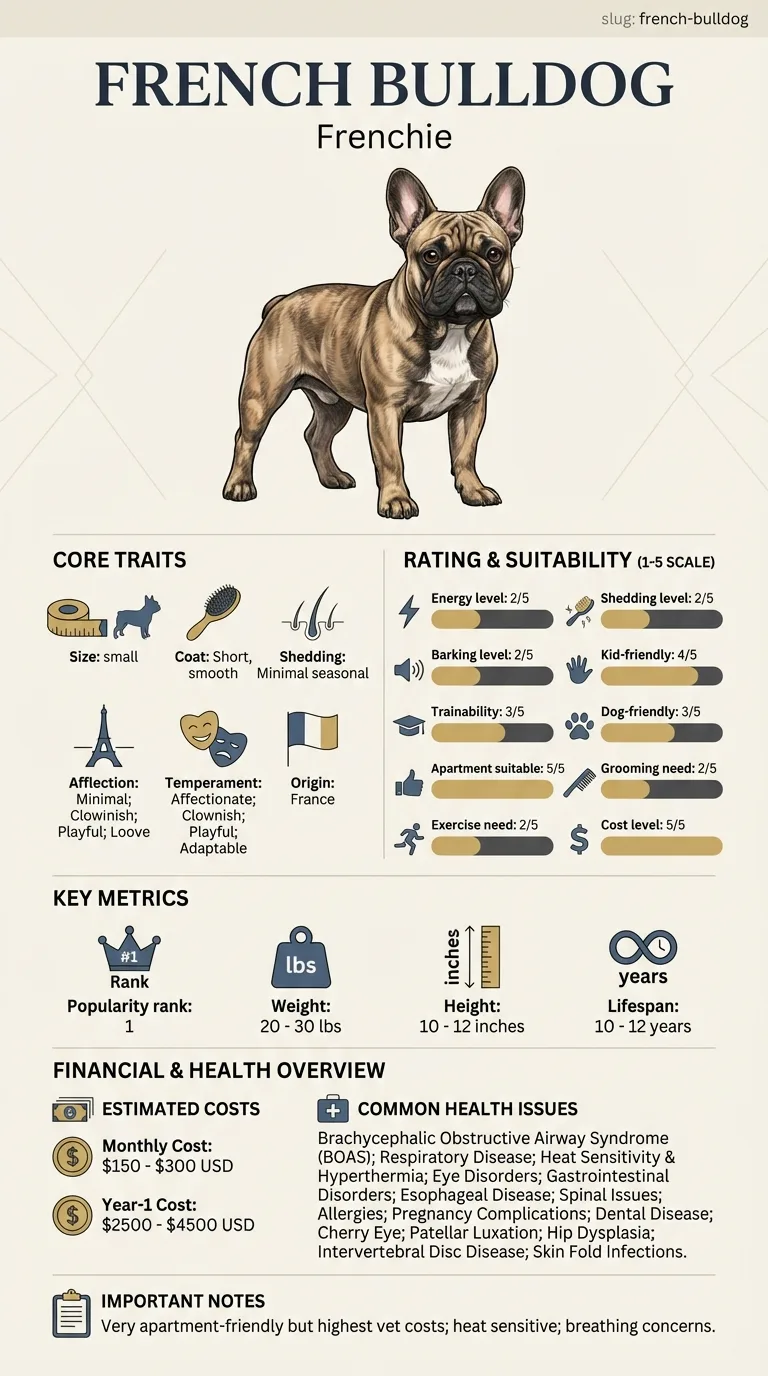
See all French Bulldog health problems, which breeds are prone to kidney disease, or the full French Bulldog breed guide for temperament, exercise needs and ownership costs.
Chronic kidney disease typically progresses gradually over months to years, though the pace varies significantly by individual dog and the stage at diagnosis. Management, once started, is an ongoing, indefinite commitment.
Success means slowing progression and maintaining good quality of life for as long as possible through consistent monitoring and management — not reversing existing damage, but preserving remaining function and comfort.
The kidneys have significant functional reserve, meaning a dog can lose a substantial portion of kidney function before bloodwork abnormalities or obvious symptoms appear using older testing methods. Newer biomarkers can catch decline somewhat earlier, which is part of why many vets now recommend including them in senior wellness panels.
Once a meaningful stage of kidney disease is identified, a specific staging system helps guide treatment — from dietary changes and blood pressure management in early stages to more intensive fluid therapy and medication in advanced stages.
Because kidney tissue that's already been lost doesn't regenerate, the entire goal of early detection is slowing further decline and preserving remaining function for as long as possible, rather than reversing damage that's already occurred — which is exactly why proactive, regular senior screening matters more than reacting to obvious symptoms.

If you think your Frenchie has kidney disease, the plan is three steps: write down what you have seen and when it started, book a veterinary appointment rather than waiting for the next flare, and take video of the behaviour or symptom before you go — the thing you are worried about rarely happens in the consulting room. Screening in the parents covers brachycephalic obstructive airway syndrome (boas), respiratory disease, heat sensitivity & hyperthermia.
What the vet visit should produce is a diagnosis and a written plan, not just reassurance: what is being ruled out, what the monitoring interval is, and which signs mean you come back sooner. Ask what the treatment costs across a year rather than per visit, because that is the number that decides whether you are managing this condition or reacting to it.
Between appointments, keep a short log — dates, what you saw, what changed. It is the single most useful thing an owner brings to a follow-up, and for kidney disease it is often what separates a clear pattern from a guess.
Harriet, a nine-year-old Frenchie, showed no symptoms at all when her annual senior bloodwork revealed early changes in her kidney values. Her vet recommended a follow-up urine test, which confirmed early-stage chronic kidney disease well before Harriet's family had noticed anything different at home. Starting a renal-support diet and increasing her water access at that early stage, along with twice-yearly rechecks, has kept Harriet's kidney values remarkably stable for the two years since diagnosis, with no progression to a more advanced stage so far.
Key takeaway: Harriet's kidney disease was caught entirely through routine screening, not symptoms — proof that the annual senior bloodwork her family almost skipped one year was doing real, meaningful work.
Increased thirst and urination are the most classically recognized early signs, though early-stage disease is often entirely without symptoms and only detected through bloodwork and urine testing.
Bloodwork measuring kidney-related values, along with a urine test to assess concentrating ability and protein levels, are the standard tools, with newer biomarkers sometimes used to catch earlier-stage decline.
No, chronic kidney disease is not curable, but its progression can often be meaningfully slowed with appropriate diet, medication, and monitoring, especially when caught early.
A specific renal-support diet, typically lower in phosphorus and adjusted in protein quality and quantity, is commonly recommended once a meaningful stage of kidney disease is confirmed, ideally guided by your vet rather than a general assumption.
Many vets recommend annual bloodwork and urine testing starting around seven years old, with more frequent monitoring if any values are borderline or a dog has other risk factors.
It's not typically associated with overt pain in most stages, though advanced disease can cause nausea, poor appetite, and general malaise that significantly affects quality of life.
This varies enormously by the stage at diagnosis and how well the dog responds to management; early-stage disease caught and managed well can allow for years of continued good quality life.
Increased thirst and urination, though early-stage disease often has no obvious symptoms at all.
Bloodwork and urine testing, sometimes including newer biomarkers for earlier detection.
No, but progression can often be meaningfully slowed with early detection and management.
A vet-recommended renal-support diet, typically adjusted in phosphorus and protein.
Many vets recommend annual bloodwork and urine testing starting around age seven.
A one-page prep sheet for this condition: the signs, the questions to ask, what to get priced. Unlocks here.
You get: Vet visit prep sheet
No spam. One-click unsubscribe. See our privacy policy.
Preview page 1 before you decide.