Health
Why does this breed have so many separate eye conditions?
Shallow eye sockets and prominent eyes leave several structures more exposed and vulnerable at once.

Quick answer
Why does this breed have so many separate eye conditions?
Shallow eye sockets and prominent eyes leave several structures more exposed and vulnerable at once.
It's not that Frenchies are simply 'unlucky' with their eyes — the orbital shape that gives the breed its expressive, forward-facing stare is also what leaves several separate structures more vulnerable at once.
This overview matters most for owners trying to make sense of why their dog's vet keeps bringing up eye health across seemingly unrelated visits, or for prospective owners trying to understand the breed's eye risk as a whole before bringing one home.
This guide is not medical advice. If your dog shows pain, sudden behavior change, or worsening symptoms, consult a licensed veterinarian.
Some links may be affiliate links. We may earn a commission at no extra cost to you. We only suggest products we believe are helpful for dog owners.
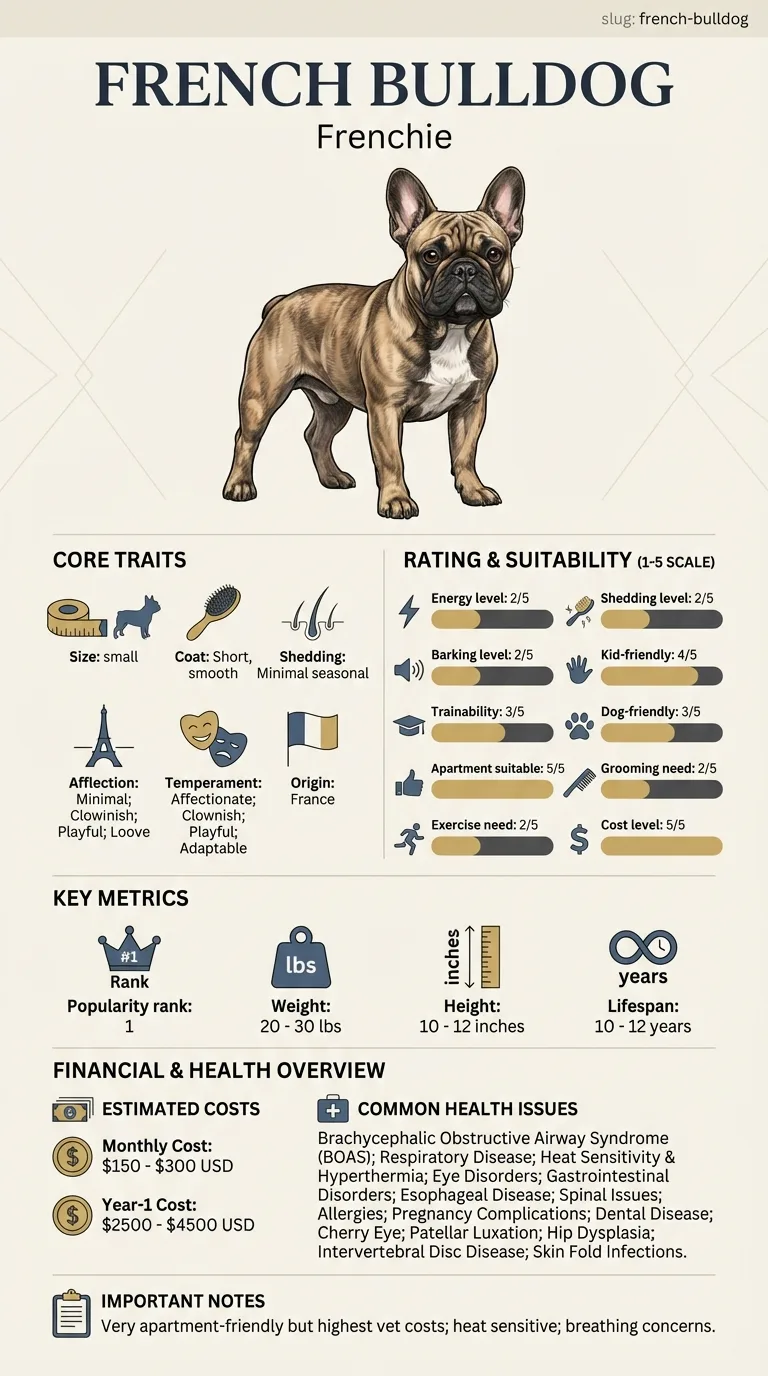
French Bulldogs are documented with an elevated overall rate of eye disorders, reflecting the combined vulnerability created by shallow eye sockets and prominent, forward-facing eyes. Rather than one condition, this encompasses several distinct diagnoses — cherry eye, cataracts, corneal dystrophy, and general injury susceptibility among them — each with its own mechanism but a shared anatomical backdrop.
Some form of eye finding is common enough in French Bulldogs that many vets treating the breed build regular eye assessment into routine wellness visits, reflecting how frequently this general category of condition appears across the breed as a whole.
The breed's brachycephalic skull shape produces shallower eye sockets and a shorter distance between the eyes and surrounding structures, physically exposing the eyes more than in longer-muzzled breeds and creating conditions where several separate structures — cornea, lens, third eyelid gland — are each more vulnerable to their own specific type of problem.
Everyday physical environment matters more for this breed's eyes than for many others: rough play, low furniture, brushy walking trails, and even normal household bumps carry a higher injury risk given how exposed the eyes sit, making environmental awareness a genuinely useful preventive tool.
Bring any redness, discharge, cloudiness, or visible lump near the eye to your vet's attention promptly, given how many distinct conditions can present with overlapping early signs in this breed.
Because 'eye problems' is such a broad label in this breed, a few common assumptions blur distinctions that actually matter for treatment.
See all French Bulldog health problems, which breeds are prone to eye disorders, or the full French Bulldog breed guide for temperament, exercise needs and ownership costs.
Because this covers many distinct conditions, there's no single timeline — some issues appear in puppyhood, others develop gradually with age. Regular monitoring should be a lifelong habit rather than a one-time check.
Success means catching whichever specific condition arises early through consistent monitoring, rather than expecting to prevent every possible eye issue this breed's anatomy makes possible.
French Bulldogs, like several brachycephalic breeds, have a shallower eye socket and a shorter distance between the eyes and the nose than longer-muzzled dogs. This means the eyes sit more prominently, with less bony protection around them, and the eyelids have less coverage margin to fully close and protect the surface during sleep or blinking.
This shared anatomy contributes differently to different conditions: it leaves the cornea more exposed to everyday scratches and dryness, puts extra stress on the connective tissue anchoring the third eyelid gland (a factor in cherry eye), and is part of why several structures — lens, cornea, eyelid glands — sit closer to their functional limits than in a breed with deeper-set eyes.
Understanding this shared root doesn't mean every Frenchie will develop every eye condition — most don't — but it explains why eye health as a whole, rather than any single diagnosis, deserves regular proactive attention in this breed specifically.

If you think your Frenchie has eye disorders, the plan is three steps: write down what you have seen and when it started, book a veterinary appointment rather than waiting for the next flare, and take video of the behaviour or symptom before you go — the thing you are worried about rarely happens in the consulting room. Screening in the parents covers brachycephalic obstructive airway syndrome (boas), respiratory disease, heat sensitivity & hyperthermia.
What the vet visit should produce is a diagnosis and a written plan, not just reassurance: what is being ruled out, what the monitoring interval is, and which signs mean you come back sooner. Ask what the treatment costs across a year rather than per visit, because that is the number that decides whether you are managing this condition or reacting to it.
Between appointments, keep a short log — dates, what you saw, what changed. It is the single most useful thing an owner brings to a follow-up, and for eye disorders it is often what separates a clear pattern from a guess.
Toffee's family didn't think much about eye health until her breeder mentioned, at pickup, that eye conditions run broadly across the breed and recommended annual checks regardless of how things looked. They built it into her yearly wellness visit without expecting to find anything. At age five, a routine check caught an early, faint corneal dystrophy finding with zero visible symptoms at home. Because they already had a baseline and a habit of checking, tracking it going forward was simple rather than starting from scratch during a crisis.
Key takeaway: Building routine eye checks into wellness visits from the start, rather than waiting for a visible problem, gave Toffee's family an easy way to catch something they'd never have noticed on their own.
Their shallow eye sockets and prominent, forward-facing eyes leave several structures — the cornea, the eyelids, the gland of the third eyelid — more exposed and vulnerable than in breeds with deeper-set eyes, contributing to a range of distinct conditions rather than one single cause.
Cherry eye, cataracts, corneal dystrophy, and general susceptibility to corneal injury are among the most frequently discussed, though severity and which specific conditions appear vary considerably by individual dog.
An annual eye exam as part of routine wellness care is a reasonable baseline, with more frequent checks if any condition has already been diagnosed or if a breeder's screening history suggests elevated risk.
Several have at least a partly inherited component, including cherry eye and certain forms of cataracts and corneal dystrophy, making a breeder's health testing history a relevant consideration for prospective buyers.
Not directly — each condition has its own separate risk factors and mechanism, though the shared underlying orbital anatomy means a dog prone to one eye issue isn't necessarily protected from developing an unrelated one.
A general vet can diagnose and manage many common conditions, but a referral to a veterinary ophthalmologist is often worthwhile for surgical procedures or more complex or progressive findings.
The underlying anatomy can't be changed, but regular monitoring, protecting the eyes during rough play, and prompt attention to any redness or discharge can catch issues earlier and reduce complications.
Shallow eye sockets and prominent eyes leave several structures more exposed and vulnerable at once.
An annual exam is a reasonable baseline, more often if a condition is already diagnosed.
Several have a partly inherited component, worth asking a breeder about.
Not directly — each has its own separate risk factors despite sharing the same underlying anatomy.
A general vet handles many cases; a veterinary ophthalmologist is often worthwhile for surgery or complex findings.
A one-page prep sheet for this condition: the signs, the questions to ask, what to get priced. Unlocks here.
You get: Vet visit prep sheet
No spam. One-click unsubscribe. See our privacy policy.
Preview page 1 before you decide.