Health
Why do so many GI issues cluster in French Bulldogs?
Negative airway pressure from labored breathing can contribute to hiatal hernia and reflux, connecting the airway and digestive systems.

Quick answer
Why do so many GI issues cluster in French Bulldogs?
Negative airway pressure from labored breathing can contribute to hiatal hernia and reflux, connecting the airway and digestive systems.
Inflammatory bowel disease, pyloric stenosis, acid reflux, and hiatal hernia sound like four separate diagnoses, but in this breed they're frequently linked by the same underlying mechanical story.
Owners dealing with a Frenchie that regurgitates frequently, has chronic soft stool, or seems perpetually gassy are the ones piecing this picture together, often after multiple vet visits addressing what seemed like separate, unrelated symptoms.
This guide is not medical advice. If your dog shows pain, sudden behavior change, or worsening symptoms, consult a licensed veterinarian.
Some links may be affiliate links. We may earn a commission at no extra cost to you. We only suggest products we believe are helpful for dog owners.
French Bulldogs are documented with a cluster of gastrointestinal conditions — inflammatory bowel disease, pyloric stenosis, acid reflux, and hiatal hernia — that, while individually distinct, are frequently connected by the same underlying mechanism: the negative pressure generated in the chest by the breed's labored, airway-limited breathing. Understanding this connection helps explain why digestive symptoms in this breed often warrant an airway-aware evaluation rather than a purely isolated GI workup.
This cluster of conditions is well documented in French Bulldogs as part of the breed's broader brachycephalic-related health profile, with hiatal hernia and reflux specifically noted in veterinary literature discussing the connection between airway obstruction and digestive symptoms in short-faced breeds.
The breed's narrowed airway forces the chest to generate stronger negative pressure with each labored breath, and this repeated mechanical stress is believed to contribute to structures like the lower esophagus and stomach being pulled through the diaphragm opening, setting up conditions for reflux and related chronic GI irritation in a way that's specifically tied to the breed's airway anatomy rather than being a purely independent digestive issue.
Diet composition, eating speed, and activity timing around meals all influence how much these underlying anatomical tendencies actually translate into visible symptoms, meaning environmental and feeding management can meaningfully reduce the practical impact even when the underlying airway-driven mechanism can't be fully changed without surgery.
See a vet for chronic regurgitation, persistent soft stool, frequent vomiting of undigested food, or any GI symptom that persists beyond a few days, so the underlying cause — dietary, structural, or airway-related — can be properly identified.
Because these conditions can look like separate, minor issues, a few common assumptions delay recognizing the pattern connecting them.
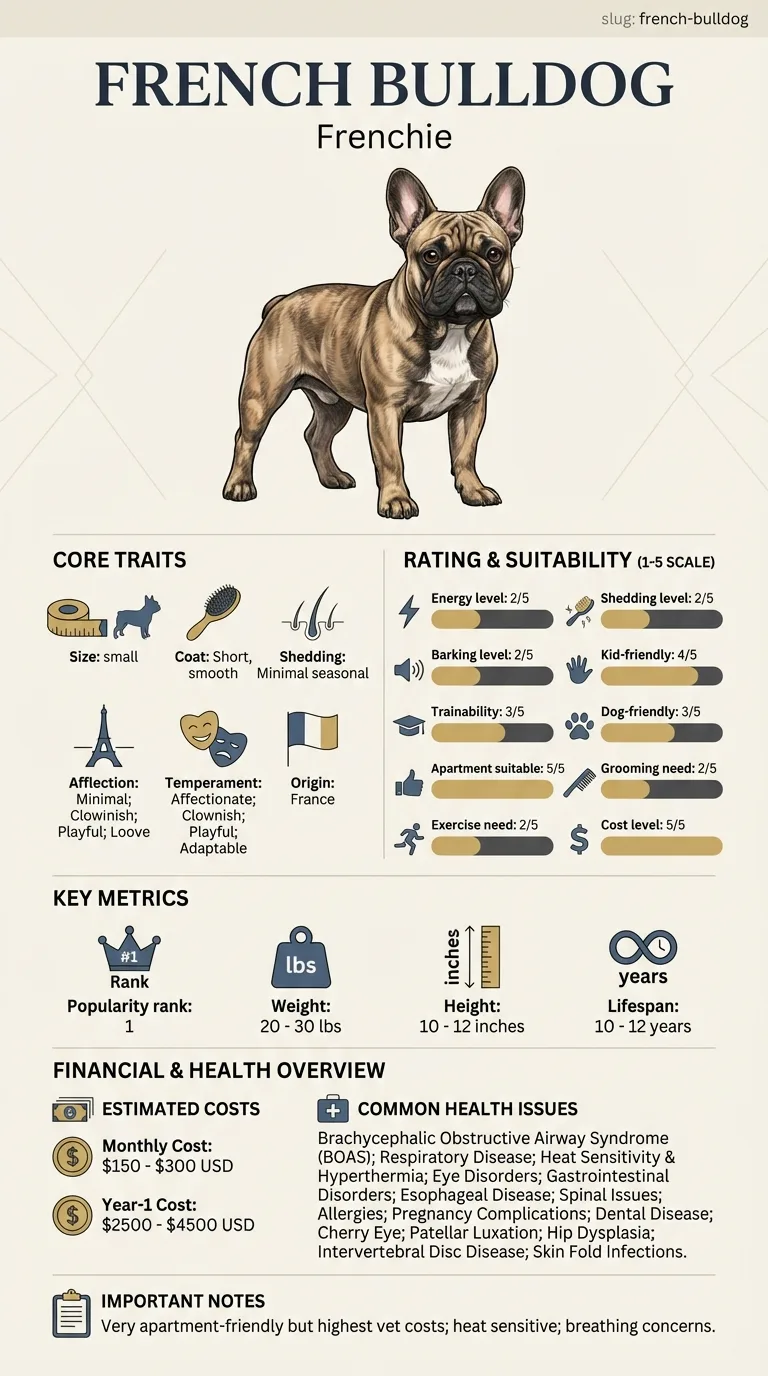
See all French Bulldog health problems, which breeds are prone to gastrointestinal disorders, or the full French Bulldog breed guide for temperament, exercise needs and ownership costs.
Identifying the specific underlying GI condition often takes a few weeks of diagnostic workup, including diet trials and sometimes imaging. Ongoing management is typically long-term, especially for hiatal hernia or inflammatory bowel disease.
Success means identifying which specific condition or combination is driving your dog's symptoms and managing it accordingly — for many dogs, that means a combination of diet adjustment and medication that meaningfully reduces symptoms even without a single complete cure.
When a dog works hard to breathe against a narrowed airway, it generates unusually strong negative pressure inside the chest cavity with every inhale. Over time, that repeated pressure differential can contribute to structures like the lower esophageal sphincter or even part of the stomach being pulled upward through the diaphragm — a hiatal hernia — which in turn makes acid reflux more likely.
Reflux and chronic GI irritation can contribute to or worsen inflammatory changes in the digestive tract, while pyloric stenosis (narrowing where the stomach empties into the small intestine) is a separate but sometimes co-occurring structural issue that can cause chronic vomiting.
This is why a French Bulldog's digestive symptoms are often best evaluated with the breed's airway status in mind rather than treated purely as an isolated digestive issue — the two systems are mechanically connected in this breed in a way they aren't in longer-muzzled dogs.

If you think your Frenchie has gastrointestinal disorders, the plan is three steps: write down what you have seen and when it started, book a veterinary appointment rather than waiting for the next flare, and take video of the behaviour or symptom before you go — the thing you are worried about rarely happens in the consulting room. Screening in the parents covers brachycephalic obstructive airway syndrome (boas), respiratory disease, heat sensitivity & hyperthermia.
What the vet visit should produce is a diagnosis and a written plan, not just reassurance: what is being ruled out, what the monitoring interval is, and which signs mean you come back sooner. Ask what the treatment costs across a year rather than per visit, because that is the number that decides whether you are managing this condition or reacting to it.
Between appointments, keep a short log — dates, what you saw, what changed. It is the single most useful thing an owner brings to a follow-up, and for gastrointestinal disorders it is often what separates a clear pattern from a guess.
Pixel, a five-year-old Frenchie, had been treated separately over two years for 'occasional vomiting,' 'sensitive stomach,' and eventually noisy, labored breathing that seemed unrelated. A new vet familiar with brachycephalic-specific GI patterns suggested evaluating them together rather than as separate issues. Imaging revealed a mild hiatal hernia contributing to her reflux-type vomiting, connected to the negative chest pressure from her also-diagnosed airway narrowing. Addressing her airway surgically, alongside smaller, more frequent meals, meaningfully reduced both her breathing effort and her digestive symptoms together.
Key takeaway: Symptoms that look like separate, minor issues in this breed sometimes share one root mechanical cause — asking whether they're connected can lead to a much more effective combined treatment plan.
Several conditions — hiatal hernia, acid reflux, and to some extent inflammatory bowel disease — are linked to the negative pressure the breed's compressed airway generates in the chest during labored breathing, which can pull on and stress digestive structures near the diaphragm.
A condition where part of the stomach is pulled upward through the diaphragm opening meant only for the esophagus, often related to chronic negative pressure from labored breathing, and it can worsen acid reflux symptoms.
A narrowing of the outlet where the stomach empties into the small intestine, which can cause chronic vomiting, particularly of undigested food some time after eating.
In some dogs, yes — reducing the negative pressure generated by labored breathing (through correcting significant airway obstruction) can secondarily improve reflux and related GI symptoms, though this varies by individual case.
Through a combination of diet trials, bloodwork, and sometimes intestinal biopsy, after ruling out other causes of chronic GI symptoms like food intolerance or structural abnormalities.
A structured elimination diet under veterinary guidance is more useful than repeatedly switching foods on your own, since it allows you to actually identify whether a specific ingredient is contributing to symptoms.
Many are, through a combination of diet management, medication for reflux or inflammation, and in some cases surgical correction of a hiatal hernia or pyloric stenosis, though ongoing monitoring is typically part of the picture.
Negative airway pressure from labored breathing can contribute to hiatal hernia and reflux, connecting the airway and digestive systems.
Part of the stomach pulled upward through the diaphragm, often linked to chronic breathing effort in this breed.
In some dogs, yes, by reducing the negative chest pressure contributing to reflux and hernia.
No, a structured elimination diet under vet guidance is more useful than repeated random switching.
Yes, many respond well to diet management, medication, and in some cases surgery.
A one-page prep sheet for this condition: the signs, the questions to ask, what to get priced. Unlocks here.
You get: Vet visit prep sheet
No spam. One-click unsubscribe. See our privacy policy.
Preview page 1 before you decide.