Health
What is the most important health tip for a French Bulldog?
Take breathing, heat tolerance, pain, and mobility changes seriously, and contact a veterinarian when they appear or worsen.

Quick answer
What is the most important health tip for a French Bulldog?
Take breathing, heat tolerance, pain, and mobility changes seriously, and contact a veterinarian when they appear or worsen.
A French Bulldog's health needs are individual, but awareness of inherited risks can support timely veterinary care.
This guide is for current or prospective French Bulldog owners who want a sensible way to discuss health history, new symptoms, and preventive care with a veterinarian.
This guide is not medical advice. If your dog shows pain, sudden behavior change, breathing difficulty, or worsening symptoms, consult a licensed veterinarian.
Some links may be affiliate links. We may earn a commission at no extra cost to you. We only suggest products we believe are helpful for dog owners.
We research and check what we publish, but we do not warrant that any figure, date, price, or statement is accurate, complete, or current, and we accept no liability for any loss, cost, injury, or other harm arising from the use of this site. Use it as one reference among several. You remain responsible for your own decisions and for your dog's care - confirm anything that matters with a licensed veterinarian or another qualified professional before you act on it. Full disclaimer.
French Bulldog owners often hear about inherited health concerns because the breed can be affected by airway, spinal, joint, eye, skin, and digestive issues. That awareness should guide observation and veterinary conversations, not lead to assumptions about any one dog.
French Bulldogs can have breed-associated health concerns, but the available input does not establish how often any condition occurs. Not every French Bulldog will develop a genetic disorder.
Inherited traits and the French Bulldog's compact, short-muzzled body shape can be relevant to veterinary evaluation of some airway, spinal, and joint concerns. These traits do not determine an individual dog's outcome.
Heat, activity level, body condition, and day-to-day exposures can affect a dog's comfort and may make a health concern more noticeable. Environmental factors do not replace a veterinary diagnosis.
Arrange a veterinary visit for persistent or recurring breathing, mobility, skin, eye, or digestive changes. Seek urgent care for breathing difficulty, collapse, severe pain, sudden weakness, or inability to walk.
The term genetic disorder can cover many different conditions. A breed association does not diagnose an individual dog, and similar symptoms can have different causes. Use this list as a starting point for a veterinary conversation, not as a checklist for self-diagnosis.
See all French Bulldog health problems, which breeds are prone to most common genetic disorders, or the full French Bulldog breed guide for temperament, exercise needs and ownership costs.
The right next step and timeline depend on the symptom and veterinary findings. Some concerns need prompt assessment, while others can be monitored under a veterinarian's guidance.
Success means you have a clear veterinary plan, notice changes early, and support your French Bulldog's comfort and safe daily routine.
Contact a veterinarian promptly if your French Bulldog develops new or worsening breathing difficulty, collapses, seems unable to cool down, shows signs of pain, cannot use a limb normally, or has a sudden change in balance or coordination. These signs are not proof of a genetic disorder, but they need professional assessment.
For less urgent changes, such as intermittent limping, repeated skin irritation, or changes in exercise tolerance, keep notes on when they occur and arrange a veterinary visit. Avoid starting supplements, medicines, or exercise restrictions without guidance, because the appropriate plan depends on the individual dog.

A French Bulldog owner notices that their dog tires more quickly on warm walks and has begun to avoid jumping onto a familiar bed. Rather than assuming these changes are normal for the breed, the owner records when they occur and schedules a veterinary appointment. The examination helps the family decide what changes and follow-up are appropriate for that individual dog.
Key takeaway: Breed awareness is most helpful when it leads to timely observation and veterinary guidance, not a self-diagnosis.
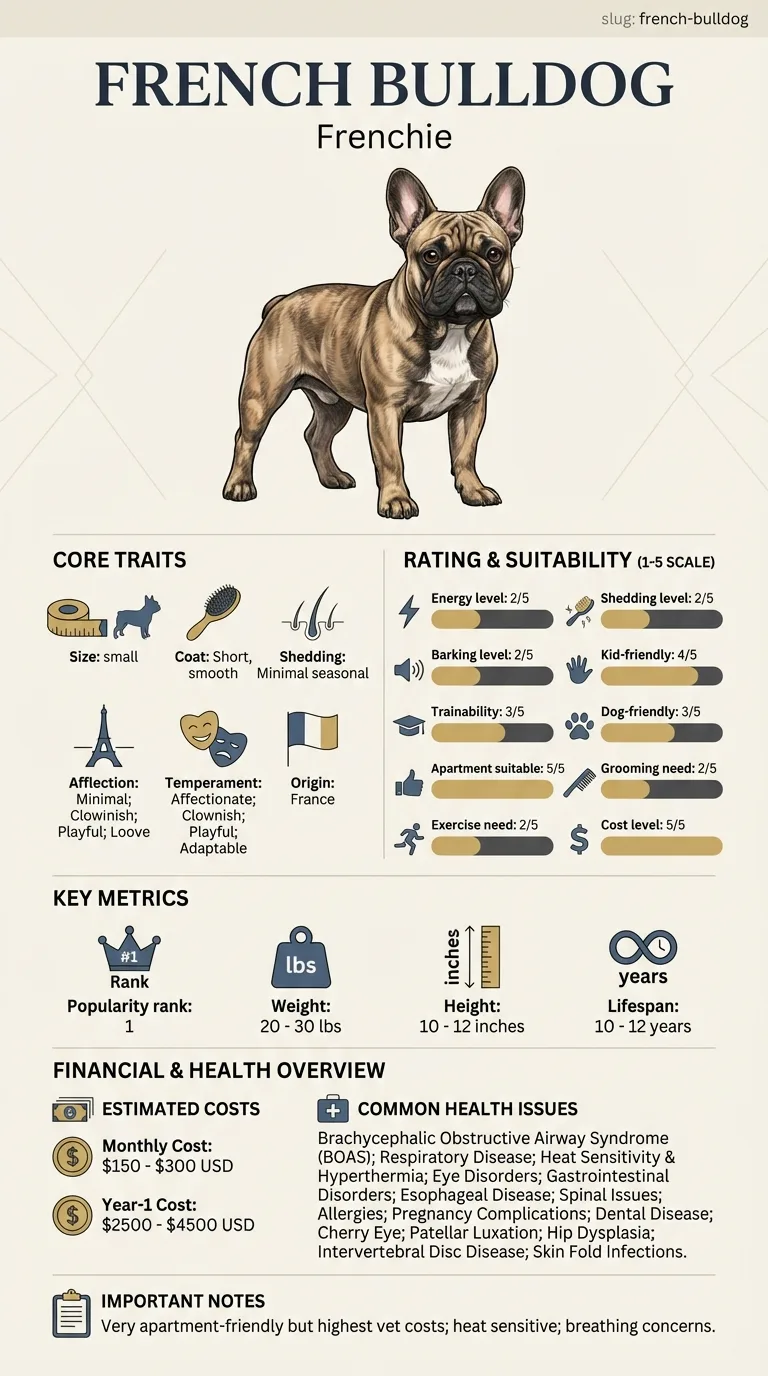
French Bulldogs may be evaluated for inherited or breed-associated concerns involving the airways, spine, joints, eyes, and skin. The page matrix for this breed also lists brachycephalic airway concerns, spinal issues, patellar luxation, hip dysplasia, eye disorders, allergies, and skin-fold infections. An individual dog may have none of these issues, and only a veterinarian can diagnose a condition.
No. Breed-related risk does not mean that every French Bulldog will develop a disorder. A dog's health is individual, so regular veterinary care and attention to changes in breathing, movement, comfort, or skin can be more useful than assuming a diagnosis.
Keep regular veterinary appointments, maintain a weight and activity plan your veterinarian supports, avoid overheating, and act on new symptoms promptly. If you are choosing a puppy, ask for available health history and discuss any questions with a veterinarian rather than relying on promises alone.
Noisy or labored breathing, heat intolerance, limping, difficulty rising, pain, weakness, changes in coordination, eye discomfort, or recurring skin irritation all warrant veterinary advice. Sudden breathing difficulty, collapse, severe pain, or inability to walk needs urgent care.
Some spinal conditions can have inherited or breed-related components, but back symptoms have more than one possible cause. A veterinarian can assess your dog and explain what testing or treatment, if any, is appropriate.
Not necessarily. French Bulldogs can have brachycephalic airway concerns related to their anatomy, while other illnesses or environmental factors can also affect breathing. Breathing changes should be assessed by a veterinarian instead of being assumed to have one cause.
Take breathing, heat tolerance, pain, and mobility changes seriously, and contact a veterinarian when they appear or worsen.
No. Symptoms and family history can be useful information, but diagnosis requires a veterinarian's assessment.
Seek urgent veterinary care for breathing difficulty, collapse, severe pain, sudden weakness, inability to walk, or signs of overheating.
A one-page prep sheet for this condition: the signs, the questions to ask, what to get priced. Unlocks here.
You get: Vet visit prep sheet
No spam. One-click unsubscribe. See our privacy policy.
Preview page 1 before you decide.