Health
Is hip dysplasia prevalence in French Bulldogs high or low compared to other breeds?
Moderate — lower than giant working breeds but high enough to be a genuine screening consideration.

Quick answer
Is hip dysplasia prevalence in French Bulldogs high or low compared to other breeds?
Moderate — lower than giant working breeds but high enough to be a genuine screening consideration.
Prevalence numbers tell you about a population, not about your individual dog — and knowing the difference changes how you should actually use that data.
Prospective buyers researching breeders are usually the ones digging into prevalence statistics, trying to decide how seriously to weigh hip screening results when picking a puppy or evaluating a breeding pair.
This guide is not medical advice. If your dog shows pain, sudden behavior change, or worsening symptoms, consult a licensed veterinarian.
Some links may be affiliate links. We may earn a commission at no extra cost to you. We only suggest products we believe are helpful for dog owners.
Hip dysplasia prevalence refers to how frequently the condition is documented across a breed population, usually measured through voluntary health screening databases like OFA. For French Bulldogs, that figure places the breed at a meaningful but moderate level of risk — a useful data point for breeders and buyers, though not a precise prediction for any one dog.
Prevalence figures vary by source and year, but French Bulldogs consistently appear in small-breed hip screening data at rates that make the condition worth taking seriously, even though it's discussed far less often than the breed's respiratory and spinal issues.
Prevalence numbers reflect the cumulative effect of breeding decisions across the whole population over many generations — how much emphasis breeders have historically placed on hip conformation relative to other traits like head shape or coat color shapes what the data eventually shows.
Reported prevalence can also be shaped by non-biological factors: which owners choose to screen their dogs, regional differences in veterinary access, and awareness campaigns that increase testing rates all influence the numbers independent of any real change in the dogs themselves.
Bring this up with your vet if you're considering breeding, buying a puppy from a line with unknown health testing, or if you simply want a baseline hip evaluation for your own dog's long-term care planning.
Statistics are useful, but only when read correctly — a few common misreadings lead owners and buyers astray.
See all French Bulldog health problems, which breeds are prone to hip dysplasia prevalence, or the full French Bulldog breed guide for temperament, exercise needs and ownership costs.
Prevalence data is typically updated as registries publish new statistics, often annually or every few years, so treat any figure as a snapshot rather than a permanent fact about the breed.
Success here looks like using the data appropriately — informing your questions to a breeder or your own screening decisions — rather than treating a single percentage as a guarantee either way.
When a screening body reports that a given percentage of evaluated French Bulldogs show hip dysplasia, that figure comes from dogs whose owners or breeders chose to submit them for screening — often a self-selected group rather than a random sample of the whole breed. That doesn't make the number useless, but it does mean it should be read as a signal of real risk rather than a precise measurement of every Frenchie alive.
What the number is genuinely useful for is comparison over time and against other breeds: French Bulldogs showing up at meaningfully higher rates than, say, a Border Collie tells you something real about relative risk, even if the exact percentage shifts depending on the dataset.
For an individual buyer, the far more actionable data point is the hip screening result of the specific parents of a specific litter, since that's a direct measurement rather than a population estimate.

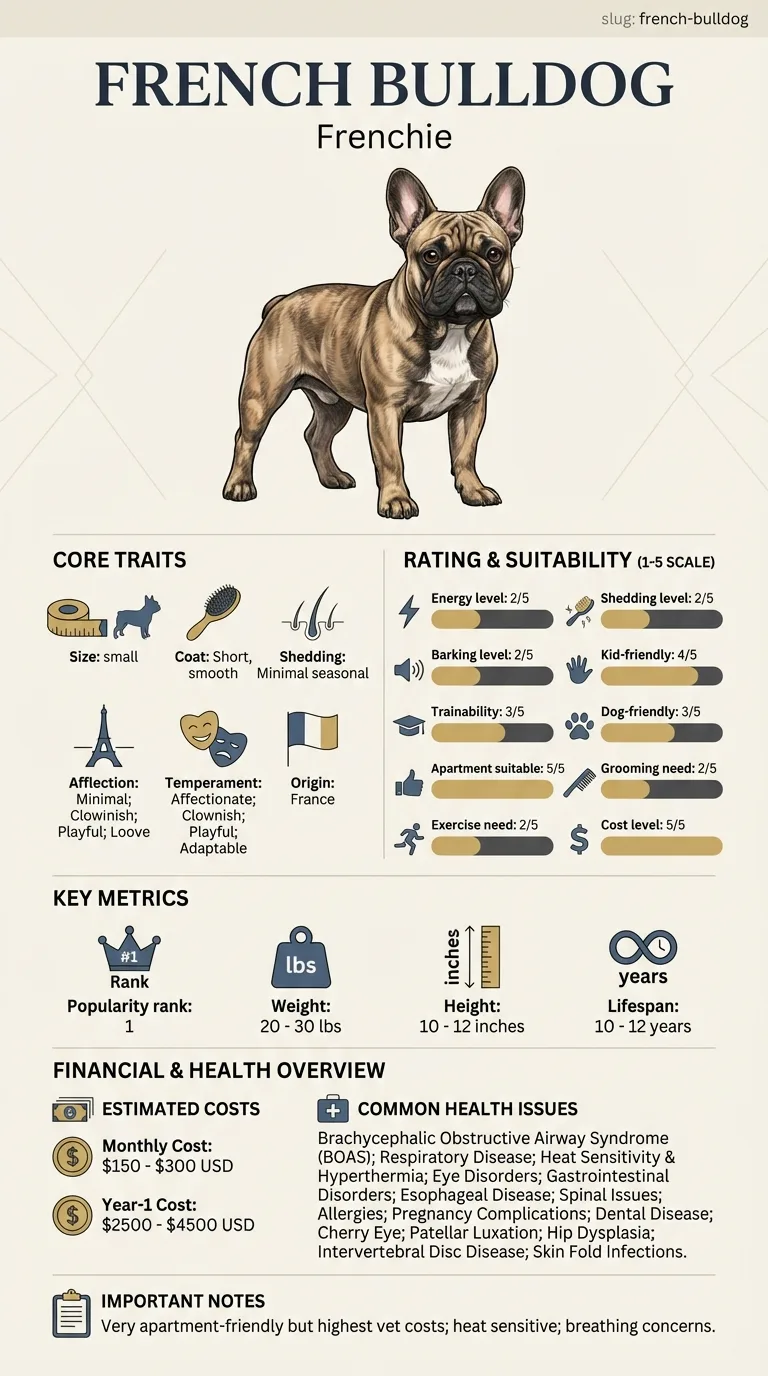
If you think your Frenchie has hip dysplasia prevalence, the plan is three steps: write down what you have seen and when it started, book a veterinary appointment rather than waiting for the next flare, and take video of the behaviour or symptom before you go — the thing you are worried about rarely happens in the consulting room. Screening in the parents covers brachycephalic obstructive airway syndrome (boas), respiratory disease, heat sensitivity & hyperthermia.
What the vet visit should produce is a diagnosis and a written plan, not just reassurance: what is being ruled out, what the monitoring interval is, and which signs mean you come back sooner. Ask what the treatment costs across a year rather than per visit, because that is the number that decides whether you are managing this condition or reacting to it.
Between appointments, keep a short log — dates, what you saw, what changed. It is the single most useful thing an owner brings to a follow-up, and for hip dysplasia prevalence it is often what separates a clear pattern from a guess.
Before getting her Frenchie puppy, Renata read that hip dysplasia prevalence in the breed was lower than in large working breeds, and almost stopped there. A breeder friend pointed out that the number was still high enough to matter, and encouraged her to ask the breeder directly for the parents' hip scores rather than relying on the general statistic. The breeder provided OFA results showing both parents scored 'good,' which gave Renata a far more specific and reassuring answer than the breed-wide number ever could. She still had her own dog's hips checked at two years old as a baseline, which came back normal.
Key takeaway: Breed prevalence is a starting point for asking better questions, not a substitute for checking the specific dog in front of you.
Screening databases place French Bulldogs among small breeds with a meaningful, non-trivial rate of hip dysplasia — lower than giant working breeds but high enough that it shouldn't be dismissed as irrelevant to the breed.
Screening registries differ in methodology, the population of dogs submitted (often skewed toward breeding stock), and scoring systems, which is why comparing raw percentages across sources can be misleading without matching methodology.
Not necessarily. Breed-wide statistics describe a population; only direct hip screening (X-rays) can tell you about your specific dog's joints.
Yes — parental hip scores are one of the most useful, specific pieces of health information a buyer can get, more directly relevant to a puppy's risk than any breed-wide statistic.
Trends can shift over time as breeders select for or against the trait, so it's worth looking at recent data rather than assuming older figures still apply.
Prevalence matters regardless of size, though a lighter dog with hip dysplasia may show milder clinical signs than a heavier breed carrying the same degree of joint malformation.
Ask the breeder directly for OFA (or equivalent registry) hip evaluation results for the puppy's parents; reputable breeders should have this documentation readily available.
Moderate — lower than giant working breeds but high enough to be a genuine screening consideration.
Not precisely — it describes the population; individual parental hip screening is more predictive.
OFA or equivalent hip evaluation scores for both parents of the litter.
Yes, selective breeding practices can shift rates up or down over time within a breed.
No — individual screening is still worthwhile regardless of the breed-wide statistic.
A one-page prep sheet for this condition: the signs, the questions to ask, what to get priced. Unlocks here.
You get: Vet visit prep sheet
No spam. One-click unsubscribe. See our privacy policy.
Preview page 1 before you decide.