Health
What is the earliest sign of hypothyroidism in a Chow Chow?
Coat change, usually thinning over the flanks and tail with a dry, dull texture, because a low-energy breed gives no useful lethargy signal.

Quick answer
What is the earliest sign of hypothyroidism in a Chow Chow?
Coat change, usually thinning over the flanks and tail with a dry, dull texture, because a low-energy breed gives no useful lethargy signal.
Thyroid disease is on this breed's documented health list, it is diagnosed with a blood test, and it is one of the few Chow problems that genuinely improves with treatment.
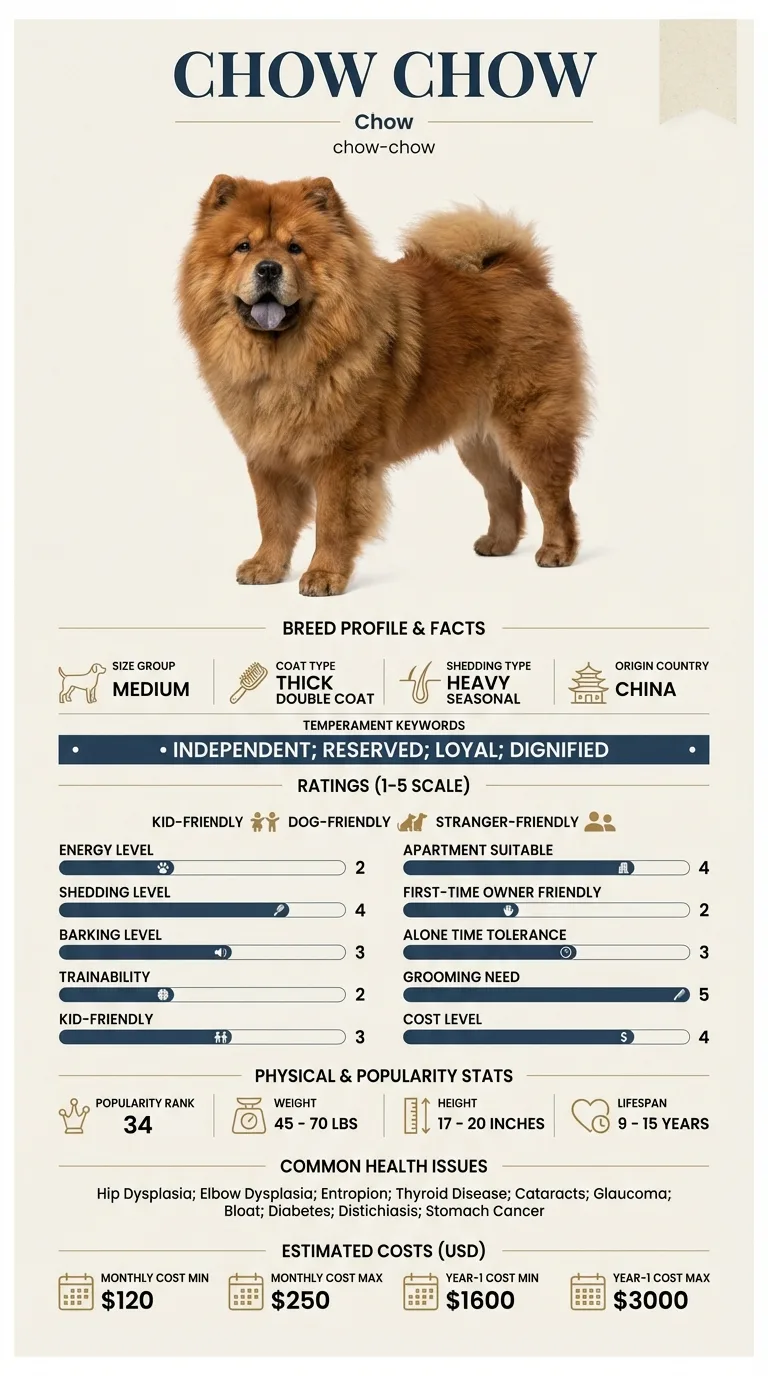
Owners of Chows between roughly four and ten years old whose coat has changed texture, who have gained weight without eating more, or who have developed recurrent skin or ear trouble that keeps coming back after treatment.
This guide is not medical advice. If your dog shows pain, sudden behavior change, or worsening symptoms, consult a licensed veterinarian.
Some links may be affiliate links. We may earn a commission at no extra cost to you. We only suggest products we believe are helpful for dog owners.
Hypothyroidism is an underproduction of thyroid hormone, and in the Chow Chow it usually announces itself through the coat and the scales rather than through behaviour. Weight climbs on unchanged food, the coat thins and dulls, the skin becomes darker and more infection-prone, and the dog starts preferring warm spots. It is diagnosed on bloodwork and managed with a daily oral hormone replacement.
Thyroid disease is one of the ten documented health issues for this breed, putting it firmly in the expected category. It is a middle-aged dog's disease, uncommon in Chows under three and increasingly relevant from four years onward in a breed that lives nine to fifteen years.
Two things make thyroid disease distinctive in this breed. The first is genuine predisposition, since thyroid disease is documented among Chow Chow health issues. The second is presentation. In most breeds the earliest complaint is that the dog has become lazy, but a Chow with an energy rating of 2 has no visible enthusiasm to lose, so that signal is unavailable. What the Chow does have is an enormous, hormonally responsive double coat, which makes dermatological signs unusually prominent and unusually early. A breed that is already heat-intolerant and starts seeking warmth is also giving a strong, easily missed clue.
Environment does not cause hypothyroidism, but it shapes how quickly it is caught. Households that groom regularly notice coat change early; those that groom seasonally may not notice for months. Warm climates delay detection of cold intolerance, since a Chow seeking a heat source is less striking in a cool house. Feeding practices matter for the weight sign: a dog whose portions were never measured gains weight for reasons nobody attributes to hormones.
Hypothyroidism is not an emergency, so book a normal appointment for coat thinning, weight gain on unchanged food, recurrent skin or ear infections, darkened greasy skin, or new heat-seeking behaviour, and ask specifically for a thyroid panel rather than a general check. There are two situations that do need urgency and are worth separating out: sudden severe weakness, collapse or a dog that cannot be roused is an emergency regardless of thyroid status, and so is any acute breathing difficulty. If your dog is already on thyroid medication, contact your vet promptly for restlessness, a racing heart, marked increases in thirst or panting, or weight loss, since those can indicate the dose needs review. Never adjust the dose yourself.
See all Chow Chow health problems, which breeds are prone to hypothyroidism, or the full Chow Chow breed guide for temperament, exercise needs and ownership costs.
Expect diagnosis to take one or two appointments, with a repeat panel if the first result is ambiguous. On treatment, demeanour usually shifts inside a month, weight responds over three to six months alongside diet, and coat takes three to six months or a full moult cycle. Monitoring bloods are typically repeated at four to eight weeks after starting and then once or twice yearly.
Success is a stable dose, a coat that has regrown its density, a weight holding steady in the healthy part of the 45 to 70 pound range, and skin infections that have stopped recurring. It is not a dog who becomes energetic, because this breed was never going to be.
A coat rated 5 out of 5 for grooming demand is a large, hormonally sensitive organ, and it registers thyroid change earlier and more obviously than behaviour does in this particular breed.
Total T4 is the usual screening test and it is easy to misread. Any significant illness suppresses it, a phenomenon usually called sick euthyroid syndrome, so a Chow tested during an infection or after an injury can look hypothyroid while having a perfectly normal thyroid gland. Several common medications lower it too. Treating on the basis of one low total T4 in an unwell dog is a well-recognised mistake.
A proper diagnosis pairs a low total T4 with a raised thyroid stimulating hormone, which shows the pituitary is shouting at an underactive gland, and often adds free T4 by a more specific method. That combination distinguishes real disease from a temporary dip.
Breed adds one more complication. Sighthounds are famous for running lower than the standard reference range, and there is broader recognition that reference intervals built from mixed populations fit some breeds imperfectly. What that means practically is not that a Chow's numbers should be dismissed, but that the interpretation belongs to a vet looking at the clinical picture alongside the panel, not to a number read off a printout.
One more thing worth timing correctly: if your dog is already on thyroid supplementation and you want to know whether the diagnosis was right, that question has to be planned with your vet, because stopping and retesting has its own protocol.

If you think your Chow has hypothyroidism, the plan is three steps: write down what you have seen and when it started, book a veterinary appointment rather than waiting for the next flare, and take video of the behaviour or symptom before you go — the thing you are worried about rarely happens in the consulting room. Screening in the parents covers hip dysplasia, elbow dysplasia, entropion.
What the vet visit should produce is a diagnosis and a written plan, not just reassurance: what is being ruled out, what the monitoring interval is, and which signs mean you come back sooner. Ask what the treatment costs across a year rather than per visit, because that is the number that decides whether you are managing this condition or reacting to it.
Between appointments, keep a short log — dates, what you saw, what changed. It is the single most useful thing an owner brings to a follow-up, and for hypothyroidism it is often what separates a clear pattern from a guess.
Jinx had been treated for four ear infections in fourteen months. Each course worked, and each time the problem returned within about six weeks. His owner Ade assumed it was allergies and started an elimination diet. The groomer raised the actual clue. Jinx's tail, which had always carried a thick plume over his back, had gone sparse, and the coat along his flanks had lost its spring. A thyroid panel showed low total T4 with a raised thyroid stimulating hormone, and the picture fitted. On daily replacement, the ears stopped recurring within two months. The tail took until the following spring to look right. Jinx lost four pounds over the same period, though Ade credits the measured meals more than the tablets.
Key takeaway: Recurrent infections that always come back are a pattern, not bad luck. In a Chow, look at the coat before you rewrite the diet.
Thyroid disease appears on the breed's documented health list, so it is a recognised concern rather than an incidental one. It typically appears in middle age, most often somewhere between four and ten years.
Usually some, but rarely all of it. Treatment restores metabolic rate; it does not undo years of surplus calories. Expect the diet to still be doing most of the work, with medication removing the headwind that made weight loss feel impossible.
Energy and demeanour often shift within two to four weeks. Coat is slower because hair grows slowly: expect three to six months before a double coat looks genuinely restored, and longer in a dog treated during the low point of a seasonal moult.
Yes, in essentially all cases. The gland does not recover, and stopping medication returns the dog to where he started within weeks. The upside is that this is one of the cheaper chronic conditions to manage once the dose is settled.
It can contribute to dullness, irritability and reduced tolerance, and those matter more in a breed already rated 2 out of 5 for stranger friendliness. A thyroid panel is a reasonable early step when an adult Chow's temperament genuinely changes rather than simply matures.
It can slow heart rate and alter rhythm, which is one reason a thyroid panel is often run before assuming a cardiac diagnosis in a middle-aged dog with low stamina.
Coat change, usually thinning over the flanks and tail with a dry, dull texture, because a low-energy breed gives no useful lethargy signal.
Not reliably. Illness and some medications lower total T4 without thyroid disease. Diagnosis usually needs T4 plus thyroid stimulating hormone, interpreted alongside the clinical picture.
Medication itself is one of the cheaper chronic prescriptions, though periodic monitoring bloods add to it. Budget above the breed's usual 120 to 250 dollar monthly range in the first year while the dose is being set.
Often the dullness lifts within a few weeks. Do not expect a reserved, independent breed to become outgoing, because that was never the thyroid's doing.
A one-page prep sheet for this condition: the signs, the questions to ask, what to get priced. Unlocks here.
You get: Vet visit prep sheet
No spam. One-click unsubscribe. See our privacy policy.
Preview page 1 before you decide.