Health
What is the most reliable early sign in a Berner?
Weight gain on unchanged food, combined with symmetrical hair thinning that does not itch. Either alone is weak evidence; together they are worth a blood test.

Quick answer
What is the most reliable early sign in a Berner?
Weight gain on unchanged food, combined with symmetrical hair thinning that does not itch. Either alone is weak evidence; together they are worth a blood test.
A middle-aged Berner who gained weight on the same food, lost coat over his flanks, and started sleeping through the evening is not simply getting older.
Owners of Bernese Mountain Dogs between about four and eight years old who have noticed a cluster of vague changes, and owners already treating thyroid disease who want to know what normal looks like on medication.
This guide is not medical advice. If your dog shows pain, sudden behavior change, or worsening symptoms, consult a licensed veterinarian.
Some links may be affiliate links. We may earn a commission at no extra cost to you. We only suggest products we believe are helpful for dog owners.
We research and check what we publish, but we do not warrant that any figure, date, price, or statement is accurate, complete, or current, and we accept no liability for any loss, cost, injury, or other harm arising from the use of this site. Use it as one reference among several. You remain responsible for your own decisions and for your dog's care - confirm anything that matters with a licensed veterinarian or another qualified professional before you act on it. Full disclaimer.
Hypothyroidism is a deficiency of thyroid hormone, most often because the dog's own immune system has gradually destroyed the gland. The result is a slowed metabolism that shows up as weight gain without increased eating, reduced energy, poor coat quality and hair loss without itching, cold intolerance, and skin or ear infections that keep returning. It is diagnosed on bloodwork and treated with lifelong daily hormone replacement.
Hypothyroidism is one of the more common hormonal disorders in dogs and is recognised across many mid to large breeds. It is not among the top Bernese concerns, which remain cancer, joint disease and bloat, but it matters disproportionately because it is inexpensive to treat and its symptoms are so easily attributed to age in a breed with a short lifespan.
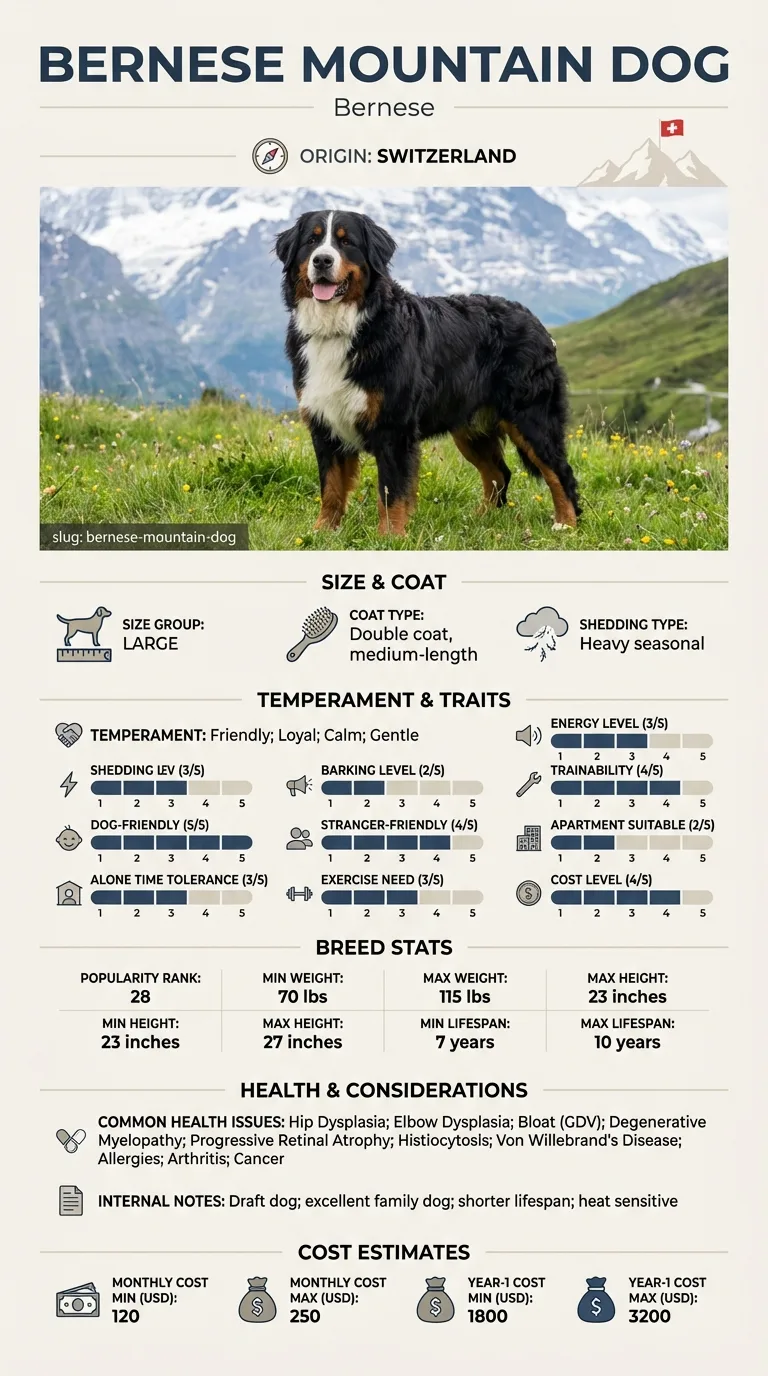
The dominant cause in dogs is an inherited immune-mediated destruction of thyroid tissue, and the tendency toward autoimmune disease runs in lines rather than appearing randomly. Two features of the Bernese make the consequences harder to spot than they would be elsewhere. The breed's temperament is described as calm and gentle with a moderate energy level, so a genuine drop in drive resembles the breed standard. And the heavy medium-length double coat conceals thinning until it is advanced, particularly on the flanks where loss typically begins.
Nothing in a household causes hypothyroidism, but several environmental factors change how it presents and how it is detected. Cold tolerance is normally a Bernese strength, so a dog who begins seeking heat sources in a cool house is showing a genuine deviation. Diet and activity determine how fast weight accumulates once metabolism slows. And because heat sensitivity already limits summer exercise in this breed, a thyroid-driven weight gain that begins in June is often blamed entirely on the season.
Hypothyroidism is not an emergency and rarely requires urgent care, so book a normal appointment for unexplained weight gain, non-itchy symmetrical hair loss, dulling coat, heat-seeking behaviour in a cold-adapted breed, or repeated ear infections. Seek prompt attention if a dog on thyroid medication becomes restless, pants excessively, loses weight rapidly or seems agitated, since these can indicate the dose is too high. Very rarely, severe untreated disease causes profound weakness or collapse, which is an emergency.
Start here: Bernese Mountain Dog Most Common Genetic Disorders
See all Bernese Mountain DOG health problems, which breeds are prone to hypothyroidism, or the full Bernese Mountain DOG breed guide for temperament, exercise needs and ownership costs.
Energy and appetite usually respond first, within two to four weeks of starting replacement. Weight follows over two to four months and only with a controlled diet. Coat is the slowest, and in a dense double-coated breed full regrowth commonly takes three to six months and sometimes a complete shed cycle. Dose is checked by bloodwork a few weeks after starting and then at intervals your vet sets, usually settling into annual monitoring.
A well-managed hypothyroid Bernese is indistinguishable from an unaffected one. That means a stable weight at the leaner end of his range, a coat that sheds on its normal seasonal schedule, ears that stop needing repeated treatment, and an energy level that matches the breed rather than a dog ten years older. This is one of the few conditions in this breed where near-complete normality is a reasonable expectation.
Hair growth is metabolically expensive, so the body is quick to deprioritise it when thyroid hormone runs low. In most breeds that produces obvious thinning. In a Bernese it produces something subtler and easier to miss, because there is so much coat to start with.
The classic pattern is symmetrical loss on the flanks, the tail and the backs of the thighs, without itching. That last detail is the useful one. Allergic hair loss comes with scratching, chewing and inflamed skin. Thyroid-related loss is quiet: the hair simply stops being replaced, and the areas that rub against surfaces thin out first.
Coat texture changes too. The undercoat can become dry and brittle, the outer coat loses its shine, and the seasonal shed that this breed does heavily and predictably can go strange, either failing to happen or happening constantly. Owners often describe it as the coat looking dull and the dog smelling different.
Skin changes follow. Thickened, darker skin in the groin and armpits, recurring ear infections that do not respond as they should, and skin infections that keep returning after treatment are all reasons to have thyroid function checked rather than treating the surface problem again.
Because a Berner is heavily coated, run your hands over the flanks and tail base rather than relying on what you can see. Thinning is felt before it is visible.
More dogs are misdiagnosed with hypothyroidism than are missed, largely because one low number gets treated as an answer. Getting the testing right at the start avoids years of unnecessary medication.

If you think your Bernese has hypothyroidism, the plan is three steps: write down what you have seen and when it started, book a veterinary appointment rather than waiting for the next flare, and take video of the behaviour or symptom before you go — the thing you are worried about rarely happens in the consulting room. Screening in the parents covers hip dysplasia, elbow dysplasia, bloat (gdv).
What the vet visit should produce is a diagnosis and a written plan, not just reassurance: what is being ruled out, what the monitoring interval is, and which signs mean you come back sooner. Ask what the treatment costs across a year rather than per visit, because that is the number that decides whether you are managing this condition or reacting to it.
Between appointments, keep a short log — dates, what you saw, what changed. It is the single most useful thing an owner brings to a follow-up, and for hypothyroidism it is often what separates a clear pattern from a guess.
Ilsa was six, and her family had been telling themselves she was slowing down gracefully. She had gained eleven pounds over a year on exactly the same food, stopped asking for her evening walk, and had begun lying on the heating vent, which was odd for a dog who had always sought the coldest tile in the house. It was her groomer who raised it. She commented that Ilsa's undercoat was coming out sparse and brittle rather than in the usual dense clumps, and that the hair over her tail base and flanks had thinned noticeably since the last visit. A full thyroid panel confirmed hypothyroidism. Ilsa started daily replacement, and her family put her on measured meals. Her energy returned inside a month. The weight took until the following spring, and her coat did not look fully normal until she had been through one complete shed.
Key takeaway: In a heavily coated breed, the person handling the coat regularly often spots thyroid disease first. If your groomer says the undercoat has changed, treat it as a clinical observation and take it to your vet.
Most dogs are diagnosed in middle age, commonly between four and eight years old. That overlaps awkwardly with the age at which a Bernese naturally slows and at which owners start attributing changes to a shortening lifespan, which is part of why it gets missed.
No. Where the thyroid tissue has been destroyed it does not regenerate, so treatment is daily hormone replacement for life. The good news is that it is one of the more satisfying conditions to treat in dogs: the medication is inexpensive, well tolerated, and the response is usually clear.
Usually yes, but not on its own. Restoring normal metabolism makes weight loss possible rather than automatic. Most owners need to combine the medication with a measured feeding plan and a gradual return to exercise, and see meaningful change over two to four months rather than weeks.
Lethargy and reduced engagement are well recognised. Claims that thyroid disease causes aggression are much more contested and should be treated cautiously. If your Bernese has developed genuine behavioural change, thyroid testing is a reasonable part of the workup but it is rarely the whole answer.
It interacts with several. Weight gain from low thyroid worsens hip and elbow dysplasia and arthritis, which are core issues in this breed. Recurrent skin and ear infections overlap with the breed's documented allergy tendency. And the lethargy it causes is easily confused with cardiac fatigue, which is worth ruling out separately.
The medication itself is one of the cheaper long-term drugs in veterinary medicine, though a 70 to 115 pound dog needs a larger dose than a small one. The ongoing cost is mostly monitoring bloodwork, typically once or twice in the first year and then annually.
This is a real question in the breed rather than a theoretical one, because the most common cause is an inherited autoimmune process. Most breed health authorities discourage breeding from affected dogs. A diagnosis in an intact dog should prompt a conversation with the breeder as well as the vet.
Weight gain on unchanged food, combined with symmetrical hair thinning that does not itch. Either alone is weak evidence; together they are worth a blood test.
Use your hands, not your eyes. Run your palms along the flanks, the tail and the backs of the thighs and compare density to the shoulders.
Not reliably. A single low total T4 is a prompt to investigate further, not a diagnosis. Ask for a full panel before starting lifelong medication.
Energy usually improves within two to four weeks. Coat regrowth is slower and often takes three to six months, especially in a heavy double coat.
A one-page prep sheet for this condition: the signs, the questions to ask, what to get priced. Unlocks here.
You get: Vet visit prep sheet
No spam. One-click unsubscribe. See our privacy policy.
Preview page 1 before you decide.