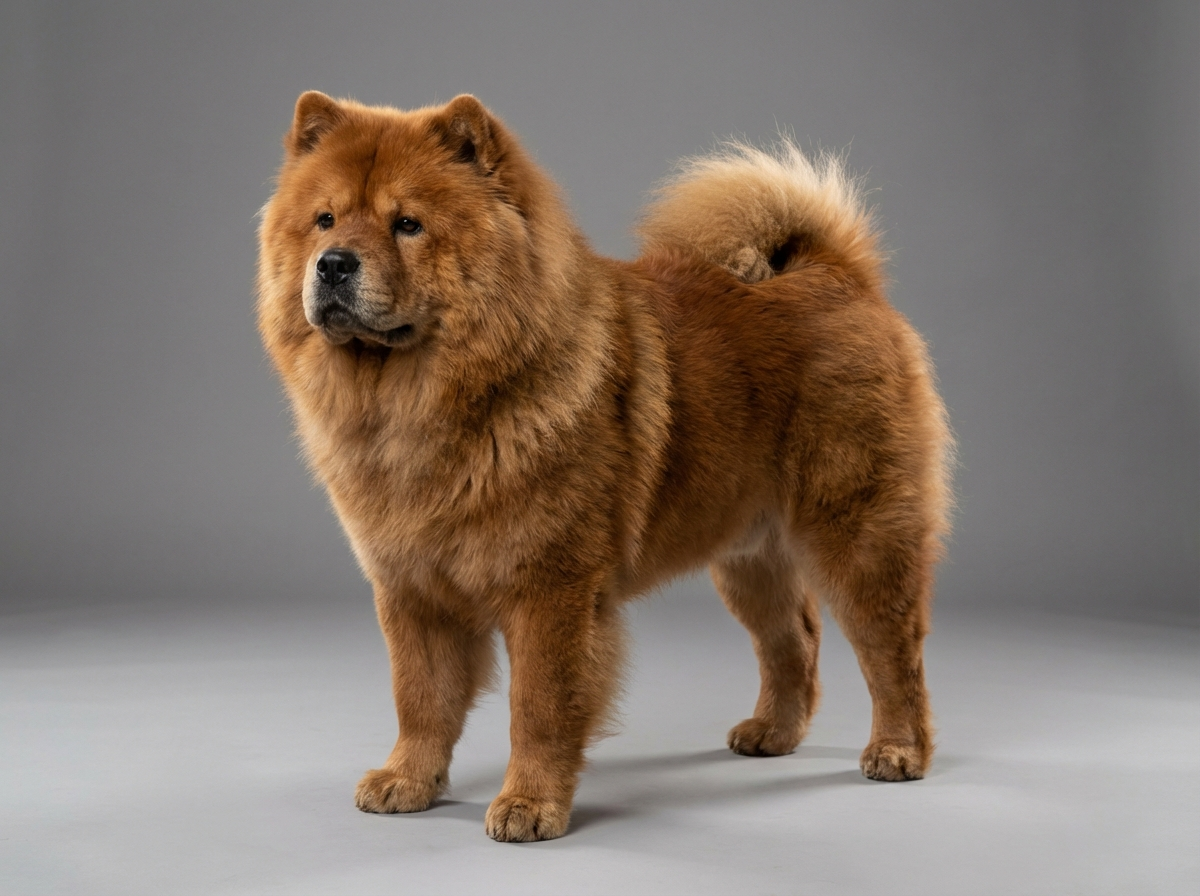
Health
My Chow stops halfway through walks. Is it his heart?
Usually not. Heat, hip or elbow pain, thyroid disease and excess weight are all more likely in this breed. Ask for those to be checked first.

Quick answer
My Chow stops halfway through walks. Is it his heart?
Usually not. Heat, hip or elbow pain, thyroid disease and excess weight are all more likely in this breed. Ask for those to be checked first.
A Chow that quits early has a short list of suspects, and three of them are on the breed's documented health list while the heart is not.
Owners of middle-aged and senior Chows who have noticed reduced tolerance for walks, and anyone who has read that subvalvular aortic stenosis is a breed risk and wants to know whether that is true.
This guide is not medical advice. If your dog shows pain, sudden behavior change, or worsening symptoms, consult a licensed veterinarian.
Some links may be affiliate links. We may earn a commission at no extra cost to you. We only suggest products we believe are helpful for dog owners.
What gets filed under Chow Chow heart problems is usually a symptom, not an organ: the dog is doing less than he was. Because four cheaper and more likely explanations sit above the heart on the list, the useful approach is a structured elimination rather than jumping to cardiac imaging. The heart still gets checked, just not first.
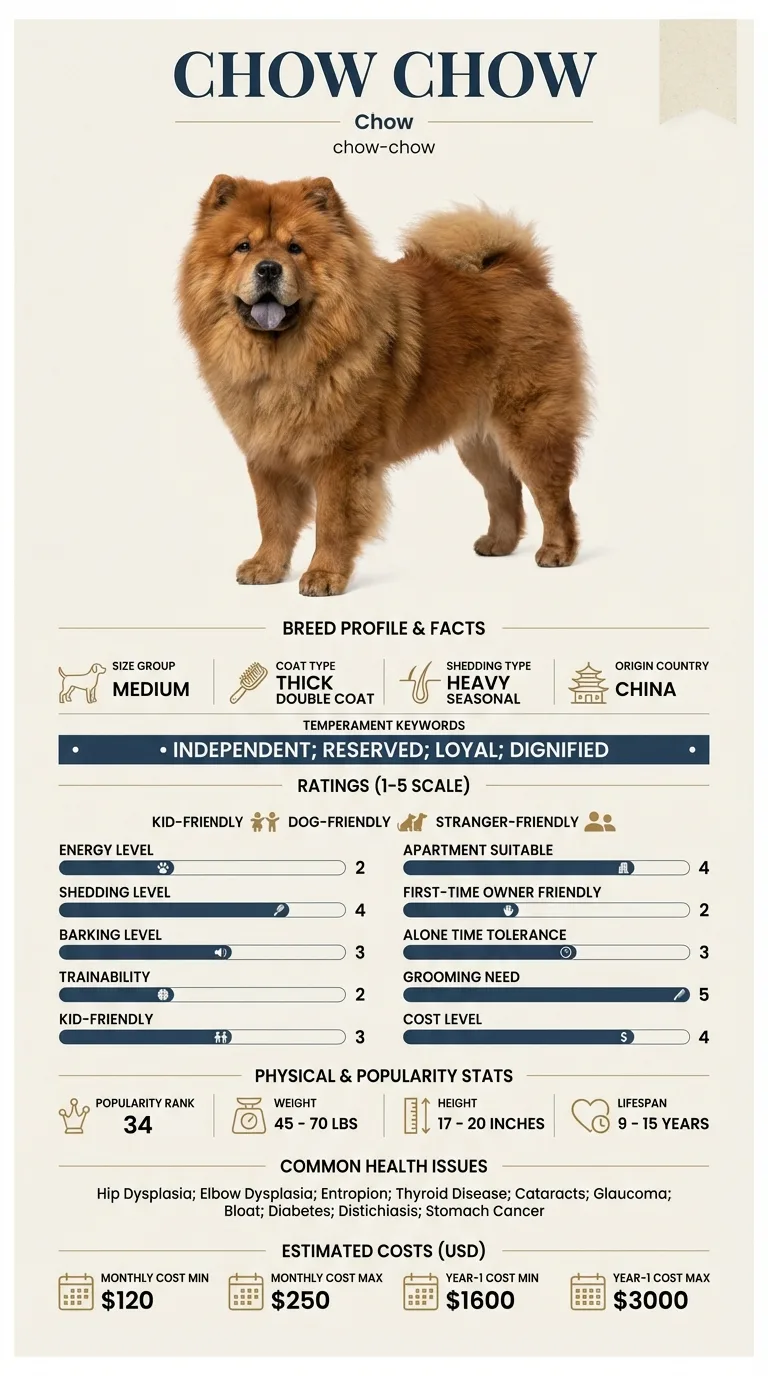
No cardiac condition appears among the ten documented Chow Chow health issues, so primary heart problems are an uncommon finding in this breed. By contrast, hip dysplasia, elbow dysplasia and thyroid disease all are documented, which is why they account for far more cases of reduced stamina.
The Chow's build and temperament make attribution unusually hard. Documented hip and elbow dysplasia produce pain in a dog too dignified to limp dramatically, so owners read reluctance as stubbornness, which the breed's independent reputation encourages. Documented thyroid disease produces exactly the lethargy that people attribute to the heart. And with energy rated 2 out of 5, there is no reserve of enthusiasm to lose visibly, so any decline is small in absolute terms even when it is large relative to that dog.
Climate dominates. Heat sensitivity is an explicit breed note, and a thick double coat holds warmth so effectively that ambient temperature alone can halve a Chow's willing walking distance. Hard flooring, stairs and long car journeys aggravate the orthopaedic contributors. Feeding habits matter too, since a low-exercise dog on a portion sized for an active one gains weight quietly and steadily under all that coat.
Go the same day if your Chow collapses, cannot get up, breathes with obvious effort at rest, has a distended or painful abdomen, or is unresponsive after a period in the heat. Bloat is documented in this breed and a swollen, hard belly with unproductive retching is a surgical emergency, not something to observe overnight. Book an ordinary appointment within a week or two for gradually reduced stamina, stiffness after rest, unexplained weight change, coat thinning, or a new reluctance to use stairs. Ask for thyroid testing and an orthopaedic exam at the same visit as the chest listen so you are not paying for three separate consultations.
See all Chow Chow health problems, which breeds are prone to heart problems, or the full Chow Chow breed guide for temperament, exercise needs and ownership costs.
The elimination process usually takes two to three weeks: one visit with bloods and an orthopaedic exam, results within days, then a two-week trial of cool-weather-only walking. If all four common causes come back clear, cardiac imaging is the reasonable next step.
Success is a named cause and a walk your dog willingly completes, even if that walk is shorter than it used to be. For many Chows the honest end point is a dog who does fifteen good minutes at dawn rather than a reluctant thirty at noon.
Order matters because the first four are cheaper to test and far more likely. A structured walk-through usually finds the answer before an echocardiogram is ever booked.
Subvalvular aortic stenosis is a congenital narrowing just below the aortic valve. The heart has to generate far higher pressure to push blood past the obstruction, which thickens the left ventricle and can cause fainting during exertion or, in severe cases, sudden death in a young dog. It is a genuinely serious condition and it is well documented in Newfoundlands, Golden Retrievers, Boxers, Rottweilers and German Shepherds.
It is not documented in the Chow Chow. The breed's recognised issues are orthopaedic, ocular, endocrine and gastric: hip dysplasia, elbow dysplasia, entropion, distichiasis, cataracts, glaucoma, thyroid disease, bloat, diabetes and stomach cancer. Where subvalvular aortic stenosis appears on Chow health pages, it has almost always been copied from a generic large-breed list.
The practical consequence is about timing rather than dismissal. SAS is a young dog's disease, usually detectable as a loud murmur in the first year. If your seven-year-old Chow developed a murmur last month, SAS is not the explanation, and searching for it wastes the appointment.

If you think your Chow has heart problems, the plan is three steps: write down what you have seen and when it started, book a veterinary appointment rather than waiting for the next flare, and take video of the behaviour or symptom before you go — the thing you are worried about rarely happens in the consulting room. Screening in the parents covers hip dysplasia, elbow dysplasia, entropion.
What the vet visit should produce is a diagnosis and a written plan, not just reassurance: what is being ruled out, what the monitoring interval is, and which signs mean you come back sooner. Ask what the treatment costs across a year rather than per visit, because that is the number that decides whether you are managing this condition or reacting to it.
Between appointments, keep a short log — dates, what you saw, what changed. It is the single most useful thing an owner brings to a follow-up, and for heart problems it is often what separates a clear pattern from a guess.
Rusty was six and had started sitting down at the same corner every evening. His owner Marcus assumed a heart problem and asked for a cardiac referral. His vet asked for two weeks first. Bloodwork showed borderline thyroid values and Rusty had gained nine pounds since his last recorded weight, which nobody had noticed under the coat. The evening walks were happening at six in the evening in August. Marcus moved them to six in the morning and Rusty walked the whole route the first day. Thyroid treatment and a measured diet followed. By October Rusty was doing his old evening loop again. The chest listen, done at every visit, stayed normal throughout.
Key takeaway: Three documented breed problems and one thermometer explained everything. Check the cheap, likely causes before booking the expensive, unlikely one.
It is not among the documented health issues for the breed. SAS clusters in Newfoundlands, Goldens, Boxers, Rottweilers and German Shepherds, and it presents in the first year of life as a loud murmur, not in middle age.
Watch what stops the walk. Orthopaedic pain shows as reluctance to start, stiffness after rest that eases with movement, difficulty rising and trouble with stairs. Cardiac limitation shows as a dog who starts willingly and then runs out of breath, with an elevated resting breath rate afterwards.
Very often, yes. This breed is explicitly noted as heat sensitive, and the same dog can manage twenty minutes at dawn and five minutes at two in the afternoon. Repeat the same route in cool conditions before assuming disease.
Not on its own. The breed is rated 2 out of 5 for both energy and exercise need, so a Chow that prefers short outings is normal. What matters is a change from that dog's own baseline, which is why owners of this breed benefit from writing the baseline down.
A general panel plus thyroid testing covers the two cheap, common, documented explanations. Anaemia and thyroid disease both cause exercise intolerance and both are far more likely in this breed than a primary cardiac problem.
Priorities are hips, elbows, eyes and thyroid, matching the documented issues. A cardiac auscultation on breeding stock is sensible general practice, but a formal SAS screening programme is aimed at other breeds.
Usually not. Heat, hip or elbow pain, thyroid disease and excess weight are all more likely in this breed. Ask for those to be checked first.
No. It is documented in Newfoundlands, Golden Retrievers, Boxers, Rottweilers and German Shepherds, and it shows up in puppies, not middle-aged dogs.
Modest. With energy and exercise need both rated 2 out of 5, short flat walks suit the breed. Judge changes against your own dog's usual, not against a retriever.
Bloodwork including thyroid, plus a weigh-in and a chest listen at the same visit. That combination resolves most cases without imaging.
A one-page prep sheet for this condition: the signs, the questions to ask, what to get priced. Unlocks here.
You get: Vet visit prep sheet
No spam. One-click unsubscribe. See our privacy policy.
Preview page 1 before you decide.