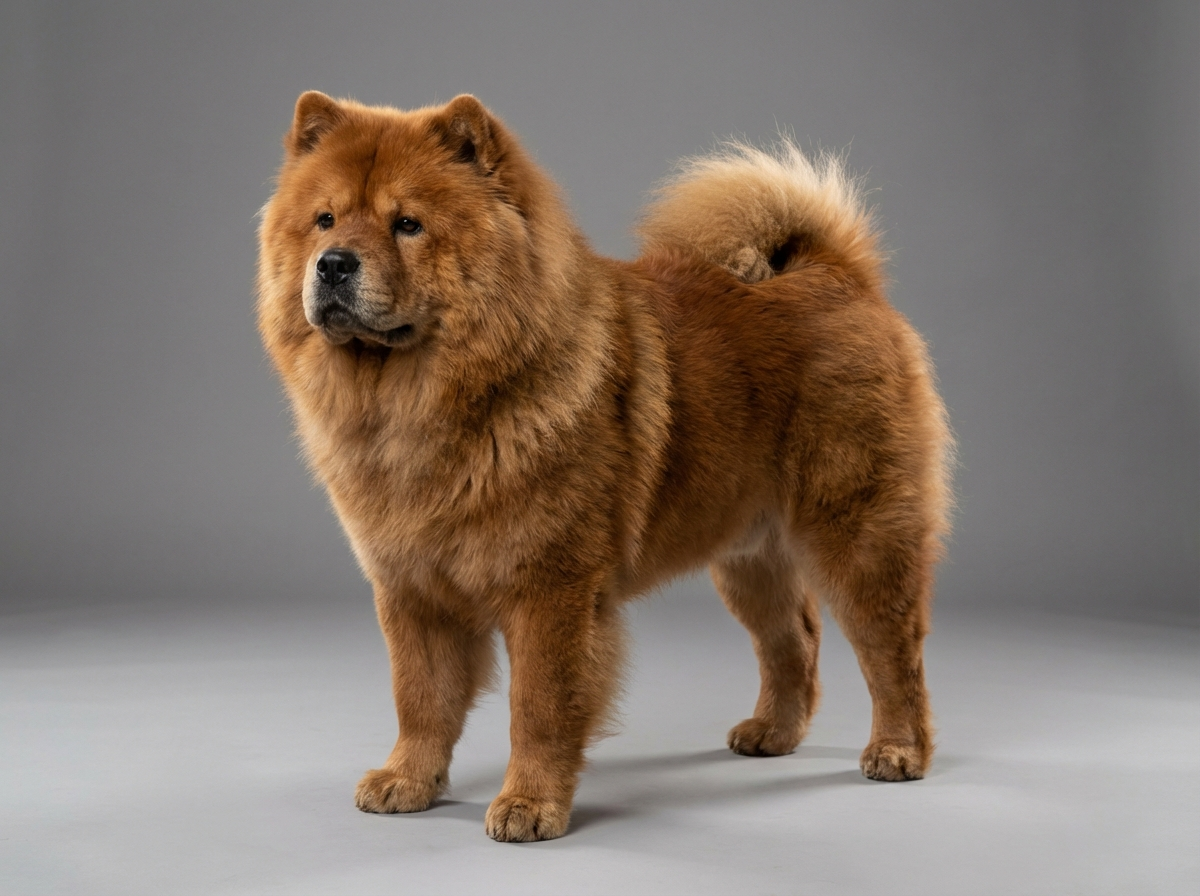
Health
What murmur grade needs an echocardiogram?
Most practices image at grade III and above, or at any grade if the dog has a cough, fainting, or a rising breath rate. Grades I and II in a well dog are often monitored.

Quick answer
What murmur grade needs an echocardiogram?
Most practices image at grade III and above, or at any grade if the dog has a cough, fainting, or a rising breath rate. Grades I and II in a well dog are often monitored.
Grades run from I to VI, and the number your vet says out loud in ten seconds decides how urgently everything else needs to happen.
Owners who left the clinic with a number and no explanation, and owners of older Chows whose murmur has been described differently by two different vets and who cannot tell whether it has genuinely changed.
This guide is not medical advice. If your dog shows pain, sudden behavior change, or worsening symptoms, consult a licensed veterinarian.
Some links may be affiliate links. We may earn a commission at no extra cost to you. We only suggest products we believe are helpful for dog owners.
A heart murmur in a Chow Chow is a finding, not an illness. The task is to work out whether the turbulence comes from a structurally abnormal valve, from a temporary state such as fear or anaemia, or from an unrelated problem such as thyroid disease. Most owners meet the word for the first time in a routine appointment and leave with more anxiety than information.
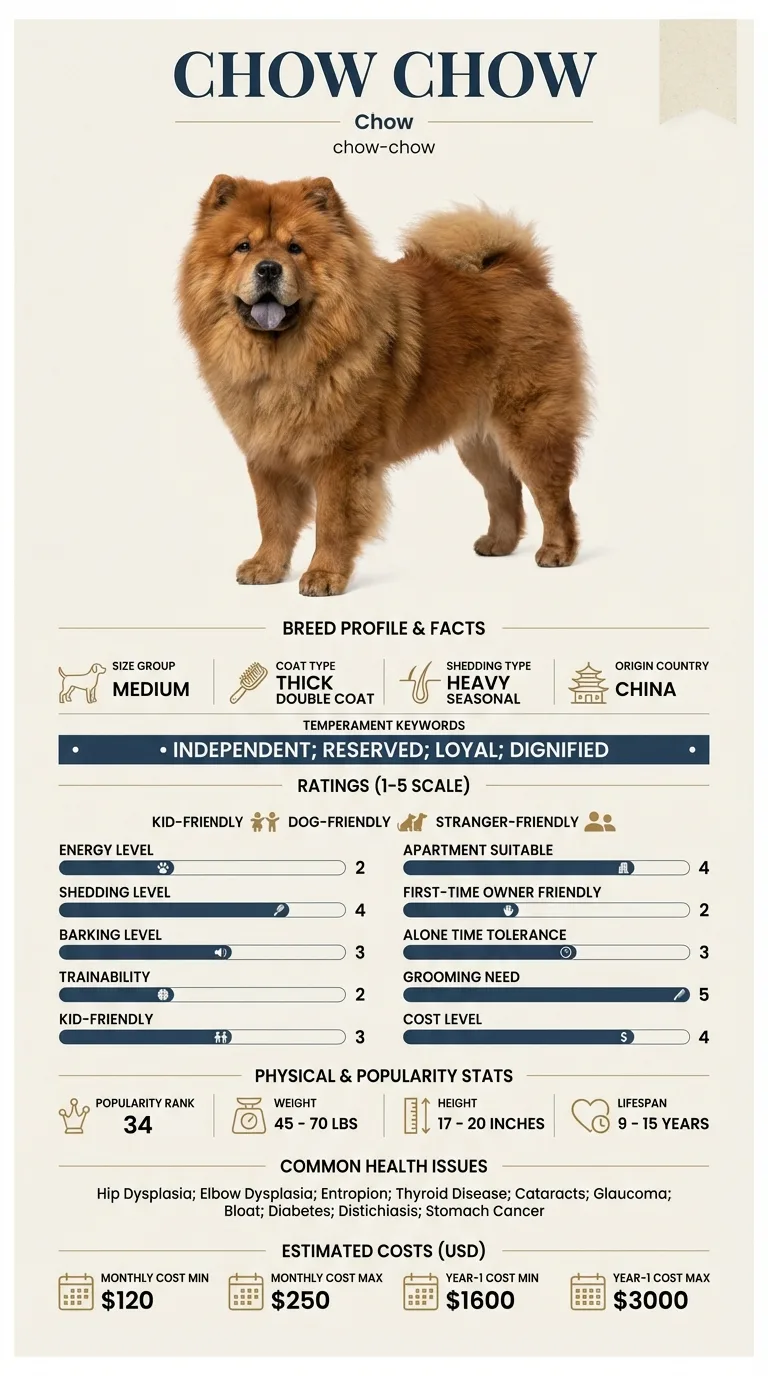
Because cardiac disease is not among the ten documented Chow Chow health issues, murmurs in this breed are usually age-related or incidental rather than inherited. They become steadily more likely across a lifespan that commonly runs from nine to fifteen years, as valve tissue changes with age in any medium-sized dog.
The Chow contributes less to the murmur itself than to how reliably it gets heard and interpreted. A grooming rating of 5 out of 5 reflects a coat dense enough to damp heart sounds, so grade assignment on this breed is systematically conservative unless the coat is parted. A stranger-friendliness rating of 2 means most Chows arrive at the clinic tense, with an elevated heart rate that exaggerates turbulence. Documented thyroid disease provides a genuine non-cardiac route to an abnormal sound.
Busy consulting rooms with barking in the background make soft murmurs undetectable, so the same dog can be graded differently by the same vet on a quiet Tuesday and a chaotic Saturday. Rotating between clinics removes the continuity that makes grade comparison possible. And in households where a low-energy dog is only brought in when visibly unwell, murmurs get discovered late and without any prior grade to compare against.
A murmur alone is rarely an emergency, but the signs that turn it into one are: collapse, breathing with the mouth open at rest, standing with elbows out and neck extended, frothy or pink discharge from the nose or mouth, or a sleeping breath rate above forty. Any of those means today. Do not try to judge by gum colour, because Chow gums and tongue are naturally blue-black and will not show pallor or cyanosis reliably. Arrange a normal appointment within a week or two for a new grade, a cough that starts after lying down, a breath count trending upward, or a puppy murmur still present at sixteen weeks.
See all Chow Chow health problems, which breeds are prone to heart murmurs, or the full Chow Chow breed guide for temperament, exercise needs and ownership costs.
A low-grade murmur in a well dog is typically rechecked in six months. If imaging is indicated, expect one to four weeks to get it done. Grades are compared over years, not weeks, so the value of good record-keeping only shows up much later.
Success is knowing the murmur's grade, its likely cause, what would make it matter, and when the next check falls. It is not the murmur disappearing, because most do not.
Grading is subjective and depends on the listener, the room and the dog's heart rate, which is why the same murmur can be called a II by one vet and a III by another. Written records over time beat any single opinion.
Puppies can have soft flow murmurs that vanish by around sixteen weeks. These are innocent, and the correct response is to recheck rather than to panic or to cancel a purchase. If a Chow puppy's murmur is still there at five months, or is louder than a grade II, it has stopped being innocent and needs looking at.
Anaemia produces murmurs by thinning the blood so it flows turbulently through perfectly normal valves. So does fever, and so does the adrenaline of a frightened dog. A Chow rated 2 out of 5 for stranger tolerance who has been restrained by two unfamiliar people has a heart rate far above baseline, and that alone can make a soft murmur audible or a moderate one sound worse. A recheck on a calmer day, ideally by the same vet, is a genuinely useful test.
The last confounder is thyroid disease, which is on this breed's documented health list. Thyroid hormone drives heart rate, and both too much and too little change what the chest sounds like. A basic blood panel is often the cheapest step between hearing a murmur and understanding it.

Tofu, a seven-year-old Chow, was graded II at his regular clinic in March and IV at an out-of-hours visit in July for an unrelated paw injury. His owner Ines went home convinced the murmur had doubled in six months. Her own vet asked one question: how was he behaving at the emergency clinic. Tofu had been muzzled, held by two nurses, and panting hard. At a booked appointment on a quiet weekday, with the coat parted and the room silent, he graded II again. Ines now books rechecks for first appointment of the morning, and the note in her phone lists grade, date and clinic. The murmur has read II or low III for three years running.
Key takeaway: Context changes the grade. Compare murmurs measured under similar conditions, and treat a jump recorded during a stressful emergency visit as a question rather than a verdict.
No. Most dogs with murmurs never develop failure, and many carry the same low-grade murmur for years without symptoms. Failure is defined by fluid backing up into the lungs or abdomen, which is a clinical picture, not a sound.
Grading depends on the listener's ear, the ambient noise, and how fast the dog's heart was beating at that moment. On a heavily coated breed it also depends on whether the coat was parted. Ask for grades to be written down, and where possible see the same vet for rechecks.
Not on that alone. Soft flow murmurs in young puppies commonly resolve by about four months. Ask the breeder to put in writing that they will take the puppy back if it persists, book a recheck at sixteen weeks, and make the decision then with information instead of now with anxiety.
It can mute one. Dense undercoat sits between the stethoscope and the chest wall and damps the sound, which pushes a genuine grade II toward sounding like a grade I. Parting the coat over the left chest takes seconds and is worth asking for.
A cough that appears when the dog lies down, a resting or sleeping breath rate that climbs above thirty, reduced appetite, a fuller-looking belly, or any fainting. Those move the situation from a sound to a condition.
It can change the drug protocol, the fluid rate and the monitoring. That is a reason to disclose it clearly, not a reason to skip needed dental work. Ask what the murmur means for the specific procedure being planned.
Most practices image at grade III and above, or at any grade if the dog has a cough, fainting, or a rising breath rate. Grades I and II in a well dog are often monitored.
Yes. Fear raises heart rate and turbulence, and this breed scores 2 out of 5 for stranger tolerance. A recheck on a calm day is a fair request.
Soft flow murmurs often resolve by around sixteen weeks. One still present at five months, or louder than grade II, needs investigation.
The grade, the date, the vet's name, and where on the chest it was loudest. That four-item note makes the next comparison meaningful.
A one-page prep sheet for this condition: the signs, the questions to ask, what to get priced. Unlocks here.
You get: Vet visit prep sheet
No spam. One-click unsubscribe. See our privacy policy.
Preview page 1 before you decide.