DogBreedCompass
← Back to breed profile

Chow Chow Heart Conditions: Why the Warning Signs Get Missed

Quick answer

What is the single most useful thing I can track at home?

Sleeping respiratory rate. Count chest rises for thirty seconds on a sleeping Chow, double it, and write it down weekly. A steady climb above thirty is worth a call even if your dog seems fine.

The hardest part of heart disease in a Chow Chow is not treating it. It is noticing it in a dog who was never enthusiastic about exercise to begin with.

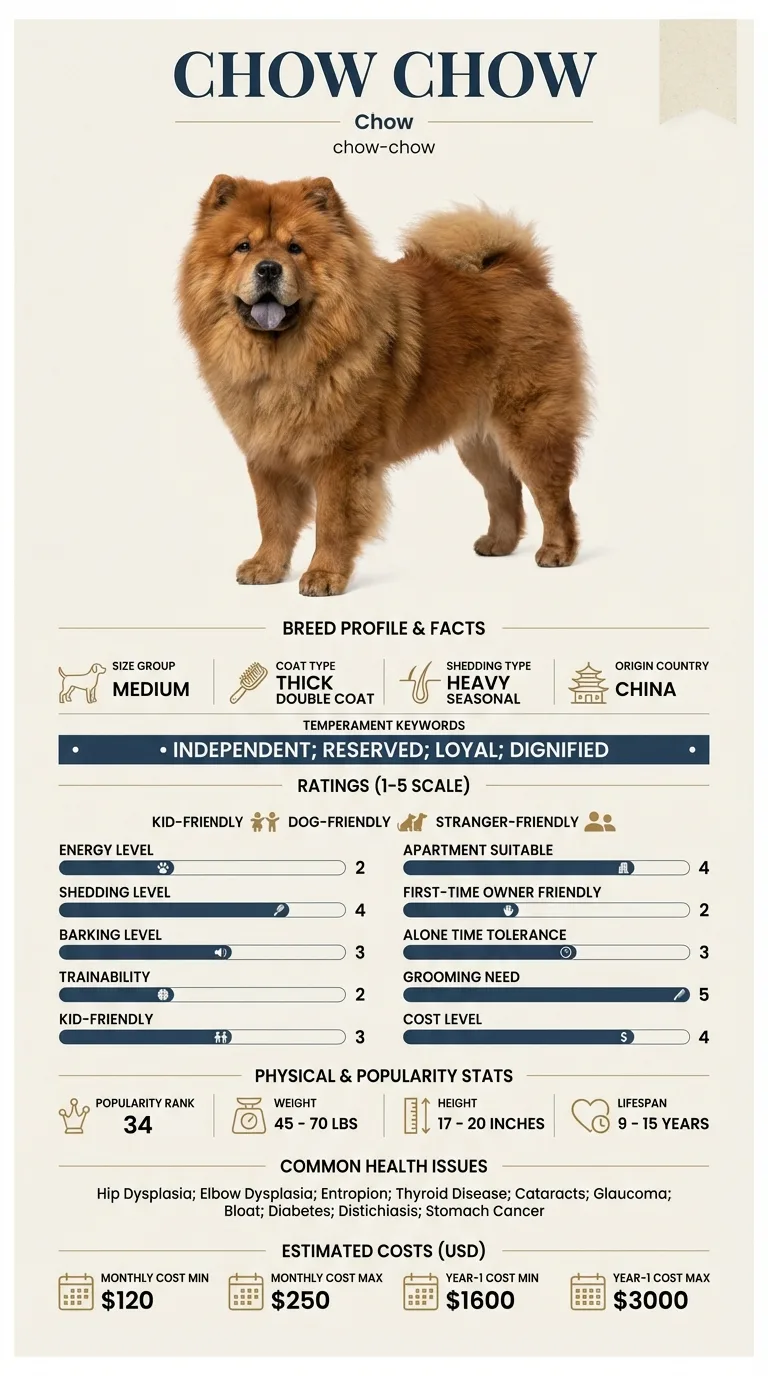
Chow Chow Heart Conditions: Why the Warning Signs Get Missed infographic

This matters most to owners of Chows past about seven years old, and to anyone whose vet has mentioned a murmur, an irregular rhythm, or an incidental finding on a pre-anesthetic workup. It also matters to owners who have quietly written off slowing down as ordinary aging in a breed that lives nine to fifteen years.

Important reminder

This guide is not medical advice. If your dog shows pain, sudden behavior change, or worsening symptoms, consult a licensed veterinarian.

Some links may be affiliate links. We may earn a commission at no extra cost to you. We only suggest products we believe are helpful for dog owners.

Check this first

What counts as an emergency, and what can wait for Monday

Go straight to an emergency clinic if your Chow collapses and cannot right himself, breathes with an open mouth while lying still, stands with elbows pushed out and neck extended to draw air, coughs up pink froth, or has a belly that has swelled noticeably over a day or two. A dog in genuine respiratory distress from heart failure will not settle no matter where you put him, and that restlessness at two in the morning is the classic presentation owners describe afterwards.

One complication is specific to this breed. The blue-black tongue and heavily pigmented gums mean the standard advice to check for pale or bluish mucous membranes largely fails here. You cannot read perfusion off a Chow's mouth the way you can off a Labrador's. Judge by effort, posture and rate instead, and tell any unfamiliar emergency vet that the dark oral pigment is normal for the breed so nobody wastes minutes on it.

Things that warrant an appointment this week rather than tonight: a new soft cough that shows up mostly after lying down, a sleeping breath count that has drifted above thirty-five, reduced appetite over several days, or a single brief wobble that resolved in seconds. None of those are safe to ignore, but none require a midnight drive.

If any of these apply, call your vet or an emergency clinic now. The rest of this page is for the cases that are not an emergency.

What this problem looks like

Heart conditions in Chow Chows cover several unrelated problems that share one presentation: a dog who is doing slightly less than before. Because the breed is naturally low-drive, reserved and physically undemonstrative, the early phase passes unnoticed and the first real clue is often a murmur picked up at a vaccination visit or a pre-anesthetic check before dental work.

Common triggers

  • Age past roughly seven years, when incidental murmurs start appearing at routine exams
  • Hot or humid weather, which demands cardiac output this breed can least afford to spend
  • Weight gain hidden beneath a heavy double coat
  • Untreated thyroid disease, which is documented in the breed and alters heart rate
  • Anesthesia or sedation, where an unrecognised murmur first gets investigated
  • Sudden exertion in a dog conditioned to a very low activity baseline

Cardiac disease is not among the ten health issues documented for the Chow Chow, so it is not a breed expectation. It becomes relevant with age. In a breed that commonly reaches nine to fifteen years, a meaningful number of individuals will pick up an age-related murmur or rhythm change somewhere in that span, exactly as any medium-sized dog would.

Why this happens

Breed factors

Three breed traits conspire here, and none of them is a heart defect. First, an energy level of 2 and exercise need of 2 remove the exercise-intolerance signal that normally reveals cardiac disease early. Second, a thick double coat physically muffles auscultation and conceals both weight change and any visible chest effort. Third, the reserved, dignified temperament means a Chow in early distress withdraws quietly to a cool corner rather than seeking out its owner. Add the blue-black oral pigment, which disables the standard gum-colour check, and you have a dog engineered to look fine until it is not.

Environment factors

Warm climates are the main external multiplier, because a Chow already struggles to shed heat through a heavy coat and a shortened muzzle, and cooling costs cardiac work. Homes with stairs, a diet rich in salty table scraps, and long gaps between veterinary exams all shift the odds. So does the practical reality that many owners of a low-energy breed skip annual visits once puppy vaccinations are done, which removes the one moment a murmur would have been caught.

What you can do at home (once it is not an emergency)

When to talk to your vet

Treat these as same-day emergencies: collapse, open-mouth breathing at rest, standing with the elbows abducted and neck stretched to breathe, any froth or pink fluid from the mouth or nose, or a resting breath rate above forty in a calm, cool dog. Do not wait for the gums to change colour, because in a Chow they will not. Book within the week for a new night-time cough, appetite loss lasting more than two or three days, a sleeping breath count trending above thirty-five, a belly that looks fuller than usual, or a single unexplained fainting episode. Before any anesthetic procedure, including a routine dental, ask specifically whether the heart has been listened to that day.

At home, alongside your vet's plan

  • Log a sleeping respiratory rate every week in the same notes app, with the date. Trends matter far more than any single reading, and a two-week climb is a reason to call.
  • Weigh your Chow monthly on the same scale and record it, because a coat this dense hides gain and loss equally well.
  • Keep the house cool and give your dog access to hard flooring or a raised mesh bed, so cooling costs him as little circulatory effort as possible.
  • Move walks to early morning or after dusk, keep them flat, and let your dog set the pace rather than the leash.
  • Cut salty human food entirely, including deli meat, cheese and stock-based leftovers, and tell everyone in the household the rule applies to them too.
  • Film any collapse, wobble or unusual breathing on your phone. Thirty seconds of video answers questions that ten minutes of description cannot.

See all Chow Chow health problems, which breeds are prone to heart conditions, or the full Chow Chow breed guide for temperament, exercise needs and ownership costs.

What to expect, and how you know it is working

Expect the diagnostic phase to take two to four weeks: an initial exam, imaging, and often a referral for an echocardiogram. If medication is started, the first recheck usually falls at seven to fourteen days, then every three to six months once numbers are stable. Home monitoring is permanent, not a phase.

Success is not a cured heart. It is a Chow whose sleeping breath count stays flat month after month, who still asks for his short evening walk, who eats and sleeps normally, and whose owner catches the next change from a notebook rather than from a crisis at three in the morning.

The home baseline that makes Chow Chow heart problems visible

Because you cannot rely on a Chow to demonstrate reduced stamina, you have to substitute measurement for observation. These six data points give a veterinarian something concrete to work with, and several of them will detect a change weeks before you would notice one by eye.

  • Sleeping respiratory rate. Count chest rises for thirty seconds while your Chow is genuinely asleep, double it, and log it weekly. A settled dog should sit comfortably under thirty breaths per minute. A rising trend over two weeks is the most useful home number in all of canine cardiology, and it costs nothing.
  • Recovery time, not distance. Time how long it takes your Chow to stop panting after a short, flat, cool-weather walk. Chows do not walk far, so distance tells you nothing. Recovery does.
  • Weight every month. A quiet three-pound gain in a 45 to 70 pound dog changes what your vet can feel and hear, and fluid retention can masquerade as gradual weight gain under that dense double coat.
  • Willingness to lie flat. Note whether your Chow still sleeps stretched on his side. Dogs with fluid backing up in the lungs often start propping themselves on the sternum or seeking cool tile at odd hours.
  • Any fainting episode, in writing. Date, time, what he was doing, how long he was down, and how he looked afterwards. One line of notes is worth more than an hour of description at the clinic.
  • The date of the last chest listen. Ask for the murmur grade in writing at every visit so you can compare a grade II last spring with a grade III this autumn.

The murmur nobody was looking for: Baozi's pre-dental surprise

Baozi was ten, sixty-two pounds, and had spent his entire life declining invitations to run. When his owner Priya booked a dental cleaning, the pre-anesthetic exam turned up a grade III murmur that had not been there at his last recorded visit two years earlier. Priya's honest reaction was that nothing about him had changed, because nothing visible had. The dental was postponed. Radiographs and an echo showed mild changes and a heart that was coping, and the plan was monitoring rather than immediate medication. Priya started counting his breaths on Sunday nights. For five months the number hovered between twenty-two and twenty-six. In week twenty-three it read thirty-one, then thirty-four, and she called on a Tuesday morning rather than waiting for a weekend crisis. That early call meant an outpatient adjustment instead of an emergency admission. Baozi had his dental eight months later, under a protocol built around what the echo had shown.

Key takeaway: In a breed that will never tell you it is tired, the notebook is the diagnostic. Priya did not spot a change in Baozi's behaviour, because there was not one to spot. She spotted a number.

Frequently asked questions

Are Chow Chows a high-risk breed for heart disease?

Cardiac disease does not appear on the documented health list for this breed, which centres on hip and elbow dysplasia, entropion, distichiasis, thyroid disease, cataracts, glaucoma, bloat, diabetes and stomach cancer. That does not make a Chow immune. It means heart trouble in a Chow is usually an individual finding rather than a breed expectation, and it deserves a real workup rather than a shrug.

My Chow has always been lazy. How would I know if that changed?

You would not, by feel. Low energy is written into the breed at 2 out of 5, so the change is too small against too flat a baseline. Replace impressions with a weekly sleeping breath count and a monthly weight. Those two numbers will move before your instincts do.

Does the thick double coat make a heart exam harder?

It makes it slower. A dense double coat muffles the stethoscope and hides the jugular pulse and any chest-wall lift, so a thorough listen on a Chow takes longer than on a smooth-coated dog. Ask your vet to part the coat over the left chest wall rather than listening through it, and expect a proper cardiac exam to take a few extra minutes.

What tests would a vet run after finding a murmur?

Typically chest radiographs to assess heart size and lung fields, blood pressure, and an echocardiogram to see what the valves and muscle are actually doing. An ECG is added when the rhythm sounds irregular. Cost is real, and this is a breed already rated 4 out of 5 for overall expense, so ask what each test will change about the plan before agreeing to all of it.

Can heat make an existing heart condition worse?

Yes, and this is where the breed's two vulnerabilities stack. Chows are noted for poor heat tolerance, and a dog whose cardiac output is already limited has less reserve to move blood to the skin for cooling. A summer afternoon that a healthy Chow merely dislikes can be genuinely dangerous for one with heart disease.

Is a cough always a heart problem?

No. Kennel cough, collapsing airways, throat irritation from a tight collar and simple reverse sneezing all produce coughing. What points toward the heart is a cough that appears when the dog lies down, worsens at night, and comes with a rising resting breath rate. A cough on its own, in a bright dog with normal breathing, usually points elsewhere.

Should I change exercise if my Chow is diagnosed?

You will usually be asked to keep activity gentle, regular and self-paced rather than stopping it. Short, flat, cool-weather walks where the dog sets the tempo preserve muscle without demanding output the heart cannot supply. What you drop is anything with a sprint in it, and anything in the middle of a hot day.

Quick answers

View more answers
Health

What is the single most useful thing I can track at home?

Sleeping respiratory rate. Count chest rises for thirty seconds on a sleeping Chow, double it, and write it down weekly. A steady climb above thirty is worth a call even if your dog seems fine.

Health

Why can't I check my Chow Chow's gum colour?

The breed carries heavy blue-black pigment in the tongue and gums, so the usual pale-or-blue check does not work. Assess breathing effort, posture and rate instead.

Costs

How much does a cardiac workup usually add to the year?

Expect diagnostics plus recheck visits to sit well above this breed's ordinary 120 to 250 dollar monthly range in the year of diagnosis, then settle once a plan is stable. Ask for a written estimate before the first echo.

Health

Is a heart murmur in an older Chow always serious?

Not always, but it always needs grading and a follow-up plan. Ask for the grade in writing so the next vet can tell whether it has changed.

Training

Can I still train and handle a Chow with heart disease?

Yes. Keep sessions short, calm and food-based, and skip anything that raises arousal sharply. Cooperative-care handling makes vet visits far less stressful for a reserved breed.

Related DogBreedCompass guides

  • Chow Chow heat sensitivityHeat intolerance and limited cardiac reserve compound each other in this breed.
  • neurologic signs in Chow ChowsFainting can be cardiac or neurological, and the two are easy to confuse.
  • Chow Chow weight managementExcess weight worsens every cardiac sign and is easy to miss under a double coat.
  • Chow Chow ownership costsOwners researching heart care usually want the full ownership cost picture.
  • Chow Chow breed profileBreed traits explain why this dog gives so few early warning signals.

Bring the right questions to the vet

A one-page prep sheet for this condition: the signs, the questions to ask, what to get priced. Unlocks here.

You get: Vet visit prep sheet

No spam. One-click unsubscribe. See our privacy policy.

Preview page 1 before you decide.

Related guides