Health
What is the earliest sign of hip dysplasia in a Chow Chow?
Usually a bunny hop on stairs or a slow, two-stage rise from hard flooring. Check on tile, not carpet, and check with your hands for thigh muscle loss.

Quick answer
What is the earliest sign of hip dysplasia in a Chow Chow?
Usually a bunny hop on stairs or a slow, two-stage rise from hard flooring. Check on tile, not carpet, and check with your hands for thigh muscle loss.
The Chow's stiff, rolling gait and dignified refusal to complain mean this breed loses more joint before anyone notices than a demonstrative dog would.
Owners who have noticed their Chow taking stairs oddly or struggling to rise from a hard floor, and puppy buyers trying to understand what a hip score on a pedigree actually promises.
This guide is not medical advice. If your dog shows pain, sudden behavior change, or worsening symptoms, consult a licensed veterinarian.
Some links may be affiliate links. We may earn a commission at no extra cost to you. We only suggest products we believe are helpful for dog owners.
Hip dysplasia in the Chow Chow is a developmental mismatch between the femoral head and the socket that holds it. The looseness causes abnormal wear, the wear causes arthritis, and the arthritis causes the pain owners eventually notice. Because this breed masks discomfort, it is common for the diagnosis to arrive several years after the joint started deteriorating.
It is the first entry on the breed's documented health list, which places it among the most significant concerns for Chow owners. Severity varies enormously between individuals, from radiographic changes that never trouble the dog to disabling arthritis by middle age, and the difference is driven by genetics, growth management and lifetime body weight.
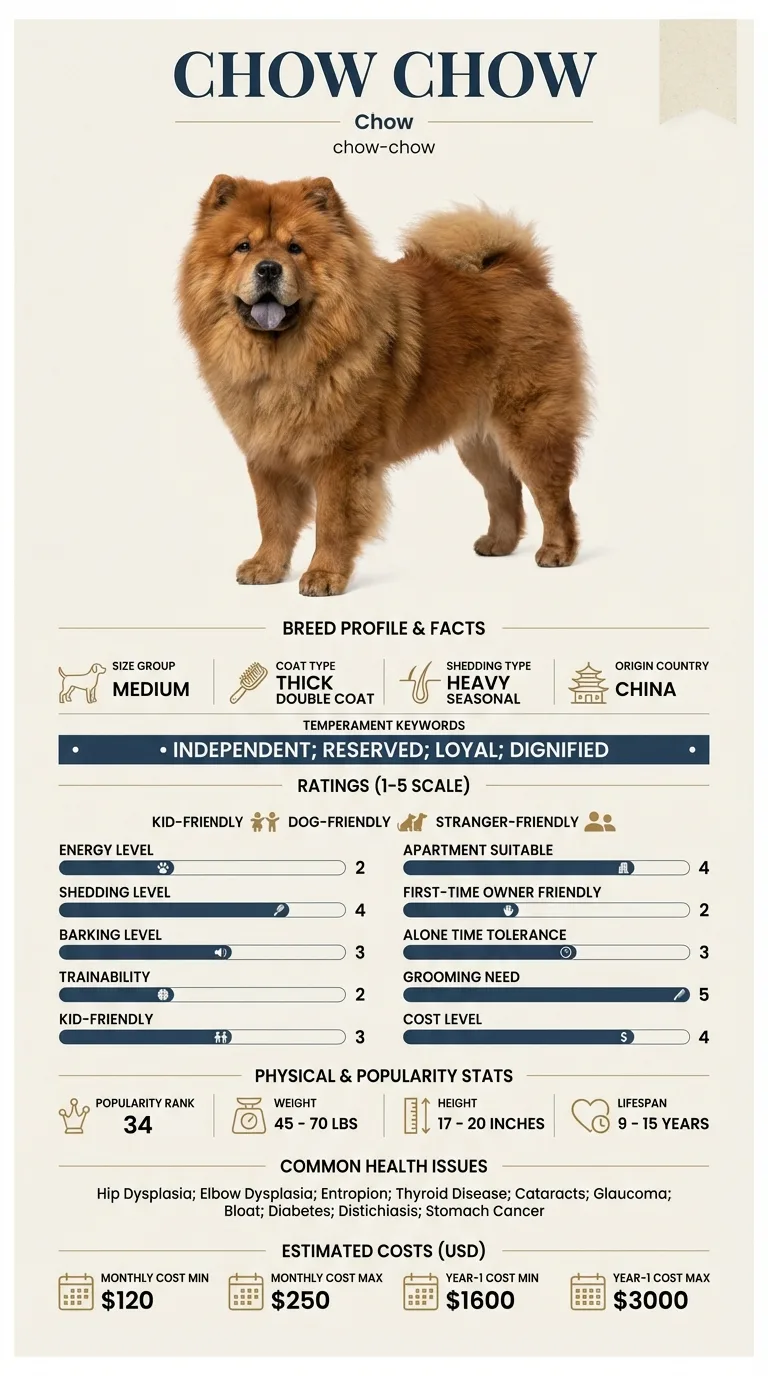
The Chow is heavily built for its height, at 45 to 70 pounds on a 17 to 20 inch frame, which concentrates load through the hips. The breed's characteristic rear construction produces a short, stilted stride with limited joint excursion, and that gait both predisposes to abnormal wear and camouflages an abnormal one. Temperament compounds it: an independent, dignified dog rated 2 out of 5 for trainability does not perform pain for its owner, so the behavioural signal that prompts a vet visit in other breeds arrives late or not at all. Dense coat then hides the muscle wastage that would otherwise be visible.
Flooring is the everyday factor most owners underestimate. Laminate and tile give a Chow's hind feet nothing to grip, and every scrabbling rise loads the joint abnormally. Homes with stairs the dog must use many times a day add repetitive impact. Feeding a growing puppy free choice, or supplementing calcium without veterinary direction, accelerates growth in a way that worsens joint conformation. Cold and damp raise stiffness, though this breed's coat means it suffers far less from cold than from heat.
Book promptly rather than urgently for a bunny hop, a two-stage rise, a narrow hind stance, sideways sitting, thigh muscle loss or shortened walks. Same-day care is needed if your Chow suddenly cannot bear weight on a hind leg, since an acute non-weight-bearing lameness usually means something other than chronic dysplasia, such as a ruptured cruciate ligament. Also treat sudden hind-limb weakness affecting both legs, loss of coordination, or dragging of the toes as urgent, because those point to the spine rather than the hips. Never give human anti-inflammatory medication, which is toxic to dogs; pain control has to come from a prescription written for your dog.
See all Chow Chow health problems, which breeds are prone to hip dysplasia, or the full Chow Chow breed guide for temperament, exercise needs and ownership costs.
Weight loss and surface changes show benefit within six to twelve weeks. A structured rehabilitation programme typically runs three to six months before hind-end muscle is meaningfully rebuilt. If surgery is chosen, expect eight to sixteen weeks of controlled recovery, with strict confinement for the first several weeks.
Success is a Chow who rises without hesitating, completes a modest daily walk willingly, holds his muscle mass, and needs pain relief on bad-weather days rather than every day. It is not a normal hip, and it is not a dog who runs like he did at two.
A grooming rating of 5 out of 5 describes a coat dense enough to conceal muscle wastage and body outline entirely. Almost every check on this list has to be done with your hands rather than your eyes.
Nothing reverses a shallow socket. Conservative management aims at a different target: reducing the load the joint carries, preserving the muscle that stabilises it, and controlling the inflammation that turns a mechanical problem into a painful one. Done well, it keeps many Chows comfortable for years.
The single most powerful lever is body weight. A Chow at the lean end of 45 to 70 pounds is carrying meaningfully less force through a bad joint than the same dog eight pounds heavier, and weight is the one variable an owner fully controls. Because the coat hides body condition, this has to be managed by monthly weighing and hands-on rib checks rather than by appearance.
The second lever is consistent low-impact movement. Muscle is the joint's shock absorber, and a dog rested into inactivity loses the support that was holding the hip together. Short, frequent, flat walks beat one long weekend outing. Controlled swimming or underwater treadmill work suits this breed well because it builds hind-end muscle without impact, though the coat takes serious drying afterwards.
What management cannot do is make the joint normal, restore lost cartilage, or guarantee the dog will never need surgery. Setting that expectation early prevents the crushing disappointment that arrives when a well-managed dog deteriorates anyway.

If you think your Chow has hip dysplasia, the plan is three steps: write down what you have seen and when it started, book a veterinary appointment rather than waiting for the next flare, and take video of the behaviour or symptom before you go — the thing you are worried about rarely happens in the consulting room. Screening in the parents covers hip dysplasia, elbow dysplasia, entropion.
What the vet visit should produce is a diagnosis and a written plan, not just reassurance: what is being ruled out, what the monitoring interval is, and which signs mean you come back sooner. Ask what the treatment costs across a year rather than per visit, because that is the number that decides whether you are managing this condition or reacting to it.
Between appointments, keep a short log — dates, what you saw, what changed. It is the single most useful thing an owner brings to a follow-up, and for hip dysplasia it is often what separates a clear pattern from a guess.
Bao was five, sixty-eight pounds, and living in a flat with polished concrete floors. His owner Lena had noticed he sat sideways and took a run-up at the sofa, but he never limped, so she filed it under personality. Radiographs showed moderate dysplasia in both hips with early arthritic change. The orthopaedic surgeon did not lead with surgery. He led with two things: get Bao to fifty-eight pounds, and stop him rising and turning on bare concrete. Lena laid rubber-backed runners along every route Bao used and switched to measured meals with weekly weighing. It took seven months to reach fifty-nine pounds. By then he was rising in one motion and doing two fifteen-minute walks a day. He takes pain relief in cold, wet weeks and has not needed a hip replacement four years on.
Key takeaway: Two unglamorous changes, flooring and body weight, bought this dog years of function. Neither required a specialist appointment to implement.
The mechanical fault is present from puppyhood, and some dogs show looseness-related pain between five and twelve months. Many others show nothing until arthritis develops in middle age. Two different presentations, same underlying problem.
The breed is known for a distinctive stilted, short-strided rear movement, which genuinely does complicate assessment. That is a reason for a vet to examine the hips rather than a reason to assume any awkwardness is normal for the breed.
Surgery changes the mechanics rather than restoring a normal joint. Total hip replacement gives the best function in suitable dogs, femoral head ostectomy trades the joint for a fibrous false one and works better in lighter dogs, and juvenile procedures apply only within narrow age windows. Which fits depends on age, weight, severity and budget.
You cannot change the genetics you bought, but you can avoid making it worse. Keeping a growing Chow lean, feeding an appropriate large-breed-growth diet under veterinary guidance, and avoiding forced running, repetitive stair work and jumping before the growth plates close all reduce added damage.
It is excellent exercise and awkward logistics. The double coat holds a great deal of water and takes a long time to dry, and a damp undercoat invites skin problems. Swim if you can commit to thorough drying afterwards, ideally with a supervised hydrotherapy session rather than a lake.
You cannot at home. Cruciate ligament rupture, lumbosacral disease, spinal problems and elbow disease all produce overlapping signs. Radiographs under sedation, with the pelvis positioned correctly, are what separate them.
Usually a bunny hop on stairs or a slow, two-stage rise from hard flooring. Check on tile, not carpet, and check with your hands for thigh muscle loss.
It is the most effective thing you control. Less body weight means less force through a poorly fitting joint every single step, for the life of the dog.
No. Muscle stabilises the joint, and rest wastes it. Swap one long walk for several short flat ones and keep them daily.
It is listed first among the Chow Chow's documented health issues, so it is a genuine breed-level concern rather than a rare one.
A one-page prep sheet for this condition: the signs, the questions to ask, what to get priced. Unlocks here.
You get: Vet visit prep sheet
No spam. One-click unsubscribe. See our privacy policy.
Preview page 1 before you decide.