Health
What is the earliest test for kidney disease?
A urine specific gravity check, which detects failing concentration before blood values change. Ask whether the blood panel also includes SDMA.

Quick answer
What is the earliest test for kidney disease?
A urine specific gravity check, which detects failing concentration before blood values change. Ask whether the blood panel also includes SDMA.
The first genuinely detectable sign is usually not thirst. It is dilute urine, and you will only find it if someone tests for it.
Owners of Chows over about seven, anyone whose dog has started drinking or urinating more, and owners who have just been given a staging number and do not know what it means.
This guide is not medical advice. If your dog shows pain, sudden behavior change, or worsening symptoms, consult a licensed veterinarian.
Some links may be affiliate links. We may earn a commission at no extra cost to you. We only suggest products we believe are helpful for dog owners.
Chronic kidney disease is the progressive, irreversible loss of the filtering units that clear waste and regulate water and minerals. It advances silently, is graded by staging systems once found, and is managed rather than cured. For a Chow Chow the additional complication is water balance, because a heat-intolerant, heavily coated dog is already losing more fluid than most.
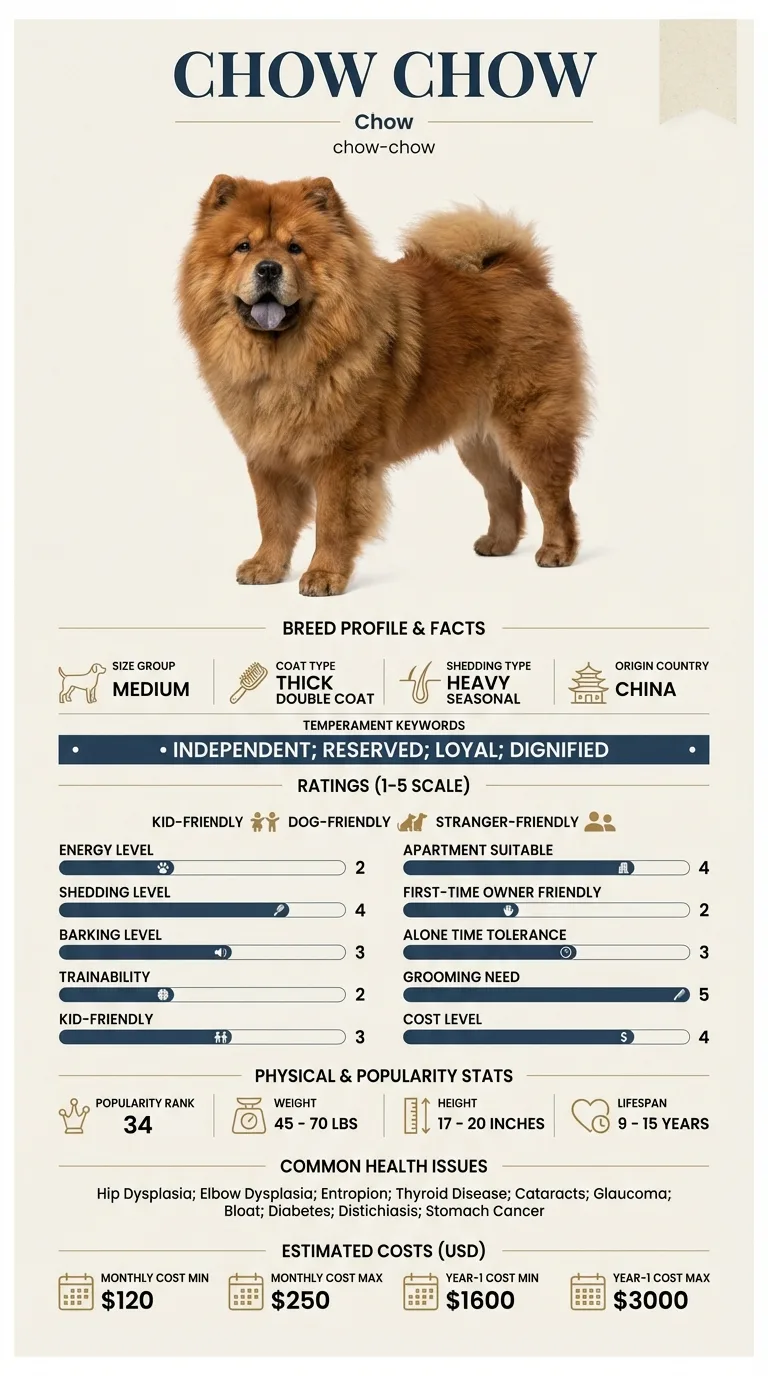
Kidney disease is not on the Chow Chow's documented health list, so it should be understood as an age-related condition rather than a breed-inherited one. It becomes progressively more likely across the second half of a nine to fifteen year lifespan, which is why senior blood and urine testing is where it is usually found.
The kidney itself is not a Chow-specific weak point, and there is no inherited nephropathy on the breed's documented list. What the breed changes is the margin for error. A dense double coat and shortened muzzle produce heavy, inefficient panting in warm conditions, which adds a second route of water loss on top of dilute urine. The breed's reserved nature also delays recognition, because a Chow that is quietly nauseous and off his food is behaving much as a dignified, independent dog behaves anyway. Documented diabetes provides an indirect route, as sustained high blood glucose is hard on the kidneys.
Access to water throughout the day is the biggest modifiable factor, and it fails in predictable ways: one bowl in one room, water left standing all day, or a dog shut in a room without any. Climate matters for the same reason heat does. Toxins account for a meaningful share of acute kidney injury, and antifreeze in garages and driveways is the most dangerous of them. Long gaps between veterinary visits remove the only realistic detection route, since this disease produces no early signs to prompt one.
Seek same-day care for repeated vomiting, complete refusal of food, marked lethargy or unsteadiness, no urine produced at all, or any suspicion your dog has swallowed antifreeze, grapes, raisins or human anti-inflammatory medication, since acute kidney injury is sometimes reversible if treated within hours. Book a prompt appointment for increased drinking and urinating, overnight accidents in a previously clean dog, unexplained weight loss, reduced appetite, or unusually foul breath. Ask specifically for a urine specific gravity and a urine protein check alongside blood, and ask for blood pressure to be measured at the same visit. Never give human painkillers to a dog with any suspicion of kidney disease.
See all Chow Chow health problems, which breeds are prone to kidney disease, or the full Chow Chow breed guide for temperament, exercise needs and ownership costs.
Chronic kidney disease progresses over months to years, and many dogs diagnosed at an early stage live well for a long time. Expect rechecks every three to six months while stable, and more often after any change in stage or medication. Diet transitions should take two to three weeks to avoid food refusal.
Success is slowing progression and keeping the dog comfortable: stable weight, normal appetite, controlled blood pressure, and staging numbers that hold rather than climb. It is not normal kidney values, and expecting those leads to disappointment at every recheck.
Owners often assume a blood test either shows kidney disease or does not. In reality there is a sequence, and the earlier tests are the cheaper ones.
A dog with reduced kidney function loses more water in urine than a healthy one and depends on drinking to stay in balance. That balance is harder to hold in a Chow Chow than in most breeds, because the same dog is also losing water through heavy panting whenever it is warm. A thick double coat and a shortened muzzle mean a Chow pants more, and pants less efficiently, than a short-coated dog of the same size. Two water losses run at once.
The practical consequence is that dehydration arrives faster and with less warning. A summer afternoon that would mildly inconvenience a healthy Chow can push one with kidney disease into a crisis, and the recovery involves intravenous fluids rather than a bowl of water.
The response is not to force water but to make drinking easy and frequent. Multiple bowls in different rooms, water refreshed often because dogs drink more from clean water, wet food rather than dry where your vet agrees, and a strictly cool-hours-only exercise routine all do more than any single intervention. Some owners are taught to give fluids under the skin at home, and where a vet has trained you in that, it is one of the most effective things available.

If you think your Chow has kidney disease, the plan is three steps: write down what you have seen and when it started, book a veterinary appointment rather than waiting for the next flare, and take video of the behaviour or symptom before you go — the thing you are worried about rarely happens in the consulting room. Screening in the parents covers hip dysplasia, elbow dysplasia, entropion.
What the vet visit should produce is a diagnosis and a written plan, not just reassurance: what is being ruled out, what the monitoring interval is, and which signs mean you come back sooner. Ask what the treatment costs across a year rather than per visit, because that is the number that decides whether you are managing this condition or reacting to it.
Between appointments, keep a short log — dates, what you saw, what changed. It is the single most useful thing an owner brings to a follow-up, and for kidney disease it is often what separates a clear pattern from a guess.
Nima's owner Beatriz booked a dental because of bad breath. She assumed tartar. The pre-anesthetic blood and urine panel showed mildly raised markers and, more tellingly, urine that was barely more concentrated than water. The dental went ahead under a modified protocol with intravenous fluids. The kidney finding changed Nima's life more than the teeth did. She moved onto a renal diet over three weeks, gained two more water bowls, and her walks moved permanently to before sunrise. Three years later Nima is twelve and still in the same stage she was diagnosed in. Beatriz measures her water intake on the first Sunday of every month and brings the number to every recheck.
Key takeaway: This disease is usually found by a test rather than by a symptom. The bad breath was real, but it was the urine sample that mattered.
It is not among the ten documented health issues for the breed, so it is not an inherited breed expectation. It is a common condition of older dogs generally, and in a breed that lives nine to fifteen years there is plenty of time for it to develop.
Drinking more and urinating more, sometimes with accidents overnight in a previously clean dog. Later come reduced appetite, weight loss, nausea, bad breath with an unusual chemical smell, and lethargy. All of these appear well after the disease has begun.
Therapeutic renal diets are one of the few interventions with genuine evidence behind them in dogs with established kidney disease, mainly through controlled phosphorus and adjusted protein. They only work if the dog eats them, which is a real problem in a breed that can be particular, so transition slowly and involve your vet if intake drops.
Never. Increased drinking in kidney disease is compensation for water lost in urine, and restricting it causes dehydration rather than reducing urination. If the urinating is unmanageable, the answer is more toilet opportunities, not less water.
Staging groups dogs by kidney function using blood markers, then substages by urine protein and blood pressure. It matters because treatment recommendations differ by stage, and because it gives you a reference point to measure the next set of results against.
Chronic kidney disease cannot be reversed, because lost nephrons do not regenerate. Acute kidney injury, from a toxin or an infection, sometimes can be if treated fast. That distinction changes everything about urgency, which is why sudden severe signs need same-day attention.
A urine specific gravity check, which detects failing concentration before blood values change. Ask whether the blood panel also includes SDMA.
No, never. The extra drinking replaces water lost in urine. Restricting it causes dehydration. Provide more toilet breaks instead.
A double-coated, shortened-muzzle breed loses substantial water through panting, on top of the water already lost in dilute urine. Dehydration arrives faster.
Discuss annual senior panels from around seven years, and every six months once any abnormality appears. Early detection is entirely a testing question.
A one-page prep sheet for this condition: the signs, the questions to ask, what to get priced. Unlocks here.
You get: Vet visit prep sheet
No spam. One-click unsubscribe. See our privacy policy.
Preview page 1 before you decide.