Living
How often should I check my Chow Chow's eyes?
Weekly is reasonable for a dog with heavy facial fur, and daily if he is already recovering from an eye issue.

Quick answer
How often should I check my Chow Chow's eyes?
Weekly is reasonable for a dog with heavy facial fur, and daily if he is already recovering from an eye issue.
A Chow's brow, cheeks and heavy coat frame the eyes so thoroughly that early redness, cloudiness or discharge can be missed for weeks, and owners often first notice a problem once it is already advanced.
Owners of a heavily coated Chow who groom infrequently, and anyone assuming that because the eyes look fine at a glance, nothing is wrong underneath the fur.
This guide is not medical advice. If your dog shows pain, sudden behavior change, or worsening symptoms, consult a licensed veterinarian.
Some links may be affiliate links. We may earn a commission at no extra cost to you. We only suggest products we believe are helpful for dog owners.
Chow Chow eye disorders are less one condition than a cluster: documented cataracts, plus commonly reported eyelid and eyelash abnormalities, plus the corneal damage either can cause. The practical challenge in this breed is not diagnosis, which a vet handles readily, but noticing anything is wrong in the first place through a face framed by heavy fur.
Cataracts are specifically documented in the breed. Eyelid and eyelash abnormalities are frequently reported by owners and groomers dealing with heavily coated, deep-set-eyed dogs, though exact rates vary and are not centrally tracked.
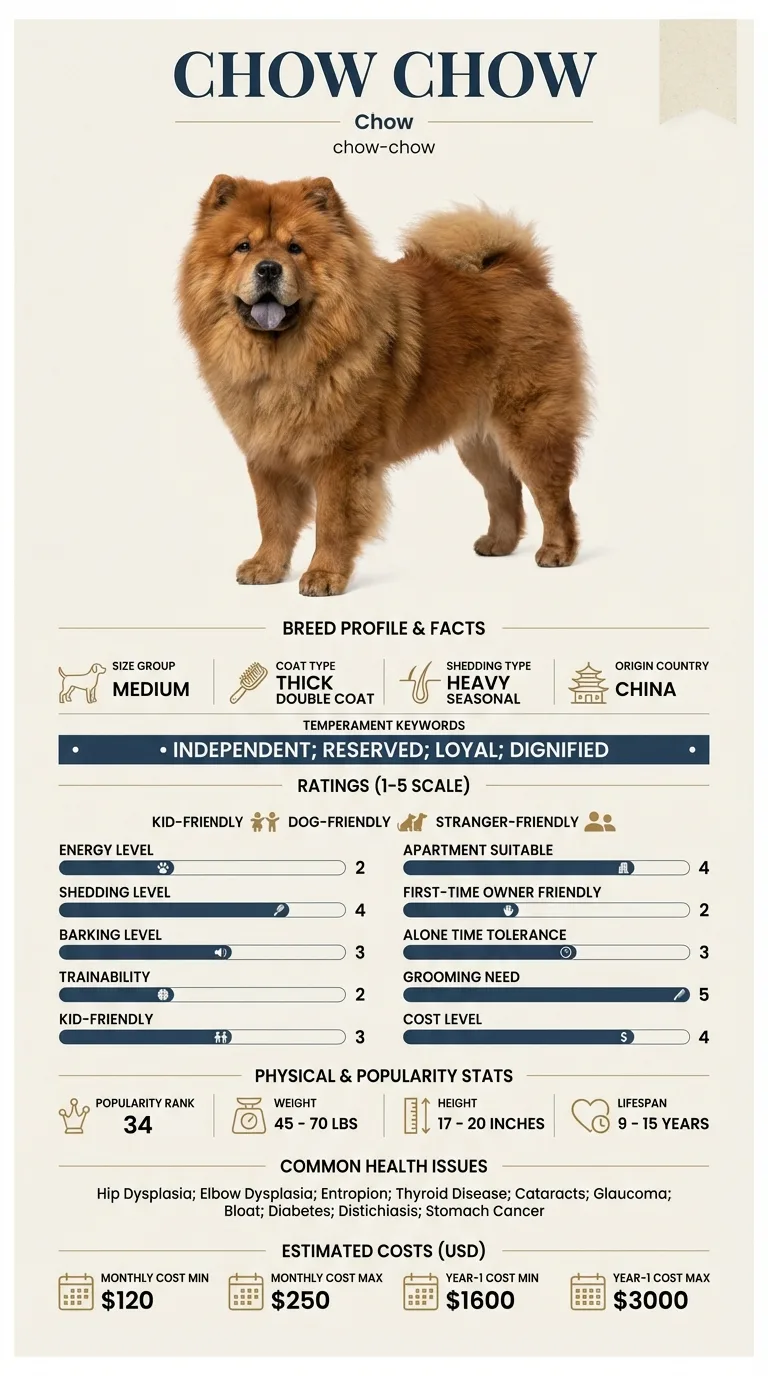
The Chow's eye conformation is small and deep-set, framed by a broad, wrinkled brow, and the coat around the face is rated 5 out of 5 for grooming demand. None of that fur causes cataracts, entropion or distichiasis directly, but together they create a face where early visual signs of any eye problem are genuinely hard to see without deliberately parting the fur and looking.
Dust, pollen, wind and dry air all irritate an already compromised eye faster than a normal one, and a dog whose lids are already rubbing hair against the cornea has far less margin before ordinary environmental exposure tips into an ulcer.
Call promptly for constant squinting, visible cloudiness that appeared over a day or two, thick or colored discharge, or a lid that looks rolled inward, and treat sudden severe pain, a visibly injured eye, or complete vision loss as same-day emergencies rather than something to monitor.
See all Chow Chow health problems, which breeds are prone to eye disorders, or the full Chow Chow breed guide for temperament, exercise needs and ownership costs.
Lid surgery for entropion or distichiasis typically resolves the irritation within a couple of weeks of healing, while cataract management is longer term and depends on whether surgery is pursued or the dog is managed for reduced vision instead.
Success is catching problems early enough that treatment is a straightforward outpatient procedure rather than an emergency, and an eye that stays comfortable even if some vision is eventually lost.
These are separate conditions with separate causes, but they share symptoms that overlap heavily: squinting, redness, discharge and a cloudy or dull look to the eye. That overlap is exactly why a proper look, not a guess from the couch, matters.
A Chow's brow and cheek fur, paired with a coat rated 5 out of 5 for grooming demand, sits close to the eye and casts shadow across exactly the surface an owner would need to inspect. A dull sheen, mild redness or slight squinting reads as normal in that lighting, especially in a breed already known for small, deep-set eyes that do not show much white.
The fix is not vigilance in general but a specific habit: part the fur and look directly at each eye under good light every week or two, particularly on a dog whose face is rarely trimmed. Compare the two eyes to each other, since asymmetry between them is usually the clearest early sign that something has changed on one side only.

If you think your Chow has eye disorders, the plan is three steps: write down what you have seen and when it started, book a veterinary appointment rather than waiting for the next flare, and take video of the behaviour or symptom before you go — the thing you are worried about rarely happens in the consulting room. Screening in the parents covers hip dysplasia, elbow dysplasia, entropion.
What the vet visit should produce is a diagnosis and a written plan, not just reassurance: what is being ruled out, what the monitoring interval is, and which signs mean you come back sooner. Ask what the treatment costs across a year rather than per visit, because that is the number that decides whether you are managing this condition or reacting to it.
Between appointments, keep a short log — dates, what you saw, what changed. It is the single most useful thing an owner brings to a follow-up, and for eye disorders it is often what separates a clear pattern from a guess.
Suki's owner Colin considered himself attentive, but Suki's thick brow fur made her eyes hard to see without effort he rarely made. A groomer trimming her face for a bath noticed her left eye looked slightly duller than the right and mentioned it in passing. Colin looked closely that evening for the first time in months and saw the lower lid on that side tucked inward, with a faint discharge he had mistaken for normal tear staining. A vet exam found early entropion with a small corneal abrasion starting underneath. A same-week lid surgery and a short course of eye drops resolved it before it became an ulcer requiring more aggressive treatment.
Key takeaway: In a heavily coated breed, someone has to deliberately look past the fur, because the eyes will not announce a problem on their own until it is well underway.
Part the fur around each eye under good light, ideally daylight, and look directly at the surface and lid margins. Compare one eye to the other, since a difference between them is often the first real clue.
The lower or upper lid rolls inward so the edge and its hair touch the eyeball. Look for constant squinting, tearing, or a lid margin that appears tucked in rather than sitting flush against the eye.
No. Entropion is the lid margin rolling inward. Distichiasis is extra eyelashes emerging from an abnormal spot on the lid itself. Both end up rubbing hair against the cornea, but the underlying structure at fault is different.
Cataracts are documented in the breed and often have a genetic component, but age, diabetes and previous eye injury can also produce them, so a vet exam is needed to establish the actual cause in an individual dog.
Treat it as urgent. An ulcer can deepen within a day or two, especially if a lid abnormality keeps irritating it, and delayed treatment raises the risk of scarring or vision loss.
Not entirely, since several have a genetic basis, but regular checks catch lid problems and ulcers early enough that surgery or treatment is far simpler than waiting for an advanced case.
Indirectly. The coat and facial fur do not cause the underlying disorders, but they delay detection, which is often what turns a manageable early problem into a harder, more expensive one.
Weekly is reasonable for a dog with heavy facial fur, and daily if he is already recovering from an eye issue.
Squinting that will not stop, visible cloudiness that appeared suddenly, or a discharge that is thick, colored or heavy.
Entropion correction commonly runs several hundred to over a thousand dollars depending on how many lids are involved and the clinic.
Some do, but many just squint or hold the eye partly closed, which is easy to miss without a direct look.
Light trimming with blunt-tip scissors well away from the eye is usually fine, but leave anything close to the lid margin to a groomer or vet.
A one-page prep sheet for this condition: the signs, the questions to ask, what to get priced. Unlocks here.
You get: Vet visit prep sheet
No spam. One-click unsubscribe. See our privacy policy.
Preview page 1 before you decide.