Health
My Chow is straining and producing no urine. What should I do?
Go to a vet immediately. A blocked urethra is life-threatening within hours, and straining with no result is not constipation until a vet says so.

Quick answer
My Chow is straining and producing no urine. What should I do?
Go to a vet immediately. A blocked urethra is life-threatening within hours, and straining with no result is not constipation until a vet says so.
Two stones can look identical on an X-ray and need entirely different treatment, because what a stone is made of decides whether it can be dissolved or must be removed.
Owners whose Chow has been straining, dribbling or passing bloody urine, and owners of a dog who has already had one stone removed and want to prevent the next.
This guide is not medical advice. If your dog shows pain, sudden behavior change, or worsening symptoms, consult a licensed veterinarian.
Some links may be affiliate links. We may earn a commission at no extra cost to you. We only suggest products we believe are helpful for dog owners.
Check this first
Male dogs have a long, narrow urethra that passes through the os penis, a small bone, and that point is where stones lodge. A stone that would have passed harmlessly in a female dog can block a male completely. When that happens, urine cannot leave the body, pressure backs up into the kidneys, and potassium rises in the bloodstream to levels that stop the heart. Dogs die from this, and they die within a day or so of complete obstruction.
What you will see is a dog straining repeatedly in the garden and producing nothing, or producing a few drops. Owners very commonly read this as constipation, because the posture looks similar and because a Chow straining in long grass is hard to observe. A dog straining to urinate without result is an emergency, and the correct action is to go now rather than to wait and see whether he manages later.
One breed detail makes this harder. A Chow Chow's dense coat and reserved manner mean owners often do not watch closely while the dog toilets, and blood in urine can go unnoticed on grass. If your dog has a history of stones, watching him urinate and confirming a normal stream becomes part of the daily routine rather than an intrusion.
If any of these apply, call your vet or an emergency clinic now. The rest of this page is for the cases that are not an emergency.
Urinary stones form when minerals dissolved in urine come out of solution and crystallise, then aggregate. They may sit silently in a kidney, irritate the bladder wall, or block the urethra. Treatment depends almost entirely on chemical composition, and prevention depends on keeping urine dilute and correcting whatever allowed the crystals to form.
Stones are not listed among the Chow Chow's ten documented health issues, so this is a general canine problem rather than a breed hallmark. Recurrence, however, is common in any dog that has formed one stone, which is why prevention planning matters more than the first episode suggests.
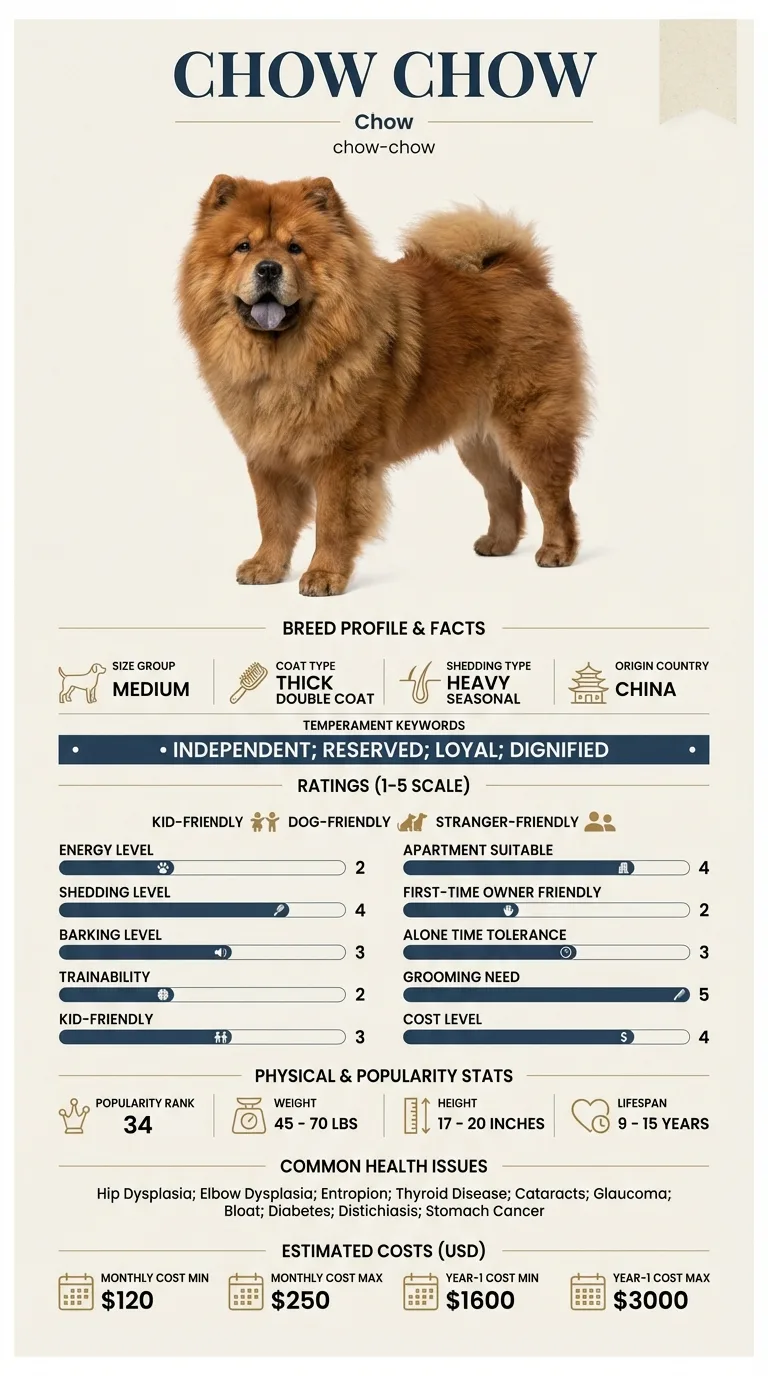
The Chow contributes no known stone-forming chemistry, but it contributes concealment and hydration risk. A reserved, dignified dog rated 2 out of 5 for stranger friendliness is not a dog most owners stand and watch while it toilets, so straining, dribbling and blood are noticed late. A dense double coat hides staining and hides the perineum entirely. And heat intolerance is relevant, because a breed that pants heavily through a heavy coat loses water and produces more concentrated urine on exactly the days it is least likely to be observed closely outdoors.
Water availability and toilet frequency do most of the work. A dog with one bowl, or one that is left many hours between opportunities to urinate, holds concentrated urine in the bladder for longer, which is the condition crystals need. Dry-food-only feeding lowers total water intake substantially compared with wet diets. Warm climates increase evaporative loss. Owner-directed diet changes intended to help, including home-prepared recipes and unsupervised supplements, can shift urine chemistry in the wrong direction.
This is a condition with a genuine emergency at one end. Go immediately for a dog straining repeatedly with little or no urine produced, crying out while trying to urinate, a tense or painful abdomen, vomiting alongside straining, or collapse. In a male dog these signs suggest urethral obstruction, which causes kidney failure and dangerous potassium rises within hours and is fatal if untreated. Do not assume constipation. Book a prompt appointment for blood in urine, increased frequency with small volumes, licking at the genitals, accidents in a house-trained dog, or a foul-smelling urine odour. Ask for a urine sample to be cultured rather than just examined, since infection drives struvite formation and needs treating properly.
See all Chow Chow health problems, which breeds are prone to kidney stones, or the full Chow Chow breed guide for temperament, exercise needs and ownership costs.
Dissolution of struvite stones, where appropriate, typically takes four to twelve weeks with repeated imaging to confirm progress. Surgical removal involves a hospital stay of one to two days and roughly two weeks of restricted activity. Prevention is permanent, and recurrence checks with urine tests and imaging usually continue every three to six months for the first year.
Success is a dog with a known stone type, a diet matched to it, urine that stays dilute, and imaging that stays clear at each recheck. Given how often stones recur, a year without a new one is a real result rather than a modest one.
The only reliable way to know which one you are dealing with is laboratory analysis of the actual stone. Guessing from an X-ray leads to prevention plans aimed at the wrong chemistry.
Duke was seven and had been squatting repeatedly in the garden all Saturday afternoon. His owner Tam thought he was constipated, gave him a spoonful of pumpkin, and planned to call the vet on Monday. By nine that evening Duke was restless, would not settle, and his belly felt tight. Tam went to the emergency clinic mostly out of guilt. Duke's bladder was distended and he was completely obstructed by a small stone lodged at the os penis. His potassium was already high enough to affect his heart rhythm. He was catheterised, stabilised overnight and had the stone removed two days later. Analysis came back as calcium oxalate, so dissolution was never going to have been an option. Duke now eats wet food, drinks from three bowls, and Tam watches him urinate every morning.
Key takeaway: Straining with nothing produced is a urinary emergency until proven otherwise. In a male dog, the difference between Saturday night and Monday morning is the difference between a stone and a funeral.
Urolithiasis is not among the ten documented health issues for the breed. Stones occur across many breeds and are driven mainly by urine chemistry, infection and hydration rather than by Chow-specific anatomy, though some breeds do carry recognised genetic predispositions to particular stone types.
Struvite stones often can, using a therapeutic diet alongside treatment of the underlying infection, and that can take several weeks of careful monitoring. Calcium oxalate cannot be dissolved. This is why identifying the type is the first question rather than a technicality.
It means the urinary tract is irritated, inflamed or injured, and stones are one of several possible causes alongside infection, inflammation and tumours. It always warrants a urine sample and an examination, and it is more urgent if accompanied by straining.
Dilute urine keeps stone-forming minerals in solution instead of allowing crystals to form. Increasing water intake, often by feeding wet food, is the single most broadly useful prevention strategy across almost every stone type.
Because prevention differs completely by type, and a stone that is removed and discarded takes that information with it. Ask before surgery that the stone be submitted, since it is easy to arrange in advance and impossible afterwards.
Females get stones just as readily, but their shorter and wider urethra means complete obstruction is much less likely. The emergency risk is dramatically lower; the underlying stone problem is not.
The early signs are set out in the sections above, and they are the reason to book a veterinary appointment rather than wait. Kidney Stones in Chows is diagnosed by a vet, not from a symptom list, and the sooner it is on record the more options remain open.
Go to a vet immediately. A blocked urethra is life-threatening within hours, and straining with no result is not constipation until a vet says so.
No. Struvite often dissolves with diet and infection treatment. Calcium oxalate never does and must be removed physically.
Dilute urine. More water intake, often through wet food, plus a diet matched to the analysed stone type.
Yes. The male urethra is long and narrow and passes through a bone, so stones lodge there. Females pass the same stones far more easily.
A one-page prep sheet for this condition: the signs, the questions to ask, what to get priced. Unlocks here.
You get: Vet visit prep sheet
No spam. One-click unsubscribe. See our privacy policy.
Preview page 1 before you decide.