Health
What are the signs of diabetes in a Chihuahua?
Drinking and urinating far more, a good or increased appetite, and weight loss anyway. Sudden cloudy eyes over weeks is another key sign.

Quick answer
What are the signs of diabetes in a Chihuahua?
Drinking and urinating far more, a good or increased appetite, and weight loss anyway. Sudden cloudy eyes over weeks is another key sign.
A dog this size may need a fraction of a unit of insulin. There is a real difference between drawing up one unit and drawing up one and a half, and on a two-to-six-pound patient that difference is not trivial.
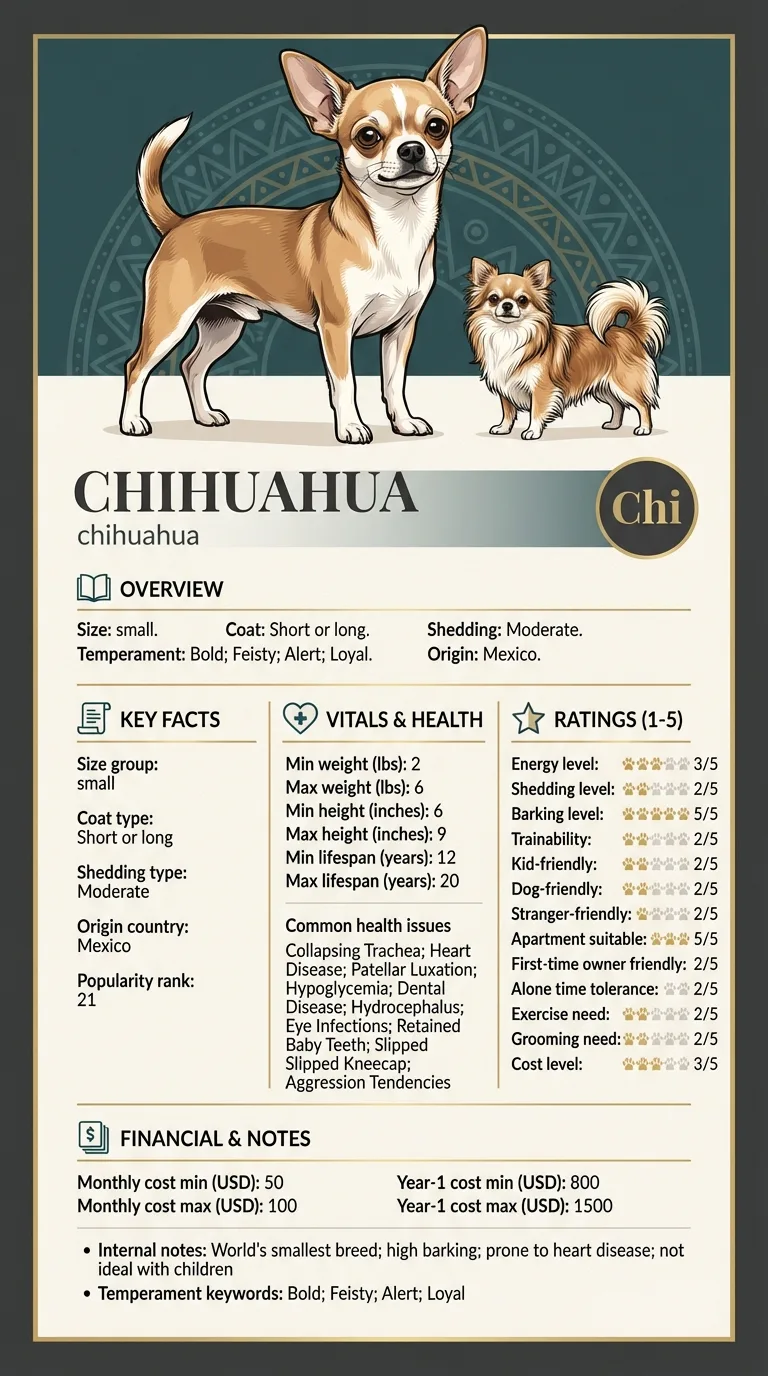
Owners of a Chihuahua newly diagnosed with diabetes who are trying to work out whether they can realistically manage it, and owners who have noticed a dog drinking far more than usual while losing weight on an unchanged diet.
This guide is not medical advice. If your dog shows pain, sudden behavior change, or worsening symptoms, consult a licensed veterinarian.
Some links may be affiliate links. We may earn a commission at no extra cost to you. We only suggest products we believe are helpful for dog owners.
We research and check what we publish, but we do not warrant that any figure, date, price, or statement is accurate, complete, or current, and we accept no liability for any loss, cost, injury, or other harm arising from the use of this site. Use it as one reference among several. You remain responsible for your own decisions and for your dog's care - confirm anything that matters with a licensed veterinarian or another qualified professional before you act on it. Full disclaimer.
Diabetes mellitus in dogs is usually a failure of insulin production, so glucose cannot enter cells and accumulates in the blood. Dogs drink and urinate excessively, eat well and lose weight, and often develop cataracts. Treatment is lifelong injected insulin combined with consistent feeding and monitoring. In a Chihuahua the added complication is that low blood sugar is already a documented breed problem, so the principal risk of the treatment overlaps with a vulnerability the dog already has.
Diabetes is not among the Chihuahua's documented health problems and other breeds carry stronger associations with it. Where it does occur it is usually in middle-aged to older dogs, with unspayed females over-represented. Because this breed commonly lives twelve to twenty years, a Chihuahua diagnosed at nine may face many years of management, which makes the sustainability of the routine a real consideration.
The Chihuahua does not carry a documented predisposition to diabetes, and inventing one would be dishonest. What it carries instead is a set of features that make the disease harder to manage. Hypoglycemia is explicitly on the breed's health list, reflecting a small liver with a small glycogen reserve in a two-to-six-pound body, which means the dog has less buffer against the main side effect of insulin. Insulin doses for a patient this size may be fractions of a unit, so measurement error carries proportionally more weight. Weight fluctuations of a few ounces, which would be invisible in a Labrador, meaningfully change insulin requirements here. And a breed that may live twenty years faces a very long management horizon.
Routine is the main environmental variable, and it is largely within an owner's control. Injections at consistent twelve-hour intervals with food given first produce predictable glucose behaviour; irregular timing produces the opposite. Uncontrolled treats and table scraps destabilise control disproportionately in a dog eating half a cup a day, so a household that cannot resist a persistent toy-breed beggar will struggle. Reproductive status matters for intact females. And an environment where nobody has been taught to recognise a hypoglycemic wobble is one where an emergency gets noticed late.
Go to an emergency clinic immediately for collapse, seizures, profound weakness, or a dog that cannot be roused, all of which may indicate severely low blood sugar. Go the same day for repeated vomiting, refusal to eat, laboured or unusually deep breathing, or breath with a sweet acetone smell, since those can signal a diabetic crisis. Call promptly if your dog has had insulin and then refused its food, if you are unsure whether a dose was given twice, or if drinking has increased again after a period of good control. Book routinely to discuss spaying if your diabetic dog is an intact female.
See all Chihuahua health problems, which breeds are prone to diabetes, or the full Chihuahua breed guide for temperament, exercise needs and ownership costs.
Finding a workable insulin dose usually takes several weeks of adjustment and repeated glucose curves, and it is normal for the first dose not to be the final one. Excessive drinking and urination typically improve within the first couple of weeks of adequate treatment. Weight generally stabilises over a month or two. Cataracts may develop regardless of good control and can do so over weeks. Beyond that, this is lifelong management with rechecks every three to six months, not a condition with an end date.
Success is a stable dog rather than a perfect blood glucose reading. That means normal drinking, a stable weight, a good appetite, no hypoglycemic episodes and a routine the household can genuinely sustain for years. Chasing textbook glucose numbers at the cost of frequent low episodes is the wrong trade in this breed particularly, and most vets managing a diabetic Chihuahua will deliberately aim for safe rather than ideal.
Hypoglycemia appears on the Chihuahua's documented health list, and it does so for a structural reason: a very small dog has a very small liver, and therefore a very small store of glycogen to release between meals. Toy breeds run closer to the edge than large dogs do.
That baseline matters enormously once insulin enters the picture, because the main risk of insulin treatment is exactly the same thing: blood sugar falling too low. So a diabetic Chihuahua is a dog with a pre-existing tendency towards hypoglycemia being given a drug whose principal danger is hypoglycemia. The two do not cancel out; they stack.
The practical consequences shape the whole management plan. Meals and injections have to be genuinely reliable, because a dog that receives insulin and then declines its food is in a dangerous position within hours. A missed meal in a healthy Chihuahua is a minor matter; in an insulin-treated one it is a call to the vet.
Owners of diabetic Chihuahuas should know the signs of a hypoglycemic episode cold: wobbling, glassy or vacant staring, weakness, trembling that is not cold-related, disorientation, and in severe cases collapse or seizures. They should also know, from their own vet and in writing, exactly what to do first if it happens, because that instruction should exist before three in the morning rather than after.

Before deciding whether this is manageable for your household, it helps to see the shape of an ordinary day rather than the summary version.
If you think your Chi has diabetes, the plan is three steps: write down what you have seen and when it started, book a veterinary appointment rather than waiting for the next flare, and take video of the behaviour or symptom before you go — the thing you are worried about rarely happens in the consulting room. Screening in the parents covers collapsing trachea, heart disease, patellar luxation.
What the vet visit should produce is a diagnosis and a written plan, not just reassurance: what is being ruled out, what the monitoring interval is, and which signs mean you come back sooner. Ask what the treatment costs across a year rather than per visit, because that is the number that decides whether you are managing this condition or reacting to it.
Between appointments, keep a short log — dates, what you saw, what changed. It is the single most useful thing an owner brings to a follow-up, and for diabetes it is often what separates a clear pattern from a guess.
Yusuf's eleven-year-old Chihuahua Sombra was diagnosed after three months of drinking so much that Yusuf had started refilling her bowl twice a day. She had lost seven ounces, which on a 5-pound dog he had not noticed until she was weighed. The first month was harder than the diagnosis. Sombra's dose was tiny and needed a specific syringe type, and the practice went through it with him twice before he was confident. Two glucose curves later they settled on a dose that worked. The change that made the difference was mundane. Yusuf set two repeating phone alarms, seven in the morning and seven in the evening, and made a rule that Sombra ate before each injection and that nobody in the house gave her anything else at all. His teenage son had been slipping her crusts, which on a dog eating half a cup a day had been quietly wrecking the numbers. Sombra is fourteen now. She developed cataracts in her second year of treatment and navigates the flat perfectly well.
Key takeaway: The medical part was solved in a month; the household part took longer. In a dog this small, an unrecorded crust from a family member is not a rounding error, and consistency beats precision every time.
Diabetes is not among the Chihuahua's documented health problems, and other breeds are more strongly associated with it. It does occur, generally in middle-aged to older dogs and more often in females that have not been spayed. What the breed does bring is a documented tendency towards low blood sugar, which makes insulin treatment a narrower balancing act than in a large dog.
The classic pattern is drinking noticeably more, urinating more, eating well or even ravenously, and losing weight anyway. In a two-to-six-pound dog a few ounces lost is proportionally substantial, so monthly weighing catches it early. Sudden cloudiness in both eyes over weeks is another significant sign, since high blood sugar can produce rapid cataracts.
High blood glucose drives sugar into the lens, where it draws water in and disrupts the lens fibres, producing cataracts that can develop over weeks rather than years. It is one of the most common complications of canine diabetes and can occur even in dogs whose glucose is reasonably controlled. Cataract surgery may be an option, and that is a conversation for a veterinary ophthalmologist.
In dogs, generally no. Canine diabetes is usually an insulin deficiency rather than the insulin resistance seen in many human and feline cases, so injected insulin is nearly always required. Diet plays an important supporting role, with consistent timing and composition making the insulin dose predictable, but it is not an alternative to treatment.
It can matter a great deal. Hormonal changes in an unspayed female during the phase after a season antagonise insulin and can precipitate or destabilise diabetes, and in some dogs spaying substantially improves control. Where an intact female is diagnosed, spaying is usually recommended as part of the treatment plan rather than as a separate matter.
For many people yes, though it is a genuine commitment rather than a minor addition to a routine. It means twice-daily injections at consistent times, reliable feeding, periodic monitoring and the ability to recognise a hypoglycemic episode. Households that travel unpredictably or cannot guarantee twelve-hour dosing intervals should discuss that honestly with their vet at the start.
Drinking and urinating far more, a good or increased appetite, and weight loss anyway. Sudden cloudy eyes over weeks is another key sign.
Because low blood sugar is already on this breed's health list, and hypoglycemia is also the main danger of insulin. The two risks stack.
Wobbling, vacant staring, trembling, weakness, disorientation, and in severe cases collapse or seizures. Have a written emergency plan from your vet in advance.
Almost never. Dogs are usually insulin-deficient and need injections. Diet makes the dose predictable rather than replacing it.
Insulin, syringes, a prescription diet, monitoring supplies and regular rechecks with bloodwork. It is a significant lifelong recurring cost.
A one-page prep sheet for this condition: the signs, the questions to ask, what to get priced. Unlocks here.
You get: Vet visit prep sheet
No spam. One-click unsubscribe. See our privacy policy.
Preview page 1 before you decide.