Health
Is a cloudy eye in an old Chihuahua serious?
Often not. A blue-grey haze is normal age change in the lens. A dense white opacity that hides the back of the eye is a true cataract.

Quick answer
Is a cloudy eye in an old Chihuahua serious?
Often not. A blue-grey haze is normal age change in the lens. A dense white opacity that hides the back of the eye is a true cataract.
Most owners who arrive worried about cataracts in an older Chihuahua are actually looking at something else: a bluish haze that appears in every ageing dog's lens and barely affects sight at all.
Owners of an older Chihuahua whose eyes have gone cloudy and who want to know whether the dog can still see, and owners of a dog already losing vision who need practical advice for a house designed by and for people.
This guide is not medical advice. If your dog shows pain, sudden behavior change, or worsening symptoms, consult a licensed veterinarian.
Some links may be affiliate links. We may earn a commission at no extra cost to you. We only suggest products we believe are helpful for dog owners.
We research and check what we publish, but we do not warrant that any figure, date, price, or statement is accurate, complete, or current, and we accept no liability for any loss, cost, injury, or other harm arising from the use of this site. Use it as one reference among several. You remain responsible for your own decisions and for your dog's care - confirm anything that matters with a licensed veterinarian or another qualified professional before you act on it. Full disclaimer.
A cataract is any loss of transparency in the lens of the eye, ranging from a speck that never matters to a dense white opacity that blocks sight entirely. It is commonly confused with nuclear sclerosis, the harmless blue-grey haze of ageing that nearly all older dogs develop. True cataracts progress, and as they mature they can leak protein and cause painful inflammation inside the eye, so they warrant monitoring even when surgery is not chosen.
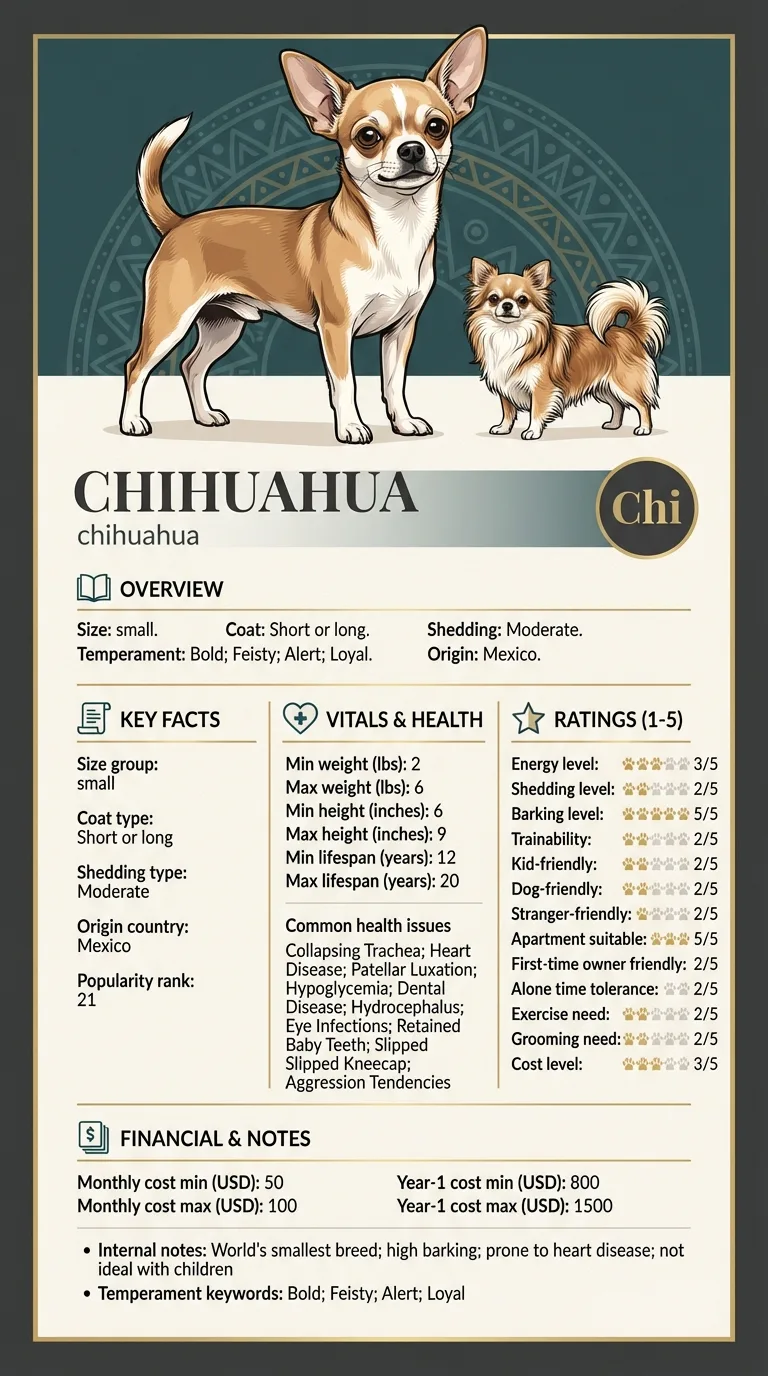
Cloudy eyes are almost universal in older Chihuahuas, though most of that cloudiness is age-related sclerosis rather than cataract. Eye problems generally are documented among this breed's common health issues, largely because a shortened face means shallower orbits and a more exposed eye. Because the breed commonly lives twelve to twenty years, lens change of some kind is close to inevitable in a dog that reaches its teens.
Two Chihuahua characteristics feed into this. The first is longevity: a breed that commonly reaches sixteen has many more years of lens ageing than a dog living to nine, so cloudy lenses are simply more likely to be seen. The second is orbital anatomy. The shortened muzzle of the apple-headed type produces shallow eye sockets and a prominent globe with a larger exposed surface, and eye infections already appear on the breed's documented health list. A more exposed eye is more prone to injury and to inflammation, and inflammation inside the eye is one of the routes to cataract formation. Inherited cataract also exists across many breeds and cannot be ruled out in a young Chihuahua.
The relevant environmental factors are about protection and about what happens after vision is lost. Rough play with substantially larger dogs, dense undergrowth on walks and household hazards at eye height all threaten a poorly protected globe. Once sight begins to fail, the environment becomes the treatment: a stable, unchanged layout supports a dog navigating from memory, while frequently rearranged furniture, moved bowls and the constant carrying that this breed receives all destroy the spatial map a blind dog is relying on.
Go the same day for a painful eye: squinting, holding the eye shut, obvious redness, rubbing the face on furniture, or a sudden change in the appearance of one eye. Pain in a cloudy eye can mean lens-induced inflammation or glaucoma, and glaucoma damages sight within hours. Book promptly for cloudiness that has developed over weeks rather than years, especially in both eyes and especially in a middle-aged dog, since that pattern warrants a blood glucose test. Book routinely for gradual haze in an older dog, simply to have it identified correctly rather than assumed.
See all Chihuahua health problems, which breeds are prone to cataracts, or the full Chihuahua breed guide for temperament, exercise needs and ownership costs.
Nuclear sclerosis develops gradually from about seven onwards and never needs treatment. True cataracts vary enormously: some remain static for years, while diabetic cataracts can render a dog blind within weeks. Where surgery is performed, vision is usually restored quickly but requires an intensive drop schedule for weeks and long-term monitoring. Dogs adapting to blindness typically look lost for two to four weeks and then navigate a stable house with surprising confidence.
Success for a mildly cloudy older Chihuahua is knowing it is age change and doing nothing. Success for a dog with genuine cataracts is either surgical restoration where that is appropriate, or a comfortable, monitored eye that never becomes painful. And success for a blind Chihuahua is a dog that walks confidently to its bowl in a house that has not moved, which is achieved by the household changing its habits rather than by anything done to the dog.
Almost every dog over about seven develops nuclear sclerosis, a normal age change in which the lens fibres compact and the centre takes on a faint blue-grey haze. It looks alarming and it is not a disease. Vision is largely preserved, particularly for distance and movement, and no treatment exists or is needed.
A true cataract looks different. It is white rather than blue-grey, it is opaque rather than hazy, and it obscures the structures behind it. Shine a torch obliquely into the eye: with nuclear sclerosis you can still make out the dark tapetal reflection behind the haze, while a dense cataract blocks it. In practice this distinction is made properly with an ophthalmoscope, so the honest answer is that a vet can tell in thirty seconds and an owner often cannot.
The reason the difference matters is that one requires nothing and the other requires attention. Cataracts do not simply sit there. As they mature, lens proteins can leak and provoke inflammation inside the eye, and that inflammation is painful and can lead to glaucoma or retinal detachment. A neglected mature cataract is not just a vision problem.
One more distinction worth knowing: cataracts that appear rapidly in both eyes of a middle-aged dog raise the possibility of diabetes, since high blood sugar draws water into the lens. That is a systemic finding hiding in an eye, and it is worth a blood test.

Dogs adapt to gradual blindness far better than people expect, because they navigate on a memorised map plus scent. The job is to keep the map accurate, and there is one habit peculiar to this breed that undermines it.
If you think your Chi has cataracts, the plan is three steps: write down what you have seen and when it started, book a veterinary appointment rather than waiting for the next flare, and take video of the behaviour or symptom before you go — the thing you are worried about rarely happens in the consulting room. Screening in the parents covers collapsing trachea, heart disease, patellar luxation.
What the vet visit should produce is a diagnosis and a written plan, not just reassurance: what is being ruled out, what the monitoring interval is, and which signs mean you come back sooner. Ask what the treatment costs across a year rather than per visit, because that is the number that decides whether you are managing this condition or reacting to it.
Between appointments, keep a short log — dates, what you saw, what changed. It is the single most useful thing an owner brings to a follow-up, and for cataracts it is often what separates a clear pattern from a guess.
Osita is a fourteen-year-old Chihuahua in Vancouver whose owner Lorne noticed she had begun bumping into things. Her eyes had been faintly cloudy for years and he had assumed it was ordinary age. This time it was a dense cataract in one eye and a maturing one in the other. Surgery was discussed and declined, on grounds of her age and Lorne's honest assessment that he could not manage drops every two hours. What her ophthalmologist insisted on instead was monitoring, because a maturing cataract can inflame the eye, and that inflammation would be the thing that actually hurt her. The household changes did most of the work. The coffee table stopped being moved for vacuuming. A rubber mat went in front of her water bowl. Most significantly, Lorne stopped scooping her up and depositing her wherever he happened to be going, which he realised had been leaving her stranded in unfamiliar spots several times a day. Within a month she was navigating the ground floor confidently.
Key takeaway: The intervention that helped most cost nothing and was the hardest to accept: putting a much-carried little dog down and letting her find her own way, so that the map in her head stayed accurate.
Probably not. Nuclear sclerosis, a normal blue-grey compacting of the lens with age, affects almost every older dog and is not a disease. A cataract is whiter, more opaque and blocks the view of structures behind it. The two are told apart easily with an ophthalmoscope and poorly by eye, so it is worth an appointment purely to be told which one you are looking at.
The cloudiness itself is not, but the consequences can be. As a cataract matures, lens protein can leak and trigger inflammation inside the eye, which is genuinely painful and can lead to glaucoma or retinal detachment. That is why a mature cataract deserves periodic monitoring by a vet even in an owner who has decided against surgery.
Yes. The lens is removed by ultrasound and usually replaced with an artificial one, and small body size is not itself a barrier. What decides suitability is whether the retina still works, assessed before surgery, plus the dog's general health and its ability to tolerate an intensive schedule of eye drops afterwards. It is specialist surgery with a specialist price.
Rapid development of cataracts in both eyes of a middle-aged dog is a recognised sign of diabetes, because high blood sugar pulls water into the lens and disrupts it. If cloudiness has appeared over weeks rather than years, mention it and ask about a blood glucose test, since the eye may be the first place the underlying disease is visible.
Usually far better than their owners do, especially when sight is lost gradually and the environment stays stable. Dogs rely heavily on scent and on memorised layout, and a Chihuahua that has lived in the same rooms for years already has the map. Most continue eating, playing and walking on a lead with very little apparent distress once the initial weeks have passed.
Inherited cataracts occur across many breeds and can appear in young dogs, so a cataract in a Chihuahua under about six is worth investigating rather than assuming it is age-related. Ask a breeder about eye screening in the parents. In older dogs, age and, less often, diabetes are the more common explanations.
Often not. A blue-grey haze is normal age change in the lens. A dense white opacity that hides the back of the eye is a true cataract.
They need monitoring at minimum, because a maturing cataract can leak protein and cause painful inflammation or glaucoma inside the eye.
Rapid bilateral cataracts in a middle-aged dog can indicate diabetes. Ask for a blood glucose test rather than treating it as an eye issue alone.
Keep furniture, bowls and beds exactly where they are, gate the stairs, use scent markers, and stop carrying the dog to random spots.
It is specialist ophthalmic surgery, priced accordingly, and includes pre-operative retinal testing and an intensive course of post-operative drops.
A one-page prep sheet for this condition: the signs, the questions to ask, what to get priced. Unlocks here.
You get: Vet visit prep sheet
No spam. One-click unsubscribe. See our privacy policy.
Preview page 1 before you decide.