Living
Chihuahua or Saint Bernard for a small apartment?
The Chihuahua, rated very high (5/5) for apartment suitability against the Saint Bernard's very low (1/5).

Quick answer
Chihuahua or Saint Bernard for a small apartment?
The Chihuahua, rated very high (5/5) for apartment suitability against the Saint Bernard's very low (1/5).
Chihuahua or Saint Bernard? On paper they differ most on apartment suitability, and on the scales Saint Bernard is the heavier at 120–180 lbs. Here is how the two compare on everything that shapes an ordinary week.
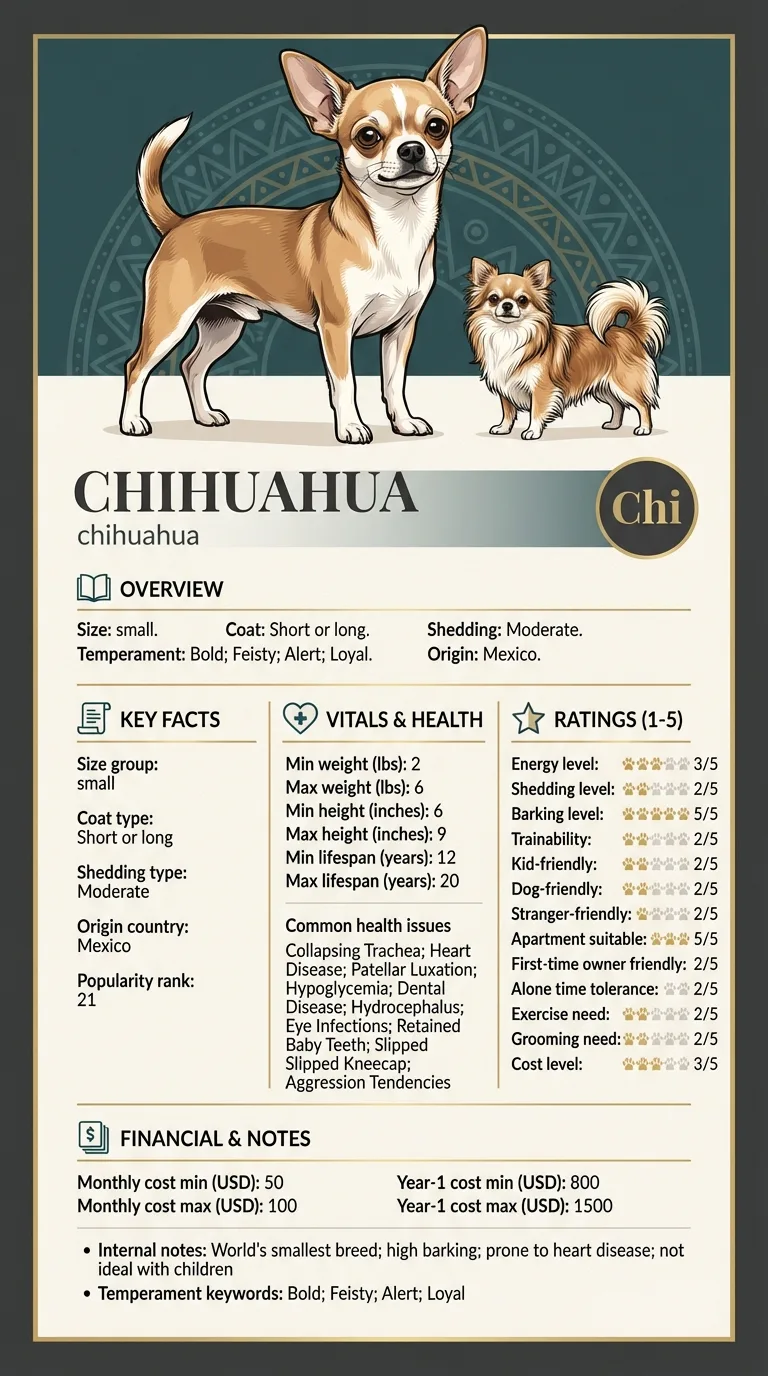
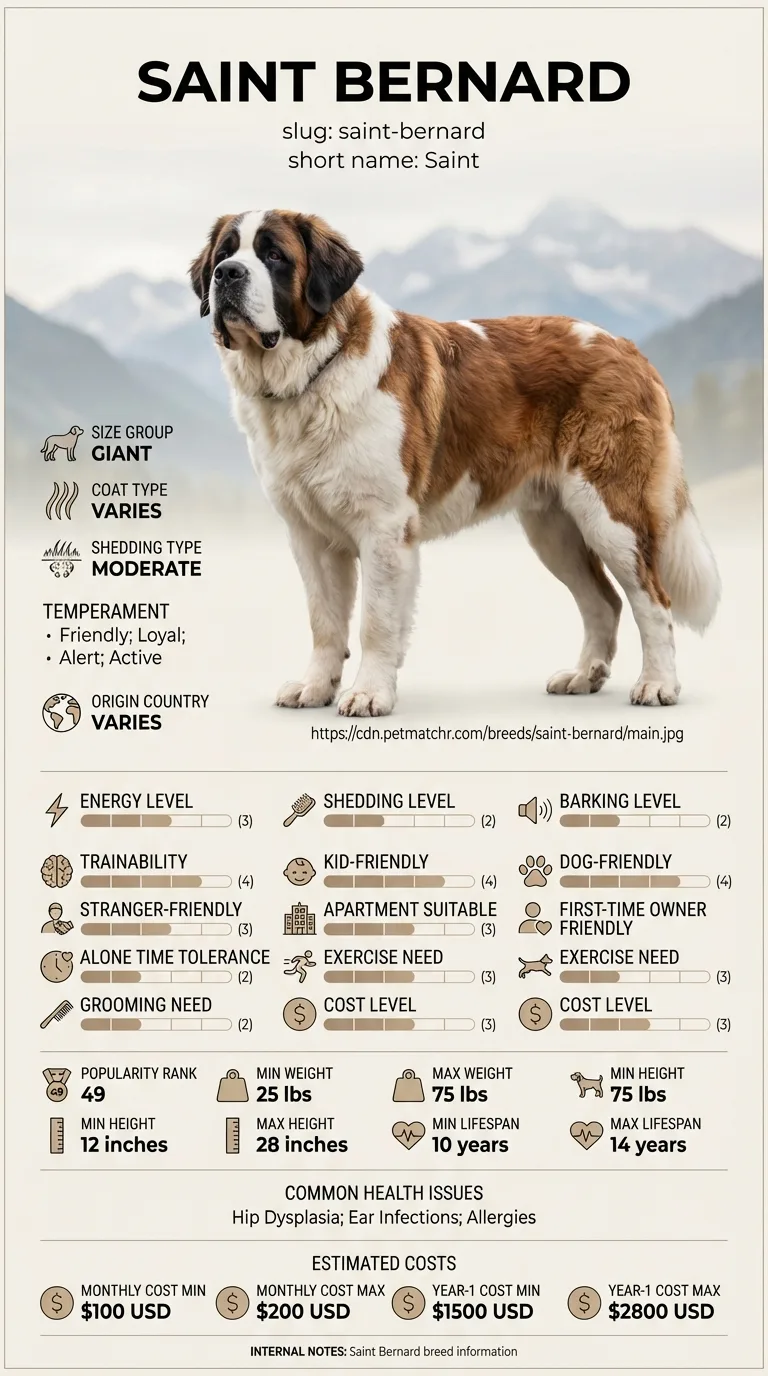
This is for someone already down to Chihuahua and Saint Bernard and deciding between them. For this pair the decision usually turns on apartment suitability and barking, so those are covered first and in most detail. Anyone choosing from a flat has a clear answer here: Chihuahua rates 5/5 against 1/5. There is no origin story here — only what changes about your week.
Between Chihuahua and Saint Bernard, apartment suitability is what separates them, and Chihuahua is the lower-effort dog of the two to keep.
Choose Chihuahua if you are in a flat or a smaller home, you do not want a standing grooming appointment and shedding is a problem in your house.
Choose Saint Bernard if this is your first dog, the dog will be alone during the working day and there are young children at home.
| Feature | chihuahua | saint bernard | Winner |
|---|---|---|---|
| Size class | small | giant | Equal |
| Weight | 2–6 lbs | 120–180 lbs | Equal |
| Height | 6–9 in | 26–30 in | Equal |
| Lifespan | 12–20 years | 8–10 years | chihuahua |
| Exercise need | Low (2/5) | Low (2/5) | Equal |
| Grooming need | Low (2/5) | Moderate (3/5) | chihuahua |
| Shedding | Low (2/5) | High (4/5) | chihuahua |
| Energy level | Moderate (3/5) | Low (2/5) | Equal |
| Barking | Very high (5/5) | Low (2/5) | saint bernard |
| Apartment suitability | Very high (5/5) | Very low (1/5) | chihuahua |
| Good for first-time owners | Low (2/5) | Moderate (3/5) | saint bernard |
| Tolerates being alone | Low (2/5) | Moderate (3/5) | saint bernard |
| Trainability | Low (2/5) | Moderate (3/5) | saint bernard |
| Good with kids | Low (2/5) | Very high (5/5) | saint bernard |
| Good with other dogs | Low (2/5) | High (4/5) | saint bernard |
| Friendly to strangers | Low (2/5) | High (4/5) | saint bernard |
| Cost level | Moderate (3/5) | Very high (5/5) | chihuahua |
| Coat | Short or long | Short or long double coat | Equal |
| Origin | Mexico | Various | Equal |
| Typical monthly cost | $50–$100 | $150–$310 | Equal |
| Typical first-year cost | $800–$1,500 | $2,200–$4,200 | Equal |
Few pairings in this comparison show a bigger gulf than this one: the Chihuahua weighs 2-6 pounds at 6-9 inches, while the Saint Bernard weighs 120-180 pounds at 26-30 inches, landing in the giant size class against the Chihuahua's small. A Saint Bernard can outweigh a Chihuahua by more than fifty times, and its short or long double coat covers a frame built for hauling through snow, not fitting in a purse. Anyone picturing both dogs side by side should imagine something closer to a large piece of furniture next to a housecat-sized companion - the practical implications for space, furniture, and even car transport follow directly from that scale difference.
Despite the size gap, exercise need actually ties at low (2/5) for both breeds - a Saint Bernard, bred for calm, methodical rescue work rather than sprinting, doesn't need the running mileage people often assume giant breeds require. Energy level favors the Chihuahua at moderate (3/5) against the Saint Bernard's low (2/5), meaning the giant breed is, if anything, the mellower of the two day to day. That said, a Saint Bernard's size means even modest exercise - a walk around the block - takes more physical space and planning than a Chihuahua's living-room play session. Neither dog is a hiking partner by breed design, but the Saint Bernard's laid-back nature makes it an easy housemate once past puppyhood.
Grooming need is low (2/5) for the Chihuahua and moderate (3/5) for the Saint Bernard, and shedding follows the same direction - low (2/5) versus high (4/5) - meaning the giant breed's short or long double coat sends noticeably more hair into the house. A Saint Bernard also drools heavily, an upkeep factor the ratings don't fully capture but that owners of the breed mention constantly, alongside the sheer volume of coat to manage during seasonal sheds. The Chihuahua's coat, whether short or long, stays comparatively easy with a weekly brush. Anyone with allergy sensitivities or a low tolerance for household hair and drool should weigh the Saint Bernard's upkeep seriously.
Apartment suitability makes the size difference concrete: the Chihuahua rates very high (5/5) while the Saint Bernard rates very low (1/5), the lowest score in this entire comparison table - a dog this large simply needs room to turn around and stretch out. Barking runs the opposite way, with the Chihuahua at very high (5/5) and the Saint Bernard at low (2/5), so the giant breed is the far quieter housemate despite its size. Alone tolerance favors the Saint Bernard too, at moderate (3/5) against the Chihuahua's low (2/5). A small urban apartment strongly favors the Chihuahua, while a house with a yard suits the Saint Bernard's space needs much better.
The Saint Bernard rates moderate (3/5) for first-time-owner suitability and moderate (3/5) for trainability, both ahead of the Chihuahua's low (2/5) scores in each category, and its gentle, patient temperament makes it a genuinely forgiving dog to train despite its intimidating size. That gentleness matters practically: a giant breed that pulls on leash or jumps up is a bigger safety concern than a small dog doing the same, so early training carries higher stakes even though the Saint Bernard's patient nature makes the process smoother. The Chihuahua's low trainability score reflects its bold, feisty, more independent streak, which often needs a more consistent, patient approach to shape reliably.
The Saint Bernard rates very high (5/5) for compatibility with kids and high (4/5) for both other dogs and friendliness to strangers, all well ahead of the Chihuahua's low (2/5) scores across the board - its gentle, friendly, watchful temperament makes it one of the more welcoming giant breeds toward family and visitors alike. Families with children or a busy household of guests will typically find the Saint Bernard's easygoing nature a smoother match, though its sheer size still means supervising interactions with very young kids to prevent accidental bumps. The Chihuahua's guarded nature toward strangers and lower kid-compatibility score make it better suited to quieter, adult-focused households.
Lifespan strongly favors the Chihuahua at 12-20 years against the Saint Bernard's 8-10, a gap typical of small-versus-giant breed comparisons where larger dogs simply age faster. The Saint Bernard's health list includes hip and elbow dysplasia tied to its rapid growth and heavy frame, dilated cardiomyopathy, entropion affecting its heavy-lidded eyes, and bloat (GDV) - a real risk for any deep-chested giant breed. The Chihuahua's list runs longer in item count, from collapsing trachea to hydrocephalus, but its issues tend toward manageable small-dog conditions rather than the acute, sometimes life-threatening emergencies like bloat that giant-breed owners need to watch for closely.
Cost level rates very high (5/5) for the Saint Bernard against moderate (3/5) for the Chihuahua, and the dollar ranges confirm it: $150-310 monthly and $2,200-4,200 in year one for the Saint Bernard versus $50-100 monthly and $800-1,500 for the Chihuahua. A dog this size eats substantially more food, needs larger-dose medications and bigger crates or beds, and its bloat risk means many owners budget for emergency surgery funds specifically. The Chihuahua's small size keeps most recurring costs modest by comparison. Anyone drawn to the Saint Bernard's gentle temperament should plan financially for roughly three times the Chihuahua's typical annual spend.
Chihuahua weighs 2–6 lbs and lives 12–20 years; Saint Bernard weighs 120–180 lbs and lives 8–10 years. The two diverge most on apartment suitability, barking and good with kids and 4 other rated axes. Almost every rated axis separates them at least slightly. Where the table declares a winner it means less work for the owner, nothing more; descriptive rows are left as ties on purpose. The value here is in the differences between the two columns; treat any single score as approximate.

It's better suited than a Chihuahua on paper, rating moderate (3/5) for first-time owners against the Chihuahua's low (2/5), thanks to its gentle, patient temperament - though its giant size still calls for real commitment to training and space.
Not comfortably - it rates very low (1/5) for apartment suitability, the lowest score in this comparison, while the Chihuahua rates very high (5/5), making the Chihuahua the clear choice for small living spaces.
The Chihuahua, rated very high (5/5) for barking against the Saint Bernard's low (2/5) - despite its giant size, the Saint Bernard tends to be the quieter of the two.
A Saint Bernard runs $150-310 monthly and $2,200-4,200 in the first year, compared to a Chihuahua's $50-100 monthly and $800-1,500 - roughly three times the spend.
Yes - they rate very high (5/5) for compatibility with kids, well above the Chihuahua's low (2/5), reflecting the breed's gentle, patient, friendly reputation, though supervision still matters given the size difference.
Chihuahuas live considerably longer, with a lifespan of 12-20 years compared to the Saint Bernard's 8-10 years, a common pattern where giant breeds age faster than toy breeds.
Hip and elbow dysplasia, dilated cardiomyopathy, entropion, and bloat (GDV) are the main concerns listed for the breed, with bloat in particular being an emergency risk that deep-chested giant breeds are prone to.
The Chihuahua, rated very high (5/5) for apartment suitability against the Saint Bernard's very low (1/5).
The Saint Bernard, rated high (4/5) for shedding versus the Chihuahua's low (2/5).
The Saint Bernard, whose energy level rates low (2/5) against the Chihuahua's moderate (3/5).
The Chihuahua, at roughly a third of the Saint Bernard's typical monthly and first-year costs.
Secure checkout on Stripe. We never see your card.
7-day money-back guarantee. Instant access.
Health information here is general and is not veterinary advice. If your dog shows pain, sudden behaviour change, or worsening symptoms, consult a licensed veterinarian.
Some links on this site are affiliate links. We may earn a commission at no extra cost to you, and we only suggest products we believe are helpful for dog owners.
We research and check what we publish, but we do not warrant that any figure, date, price, or statement is accurate, complete, or current, and we accept no liability for any loss, cost, injury, or other harm arising from the use of this site. Use it as one reference among several. You remain responsible for your own decisions and for your dog's care - confirm anything that matters with a licensed veterinarian or another qualified professional before you act on it. Full disclaimer.
Match your lifestyle to the right dog.
Take quizNot sure which breed is right for you? Take our 2-minute quiz to find out.
Take the quiz