Health
What is a molera in a Chihuahua?
An opening in the top of the skull where the bones have not fused. Common in this breed and often harmless, but it leaves that spot unprotected.

Quick answer
What is a molera in a Chihuahua?
An opening in the top of the skull where the bones have not fused. Common in this breed and often harmless, but it leaves that spot unprotected.
A Chihuahua puppy may weigh less than a pound at eight weeks. At that size the skull may not have finished closing, the leg bones are the diameter of a matchstick, and a missed meal can drop the blood sugar within hours.
New owners of a Chihuahua puppy working out what is normal in a dog this small, owners who have felt a soft spot on the top of the head and want to know whether to worry, and anyone with a young Chihuahua that has started limping on a back leg between four and eleven months.
This guide is not medical advice. If your dog shows pain, sudden behavior change, or worsening symptoms, consult a licensed veterinarian.
Some links may be affiliate links. We may earn a commission at no extra cost to you. We only suggest products we believe are helpful for dog owners.
We research and check what we publish, but we do not warrant that any figure, date, price, or statement is accurate, complete, or current, and we accept no liability for any loss, cost, injury, or other harm arising from the use of this site. Use it as one reference among several. You remain responsible for your own decisions and for your dog's care - confirm anything that matters with a licensed veterinarian or another qualified professional before you act on it. Full disclaimer.
Developmental problems in Chihuahuas are toy-breed problems, not large-breed ones. They cluster in four places: an incompletely closed skull, a jaw too small for a full set of adult teeth arriving alongside the baby ones, a hip joint whose femoral head can lose its blood supply in young dogs, and long bones slender enough to fracture from household falls. Add the blood sugar instability of a very small puppy and you have the whole first-year picture.
Several of these are on the Chihuahua's documented health list rather than being rare curiosities. Retained baby teeth, hypoglycemia, patellar luxation and hydrocephalus all appear there explicitly, and an unclosed fontanelle is common enough in the breed to be considered characteristic. Serious problems affect a minority of puppies, but the majority will encounter at least one item on this list during their first year.
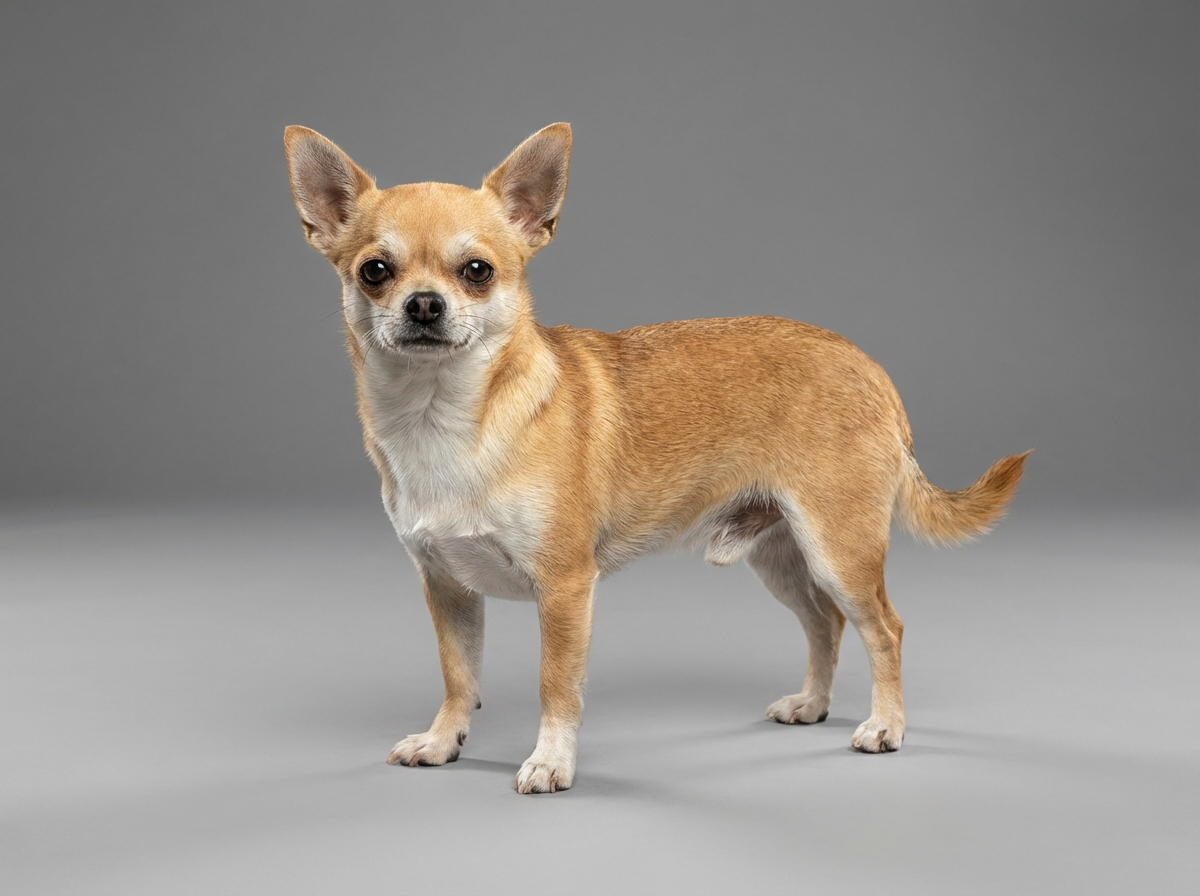
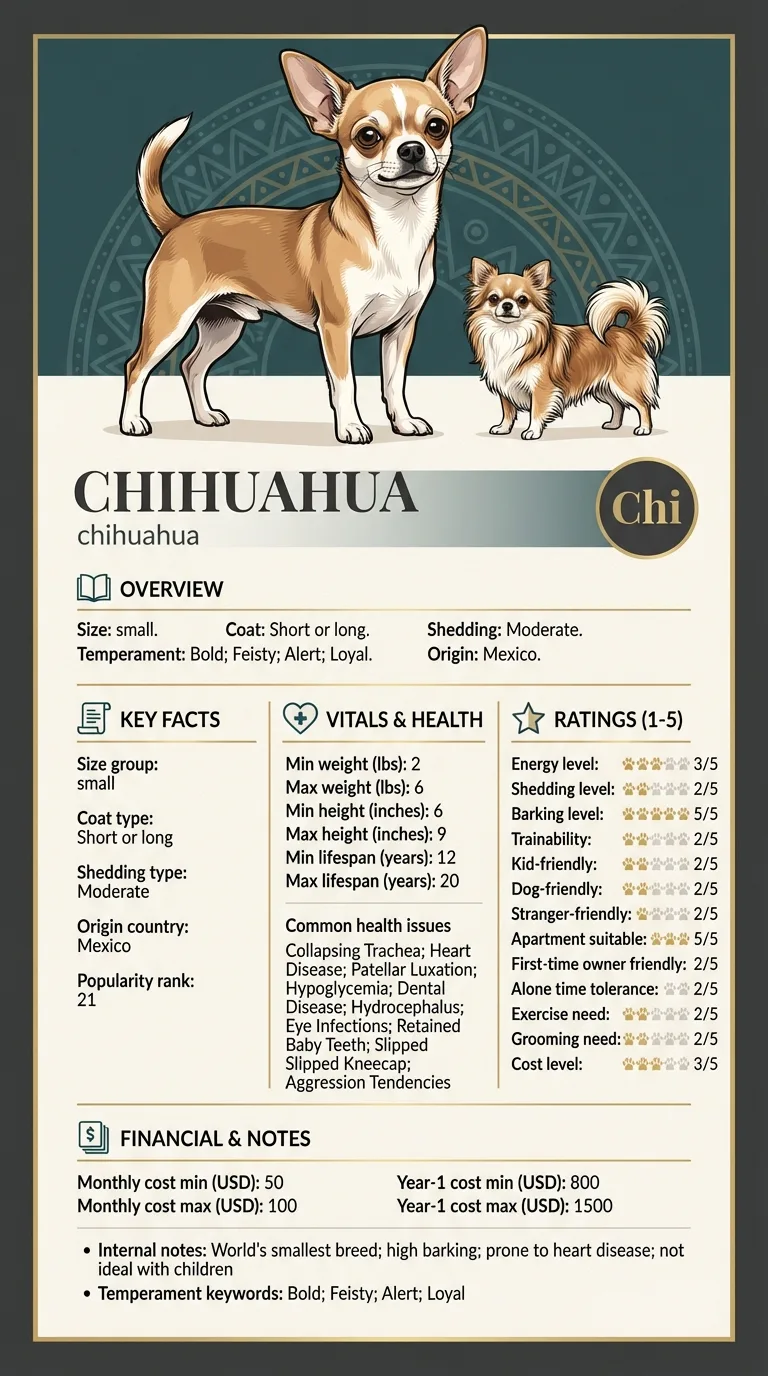
Everything here follows from being the smallest recognised breed, at two to six pounds and six to nine inches. The apple-shaped skull that gives the Chihuahua its silhouette frequently comes with a fontanelle that fuses late or never, and the same head shape is associated with the hydrocephalus recorded among the breed's health problems. The jaw is small while the number of teeth is not, so deciduous teeth are commonly retained and the mouth becomes crowded from the outset. The femoral head in toy breeds is supplied by a precarious blood supply that can fail in young dogs. And the long bones of the forelimb are so slender that a fall of a couple of feet transmits enough force to break them.
The controllable half of this is height and grip. A Chihuahua puppy that is carried at chest level and allowed to leap down is repeatedly risking a foreleg fracture, and a household with young children multiplies the number of those opportunities. Polished floors deny a puppy traction while it is learning coordination. Feeding routine matters too: a very small puppy needs frequent small meals rather than one or two, because the liver's glycogen store is proportionally tiny. Over-supplementation with minerals in the belief it strengthens bone is a genuine risk in a dog with no dosing margin.
Go the same day for a puppy that is wobbly, glassy-eyed, disoriented or collapsing, since hypoglycemia in a very small Chihuahua can progress to seizures and is a genuine emergency. Go immediately for any suspected fracture, meaning a leg the puppy will not put down at all, or for a head injury in a dog with a known soft spot. Book promptly for a persistent limp, particularly one that worsens over weeks in a four-to-eleven-month-old, for a double row of teeth at six months or older, and for a head that looks increasingly domed or for circling, head pressing or seizures.
See all Chihuahua health problems, which breeds are prone to bone growth issues, or the full Chihuahua breed guide for temperament, exercise needs and ownership costs.
Most of this resolves or declares itself within twelve months. Puppy hypoglycemia typically stops being a concern by three to four months as the dog puts on mass. Retained teeth are usually addressed around six months, often alongside neutering. Femoral head necrosis presents between four and eleven months and, if treated surgically, needs several weeks of rehabilitation. An open fontanelle may close by around a year or may remain open for life, and in itself that is not a problem requiring treatment.
Success at the end of the first year is a Chihuahua with a single clean row of adult teeth, no retained deciduous canines, two hind legs that bear weight evenly, no history of a fracture, and a household that has permanently adopted no-jumping rules. It is not a puppy that avoided every item on the list by luck. The measure is whether the ones that appeared were caught early enough to be fixed cheaply rather than managed expensively for the next fifteen years.
Chihuahua puppies are frequently born with a molera, an opening at the top of the skull where the bones have not yet fused. Every mammal is born with skull sutures that close after birth. What distinguishes this breed is that the opening is common, is regarded as characteristic of the apple-shaped head, and in a proportion of dogs never fully closes at all.
An ordinary molera is not a disease. It is a coin-sized or smaller gap, usually towards the top of the skull, that you can feel as a soft depression under the skin. Many Chihuahuas carry one into adult life with no consequence whatsoever.
What matters is the exception. Hydrocephalus, the accumulation of fluid within the brain, appears on the Chihuahua's documented health list, and a very large or expanding opening can accompany it. The signs to watch for are a domed head that looks disproportionate even for this breed, eyes that appear to point outwards and downwards, a puppy that seems slow to learn or behaves oddly, circling, pressing the head against furniture, or seizures. Those need veterinary assessment, and the presence of a soft spot alone does not.
The practical consequence of a molera is protection. A skull with a gap in it has no bone over that spot, so head knocks matter more. Keep the dog off high furniture, do not let children carry it, and be careful about rough play with larger dogs.

Four separate developmental problems appear on this breed's health profile, and each has its own window and its own signs.
If you think your Chi has bone & growth issues, the plan is three steps: write down what you have seen and when it started, book a veterinary appointment rather than waiting for the next flare, and take video of the behaviour or symptom before you go — the thing you are worried about rarely happens in the consulting room. Screening in the parents covers collapsing trachea, heart disease, patellar luxation.
What the vet visit should produce is a diagnosis and a written plan, not just reassurance: what is being ruled out, what the monitoring interval is, and which signs mean you come back sooner. Ask what the treatment costs across a year rather than per visit, because that is the number that decides whether you are managing this condition or reacting to it.
Between appointments, keep a short log — dates, what you saw, what changed. It is the single most useful thing an owner brings to a follow-up, and for bone & growth issues it is often what separates a clear pattern from a guess.
Chispa is a Chihuahua in Galway who weighed 2.6 pounds at six months. Her owner Fionn had done everything by the book on feeding and vaccination but had never looked properly inside her mouth, on the reasonable grounds that she objected loudly. At her pre-neutering examination the vet counted four canine teeth on the upper jaw instead of two. Both deciduous canines had been retained, and food debris was already packed into the groove between each pair. They were removed during the same anesthetic as her spay, which turned two procedures into one and saved a separate day under anesthesia. The vet also pointed out something Fionn had dismissed: Chispa occasionally hopped for two or three strides on her left back leg before running on normally. That was a grade one kneecap, noted and monitored rather than operated on, and it now shapes her exercise and her weight for life.
Key takeaway: Both findings were free to detect and cheap to act on at six months. Left alone, retained canines would have started periodontal disease years early, and an unnoticed kneecap would have quietly built arthritis across a lifespan that in this breed can run to twenty.
It is common in this breed and is widely regarded as characteristic of the apple-headed type. A small, stable opening with a bright, normal puppy is not itself a problem. What warrants assessment is a very large or enlarging gap, a head that looks increasingly domed, eyes that turn outwards and downwards, unusual behaviour, circling or seizures, since hydrocephalus is documented in Chihuahuas.
Because the deciduous teeth have not come out as the adult ones erupted. Retained baby teeth are on the Chihuahua's documented health list, and the reason is largely space: a full set of adult teeth is trying to arrive in one of the smallest jaws in dogdom. Retained teeth trap food and start the periodontal disease this breed is famous for, so they are usually removed, often at neutering.
Two things dominate at that age. A skipping gait that resolves after a few strides suggests a kneecap slipping out of its groove. A progressive lameness that gets worse over weeks, with the thigh muscle visibly shrinking, between roughly four and eleven months, raises the possibility of necrosis of the femoral head. The second needs radiographs promptly, so book rather than waiting it out.
Not without veterinary direction. Supplementing calcium on top of a complete puppy food disturbs the mineral balance that bone development depends on and can cause harm rather than build stronger bones. A dog this size also has almost no dosing margin. If you have concerns about growth, raise them at a vaccination appointment rather than adding anything to the bowl.
More careful than feels reasonable. The foreleg bones of a toy puppy are slender enough to break from a jump off a sofa or a slip out of a child's arms, and a skull that has not finished closing has an unprotected area. Practical rules: no jumping down from anything, adults do the carrying, and supervised play only with dogs of similar size.
Most of them declare themselves within the first year. Retained teeth show from four months, femoral head necrosis between four and eleven, kneecap instability usually in the first year or two, and puppy hypoglycemia largely resolves by three or four months as the dog gains mass. What continues for life is the consequence of any of them, which is why the first year is worth watching properly.
An opening in the top of the skull where the bones have not fused. Common in this breed and often harmless, but it leaves that spot unprotected.
Usually yes. A double row traps food against the adult tooth and starts periodontal disease early in a breed that already has crowded jaws.
A skipping stride suggests a slipping kneecap; a steadily worsening lameness with muscle loss needs radiographs to check the hip. Book rather than wait.
No jumping down from furniture or arms, adults only doing the carrying, non-slip flooring, and no rough play with larger dogs.
Typically eight hundred to fifteen hundred dollars for a Chihuahua's first year, and retained-tooth removal or orthopaedic radiographs push it beyond that.
A one-page prep sheet for this condition: the signs, the questions to ask, what to get priced. Unlocks here.
You get: Vet visit prep sheet
No spam. One-click unsubscribe. See our privacy policy.
Preview page 1 before you decide.