Costs
Chihuahua cost in Louisville
About $44–$87/month, $700–$1,290 for year one — below average, with a real staircase consideration for this breed's kneecaps in the city's historic housing stock.

See Chihuahua price across all cities →
Quick answer
Chihuahua cost in Louisville
About $44–$87/month, $700–$1,290 for year one — below average, with a real staircase consideration for this breed's kneecaps in the city's historic housing stock.
A Chihuahua in Louisville costs about $44–$87 a month, with the first year around $700–$1,290 — below the national average, in a city where older housing stock brings one real, easy-to-miss joint consideration.
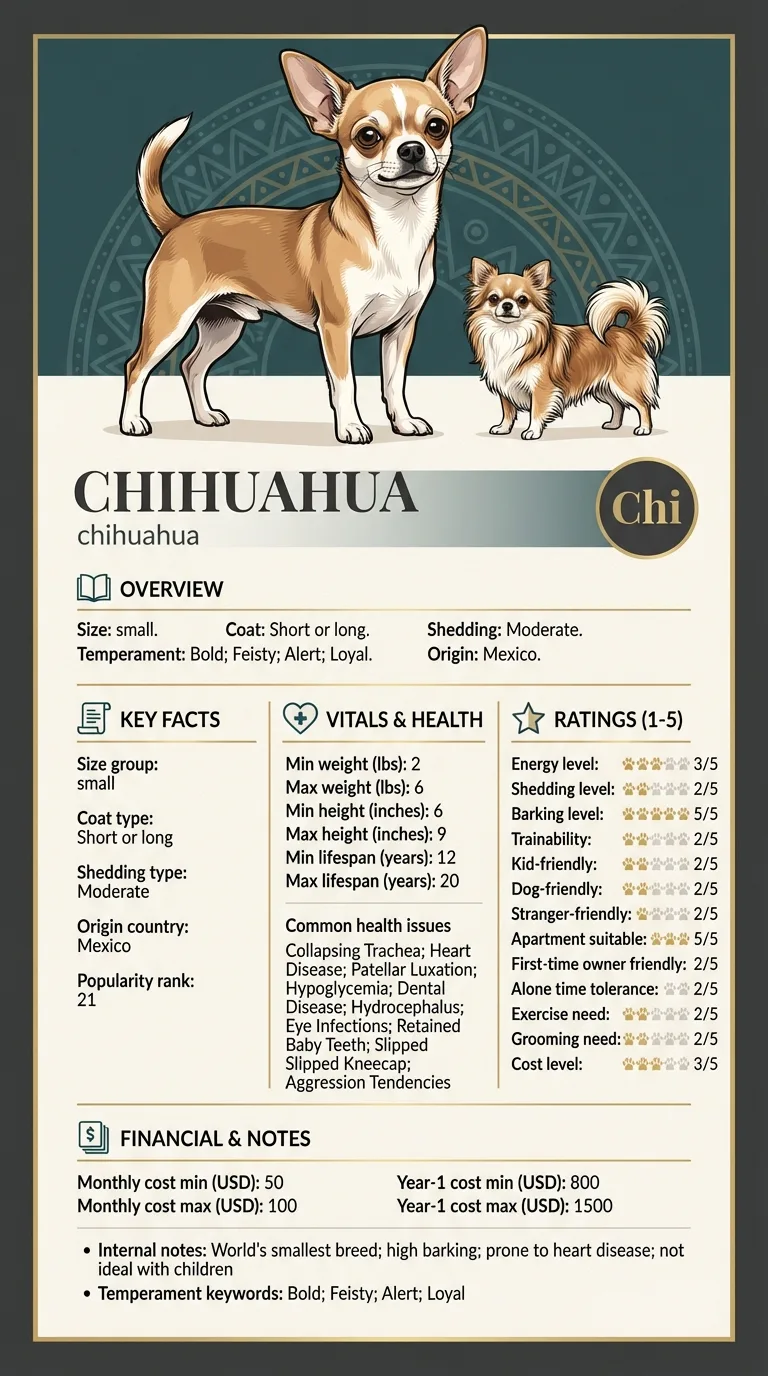
Heart disease and collapsing trachea are the two chronic conditions most worth a vet's early attention in this breed. Hypoglycemia is the acute risk specific to small puppies — a missed meal can turn dangerous fast in a dog this size.
These figures adjust the Chihuahua's typical national cost range down for Louisville's below-average market, with a small added line item for a baby gate given the joint stress historic rowhome stairs can add.
Estimate · source: estimation · confidence: medium · updated 2026-09-05 · not a quote
| Item | Cost range |
|---|---|
Baby gate or stair barrier (joint protection) A real, low-cost way to limit unsupervised stair access given the steeper, narrower staircases common in Louisville's historic rowhomes. | $25 - $55 |
One-time setup (initial vet visit, spay/neuter, gear) Covers the first exam, vaccinations, spay/neuter if needed, and basic gear — priced at Louisville's generally affordable rates. | $190 - $325 |
| Item | Cost range |
|---|---|
Food Genuinely low given this breed's tiny size, consistent with Louisville's generally lower price level. | $11 - $20 |
Flea & tick prevention A moderate season, longer than the upper Midwest but well short of year-round, consistent with Kentucky's temperate climate. | $7 - $14 |
Each range starts from a national baseline for this breed's size class and is then adjusted for local cost of living and veterinary pricing. The baselines, and the source each one came from, are listed on our sources page (dataset 2026.09). Two inputs, the purchase price and the emergency reserve, have no published national figure we could verify, so we leave them to you rather than invent them.
These are planning estimates, not quotes. Your own numbers will move with the individual dog, your vet and your insurer. Build a budget with your own figures.
For a Chihuahua in Louisville, insurance is worth taking seriously given the breed's documented heart disease and patellar luxation risk, even though the local vet market itself runs at a below-average, unremarkable level.
This breed's real heart-disease and joint-slippage statistics make insurance worth locking in early — a policy bought before any diagnosis covers costs a self-funded emergency fund alone often can't stretch to match.
Owners with a solid emergency fund and the discipline to leave it untouched for anything but a genuine vet emergency can reasonably self-insure instead.
Louisville already starts from a low cost base for this breed; the real breed-specific planning here is historic-stair awareness, not routine cost-cutting.
Old Louisville holds one of the largest collections of Victorian-era homes in the country, and the original staircases in these historic rowhomes and townhouses tend to be genuinely steeper and narrower than modern building code allows today. For most breeds that's simply a quirky architectural detail. For a dog with this breed's documented patellar luxation risk, repeated unsupervised trips up and down a steep, narrow historic staircase is a real, everyday joint stressor worth addressing with a baby gate to limit unsupervised access or by carrying the dog on the steepest flights.
Outside that specific housing consideration, Louisville is otherwise a genuinely below-average-cost Southern metro across nearly every category this site tracks, without a single dramatic cost factor pushing prices sharply in either direction.
Kentucky's real four-season climate keeps flea-and-tick prevention on a moderate window, running longer than the upper Midwest but stopping well short of year-round.

A Louisville Chihuahua owner renting a beautifully preserved Old Louisville townhouse let their new puppy navigate the original Victorian staircase freely for months, assuming it was no different from any other set of stairs. A vet visit for an occasional back-leg limp led to a patellar luxation diagnosis, and the vet specifically flagged the unusually steep, narrow stairs as a likely contributing factor once the owner described the home's layout.
Key takeaway: In Louisville's historic housing stock specifically, a genuinely charming architectural detail can be a real, overlooked joint stressor for this breed — a simple gate is a cheap fix worth installing before symptoms show up, not after.
About $44–$87, below the national average, consistent with Louisville's generally lower cost of living.
Roughly $700–$1,290, including the initial vet exam, spay/neuter if needed, and gear on top of ongoing monthly costs.
They can, genuinely — Old Louisville's Victorian-era staircases tend to be steeper and narrower than modern builds, and repeated unsupervised trips up and down are a real contributing factor to this breed's documented patellar luxation risk.
Genuinely affordable — Louisville is a below-average-cost Southern metro across nearly every category this site tracks, without a single dramatic factor pushing prices sharply in either direction.
Worth pricing out given the breed's documented heart disease and dental risk, bought while the dog is young and before anything is on record.
Around $360 covers a typical significant vet visit in this market, reflecting Louisville's below-national-average general pricing.
About $44–$87/month, $700–$1,290 for year one — below average, with a real staircase consideration for this breed's kneecaps in the city's historic housing stock.
This guide is not medical advice. If your dog shows pain, sudden behavior change, or worsening symptoms, consult a licensed veterinarian.
Some links may be affiliate links. We may earn a commission at no extra cost to you. We only suggest products we believe are helpful for dog owners.
We research and check what we publish, but we do not warrant that any figure, date, price, or statement is accurate, complete, or current, and we accept no liability for any loss, cost, injury, or other harm arising from the use of this site. Use it as one reference among several. You remain responsible for your own decisions and for your dog's care - confirm anything that matters with a licensed veterinarian or another qualified professional before you act on it. Full disclaimer.
One sheet with every line item, the emergency fund and when insurance pays off - unlocks on this page.
You get: 12-month budget sheet
No spam. One-click unsubscribe. See our privacy policy.
Preview page 1 before you decide.