Health
What are the first signs of hypothyroidism in a dog?
Lethargy, weight gain on unchanged food, seeking warmth, and a coat that regrows slowly after clipping.

Quick answer
What are the first signs of hypothyroidism in a dog?
Lethargy, weight gain on unchanged food, seeking warmth, and a coat that regrows slowly after clipping.
Hypothyroidism is one of the few chronic canine conditions with a genuinely satisfying treatment, and one of the easiest to miss in a dog whose coat hides its body.
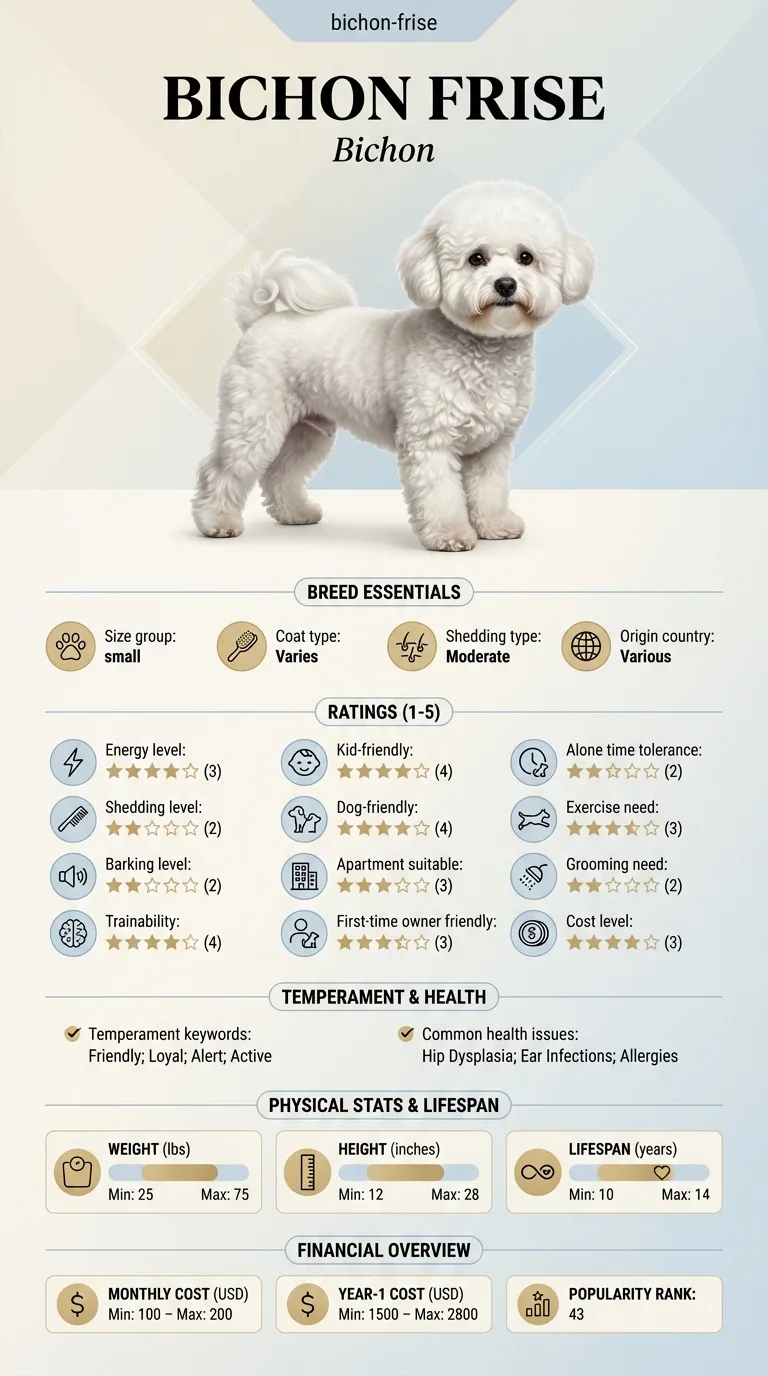
Owners of middle-aged Bichons who have noticed weight creeping on despite unchanged feeding, a coat that has lost its bounce, or a dog that has quietly stopped being the cheerful nuisance it used to be.
This guide is not medical advice. If your dog shows pain, sudden behavior change, or worsening symptoms, consult a licensed veterinarian.
Some links may be affiliate links. We may earn a commission at no extra cost to you. We only suggest products we believe are helpful for dog owners.
We research and check what we publish, but we do not warrant that any figure, date, price, or statement is accurate, complete, or current, and we accept no liability for any loss, cost, injury, or other harm arising from the use of this site. Use it as one reference among several. You remain responsible for your own decisions and for your dog's care - confirm anything that matters with a licensed veterinarian or another qualified professional before you act on it. Full disclaimer.
Hypothyroidism is a shortfall of thyroid hormone that slows the whole body down. It develops gradually over months, produces no single dramatic symptom, and is diagnosed on bloodwork rather than examination. In a Bichon Frise the practical difficulty is detection, because a thick professionally maintained coat conceals both the weight change and the coat change that would flag it in another breed.
Hypothyroidism is one of the more frequently diagnosed hormonal conditions in dogs overall, concentrated in middle age. It is also one of the more frequently over-diagnosed, because a low reading on a single test is common in dogs who are simply unwell with something else. Both facts argue for proper testing rather than for assumption in either direction.
There is no strong Bichon-specific driver, and inventing one would be dishonest. What the breed contributes is a set of traits that delay recognition. A dense curly coat with very low shedding masks hair quality changes for months. A body weight of only 12 to 18 pounds means a small absolute gain is proportionally large yet visually invisible. A naturally moderate energy level, rated three out of five, means reduced activity does not stand out the way it would in a working breed.
The most influential environmental factor is the interpretation the household applies. A dog that sleeps more and walks less gets described as slowing down with age, and in a breed that lives 14 or 15 years that explanation is plausible for far too long. Reduced winter activity, a groomer changing, or a household becoming busier all provide alternative explanations that push the vet visit further out.
Book a non-urgent appointment for gradual weight gain, reduced energy, cold-seeking behaviour, recurrent skin or ear infections, or a coat that is regrowing poorly. Seek prompt attention if your dog is markedly weak, unsteady, has facial drooping or asymmetry, or has become profoundly dull and unresponsive, since severe untreated thyroid deficiency can occasionally reach a crisis point and those signs also overlap with neurological emergencies. Do not adjust prescribed thyroid doses yourself; both under and over-treatment cause real problems.
See all Bichon Frise health problems, which breeds are prone to hypothyroidism, or the full Bichon Frise breed guide for temperament, exercise needs and ownership costs.
Energy and mood typically improve within two to four weeks of starting the correct dose. Coat and skin take longer, often three to six months, because hair has to grow through a full cycle. Weight loss follows the feeding plan rather than the medication and usually takes a similar three to six months.
Bloodwork in the target range on a stable dose, a dog that asks for walks again, a coat your groomer says has come back to normal, and a body condition you can verify by feel. Success is a dog that no longer seems old for its age.
Most descriptions of canine hypothyroidism list hair loss, a dull dry coat, and thinning along the flanks and tail. Those descriptions were written with short-coated breeds in mind, where the skin is visible and change is obvious.
A Bichon Frise wears a dense curly double coat that is professionally trimmed every few weeks. Coat change in this breed reaches the owner filtered through a groomer, and it tends to arrive as a comment rather than an observation: the coat is taking longer to grow back, it feels different to scissor, it is not holding shape the way it did.
Weight change is similarly disguised. A dog carrying an extra two pounds under half an inch of curl looks identical to one that is not. This is why body condition in a Bichon must be assessed by hand, feeling for ribs and waist, rather than by eye.
The signs owners do notice tend to be behavioural: less enthusiasm for walks, seeking out warm spots, sleeping more, and a general flatness in a breed whose defining trait is cheerfulness. Those changes are easy to file under ageing, especially in a breed that lives long enough for owners to expect a long slow decline.

Thyroid testing produces more false alarms than most owners expect, and understanding why prevents both over-treatment and premature dismissal.
Poppy was seven when her groomer mentioned, for the third appointment running, that her coat was taking noticeably longer to grow back and felt cottony to scissor. Her owner Fran had put Poppy's reduced walking down to a cold winter. Fran mentioned the coat comment almost as an afterthought at the annual vaccination. Her vet felt Poppy's ribs, found she had gained two and a half pounds since the previous year, and ran a full thyroid panel rather than a single value. The results confirmed genuine thyroid failure. Six weeks after starting treatment Poppy was pulling toward the park again. Her coat took until the following summer to look right.
Key takeaway: In a heavily coated breed, the groomer often sees the first sign. Take their observations to the vet as evidence rather than as small talk.
It is not one of the breed's headline conditions, which are skin allergies, patellar luxation, bladder stones, cataracts and dental disease. Hypothyroidism occurs across many breeds in middle age and should be on the list when a Bichon slows down unexplainedly, but it is not a breed-defining risk.
Most commonly between about four and ten years. That places it squarely in the middle of a Bichon's 14 to 15 year lifespan, which is unfortunate timing because it is precisely when owners start attributing changes to age rather than to a treatable condition.
It can contribute. Low thyroid function impairs skin barrier repair and makes recurrent infections harder to clear. In a breed already prone to skin allergies, this creates a frustrating loop where the allergy is treated repeatedly and the underlying reason it keeps returning goes unexamined.
Yes. Thyroid replacement is given daily for life, usually twice a day, with follow-up bloodwork to confirm the level is right. It is one of the less expensive long-term medications, but consistency matters and missed doses show up in the dog.
Often, though not automatically. Treatment restores the metabolic rate, but weight that accumulated over a year does not vanish on its own. Expect to combine medication with measured feeding and a rebuilt walking routine over several months.
Owners frequently report a dog becoming withdrawn, less playful or less tolerant, and describe it returning to itself after treatment. Behaviour change is a reasonable reason to include thyroid testing in an investigation, though it should never be the only thing investigated.
Lethargy, weight gain on unchanged food, seeking warmth, and a coat that regrows slowly after clipping.
It is rarely an emergency but is genuinely debilitating untreated. Diagnosed and treated, most dogs return to normal function.
The daily tablets are among the cheaper chronic medications; the recurring cost is monitoring bloodwork every six to twelve months.
Usually not, but tell your vet what you feed, since some diets and supplements can interfere with thyroid medication absorption.
Most owners notice more interest in walks and play within a few weeks of starting treatment at the right dose.
A one-page prep sheet for this condition: the signs, the questions to ask, what to get priced. Unlocks here.
You get: Vet visit prep sheet
No spam. One-click unsubscribe. See our privacy policy.
Preview page 1 before you decide.