Behavior
Bichon Frise or GWP for a small home?
Bichon Frise; the GWP needs far more space and exercise to be happy.

Quick answer
Bichon Frise or GWP for a small home?
Bichon Frise; the GWP needs far more space and exercise to be happy.
Bichon Frise or German Wirehaired Pointer? On paper they differ most on apartment suitability, and on the scales German Wirehaired Pointer is the heavier at 60–70 lbs. Here is how the two compare on everything that shapes an ordinary week.
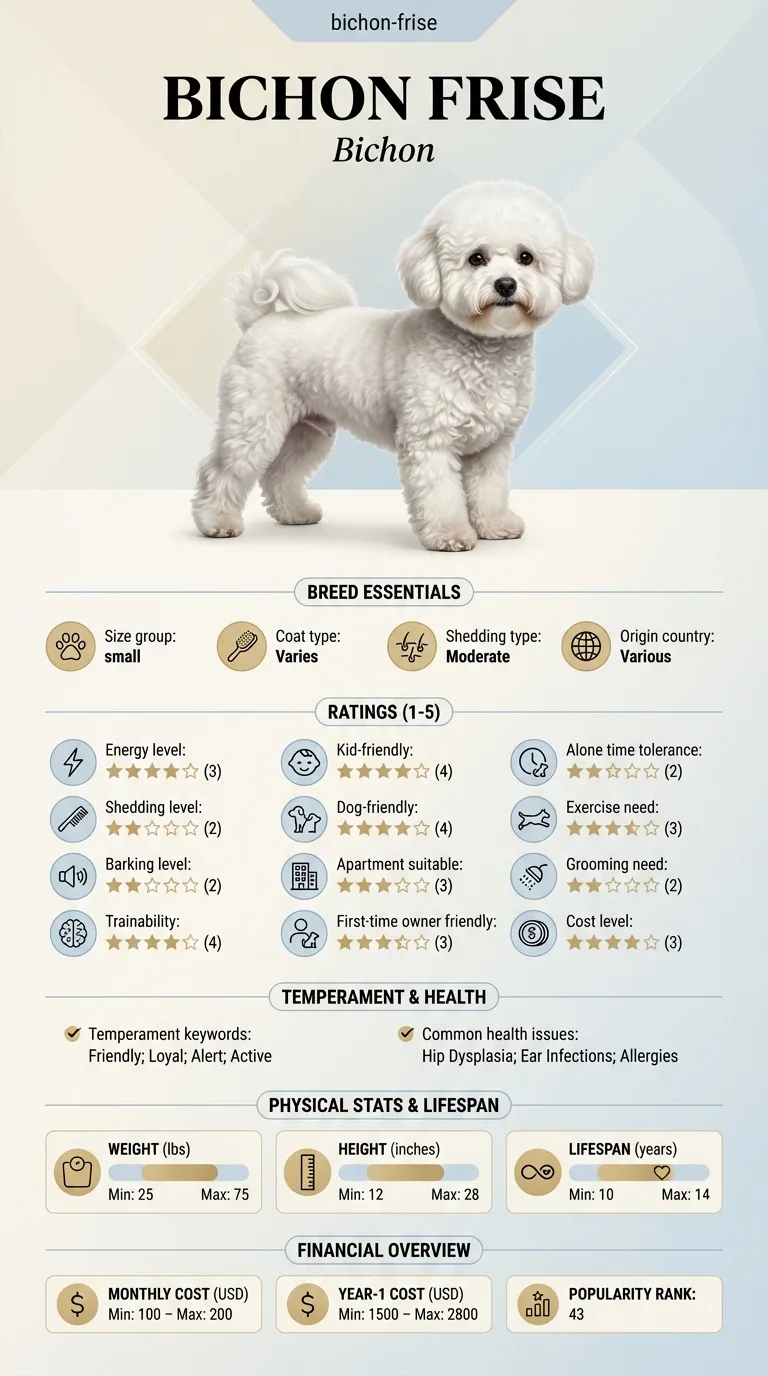
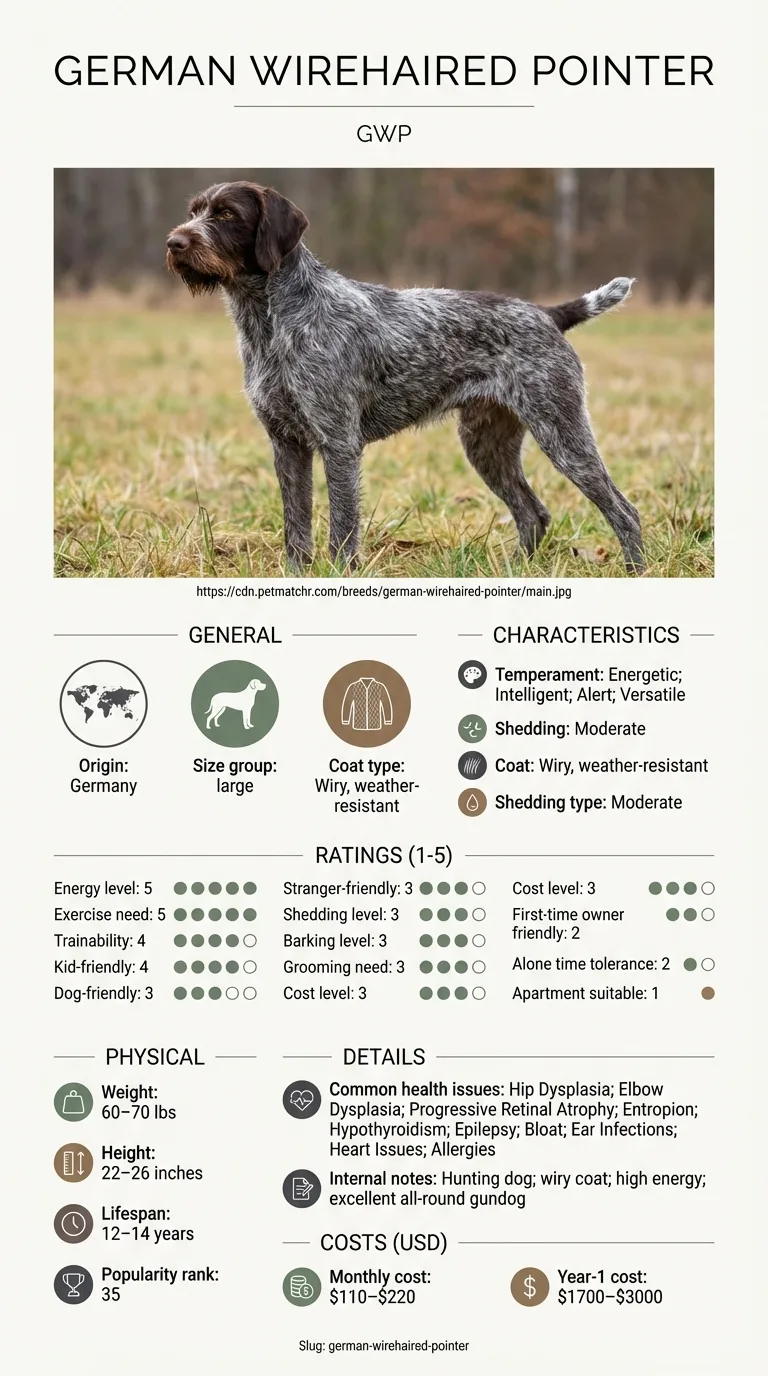
This is for someone already down to Bichon Frise and German Wirehaired Pointer and deciding between them. For this pair the decision usually turns on apartment suitability and exercise need, so those are covered first and in most detail. Anyone choosing from a flat has a clear answer here: Bichon Frise rates 5/5 against 1/5. There is no origin story here — only what changes about your week.
Between Bichon Frise and German Wirehaired Pointer, apartment suitability is what separates them, and Bichon Frise is the lower-effort dog of the two to keep.
Choose Bichon Frise if you are in a flat or a smaller home, this is your first dog and shedding is a problem in your house.
Choose German Wirehaired Pointer if you do not want a standing grooming appointment, you want a dog that picks up training quickly and you want a dog that can keep up with an active routine.
| Feature | bichon frise | german wirehaired pointer | Winner |
|---|---|---|---|
| Size class | small | large | Equal |
| Weight | 12–18 lbs | 60–70 lbs | Equal |
| Height | 9–12 in | 22–26 in | Equal |
| Lifespan | 14–15 years | 12–14 years | bichon frise |
| Exercise need | Low (2/5) | Very high (5/5) | bichon frise |
| Grooming need | Very high (5/5) | Moderate (3/5) | german wirehaired pointer |
| Shedding | Very low (1/5) | Moderate (3/5) | bichon frise |
| Energy level | Moderate (3/5) | Very high (5/5) | Equal |
| Barking | Moderate (3/5) | Moderate (3/5) | Equal |
| Apartment suitability | Very high (5/5) | Very low (1/5) | bichon frise |
| Good for first-time owners | High (4/5) | Low (2/5) | bichon frise |
| Tolerates being alone | Low (2/5) | Low (2/5) | Equal |
| Trainability | Moderate (3/5) | High (4/5) | german wirehaired pointer |
| Good with kids | High (4/5) | High (4/5) | Equal |
| Good with other dogs | High (4/5) | Moderate (3/5) | bichon frise |
| Friendly to strangers | High (4/5) | Moderate (3/5) | bichon frise |
| Cost level | Moderate (3/5) | Moderate (3/5) | Equal |
| Coat | Curly, dense double coat | Wiry, weather-resistant | Equal |
| Origin | Various | Germany | Equal |
| Typical monthly cost | $80–$150 | $110–$220 | Equal |
| Typical first-year cost | $1,100–$2,300 | $1,700–$3,000 | Equal |
Twelve to eighteen pounds against sixty to seventy: the German Wirehaired Pointer outweighs the Bichon Frise by roughly four to five times over, and stands 22-26 inches at the shoulder compared to the Bichon's 9-12 inches. Where the Bichon carries a soft, rounded silhouette built for lap life, the GWP has a rugged, weatherproof frame designed for cold-water retrieving and long days afield. This is one of the largest size gaps you'll find in a breed comparison, and it drives nearly every other difference on this page, from exercise tolerance to the practicalities of car travel and vet visits.
Exercise need sits at 5/5 for the GWP and just 2/5 for the Bichon, a genuine mismatch in daily output. The GWP was bred as a versatile hunting dog expected to track, point, and retrieve for hours, and that drive doesn't switch off just because it's living as a house pet; expect to need 60-90 minutes of real activity most days. The Bichon's moderate 3/5 energy level and low exercise requirement mean a couple of short walks and some indoor play satisfy it fully. Owners who enjoy hiking or hunting will find the GWP a willing partner; those without that lifestyle will find it a handful.
Coat care lands in the middle for the GWP: moderate (3/5) grooming for its wiry, weather-resistant coat, which needs regular brushing and periodic hand-stripping but no professional salon visits. The Bichon Frise sits at the opposite extreme with very high (5/5) grooming demands from its curly double coat. Shedding, though, favors the Bichon clearly, very low (1/5) versus the GWP's moderate (3/5). Someone who wants minimal grooming bills but doesn't mind some hair around the house will lean GWP; someone chasing a low-shed home despite higher grooming costs will lean Bichon.
Apartment suitability couldn't be more lopsided: 5/5 for the Bichon, 1/5 for the GWP. A dog built to range for miles across rough terrain simply doesn't thrive boxed into a small unit, regardless of how much the owner loves it. Both breeds share the same low (2/5) tolerance for being left alone, which means solo hours are a challenge for either, but a GWP left alone and under-exercised in a cramped space is a much bigger behavioral risk than a bored Bichon, which tends toward moderate (3/5) barking rather than the kind of frantic energy release a working breed can produce.
The GWP rates high (4/5) for trainability, a notch below its GSP cousin but still strong, since it was bred to work closely with a handler in the field. That intelligence comes with a caveat: it rates low (2/5) for first-time owners, needing someone comfortable with structure and firm, consistent guidance. The Bichon Frise flips that profile, rated high (4/5) for first-timers despite only moderate (3/5) trainability; it's easier to live with day-to-day even if it won't master complex commands as readily. A first-time dog owner set on a GWP should plan for professional training support.
With other dogs, the Bichon edges ahead, high (4/5) versus the GWP's moderate (3/5), and the same gap appears with strangers, where the Bichon rates high (4/5) against the GWP's moderate (3/5). Both breeds score high (4/5) with kids, so families aren't choosing between one kid-friendly breed and one that isn't. The practical difference in a busy household is more about scale and socialization effort: the GWP's size and moderate rating around unfamiliar dogs means more deliberate introductions at the dog park, while the Bichon tends to mix more readily into new social situations.
The Bichon's 14-15 year lifespan beats the GWP's already-respectable 12-14 years, itself long for a large breed. Health profiles diverge sharply in length: the Bichon's five listed concerns (skin allergies, patellar luxation, bladder stones, cataracts, dental disease) are dwarfed by the GWP's ten, including hip and elbow dysplasia, progressive retinal atrophy, entropion, epilepsy, and bloat. Entropion, an eyelid condition, and bloat both warrant specific attention in this breed given its size and structure. Bichon owners should focus preventive care on teeth, joints, and skin; GWP owners should discuss orthopedic screening and bloat-prevention feeding practices with their vet.
Monthly costs run $80-150 for the Bichon and $110-220 for the GWP, with first-year totals of $1,100-2,300 versus $1,700-3,000. The GWP's larger body drives food costs up and its longer list of hereditary health conditions can mean more diagnostic and screening expenses over its lifetime. The Bichon's spending concentrates almost entirely in the grooming chair rather than the vet's office, given its shorter, more contained list of common issues. Either way, budgeting an extra $500-700 in the first year for the GWP over the Bichon is a reasonable expectation.
Bichon Frise weighs 12–18 lbs and lives 14–15 years; German Wirehaired Pointer weighs 60–70 lbs and lives 12–14 years. The two diverge most on apartment suitability, exercise need and grooming need and 3 other rated axes. They are level on tolerates being alone, barking and cost level, so those cannot decide it. Where the table declares a winner it means less work for the owner, nothing more; descriptive rows are left as ties on purpose. The value here is in the differences between the two columns; treat any single score as approximate.

Considerably; the GWP weighs 60-70 lbs and stands 22-26 inches, while the Bichon weighs just 12-18 lbs and stands 9-12 inches, roughly a four- to five-fold weight difference.
It's moderate (3/5), driven by its wiry double coat, compared to the Bichon's very low (1/5) shedding, though the Bichon needs far more frequent grooming to stay mat-free.
Not comfortably; it rates very low (1/5) on apartment suitability due to its 5/5 exercise need, versus the Bichon's very high (5/5) rating.
The Bichon Frise, rated high (4/5) for first-timers against the GWP's low (2/5); the GWP's working drive and moderate wariness with other dogs benefit from an experienced handler.
It's moderate (3/5), a step below the Bichon's high (4/5), so socialization and careful introductions matter more with a GWP at the dog park.
Its list includes hip and elbow dysplasia, progressive retinal atrophy, entropion, epilepsy, bloat, and hypothyroidism, ten conditions total, roughly double the Bichon's five.
The GWP, at roughly $1,700-3,000 versus $1,100-2,300 for the Bichon, mainly due to food volume and a larger set of health screenings worth budgeting for.
Bichon Frise; the GWP needs far more space and exercise to be happy.
The GWP, rated high (4/5) versus the Bichon's moderate (3/5), though it needs an experienced handler.
The Bichon Frise, at 14-15 years versus the GWP's 12-14 years.
The Bichon Frise rates high (4/5) versus the GWP's moderate (3/5).
Secure checkout on Stripe. We never see your card.
7-day money-back guarantee. Instant access.
Health information here is general and is not veterinary advice. If your dog shows pain, sudden behaviour change, or worsening symptoms, consult a licensed veterinarian.
Some links on this site are affiliate links. We may earn a commission at no extra cost to you, and we only suggest products we believe are helpful for dog owners.
We research and check what we publish, but we do not warrant that any figure, date, price, or statement is accurate, complete, or current, and we accept no liability for any loss, cost, injury, or other harm arising from the use of this site. Use it as one reference among several. You remain responsible for your own decisions and for your dog's care - confirm anything that matters with a licensed veterinarian or another qualified professional before you act on it. Full disclaimer.
Match your lifestyle to the right dog.
Take quizNot sure which breed is right for you? Take our 2-minute quiz to find out.
Take the quiz