Von Willebrand's Type 1: Reading a Genetic Result, Not Just a Symptom
Quick answer
What is the difference between DNA-affected and clinically affected for Von Willebrand's Type 1?
DNA-affected describes the genetic result: two variant copies. Clinically affected means the dog actually shows a meaningful bleeding tendency, which many genetically affected Type 1 dogs never do.
A dog can test genetically affected for Type 1 and never bleed abnormally in its entire life. That gap between test result and symptom is the whole story here.
Breeders making pairing decisions based on DNA panel results, and owners trying to understand what a 'DNA affected' result actually means for a dog that has never shown any sign of a bleeding problem.
Important reminder
This guide is not medical advice. If your dog shows pain, sudden behavior change, or worsening symptoms, consult a licensed veterinarian.
Some links may be affiliate links. We may earn a commission at no extra cost to you. We only suggest products we believe are helpful for dog owners.
We research and check what we publish, but we do not warrant that any figure, date, price, or statement is accurate, complete, or current, and we accept no liability for any loss, cost, injury, or other harm arising from the use of this site. Use it as one reference among several. You remain responsible for your own decisions and for your dog's care - confirm anything that matters with a licensed veterinarian or another qualified professional before you act on it. Full disclaimer.
What this problem looks like
Type 1 Von Willebrand's disease is diagnosed genetically through a DNA panel reporting clear, carrier, or affected status for the relevant variant. Because Type 1 involves only a partial reduction in clotting protein, the genetic result often does not match clinical severity, and many DNA-affected dogs never show a meaningful bleeding problem.
Common triggers
Breeding two carrier dogs together without planning around the expected litter ratio
Breeding an affected dog to a carrier or another affected dog
Relying on DNA status alone before a major surgery without a functional clotting screen
Skipping genetic testing because a dog has never shown a bleeding problem
Misreading a carrier result as equivalent to an affected result
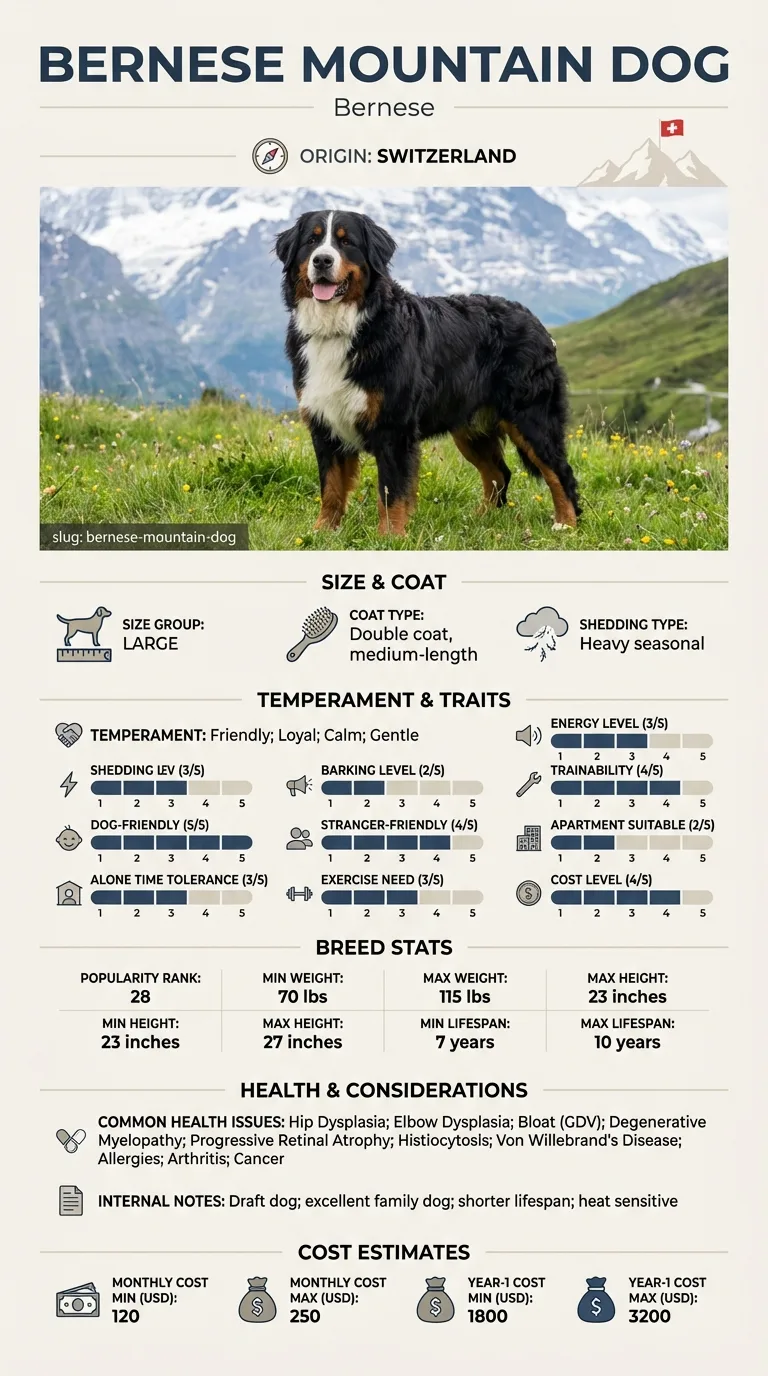
Von Willebrand's disease is listed among this breed's documented health issues, and DNA panel testing for the Type 1 variant is a standard, widely available screening tool used by breeders and owners to establish genetic status ahead of breeding decisions or planned surgery.
Why this happens
Breed factors
This is a documented, inherited condition in the Bernese Mountain Dog, transmitted through ordinary recessive inheritance. Its presence in the breed reflects the same population history and gene pool factors that explain why this breed's overall documented health list runs long, rather than any factor related to size, coat or temperament.
Environment factors
Breeding program decisions, specifically whether carrier or affected dogs are paired with other carriers or affected dogs, are the main modifiable factor at the population level. For an individual dog, whether the genetic status is known and communicated ahead of a major surgery is the environmental factor that matters most.
What you can do at home (once it is not an emergency)
When to talk to your vet
Discuss DNA testing at your dog's first wellness visit if breeding is being considered, and again before any planned major surgery or dental procedure regardless of whether your dog has ever shown a bleeding problem. There is no emergency associated with the genetic result itself; the urgency applies to making sure the information reaches the surgical team in advance of a procedure.
At home, alongside your vet's plan
Request a DNA panel result from the breeder before acquiring a puppy, and ask what pairing decisions were made in light of the parents' status.
If breeding your own dog, pair a carrier only with a clear dog, and never pair two carriers or two affected dogs together.
Keep a copy of your dog's DNA test result alongside its other veterinary records for easy reference before any future procedure.
Consider a functional clotting screen alongside the DNA result before a first major surgery, since the two tests answer different questions.
Share the full genetic result, not just a summary, with any new vet or specialist your dog sees.
Where genetic results get misread
Because a DNA panel produces a clean-looking result, clear, carrier, or affected, it's tempting to treat it as a diagnosis. For Type 1 specifically, the genetic label and the clinical reality often don't match.
Treating a DNA-affected result as a symptom diagnosis. Type 1 is frequently mild and subclinical, meaning many genetically affected dogs never show a meaningful bleeding tendency.
Breeding two carriers together without understanding the maths. Two carrier parents can, on average, produce a quarter affected, half carrier, and a quarter clear puppies, and knowing which is which matters for planning.
Assuming a 'clear' DNA result means a dog can never have a bleeding problem. It rules out this specific inherited variant, not every possible cause of abnormal bleeding.
Skipping DNA testing because a dog has never bled abnormally. Given how often Type 1 is clinically silent, absence of symptoms doesn't tell you the genetic status.
Overreacting to a carrier result as if it were the same as an affected result. A carrier typically has one normal and one variant copy and is not expected to show the same bleeding tendency as a dog with two variant copies.
Making a breeding decision based on DNA status alone, without also factoring in the dog's other health clearances and the diversity of the wider gene pool.
More Bernese Mountain DOG health & behavior issues
DNA testing produces a result within days to a couple of weeks of sample submission and does not change over the dog's lifetime, since it reflects fixed genetic status rather than a fluctuating clinical measure.
For breeders, success is pairings planned around known genetic status that avoid producing affected puppies unnecessarily. For individual owners, success is a genetic result on file and shared proactively with every vet involved in the dog's care, regardless of whether the dog has ever shown a clinical bleeding problem.
Why Type 1 specifically breaks the simple story
Von Willebrand's disease has more than one form, and they behave differently. Type 1 involves a partial reduction in the relevant clotting protein rather than its near-total absence, and it is inherited in a way where the severity of a dog's actual bleeding tendency can vary considerably even among dogs that test genetically the same. This means a DNA panel showing a dog as 'affected' for Type 1 is reporting a genetic fact, not predicting how that individual dog will behave clinically. Some genetically affected dogs bleed excessively at surgery; others go through multiple procedures over a lifetime without ever showing a problem.
This matters enormously for how a breeder should use the test. A DNA panel is precise about genotype: clear means no variant copies, carrier means one variant copy, and affected means two variant copies. Breeding two carriers together follows ordinary recessive inheritance patterns, producing on average a mix of clear, carrier, and affected puppies, and knowing this ratio lets a breeder plan pairings deliberately rather than guessing. A responsible approach generally avoids pairing two carriers or two affected dogs together, not because every resulting puppy would necessarily bleed, but because there's no way to know in advance which affected puppies will be the mild, silent majority and which might have a more clinically significant bleeding tendency.
For an individual dog owner, an affected result is not itself an emergency or even necessarily a reason for major lifestyle change. It is a reason to ensure any future surgical or dental team knows the genetic status in advance and screens appropriately before a procedure, exactly as covered for the clinical side of this condition elsewhere. The DNA test and a functional clotting screen answer different questions, and a full picture, especially before a first major surgery, often benefits from both rather than either alone.
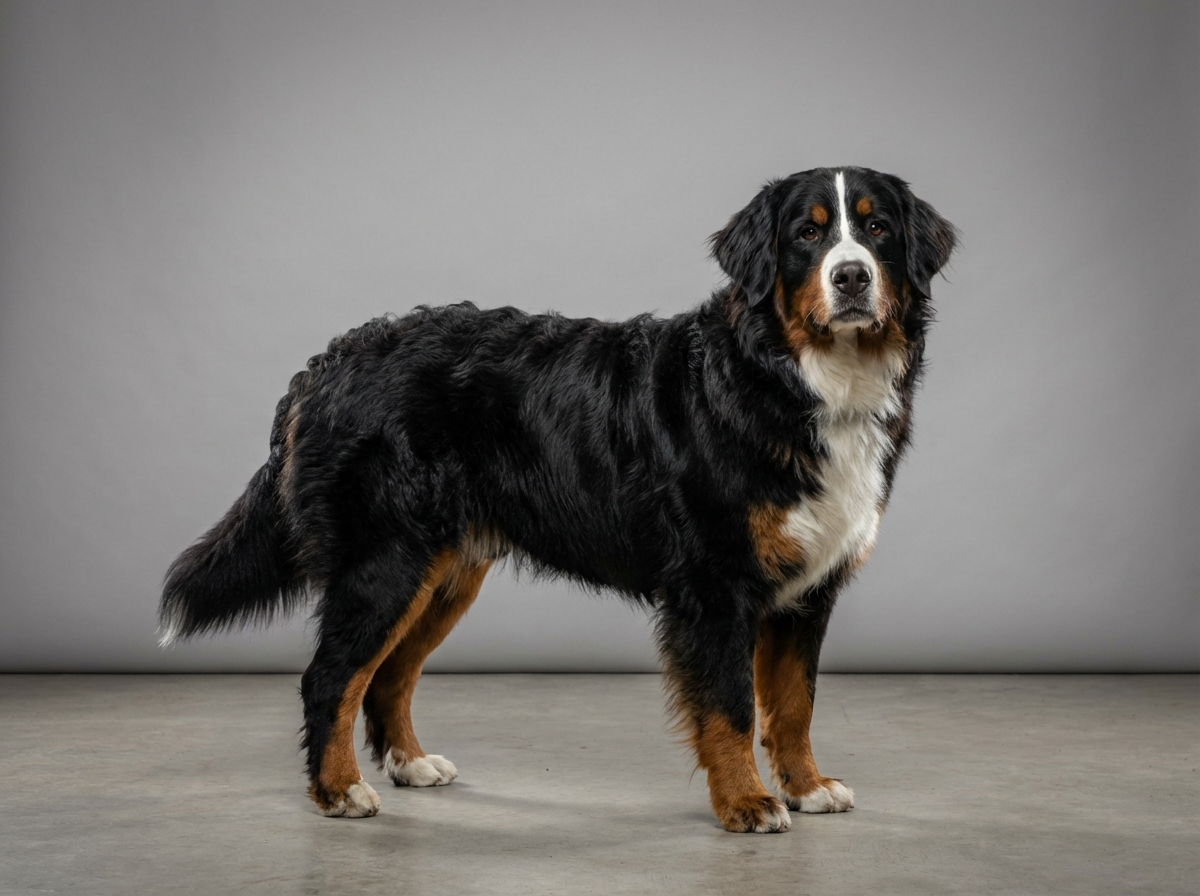
A Bernese Mountain Dog puppy with breeding paperwork
What to do next about von willebrand's disease (vwd1) in Berneses
If you think your Bernese has von willebrand's disease (vwd1), the plan is three steps: write down what you have seen and when it started, book a veterinary appointment rather than waiting for the next flare, and take video of the behaviour or symptom before you go — the thing you are worried about rarely happens in the consulting room. Screening in the parents covers hip dysplasia, elbow dysplasia, bloat (gdv).
What the vet visit should produce is a diagnosis and a written plan, not just reassurance: what is being ruled out, what the monitoring interval is, and which signs mean you come back sooner. Ask what the treatment costs across a year rather than per visit, because that is the number that decides whether you are managing this condition or reacting to it.
Between appointments, keep a short log — dates, what you saw, what changed. It is the single most useful thing an owner brings to a follow-up, and for von willebrand's disease (vwd1) it is often what separates a clear pattern from a guess.
Rosa's result didn't match her history
Lotte, a small hobby breeder, ran DNA panels on her breeding female Rosa before a planned litter and was surprised to see an affected result for Type 1, since Rosa had already whelped two litters and undergone a dental cleaning with no bleeding concerns ever noted.
Rather than dismiss the result, Lotte discussed it with her vet, who explained that Type 1 is often clinically silent even in genetically affected dogs. Lotte chose a clear stud for Rosa's next litter to avoid producing affected puppies, and made sure Rosa's own veterinary file now flagged the genetic result for any future procedure, even though Rosa herself had never shown a symptom.
Key takeaway: A dog's history of trouble-free surgeries doesn't rule out a genetic finding, and a genetic finding doesn't necessarily predict future trouble. Both pieces of information are worth having, and worth keeping on file even when they seem to disagree.
Frequently asked questions
What does a DNA-affected result for Type 1 actually mean?
It means the dog carries two copies of the variant associated with reduced clotting protein production. It reports genetic status, not a guarantee of how the dog will bleed clinically, since Type 1 in particular is often mild and subclinical.
Can a genetically affected dog live a normal life?
Often, yes. Many dogs that test affected for Type 1 never show a clinically meaningful bleeding tendency, though the genetic result should still be shared with any vet performing surgery or dental work.
What happens if I breed two carriers together?
Following ordinary recessive inheritance, the litter would be expected to average roughly a quarter clear, half carrier, and a quarter affected puppies. Most breed clubs and testing labs recommend avoiding carrier-to-carrier or affected-to-affected pairings.
Is a DNA test better than a clinical bleeding test?
They answer different questions. The DNA test reports genetic status precisely; a functional clotting screen shows how the protein is actually behaving in that individual dog. Using both gives a fuller picture, particularly before a first major surgery.
Should I test my dog even if it has never had a bleeding problem?
Yes, particularly if breeding is being considered or a major surgery is planned, since Type 1 is frequently silent clinically and the only way to know genetic status in advance is to test for it directly.
Does a carrier result mean my dog will bleed abnormally?
Not typically. A carrier has one normal and one variant copy and is not generally expected to show the same bleeding tendency as a dog with two variant copies, though this should still be discussed with your vet before major surgery.
Why do genetically identical results behave so differently between dogs?
Type 1 involves a partial rather than complete protein deficiency, and other factors beyond the single tested variant appear to influence how much any individual dog's clotting ability is actually affected, which is why clinical severity varies even among dogs with the same DNA result.
What is the difference between DNA-affected and clinically affected for Von Willebrand's Type 1?
DNA-affected describes the genetic result: two variant copies. Clinically affected means the dog actually shows a meaningful bleeding tendency, which many genetically affected Type 1 dogs never do.
Training
Should carrier dogs be used for breeding?
A carrier can generally be bred, but not to another carrier or an affected dog, to avoid producing genetically affected puppies in the litter.
Health
Is a DNA test alone enough before a major surgery?
Many vets recommend pairing it with a functional clotting screen, since the DNA result alone doesn't predict how significantly that individual dog's clotting is actually affected.
Costs
How much does DNA testing for this condition typically cost?
It is a standard single-panel genetic test, a modest cost relative to the surgical planning and blood product availability it can inform ahead of time.
Health
Can two clear parents produce an affected puppy?
Not for this specific variant, since two clear parents carry no copies of it to pass on. An affected puppy requires each parent to contribute at least one variant copy.
Related DogBreedCompass guides
living with Von Willebrand's disease in Bernese Mountain Dogs – The day-to-day and surgical-planning side of living with this same condition, for owners rather than breeders.
genetic load in Bernese Mountain Dogs – The population genetics reasoning behind why this breed carries several such inherited conditions at once.
genetic disorders in Bernese Mountain Dogs – A broader, health-history-focused look at genetic disorder concerns in this breed.