Health
How do I check if my Bichon is overweight?
Feel for ribs with light pressure and for a waist behind the ribcage. Looking at a coated dog tells you almost nothing.

Quick answer
How do I check if my Bichon is overweight?
Feel for ribs with light pressure and for a waist behind the ribcage. Looking at a coated dog tells you almost nothing.
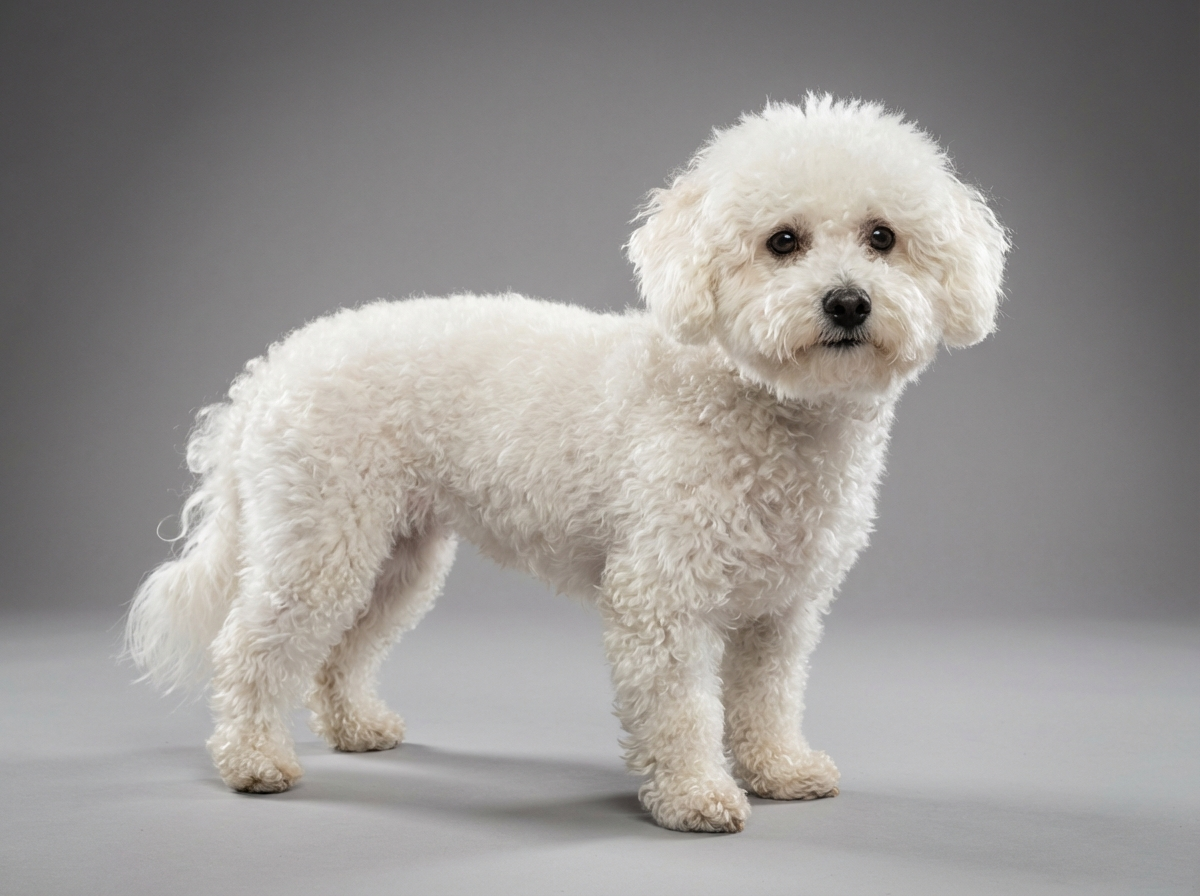
Nobody looks at a Bichon and thinks it is fat. That is the whole problem. This breed's coat is the most effective disguise for weight gain in the small dog world.
Owners who were told at a check-up that their dog needs to lose weight and were genuinely surprised, and anyone whose Bichon has developed joint stiffness or reduced heat tolerance and is looking for the underlying reason.
This guide is not medical advice. If your dog shows pain, sudden behavior change, or worsening symptoms, consult a licensed veterinarian.
Some links may be affiliate links. We may earn a commission at no extra cost to you. We only suggest products we believe are helpful for dog owners.
We research and check what we publish, but we do not warrant that any figure, date, price, or statement is accurate, complete, or current, and we accept no liability for any loss, cost, injury, or other harm arising from the use of this site. Use it as one reference among several. You remain responsible for your own decisions and for your dog's care - confirm anything that matters with a licensed veterinarian or another qualified professional before you act on it. Full disclaimer.
Excess weight in the Bichon Frise is a detection problem before it is a discipline problem. The breed's dense curly coat, professionally shaped every few weeks, conceals body outline so completely that owners genuinely cannot see gain until it is substantial. Since the consequences land on knees, heat tolerance and metabolic health, the practical priority is establishing a monthly hands-on assessment and a measured ration.
Excess body weight is among the most frequently identified health problems in companion dogs across all breeds, and small companion breeds with modest exercise requirements are well represented. What distinguishes the Bichon is not a higher rate but a longer delay before anyone notices, because the visual cues that prompt action in other breeds are simply not available.
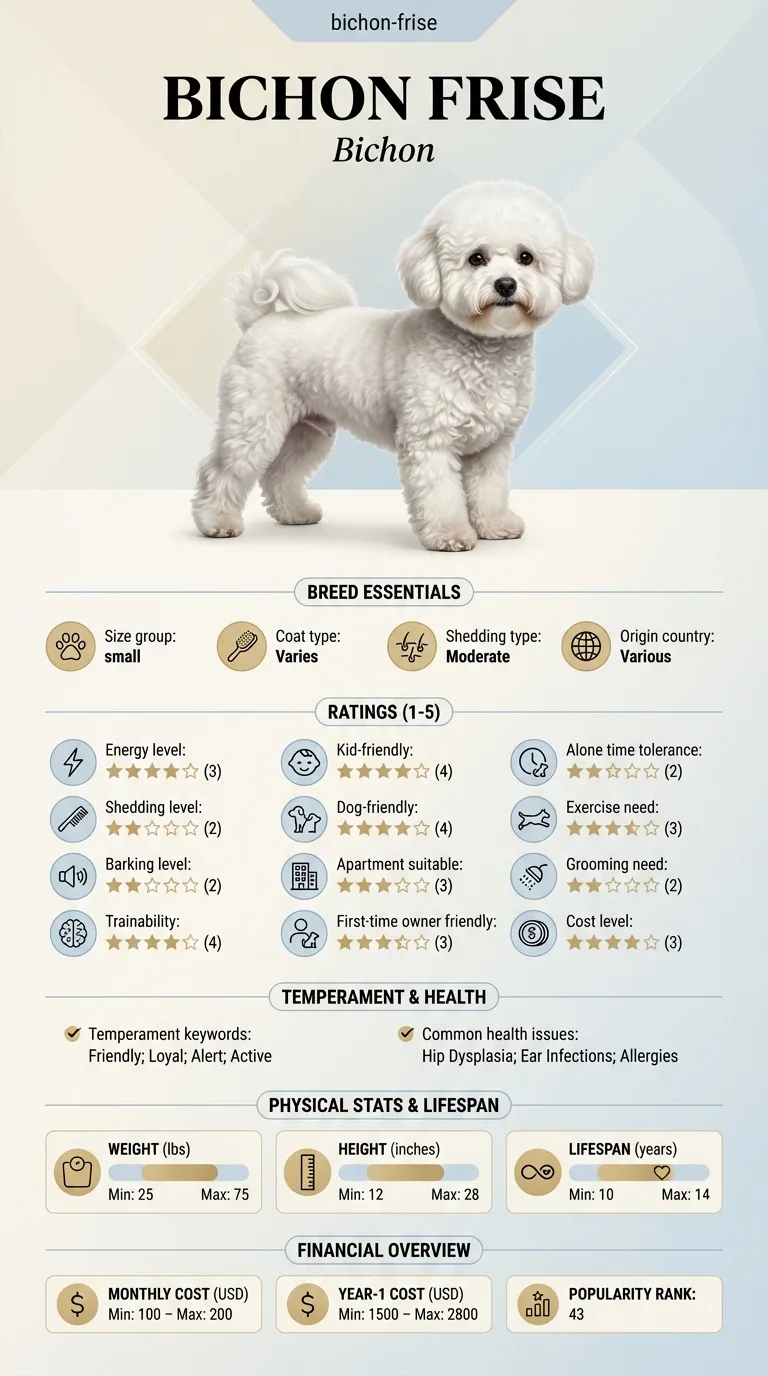
Three documented traits combine unhelpfully. The coat is curly, dense and very low shedding, so it holds its shaped outline regardless of what is underneath. The exercise requirement is modest, rated two out of five, so daily energy expenditure is low. And the adult weight range of 12 to 18 pounds is narrow enough that small absolute gains are large proportional ones. None of these makes a Bichon inherently prone to gain; together they make gain hard to spot and easy to sustain.
Household feeding behaviour is the dominant factor. This is an affectionate, people-focused breed that solicits attention effectively, and food is the easiest currency to pay in. Homes with several adults, visitors, or children who share snacks accumulate an unmeasured second diet on top of the measured one. Winter reduces walking, and in summer a heavily coated dog opts out of midday activity, so both seasons can trim expenditure without anyone adjusting intake.
Book an appointment before starting any significant reduction, so a target weight and a safe rate are set for your individual dog. Contact your vet promptly if weight has increased without any change in feeding, if your dog is also drinking more, seeking warmth or losing coat quality, since those suggest a hormonal cause. Seek urgent attention for a dog that stops eating entirely for more than a day, particularly during a weight loss programme, and for any sudden abdominal swelling, which is not weight gain and needs assessing immediately.
See all Bichon Frise health problems, which breeds are prone to obesity, or the full Bichon Frise breed guide for temperament, exercise needs and ownership costs.
Safe loss in a small dog is gradual, so bringing a Bichon down by two pounds typically takes three to four months. You will feel the difference in ribs and waist before the scale looks impressive. Owners usually notice improved willingness on walks within about six weeks.
Ribs easily felt with light pressure, a clear waist behind the ribcage, a dog that moves freely on stairs and copes better with warm weather, and a stable weight held for a year rather than a low point reached and lost again.
Since you cannot see the outline of this breed, learn to read the body underneath. Do this monthly, on a set date, and record what you find.
A dog this size needs a strikingly small amount of food, and that is where the trouble starts. The daily ration for a 15-pound dog is a matter of a few hundred calories, so the margin for error is tiny.
Consider what a single small biscuit represents. On a Labrador's daily budget it barely registers. On a Bichon's, a couple of treats plus a corner of toast plus the last spoonful of yoghurt can add a third of the day's energy without anyone thinking a meal has been given.
Multiple people feeding is the other structural problem. In a household of four, if each person gives one small treat a day, the dog has received four. Nobody has done anything unreasonable and the dog is overfed.
The breed's exercise need compounds it. A Bichon's requirement is genuinely modest, so the calories are not being burned off by long working days. This is a companion animal built for a sedate routine with an appetite that does not know that.
The fix is arithmetic rather than willpower. Measure the daily ration, take treats out of that measured amount rather than adding them on top, and appoint one person responsible for the total.

Dexter looked immaculate. His owner Paul had him trimmed every five weeks and thought he looked exactly as he always had. At a routine vaccination the practice weighed him: nineteen pounds, up from fifteen and a half two years earlier. Paul was sceptical until the vet took his hands and put them on Dexter's ribs. He could not find them without pressing hard. They weighed his food, discovered the scoop held nearly half again what Paul assumed, and moved his treats inside the ration. Paul's teenage son was giving cheese most evenings without mentioning it. Dexter reached sixteen pounds over five months and started completing the full park loop again.
Key takeaway: In this breed the groomer's work and the owner's eye conspire against you. Weigh the food, weigh the dog, and trust your hands over the mirror.
The breed's typical adult range is 12 to 18 pounds at a height of nine to twelve inches. Where an individual should sit within that range depends on frame size, which is why body condition assessed by touch is a better target than a single number on a chart.
Because the proportions are extreme. Two extra pounds on a 14-pound dog is over fourteen percent of body mass, and that load passes through knees already prone to patellar luxation, a documented concern in this breed. It also reduces heat tolerance in a dog carrying a heavy coat.
Slowly and under veterinary guidance. Rapid restriction in a small dog risks nutritional shortfalls and muscle loss. Ask your vet to set a target and a weekly rate, and weigh on the same scale so the numbers are comparable week to week.
Do not do this without advice. Reducing a complete diet also reduces the vitamins and minerals it contains, which matters more in a small ration. A therapeutic weight diet delivers fewer calories in a similar volume without the shortfall, and your vet can advise on whether that suits.
Not on its own. A Bichon's exercise requirement is modest, and you cannot realistically walk enough to outrun a persistent calorie surplus in a dog this size. Exercise preserves muscle and joint health during weight loss; intake is what determines whether the weight comes off.
It can be. Reduced thyroid function slows metabolism and causes gain on unchanged food, and it is commonly missed in this breed because the coat hides both the weight and the coat changes. If gain is unexplained, ask your vet about testing rather than assuming overfeeding.
Feel for ribs with light pressure and for a waist behind the ribcage. Looking at a coated dog tells you almost nothing.
Keep treats under roughly a tenth of daily calories, and subtract them from the measured meal rather than adding them.
Therapeutic diets cost more per bag but often less overall, since you are feeding a controlled amount and buying fewer treats.
Kitchen scales. Cup measures vary enough to matter when the whole daily ration is only a small quantity.
Split the same ration into more meals, use a slow feeder, and have everyone ignore begging consistently rather than intermittently.
A one-page prep sheet for this condition: the signs, the questions to ask, what to get priced. Unlocks here.
You get: Vet visit prep sheet
No spam. One-click unsubscribe. See our privacy policy.
Preview page 1 before you decide.