Health
What's the biggest warning sign of IVDD in a French Bulldog?
Sudden reluctance to jump combined with a hunched back or crying out when touched or picked up.

Quick answer
What's the biggest warning sign of IVDD in a French Bulldog?
Sudden reluctance to jump combined with a hunched back or crying out when touched or picked up.
A sudden reluctance to jump, a hunched back, or a yelp when picked up isn't a quirky mood — in this breed, it's one of the more urgent signs an owner can see.
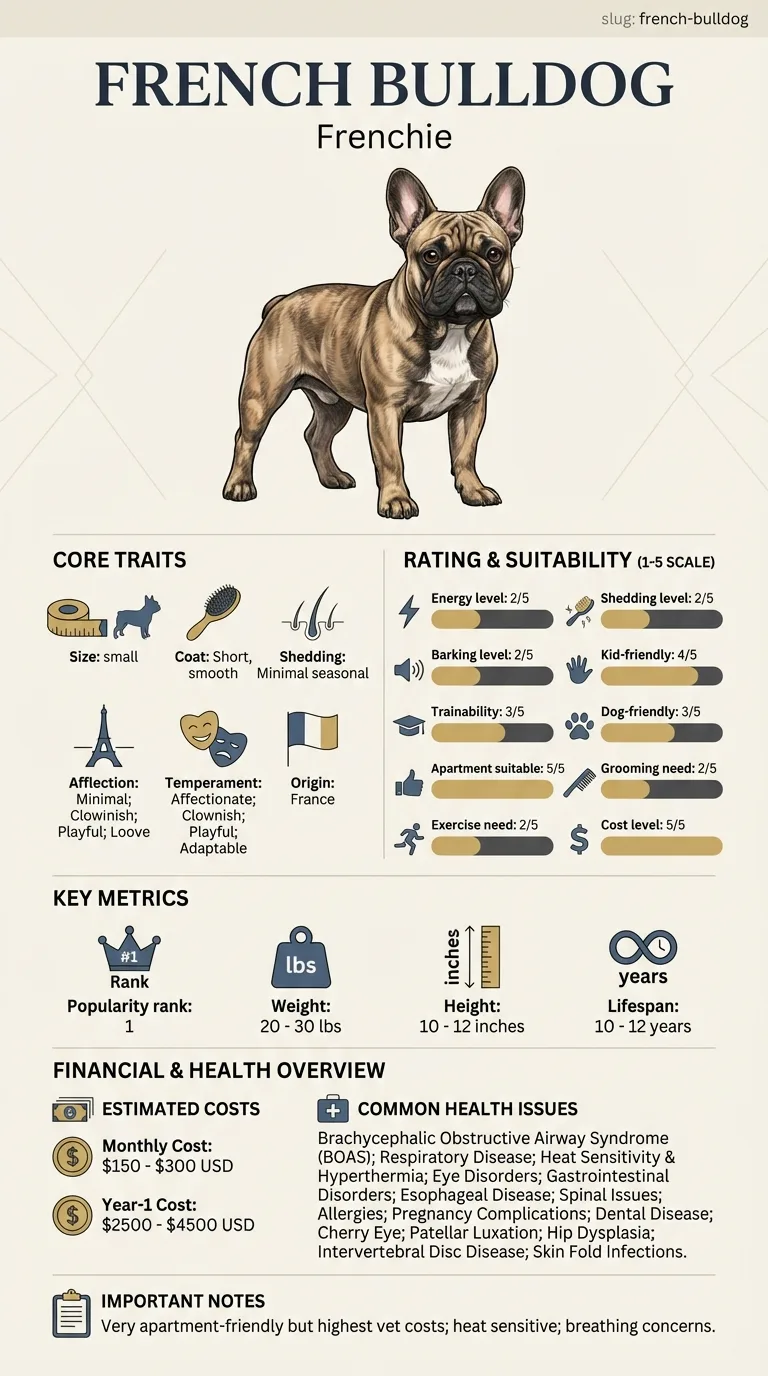
This affects owners across every age group, but it hits hardest for families who didn't know disc disease was a defining risk of the breed until the day their otherwise healthy-looking dog suddenly couldn't walk normally.
This guide is not medical advice. If your dog shows pain, sudden behavior change, or worsening symptoms, consult a licensed veterinarian.
Some links may be affiliate links. We may earn a commission at no extra cost to you. We only suggest products we believe are helpful for dog owners.
We research and check what we publish, but we do not warrant that any figure, date, price, or statement is accurate, complete, or current, and we accept no liability for any loss, cost, injury, or other harm arising from the use of this site. Use it as one reference among several. You remain responsible for your own decisions and for your dog's care - confirm anything that matters with a licensed veterinarian or another qualified professional before you act on it. Full disclaimer.
Check this first
A dog that suddenly can't stand, drags one or both back legs, loses bladder or bowel control, or cries out in pain when the back or neck is touched needs emergency veterinary attention immediately — every hour of delay with significant spinal cord compression can reduce the odds of full recovery, especially with surgery.
Milder signs — occasional reluctance to jump, a slightly hunched posture, mild stiffness — still warrant a prompt vet visit, but represent a different urgency level than sudden paralysis or loss of bladder control.
Owners are sometimes told to 'crate rest and watch,' which is appropriate for very mild, non-progressive signs under direct veterinary guidance, but it is not the right response to any sudden loss of leg function or bladder control.
If any of these apply, call your vet or an emergency clinic now. The rest of this page is for the cases that are not an emergency.
Intervertebral disc disease (IVDD) occurs when the cushioning discs between spinal vertebrae degenerate, calcify, bulge, or rupture, putting pressure on the spinal cord. In French Bulldogs, this process starts earlier and progresses faster than in most other breeds because of the chondrodystrophic trait behind the breed's compact build, making IVDD one of the most consequential health risks owners need to understand.
IVDD is one of the most frequently cited and clinically significant health conditions in French Bulldogs, with the breed consistently appearing among those most affected in veterinary neurology literature. Severity ranges widely, from mild, non-progressive discomfort to sudden, severe paralysis.
The FGF4-linked chondrodystrophic trait that gives French Bulldogs their short legs also causes intervertebral discs to lose their soft, gel-like cushioning and calcify years earlier than in non-chondrodystrophic breeds. A calcified disc is more brittle and prone to sudden rupture or slow bulging under everyday mechanical stress than a healthy, pliable one.
Body weight, jumping habits, and how a dog is handled day to day all influence how much stress an already-vulnerable spine absorbs. A lean dog that's lifted properly and uses ramps instead of jumping puts meaningfully less cumulative load on its discs than a heavier dog that jumps on and off furniture dozens of times a day.
Seek immediate veterinary care for sudden leg weakness, dragging of the back legs, loss of bladder or bowel control, or crying out when the back or neck is touched. See a vet promptly, though not necessarily as an emergency, for reluctance to jump, a hunched posture, or general stiffness that persists beyond a day.
Because early signs can look mild, several common reactions end up making the eventual outcome worse.
See all French Bulldog health problems, which breeds are prone to intervertebral disc disease ivdd, or the full French Bulldog breed guide for temperament, exercise needs and ownership costs.
A sudden, severe disc event requires urgent decision-making within hours to days, particularly if surgery is being considered. Recovery, if surgical, typically involves several weeks of restricted activity and physical rehabilitation.
Success looks different depending on severity — for a mild case, it's a return to comfortable, restricted-jump daily life; for a severe case treated promptly, it's regaining functional walking, which isn't guaranteed but is achievable with fast, appropriate treatment.
Waffles, a four-year-old Frenchie, went from his normal self to suddenly refusing to move off his bed one morning, crying out when his owner tried to lift him. Within hours his back legs looked increasingly wobbly, and by that afternoon he could barely stand. An emergency vet visit and MRI confirmed a herniated disc compressing his spinal cord. Given the severity and how quickly it had progressed, his vet recommended immediate surgical decompression rather than waiting to see if medication alone would help. Waffles spent the next several weeks in structured rehabilitation, regaining the ability to walk within about three weeks and returning to nearly normal movement by two months out.
Key takeaway: The speed of Waffles' decline was itself the warning sign — with IVDD, how fast symptoms progress matters as much as how bad they look at any single moment.
Their chondrodystrophic build — the genetic trait behind their short legs — causes intervertebral discs to calcify and lose their normal cushioning years earlier than in non-chondrodystrophic breeds, making them mechanically more likely to herniate or bulge under everyday stress.
Reluctance to jump or climb stairs, a hunched or arched back, reduced activity, yelping when picked up or touched along the spine, and a stiff or wobbly gait are common early indicators.
It can be. Sudden loss of leg function, dragging the back legs, or loss of bladder or bowel control are emergencies requiring immediate veterinary care, since spinal cord compression can worsen quickly.
Not always — milder cases without significant neurological deficits are sometimes managed with strict crate rest and medication, but moderate to severe cases, especially with weakness or paralysis, often need surgical decompression for the best recovery chances.
Surgical treatment, including imaging and post-operative care, commonly runs anywhere from about $4,000 to $10,000 depending on severity, location, and specialist fees.
Many dogs, especially those treated promptly, regain good function. Recovery odds decrease with the severity of the initial neurological deficit and the delay before treatment.
Keep your dog lean, use ramps or steps instead of allowing jumping on and off furniture, support the torso when lifting, and avoid activities that involve twisting or hard landings on the spine.
Yes, a dog that has had one disc event is at increased risk for another, at the same or a different spinal level, which is part of why long-term activity management matters even after recovery.
Sudden reluctance to jump combined with a hunched back or crying out when touched or picked up.
It can be — sudden leg weakness, dragging, or loss of bladder control need immediate veterinary care.
Surgical cases commonly range from $4,000 to $10,000 including imaging and post-operative care.
Not entirely, but weight control and avoiding jumping and twisting significantly reduce the risk.
Many do, especially with prompt treatment; outcomes depend heavily on severity and how quickly care begins.
A one-page prep sheet for this condition: the signs, the questions to ask, what to get priced. Unlocks here.
You get: Vet visit prep sheet
No spam. One-click unsubscribe. See our privacy policy.
Preview page 1 before you decide.