Health
What is the first sign of DM in a Bernese?
Scuffing of the hind feet with wear on the outer nails, and a slight sway at the back end, in a dog showing no pain at all.

Quick answer
What is the first sign of DM in a Bernese?
Scuffing of the hind feet with wear on the outer nails, and a slight sway at the back end, in a dog showing no pain at all.
This disease takes function without taking comfort. That is what makes the decisions so hard.
Owners of Berners aged seven and over who have noticed the hind feet scuffing on pavement, and owners who have just had the diagnosis confirmed and need to know what the next eighteen months look like.
This guide is not medical advice. If your dog shows pain, sudden behavior change, or worsening symptoms, consult a licensed veterinarian.
Some links may be affiliate links. We may earn a commission at no extra cost to you. We only suggest products we believe are helpful for dog owners.
We research and check what we publish, but we do not warrant that any figure, date, price, or statement is accurate, complete, or current, and we accept no liability for any loss, cost, injury, or other harm arising from the use of this site. Use it as one reference among several. You remain responsible for your own decisions and for your dog's care - confirm anything that matters with a licensed veterinarian or another qualified professional before you act on it. Full disclaimer.
Degenerative myelopathy is progressive breakdown of the insulating material around nerve fibres in the spinal cord, beginning in the region serving the hind limbs. Messages between brain and legs degrade, coordination fails, and weakness follows. The dog remains alert, hungry and pain-free while losing the use of its back end.
Degenerative myelopathy is on the Bernese Mountain Dog's documented health issue list, which puts it among the conditions owners of this breed should recognise. It is nonetheless far from universal, and hind-limb problems in an older Berner are more often orthopaedic than neurological.
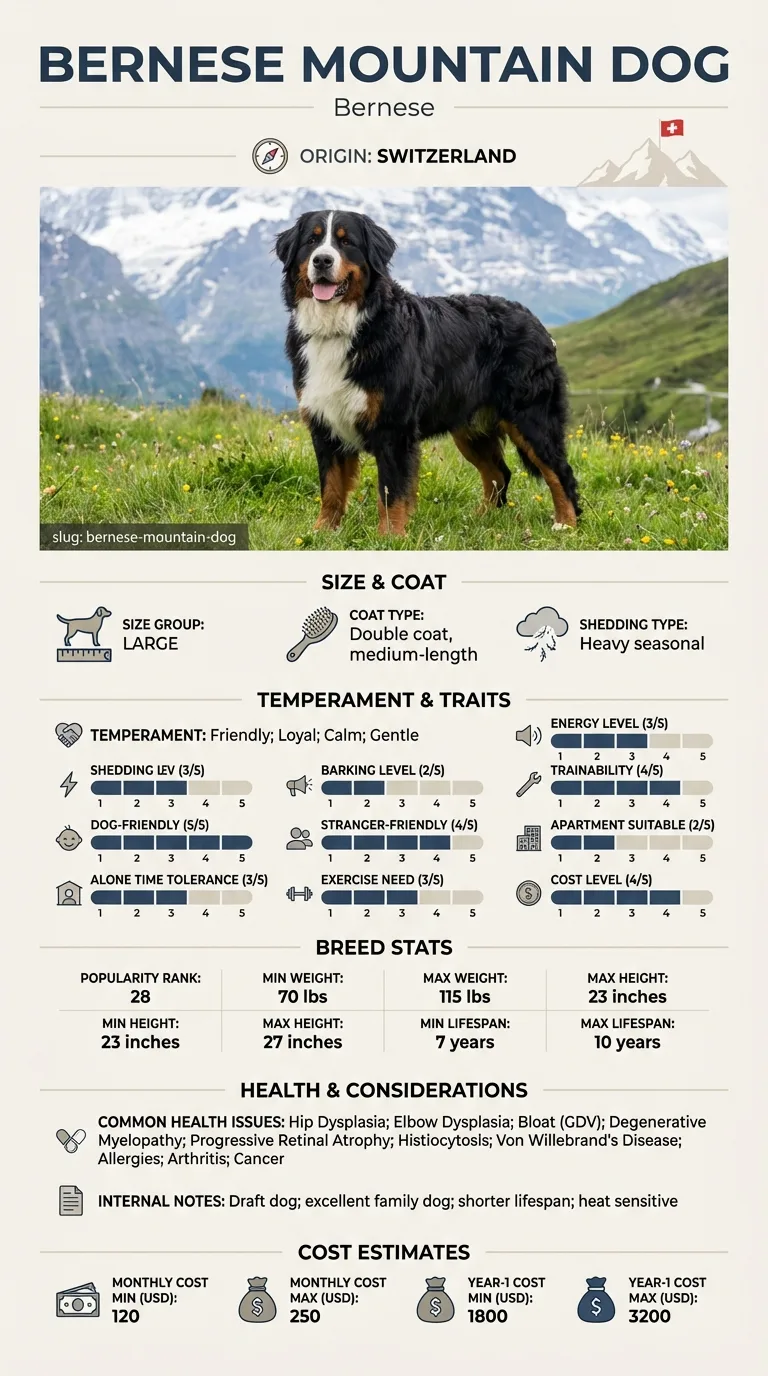
The disease is documented in the breed, so inherited susceptibility is the direct answer. Two further breed facts shape the experience rather than the biology: at 70 to 115 pounds a Bernese is beyond what most owners can lift or support unaided, and with a seven to ten year lifespan the disease arrives in a dog already dealing with the arthritis and joint conditions the breed also carries.
Nothing an owner did caused this, and that is worth saying plainly. Environment determines how well the dog copes: hard smooth floors cause falls, stairs become impassable, pavement wears open a dragging paw, and an inactive routine accelerates the muscle loss that makes everything harder.
Book promptly for scuffed hind feet, a swaying back end, or crossing hind legs in an older Bernese, specifically so that treatable causes can be excluded. Go the same day if there is pain, if the decline has happened over hours or days rather than months, or if your dog has lost bladder or bowel control suddenly, because that combination points at spinal cord compression, which is time-critical and sometimes treatable. Once a working diagnosis exists, contact your vet if the dog develops sores on the feet or hips, becomes unable to rise unaided, or shows any change in the front limbs, and revisit the quality-of-life conversation at each stage rather than only at the end.
Nothing here changes the disease. All of it changes how the months go.
Start here: Bernese Mountain Dog Most Common Genetic Disorders
See all Bernese Mountain DOG health problems, which breeds are prone to degenerative myelopathy dm, or the full Bernese Mountain DOG breed guide for temperament, exercise needs and ownership costs.
Typically six months to three years from the first scuff, and often at the shorter end for a giant breed. Progression is steady rather than sudden, with plateaus that can be mistaken for improvement.
Not a cure, and not a halt. A dog kept mobile, clean, well muscled and interested for as long as possible, and an owner who made each decision early rather than in crisis.
It begins with a scuff. The dog catches the top of one hind foot on pavement, and there is wear on the outer nails of that foot. There may be a slight sway at the back end when it walks away from you, or crossing of the hind legs on a turn. Crucially the dog shows no pain, does not flinch when the back is handled, and is otherwise entirely well. Most owners notice this stage in hindsight rather than at the time.
Over the following months the weakness becomes obvious. The dog knuckles a paw over and does not correct it. It struggles to rise on smooth floors, wobbles on turns, and its hindquarter muscle visibly wastes. It still wants its walk and still eats with enthusiasm, which is the disorienting part.
Eventually the hind legs cannot support the dog at all. At this point a wheeled cart allows many dogs a genuinely good period of continued mobility, and dogs adapt to them faster than owners expect. Bladder and bowel control is commonly lost around this stage. In the final phase the front limbs begin to be affected too.
The timeline in large breeds is often quoted at six months to three years from first signs, and body size shortens the usable portion of it, because a 70 to 115 pound dog becomes unmanageable at home sooner than a spaniel does. Given the breed's seven to ten year lifespan, most affected Berners are already senior when it starts.
Diagnosis is by exclusion. Compressive spinal disease, hip and knee problems and other neurological conditions must all be ruled out first, and some of those are treatable, which is precisely why the workup is worth doing rather than assuming the worst.

Kuno was eight when his owner Marisol noticed the outer nails of his left hind foot were worn flat. There was no pain and no limp. A full workup ruled out compression and hip disease, and a working diagnosis of degenerative myelopathy was made. Her vet's advice surprised her: order the cart now, not later. Marisol measured him, ordered it, and introduced it while he could still walk. When he needed it eight months on, Kuno already knew what it was and took to it in an afternoon. He had another five months of morning walks in it before the front limbs began to weaken. Marisol kept a weekly quality-of-life note throughout, and says it was the record, not any single day, that told her when.
Key takeaway: Every decision in this disease is easier taken early. The cart bought time only because it arrived before the crisis it was meant to solve.
No, and that absence of pain is one of the diagnostic features. A dog with a painful back arches, flinches or objects to handling. A dog with this disease is comfortable throughout, which is why comfort alone cannot be used to judge how far it has progressed.
It reports whether your dog carries a variant associated with the disease. It identifies risk, not disease. Many dogs with two copies never develop clinical signs, and a positive result in a healthy dog does not mean the illness is coming. It is most useful to breeders.
By excluding everything else. That means a neurological examination, imaging of the spine to rule out compression, and assessment of the hips and knees. A confident diagnosis in life is a diagnosis of exclusion, and confirming it definitively is only possible after death.
There is no treatment that stops or reverses the disease. Structured physiotherapy and consistent controlled exercise are the interventions with the best support for maintaining function longer. Be sceptical of any product promising to halt progression.
Commonly six months to three years from first signs, though large breeds often reach the point of unmanageable mobility at home sooner. Most owners of giant breeds find the practical limits arrive before the disease's natural end point.
For many, yes. Carts sized for hundred-pound dogs exist, and dogs typically take to them within days. Measure and order early rather than waiting, since fitting takes time and the dog learns more easily while it still has some hind-limb strength.
Scuffing of the hind feet with wear on the outer nails, and a slight sway at the back end, in a dog showing no pain at all.
You cannot without a workup. Pain, if present, argues for a compressive or orthopaedic cause, and several of those have treatments worth having.
Non-slip flooring throughout, a rear-support harness, a car ramp, protective boots for scuffing feet, and everything the dog needs on one level.
Diagnostic imaging upfront, then physiotherapy sessions, boots, harnesses and eventually a cart. Equipment for a hundred-pound dog costs more at every step.
Yes, and you should. Regular controlled exercise, guided by a rehabilitation therapist, is the intervention most associated with maintaining function longer.
A one-page prep sheet for this condition: the signs, the questions to ask, what to get priced. Unlocks here.
You get: Vet visit prep sheet
No spam. One-click unsubscribe. See our privacy policy.
Preview page 1 before you decide.