Health
Does disc disease look different in large breeds?
Yes. It usually develops over months as a gradual protrusion rather than as an overnight rupture, so the early signs are subtle changes in stride and willingness to jump.

Quick answer
Does disc disease look different in large breeds?
Yes. It usually develops over months as a gradual protrusion rather than as an overnight rupture, so the early signs are subtle changes in stride and willingness to jump.
In a Berner, disc disease usually creeps. That makes it easier to miss and harder to date.
Owners trying to work out whether the slow change in their dog's gait over the last six months is age, arthritis, or something pressing on the spinal cord.
This guide is not medical advice. If your dog shows pain, sudden behavior change, or worsening symptoms, consult a licensed veterinarian.
Some links may be affiliate links. We may earn a commission at no extra cost to you. We only suggest products we believe are helpful for dog owners.
We research and check what we publish, but we do not warrant that any figure, date, price, or statement is accurate, complete, or current, and we accept no liability for any loss, cost, injury, or other harm arising from the use of this site. Use it as one reference among several. You remain responsible for your own decisions and for your dog's care - confirm anything that matters with a licensed veterinarian or another qualified professional before you act on it. Full disclaimer.
Each spinal disc is a cushion between two vertebrae. When its outer ring weakens, the disc bulges toward the spinal cord above it. In large breeds this happens slowly, so the cord is compressed by degrees, and the dog loses coordination and comfort gradually rather than all at once.
Far less common in this breed than hip and elbow disease, and less common than in the short-legged breeds famous for it. It matters because it is treatable when found, and because it can be mistaken for conditions that are not.
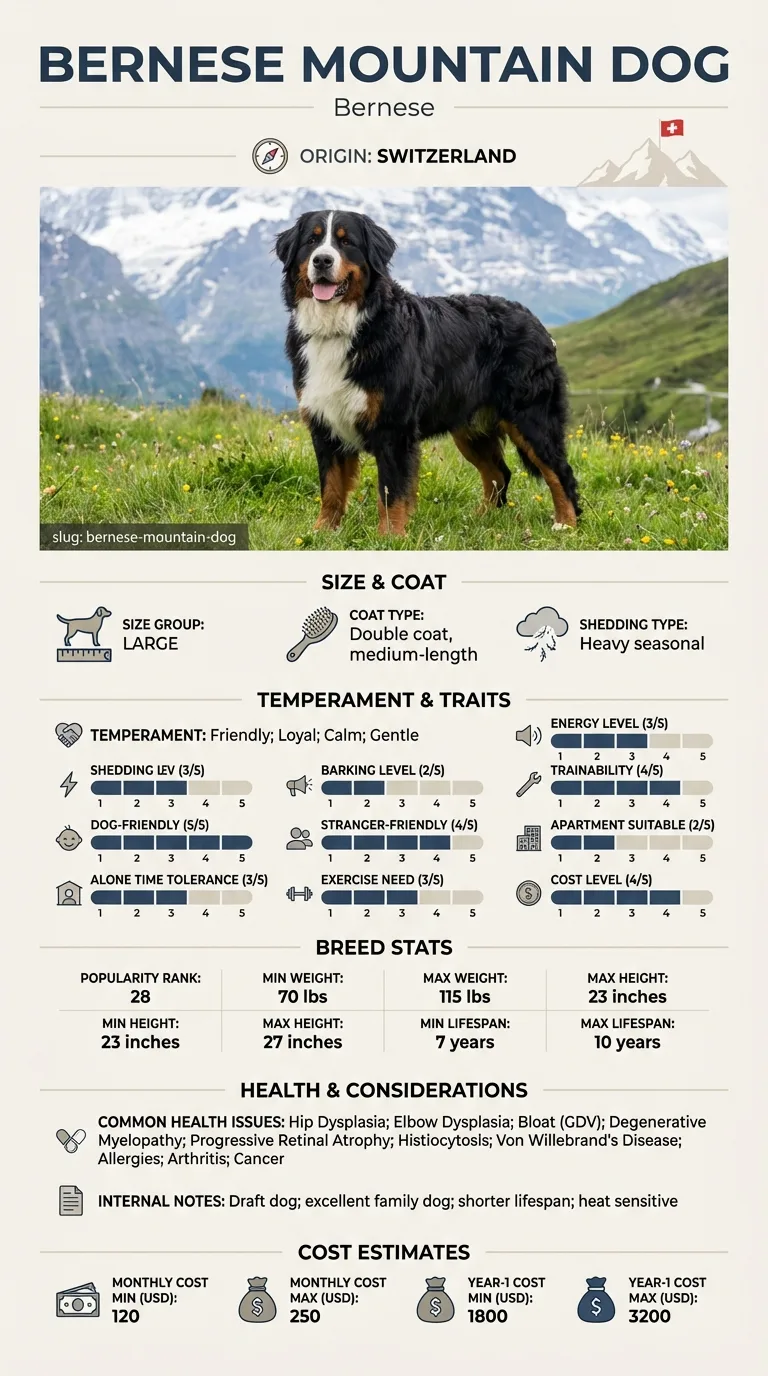
Bernese discs age the way large-breed discs age: fibrously and slowly, rather than calcifying in the first years of life. Combined with a 70 to 115 pound body and a draft-work heritage that drives force through the spine, that produces the gradual bulging pattern. The breed's documented degenerative myelopathy is the main condition it must be told apart from.
Household architecture is the practical driver. Stairs, high car boots and slippery floors generate repeated loading and occasional violent twists. Collar walking on a dog that pulls adds cervical strain. None of these cause disc disease outright, but they determine how quickly a weakening disc is pushed over the line.
Go immediately, day or night, for a dog that cannot stand on its hind legs, is dragging a foot, has lost bladder or bowel control, or has cried out and then become unwilling to move. These are signs of significant spinal cord compression and outcomes depend on how fast treatment begins. Book within a week for a gradual shortening of stride, new reluctance to jump, scuffed hind nails, or pain when the back or neck is handled. Bring your monthly videos; a documented six-month decline tells a neurologist more than any description.
Most missteps here come from applying a small-breed template to a hundred-pound dog. These are the ones that cost the most.
Start here: Bernese Mountain Dog Most Common Genetic Disorders
See all Bernese Mountain DOG health problems, which breeds are prone to backspine issues, or the full Bernese Mountain DOG breed guide for temperament, exercise needs and ownership costs.
Conservatively managed dogs usually stabilise over six to twelve weeks of strict restriction. Surgical cases need six to eight weeks of intensive nursing, and large dogs regain function more slowly than small ones.
A stable gait held for months at a time, comfort on handling, and maintained hindquarter muscle. Full restoration of a young dog's movement is rarely the realistic goal.
It begins as something you would never book an appointment for. The dog takes an extra beat before jumping into the car. Its stride behind shortens slightly. It stops shaking itself off as vigorously after a swim. None of it is alarming, and a calm, uncomplaining breed makes it easier to explain away.
Over the following months the changes accumulate. The hind feet start to scuff on rough ground. The dog becomes unwilling to turn its head fully to one side if the affected disc is in the neck. Some dogs develop a hunched stance or hold the tail lower than usual. Muscle over the affected end begins to waste, which is why comparing old photographs with current ones is genuinely useful evidence.
What separates this from the other large-breed spinal condition Bernese owners hear about is pain. Gradual disc protrusion usually hurts, at least intermittently, and the dog reacts to pressure over the spine. Degenerative myelopathy, which is on the breed's documented health list, does not hurt at all. If your dog is uncomfortable, that argues for a compressive cause rather than a degenerative one, and compressive causes have treatments.
The acute overlay is the emergency. A dog with an existing bulging disc can decompensate suddenly, going from managing to non-walking in a day. Loss of hind-limb function, loss of bladder control, or a dog that cries out and then cannot rise means going in now.

If you think your Bernese has back/spine issues, the plan is three steps: write down what you have seen and when it started, book a veterinary appointment rather than waiting for the next flare, and take video of the behaviour or symptom before you go — the thing you are worried about rarely happens in the consulting room. Screening in the parents covers hip dysplasia, elbow dysplasia, bloat (gdv).
What the vet visit should produce is a diagnosis and a written plan, not just reassurance: what is being ruled out, what the monitoring interval is, and which signs mean you come back sooner. Ask what the treatment costs across a year rather than per visit, because that is the number that decides whether you are managing this condition or reacting to it.
Between appointments, keep a short log — dates, what you saw, what changed. It is the single most useful thing an owner brings to a follow-up, and for back/spine issues it is often what separates a clear pattern from a guess.
Sennen was seven when his owner Marta started filming him walking away from her down the same lane on the first Sunday of each month. She had begun the habit for a different reason, to track his weight after a diet. By the fourth clip the difference in his hind stride was unmistakable, though she had noticed nothing day to day. Her vet examined him, found pain over the lower spine, and referred him. Imaging showed a bulging disc pressing on the cord. He was managed conservatively with restriction and rehabilitation, and his sixth-month video looked better than his fourth.
Key takeaway: Slow disease needs a slow measuring stick. A monthly video from a fixed viewpoint is the cheapest diagnostic tool a large-breed owner has.
They can, but in the slow protrusive form typical of large, normally proportioned breeds rather than the explosive form associated with cartilage-modified breeds. It is not listed among the Bernese Mountain Dog's headline documented health issues, which centre on hips, elbows, bloat, degenerative myelopathy, eyes, histiocytosis, bleeding disorder, allergies, arthritis and cancer.
Mostly by pain and by imaging. Disc protrusion is usually painful and shows compression on MRI. Degenerative myelopathy is painless, progresses steadily, and shows no compressive lesion. Since one has treatment options and the other does not, distinguishing them properly matters.
Only if the result would change what you do. MRI under general anaesthesia at a referral centre is how compression is confirmed and located before surgery. If surgery is not on the table for medical or financial reasons, your vet may reasonably manage conservatively without it.
Yes, and size is not itself a barrier, though it makes post-operative nursing much harder. A hundred-pound dog that cannot walk needs slings, help to toilet and a household set up for it. Discuss the recovery honestly with the surgeon before deciding.
For slowly progressive protrusion, many dogs do reasonably on strict activity restriction, prescribed pain relief and a rehabilitation programme. It manages the problem rather than removing the compression, so expect a plan reviewed over years rather than a resolution.
Yes for any large dog that pulls, and especially where neck-region discs are suspected. A well-fitted body harness spreads force across the chest instead of concentrating it on the cervical spine, and a Berner leaning into a collar generates real force.
Yes. It usually develops over months as a gradual protrusion rather than as an overnight rupture, so the early signs are subtle changes in stride and willingness to jump.
Sudden inability to stand, dragging hind feet, or loss of bladder control. Go immediately; the window for the best outcome is measured in hours.
Lead walks only for toileting, non-slip flooring, no stairs, no jumping into cars, and a barrier to stop the dog following you room to room.
MRI plus surgery at a referral centre is one of the largest bills a dog owner can face, before nursing costs. Ask for a written estimate before committing.
Introduce it with food while the dog is well, a few seconds at a time, so it is a familiar object rather than something forced on a frightened dog.
A one-page prep sheet for this condition: the signs, the questions to ask, what to get priced. Unlocks here.
You get: Vet visit prep sheet
No spam. One-click unsubscribe. See our privacy policy.
Preview page 1 before you decide.