Living
Do both suit apartment living equally?
Yes, both rate very high (5/5) with low barking — an easy tie.

Quick answer
Do both suit apartment living equally?
Yes, both rate very high (5/5) with low barking — an easy tie.
Bulldog (English) or Pug? On paper they differ most on good for first-time owners, and on the scales Bulldog (English) is the heavier at 40–50 lbs. Here is how the two compare on everything that shapes an ordinary week.
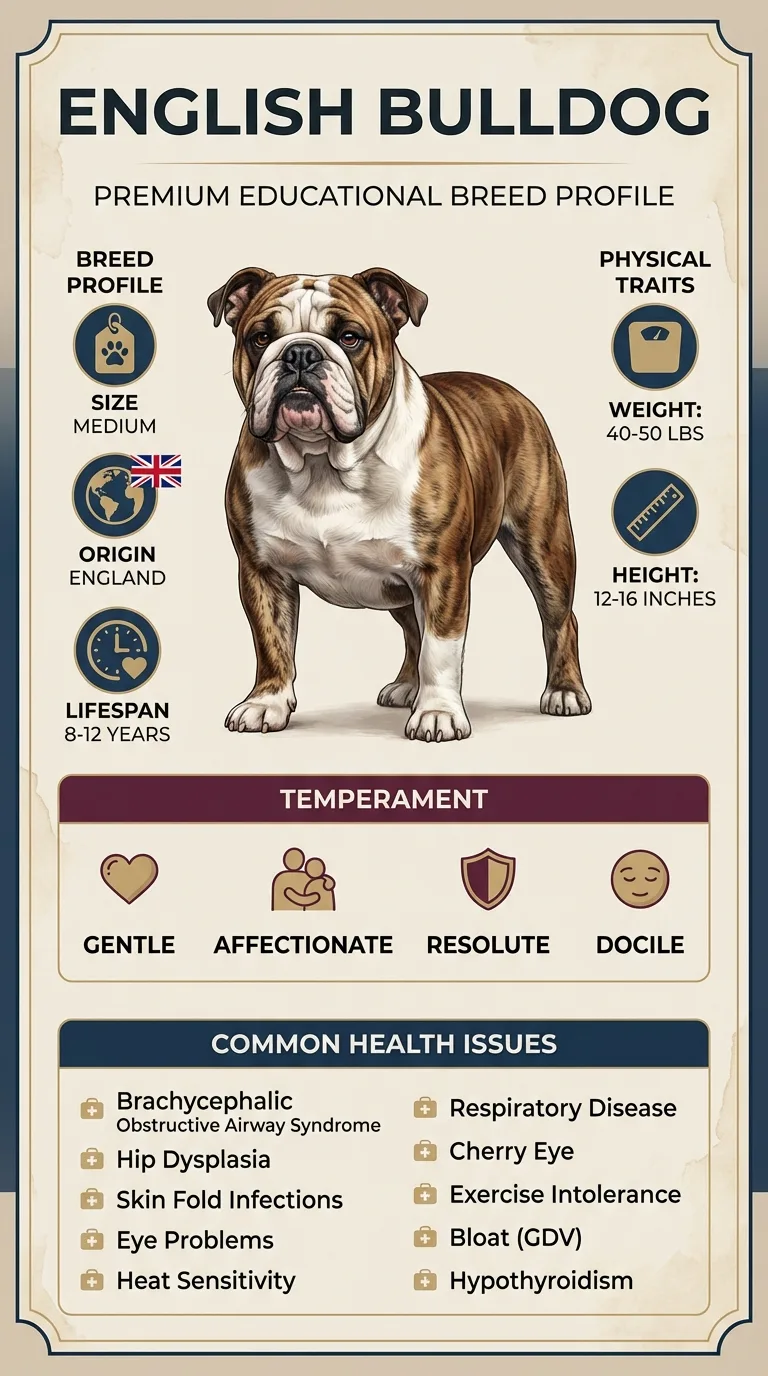
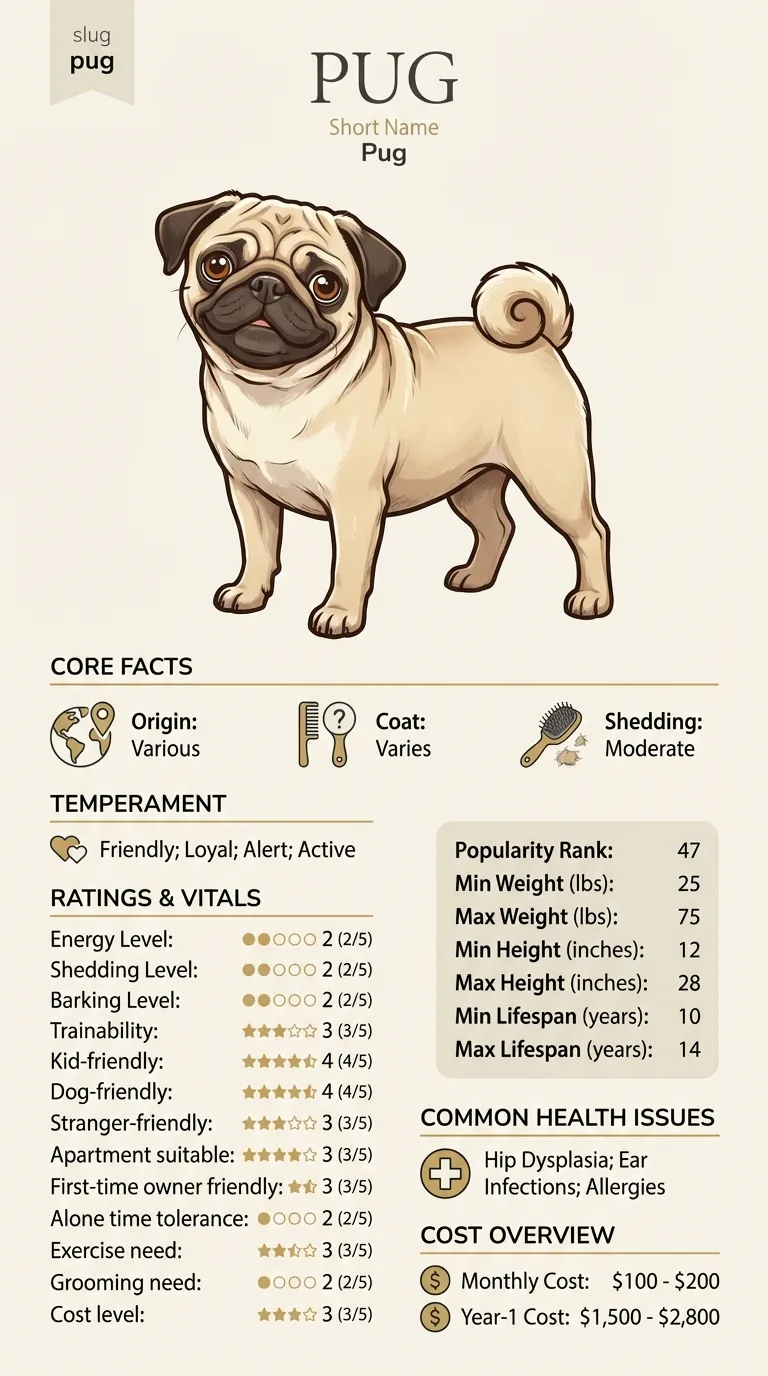
This is for someone already down to Bulldog (English) and Pug and deciding between them. For this pair the decision usually turns on good for first-time owners and cost level, so those are covered first and in most detail. Both rate 5/5 for flats, so housing does not settle this one. It is written for the decision rather than the breed history.
Between Bulldog (English) and Pug, good for first-time owners is what separates them, and Pug is the lower-effort dog of the two to keep.
Choose Bulldog (English) if shedding is a problem in your house, the dog will be alone during the working day and you want a dog that is more watchful with visitors.
Choose Pug if this is your first dog, you do not want a standing grooming appointment and a smaller dog suits your car, your home or your back.
| Feature | bulldog | pug | Winner |
|---|---|---|---|
| Size class | medium | small | Equal |
| Weight | 40–50 lbs | 14–18 lbs | Equal |
| Height | 12–16 in | 10–13 in | Equal |
| Lifespan | 8–12 years | 13–15 years | pug |
| Exercise need | Low (2/5) | Low (2/5) | Equal |
| Grooming need | Moderate (3/5) | Low (2/5) | pug |
| Shedding | Moderate (3/5) | High (4/5) | bulldog |
| Energy level | Low (2/5) | Low (2/5) | Equal |
| Barking | Low (2/5) | Low (2/5) | Equal |
| Apartment suitability | Very high (5/5) | Very high (5/5) | Equal |
| Good for first-time owners | Moderate (3/5) | Very high (5/5) | pug |
| Tolerates being alone | Moderate (3/5) | Low (2/5) | bulldog |
| Trainability | Moderate (3/5) | Moderate (3/5) | Equal |
| Good with kids | Very high (5/5) | Very high (5/5) | Equal |
| Good with other dogs | High (4/5) | High (4/5) | Equal |
| Friendly to strangers | High (4/5) | Very high (5/5) | pug |
| Cost level | Very high (5/5) | Moderate (3/5) | pug |
| Coat | Short, smooth | Short, smooth double coat | Equal |
| Origin | England | Various | Equal |
| Typical monthly cost | $150–$350 | $80–$150 | Equal |
| Typical first-year cost | $2,500–$5,000 | $1,100–$2,300 | Equal |
Both breeds sit in the flat-faced, short-legged mold, but the Pug is considerably smaller — 14 to 18 pounds and 10 to 13 inches against the Bulldog's 40 to 50 pounds and 12 to 16 inches. Roughly a third of the mass on a similar-height frame gives the Pug a noticeably more compact, portable build.
Exercise need, energy level, and barking all tie between these two, each rated low (2/5). This is one of the closer temperament matches in this database — both breeds are content with modest activity and neither is going to demand a jogging partner.
The Pug is the lower-maintenance coat, low (2/5) grooming against the Bulldog's moderate (3/5) — its short coat needs less brushing and no fold care. Shedding flips the other way though: high (4/5) for the Pug versus moderate (3/5) for the Bulldog, so despite easier grooming, expect more loose hair from the smaller dog.
Both breeds tie at very high (5/5) for apartment suitability and low (2/5) for barking, making this pairing an easy call for small-space living either way. The one gap is tolerance for being alone: the Bulldog rates moderate (3/5), the Pug low (2/5), so the Pug is more prone to distress if left by itself for long stretches.
The Pug is rated the better breed for first-time owners, high (4/5) against the Bulldog's moderate (3/5), even though trainability itself ties at moderate (3/5) for both. In practice both breeds can be food-motivated but stubborn, and neither responds well to harsh corrections — patience matters more than intensity.
Kids and other dogs tie for both breeds, very high (5/5) with kids and high (4/5) with other dogs. The Pug edges ahead with strangers, very high (5/5) against the Bulldog's high (4/5) — a small margin, but the Pug rates slightly more universally friendly across the board.
Both breeds share the defining risk of their flat-faced build, brachycephalic obstructive airway syndrome, along with heat sensitivity concerns generally. Beyond that their lists diverge: the Bulldog adds hip dysplasia, skin fold infections, and bloat, while the Pug's list includes pug dog encephalitis, corneal ulcers, hemivertebrae, and obesity risk. The Pug is expected to live somewhat longer, 13 to 15 years against the Bulldog's 8 to 12.
The Pug is rated meaningfully cheaper to keep, moderate (3/5) against the Bulldog's very high (5/5) — $80 to $150 a month versus $150 to $350, and $1,100 to $2,300 in year one against $2,500 to $5,000. Both breeds can still carry surprise vet costs tied to their shared airway risk, so budget some cushion regardless of which one you pick.
Bulldog (English) weighs 40–50 lbs and lives 8–12 years; Pug weighs 14–18 lbs and lives 13–15 years. The two diverge most on good for first-time owners and cost level. They are level on apartment suitability, barking and good with other dogs, so those cannot decide it. In the table, a "winner" means easier for an ordinary household — not better. Size, coat and origin are recorded without a verdict. Because both breeds are scored the same way, the gaps are reliable even where the absolute numbers are rough.

Both are brachycephalic, flat-faced breeds and share BOAS as a health risk, though the Pug is much smaller — 14 to 18 pounds against the Bulldog's 40 to 50.
The Pug, rated high (4/5) against the Bulldog's moderate (3/5), despite needing less grooming overall.
Rated slightly better, high (4/5) versus the Bulldog's moderate (3/5), though trainability itself is tied between them.
Yes, both rate very high (5/5) for apartment suitability and low (2/5) for barking.
The Pug, clearly — $80 to $150 a month versus $150 to $350 for the Bulldog.
Both carry BOAS and general heat sensitivity from their flat-faced structure. Their other risks diverge — the Bulldog toward hip dysplasia and bloat, the Pug toward encephalitis and corneal ulcers.
The Pug, by a few years — 13 to 15 versus the Bulldog's 8 to 12.
Yes, both rate very high (5/5) with low barking — an easy tie.
The Pug, $80–$150 a month versus $150–$350 for the Bulldog.
Neither — both rate low (2/5), a tie on exercise need.
Yes — both are prone to BOAS from their flat-faced build, though their other conditions differ.
See every pug comparison.
Secure checkout on Stripe. We never see your card.
7-day money-back guarantee. Instant access.

Health information here is general and is not veterinary advice. If your dog shows pain, sudden behaviour change, or worsening symptoms, consult a licensed veterinarian.
Some links on this site are affiliate links. We may earn a commission at no extra cost to you, and we only suggest products we believe are helpful for dog owners.
We research and check what we publish, but we do not warrant that any figure, date, price, or statement is accurate, complete, or current, and we accept no liability for any loss, cost, injury, or other harm arising from the use of this site. Use it as one reference among several. You remain responsible for your own decisions and for your dog's care - confirm anything that matters with a licensed veterinarian or another qualified professional before you act on it. Full disclaimer.
Match your lifestyle to the right dog.
Take quizNot sure which breed is right for you? Take our 2-minute quiz to find out.
Take the quiz