Living
Which breed should most people pick?
For a household with kids or frequent visitors, the Pug. For a low-shedding home where grooming time is acceptable, the Maltese.

Quick answer
Which breed should most people pick?
For a household with kids or frequent visitors, the Pug. For a low-shedding home where grooming time is acceptable, the Maltese.
Maltese or Pug? On paper they differ most on shedding, and on the scales Pug is the heavier at 14–18 lbs. Here is how the two compare on everything that shapes an ordinary week.
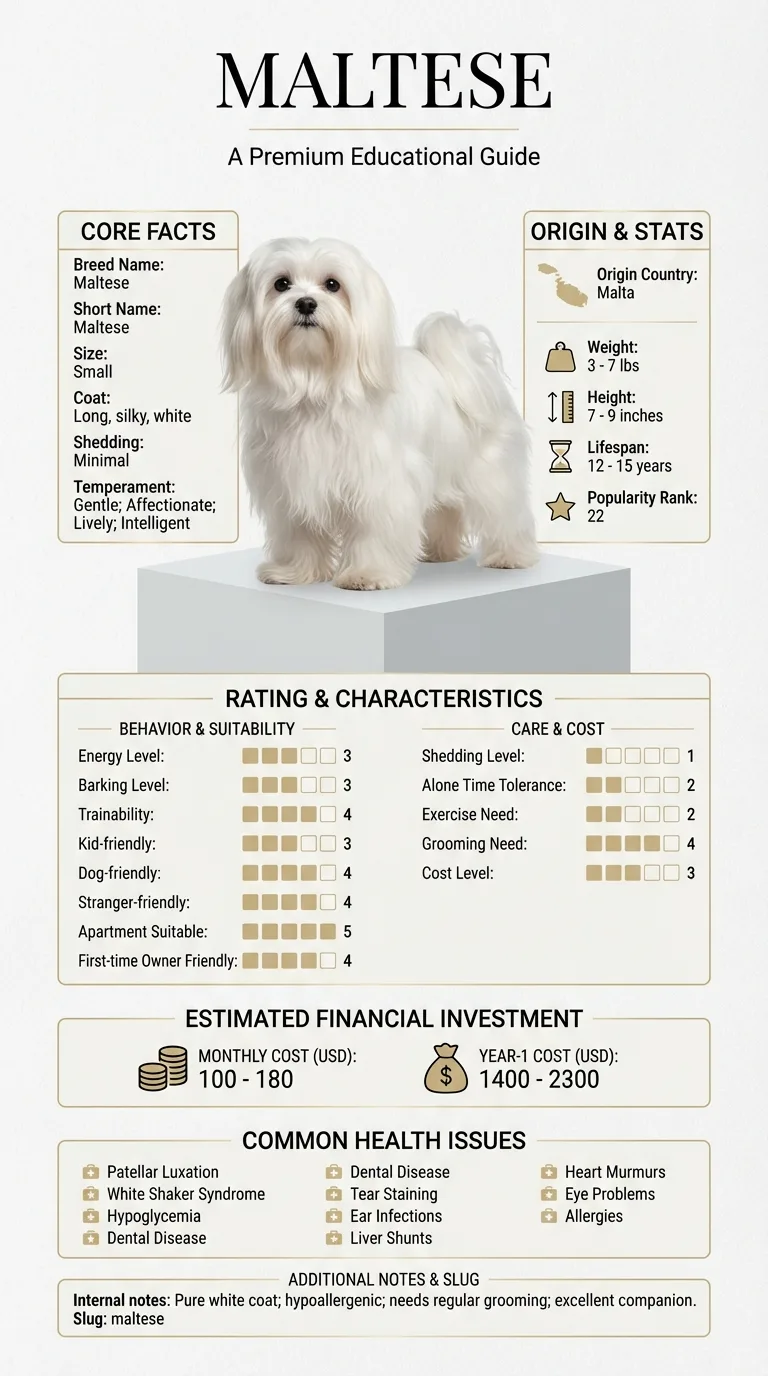
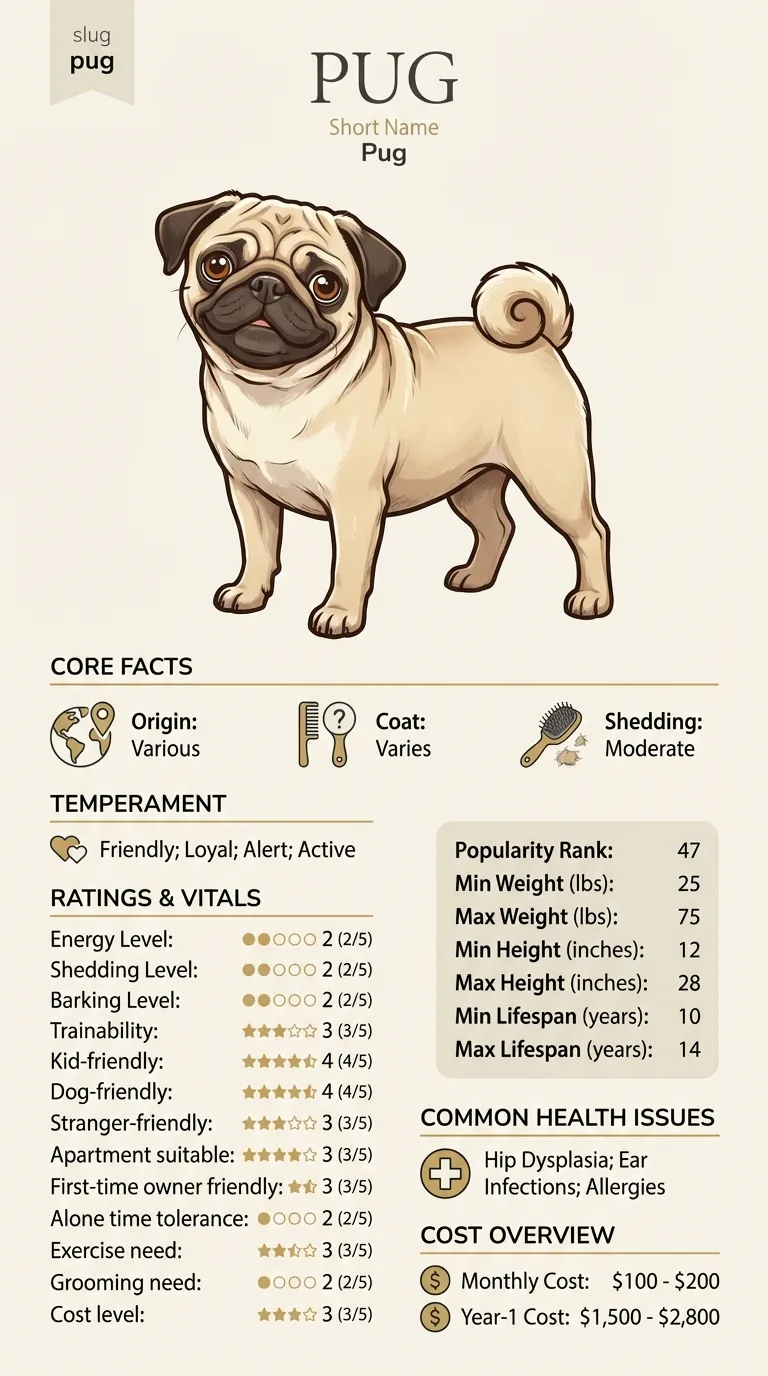
This is for someone already down to Maltese and Pug and deciding between them. For this pair the decision usually turns on shedding and grooming need, so those are covered first and in most detail. Both rate 5/5 for flats, so housing does not settle this one. It is written for the decision rather than the breed history.
Between Maltese and Pug, shedding is what separates them, and Pug is the lower-effort dog of the two to keep.
Choose Maltese if shedding is a problem in your house, you want a dog that picks up training quickly and a smaller dog suits your car, your home or your back.
Choose Pug if this is your first dog, you do not want a standing grooming appointment and there are young children at home.
| Feature | maltese | pug | Winner |
|---|---|---|---|
| Size class | small | small | Equal |
| Weight | 3–7 lbs | 14–18 lbs | Equal |
| Height | 7–9 in | 10–13 in | Equal |
| Lifespan | 12–15 years | 13–15 years | pug |
| Exercise need | Low (2/5) | Low (2/5) | Equal |
| Grooming need | High (4/5) | Low (2/5) | pug |
| Shedding | Very low (1/5) | High (4/5) | maltese |
| Energy level | Moderate (3/5) | Low (2/5) | Equal |
| Barking | Moderate (3/5) | Low (2/5) | pug |
| Apartment suitability | Very high (5/5) | Very high (5/5) | Equal |
| Good for first-time owners | High (4/5) | Very high (5/5) | pug |
| Tolerates being alone | Low (2/5) | Low (2/5) | Equal |
| Trainability | High (4/5) | Moderate (3/5) | maltese |
| Good with kids | Moderate (3/5) | Very high (5/5) | pug |
| Good with other dogs | High (4/5) | High (4/5) | Equal |
| Friendly to strangers | High (4/5) | Very high (5/5) | pug |
| Cost level | Moderate (3/5) | Moderate (3/5) | Equal |
| Coat | Long, silky, white | Short, smooth double coat | Equal |
| Origin | Malta | Various | Equal |
| Typical monthly cost | $100–$180 | $80–$150 | Equal |
| Typical first-year cost | $1,400–$2,300 | $1,100–$2,300 | Equal |
Both are small breeds, but the Pug carries roughly double to triple the Maltese's weight — 14-18 lbs versus 3-7 lbs, on a similar 10-13 inch frame. The Maltese is slighter and more fragile-feeling; the Pug is compact and stocky. Neither needs much room, but the Pug's build is noticeably sturdier for its size.
Both tie at Low (2/5) exercise need — neither breed asks for much beyond short walks and indoor play. This is a genuinely easy pairing on the activity front; whichever you pick, you're not signing up for daily runs or fetch marathons. Keep in mind the Pug's brachycephalic build means even that modest activity should avoid heat and overexertion.
These trade off almost perfectly. The Maltese needs High (4/5) grooming for that long coat but sheds almost nothing (1/5). The Pug needs far less brushing (2/5) but sheds heavily (4/5) — that short double coat comes off constantly. If you hate vacuuming, pick the Maltese; if you hate brushing and trims, pick the Pug.
Both rate Very High (5/5) for apartment suitability, and both are quieter than average — the Pug edges out the Maltese slightly on barking (Low vs Moderate). Neither handles being left alone especially well (2/5 each), so this pairing doesn't help much if long solo hours are your main constraint; plan for a dog walker or shorter workdays either way.
The Pug rates Very High (5/5) for first-time owners against the Maltese's High (4/5), largely on temperament rather than trainability — the Maltese actually trains slightly better (4/5 vs 3/5). Neither is a difficult first dog. The Pug's easygoing, food-motivated nature makes it especially forgiving of a beginner's mistakes.
The Pug is the stronger choice with kids (Very High vs Moderate) and with strangers (Very High vs High) — it's a famously social, sturdy little dog. Both get along well with other dogs. If you have young children or a busy household with frequent visitors, the data leans clearly toward the Pug over the more delicate Maltese.
The Pug lives slightly longer on average, 13-15 years versus 12-15. Their health profiles couldn't be more different: the Maltese's list is mostly small-dog joint, eye and dental issues, while the Pug's centers on its flat face — brachycephalic airway syndrome, corneal ulcers, encephalitis — conditions tied directly to its skull shape. Breathing and heat tolerance are the Pug's real ongoing concern.
Costs are close, with the Pug actually running slightly cheaper: $80-150 a month and $1,100-2,300 in year one, against the Maltese's $100-180 and $1,400-2,300. The Maltese's higher grooming needs likely account for most of the gap. Both are moderate-cost breeds overall compared to larger dogs on this site.
Maltese weighs 3–7 lbs and lives 12–15 years; Pug weighs 14–18 lbs and lives 13–15 years. The two diverge most on shedding, grooming need and good with kids. They are level on tolerates being alone, apartment suitability and cost level, so those cannot decide it. In the table, a "winner" means easier for an ordinary household — not better. Size, coat and origin are recorded without a verdict. Because both breeds are scored the same way, the gaps are reliable even where the absolute numbers are rough.

The Pug, by roughly two to three times the weight — 14-18 lbs versus the Maltese's 3-7 lbs, though both are still classed as small breeds.
The Pug, rated High (4/5) against the Maltese's Very Low (1/5). The trade-off is grooming: the Pug needs far less brushing day to day, while the Maltese's coat requires regular upkeep to avoid mats.
The Pug edges it out at Very High (5/5) versus the Maltese's High (4/5), mainly on easygoing temperament. Both are genuinely beginner-friendly breeds.
No — both tie at Low (2/5). This is one of the lower-energy pairings on the site, though the Pug's flat face means exercise should stay light and avoid heat regardless.
The Pug runs slightly cheaper at $80-150 versus the Maltese's $100-180, largely because the Maltese needs more grooming maintenance.
No overlap in this data. The Maltese's risks are mostly small-dog joint and eye issues; the Pug's are almost entirely tied to its flat face and breathing, like BOAS and corneal ulcers.
The Pug, rated Very High versus the Maltese's Moderate. Its sturdier build handles boisterous play better than the more delicate Maltese.
For a household with kids or frequent visitors, the Pug. For a low-shedding home where grooming time is acceptable, the Maltese.
$80-150 for a Pug, $100-180 for a Maltese — both are moderate-cost small breeds with only a modest gap between them.
Both tie at Low (2/5) — short walks and indoor play satisfy either breed.
The Pug, slightly — 13-15 years versus the Maltese's 12-15, though the difference is minor.
See every pug comparison.
Secure checkout on Stripe. We never see your card.
7-day money-back guarantee. Instant access.
Health information here is general and is not veterinary advice. If your dog shows pain, sudden behaviour change, or worsening symptoms, consult a licensed veterinarian.
Some links on this site are affiliate links. We may earn a commission at no extra cost to you, and we only suggest products we believe are helpful for dog owners.
We research and check what we publish, but we do not warrant that any figure, date, price, or statement is accurate, complete, or current, and we accept no liability for any loss, cost, injury, or other harm arising from the use of this site. Use it as one reference among several. You remain responsible for your own decisions and for your dog's care - confirm anything that matters with a licensed veterinarian or another qualified professional before you act on it. Full disclaimer.
Match your lifestyle to the right dog.
Take quizNot sure which breed is right for you? Take our 2-minute quiz to find out.
Take the quiz