Living
Which fits your household better?
The Pug is the better fit for a quiet, low-activity household; the Cocker suits someone who wants an active daily walking partner.

Quick answer
Which fits your household better?
The Pug is the better fit for a quiet, low-activity household; the Cocker suits someone who wants an active daily walking partner.
English Cocker Spaniel or Pug? On paper they differ most on exercise need, and on the scales English Cocker Spaniel is the heavier at 26–34 lbs. Here is how the two compare on everything that shapes an ordinary week.
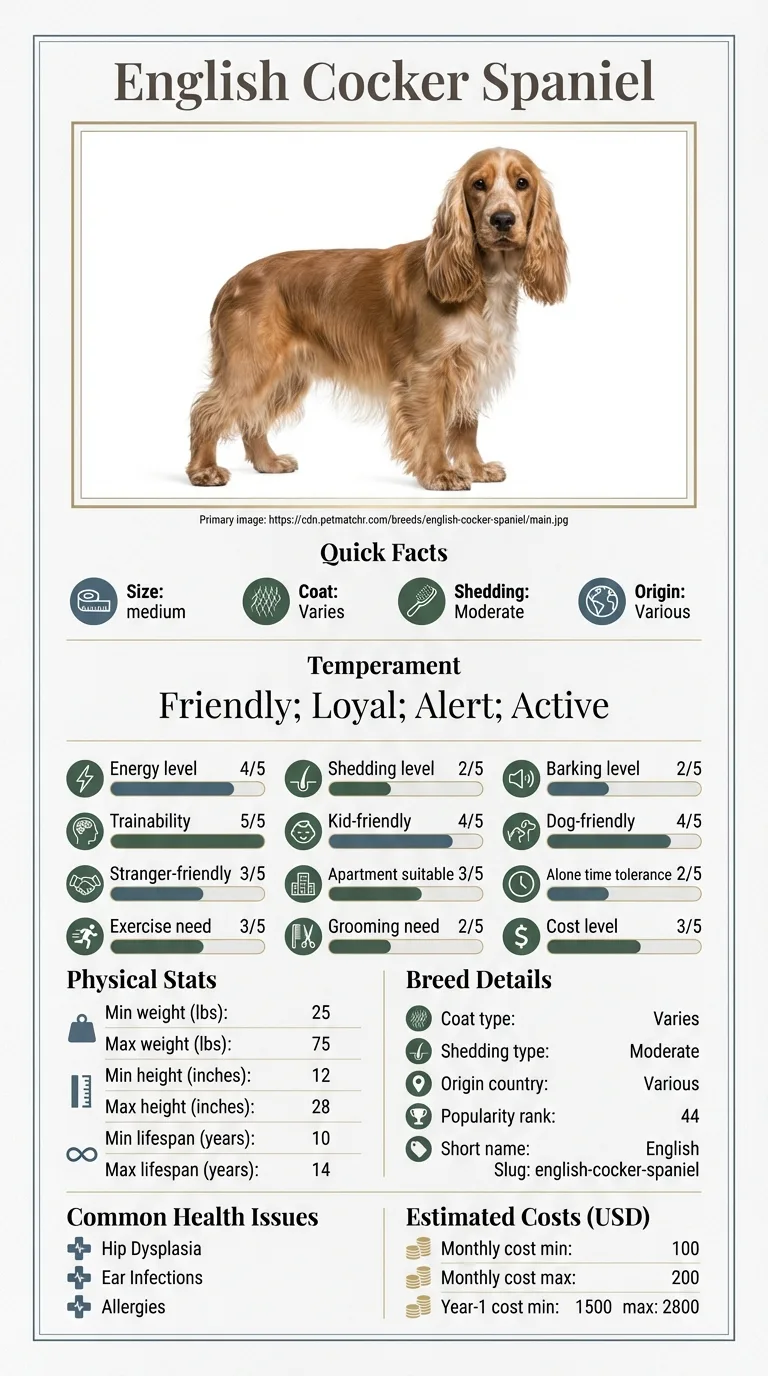
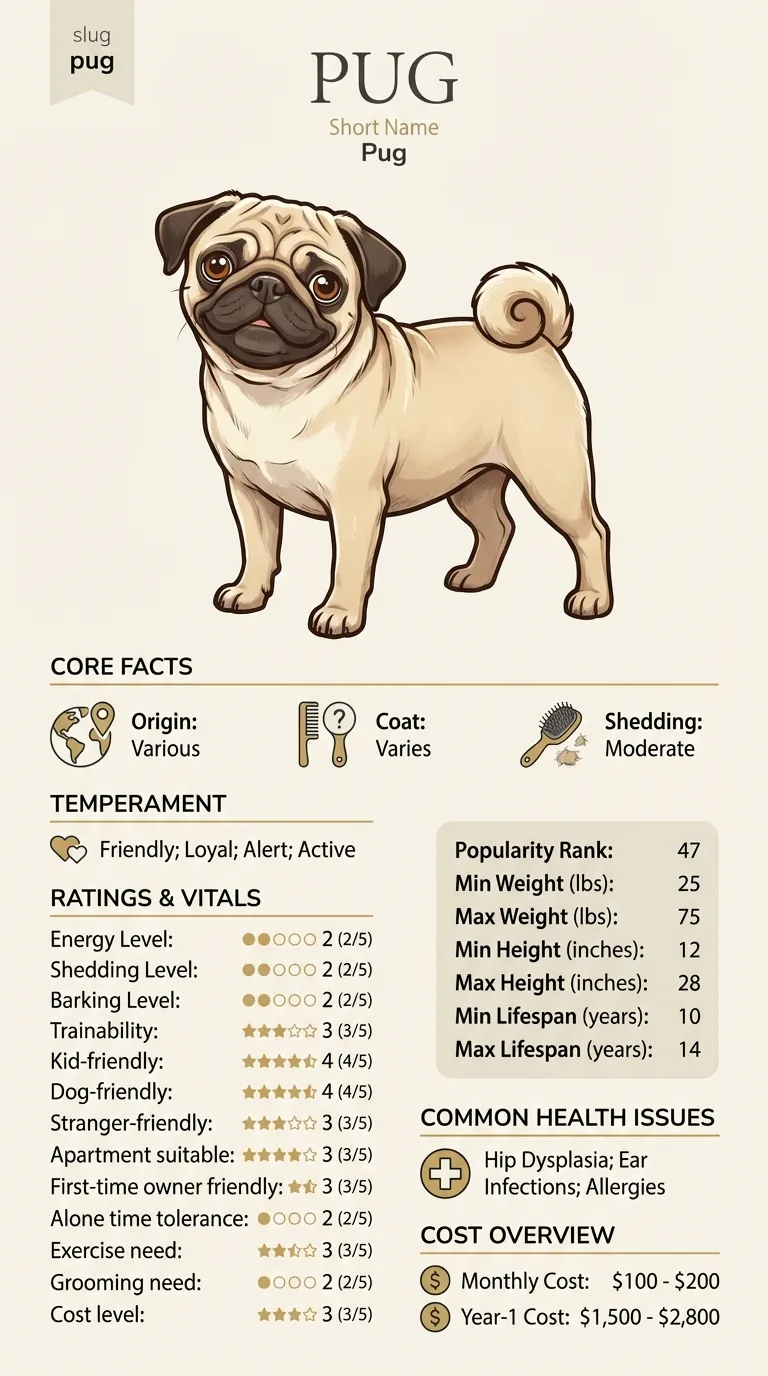
This is for someone already down to English Cocker Spaniel and Pug and deciding between them. For this pair the decision usually turns on exercise need and grooming need, so those are covered first and in most detail. Anyone choosing from a flat has a clear answer here: Pug rates 5/5 against 4/5. It is written for the decision rather than the breed history.
Between English Cocker Spaniel and Pug, exercise need is what separates them, and Pug is the lower-effort dog of the two to keep.
Choose English Cocker Spaniel if shedding is a problem in your house, you want a dog that picks up training quickly and you want a dog that can keep up with an active routine.
Choose Pug if you are in a flat or a smaller home, this is your first dog and you do not want a standing grooming appointment.
| Feature | english cocker spaniel | pug | Winner |
|---|---|---|---|
| Size class | medium | small | Equal |
| Weight | 26–34 lbs | 14–18 lbs | Equal |
| Height | 15–17 in | 10–13 in | Equal |
| Lifespan | 12–14 years | 13–15 years | pug |
| Exercise need | High (4/5) | Low (2/5) | pug |
| Grooming need | High (4/5) | Low (2/5) | pug |
| Shedding | Moderate (3/5) | High (4/5) | english cocker spaniel |
| Energy level | High (4/5) | Low (2/5) | Equal |
| Barking | Moderate (3/5) | Low (2/5) | pug |
| Apartment suitability | High (4/5) | Very high (5/5) | pug |
| Good for first-time owners | High (4/5) | Very high (5/5) | pug |
| Tolerates being alone | Low (2/5) | Low (2/5) | Equal |
| Trainability | High (4/5) | Moderate (3/5) | english cocker spaniel |
| Good with kids | Very high (5/5) | Very high (5/5) | Equal |
| Good with other dogs | High (4/5) | High (4/5) | Equal |
| Friendly to strangers | High (4/5) | Very high (5/5) | pug |
| Cost level | Moderate (3/5) | Moderate (3/5) | Equal |
| Coat | Medium, silky and feathered | Short, smooth double coat | Equal |
| Origin | Various | Various | Equal |
| Typical monthly cost | $100–$200 | $80–$150 | Equal |
| Typical first-year cost | $1,400–$2,900 | $1,100–$2,300 | Equal |
The Pug runs noticeably smaller and more compact - 14-18 lbs and 10-13 in, against the Cocker's 26-34 lbs and 15-17 in. Both are solidly small-to-medium dogs you can pick up without much effort, but the Pug's short, dense build and flat face give it a completely different physical profile from the Cocker's leaner, longer-legged sporting frame.
The exercise gap here is the biggest number on the page: the Cocker rates High (4/5) for exercise need, the Pug just Low (2/5). Pugs also can't handle heat or long exertion well given their flat faces, so their lower activity needs aren't just a preference, they're closer to a physical limit. A short walk and some play satisfies a Pug; the Cocker wants considerably more.
Grooming and shedding trade places between these two. The Pug needs far less brushing and trimming - Low (2/5) against the Cocker's High (4/5) - but sheds more, High (4/5) against Moderate (3/5), thanks to that short double coat that releases hair constantly rather than in seasonal waves. Less time at the groomer, more time with the lint roller.
The Pug rates better for apartment life on both counts that matter for neighbors - Very High (5/5) apartment suitability and Low (2/5) barking, against the Cocker's High (4/5) and Moderate (3/5). Both dogs handle being left alone equally poorly, Low (2/5) for each, so neither is the answer if you need a dog for long solo stretches during the workday.
First-time owners actually do better with the Pug on paper, Very High (5/5) against the Cocker's High (4/5) - it's a famously low-drama companion breed. Training is the flip side: the Cocker rates High (4/5) trainability against the Pug's Moderate (3/5), reflecting the Pug's more independent, food-motivated-but-stubborn streak. Easy to live with, a bit more work to actually train.
Kids and other dogs are a dead heat - both breeds rate Very High (5/5) with kids and High (4/5) with other dogs. The Pug pulls slightly ahead with strangers, Very High (5/5) against the Cocker's already-good High (4/5); it's genuinely hard to find a Pug that doesn't want to make friends with whoever walks in the door.
The Pug edges out a slightly longer lifespan, 13-15 years against the Cocker's 12-14, but that comes with a very different - and in some ways more serious - set of risks. Its flat face brings brachycephalic airway syndrome (BOAS) and a higher risk of corneal ulcers, plus obesity if its lower exercise needs aren't matched with careful feeding. None of the Cocker's ear, hip, and kidney-related risks show up on the Pug's list, or vice versa; these are two genuinely different health profiles.
Both rate Moderate (3/5) on general cost level, but the Pug runs cheaper in real dollars: $80-150 a month against the Cocker's $100-200, and $1,100-2,300 for a first year against $1,400-2,900. The Pug's shorter coat and smaller size keep routine costs down, though BOAS-related vet care can be a real expense if it develops.
English Cocker Spaniel weighs 26–34 lbs and lives 12–14 years; Pug weighs 14–18 lbs and lives 13–15 years. The two diverge most on exercise need, grooming need and energy level. They are level on tolerates being alone, cost level and good with other dogs, so those cannot decide it. In the table, a "winner" means easier for an ordinary household — not better. Size, coat and origin are recorded without a verdict. Because both breeds are scored the same way, the gaps are reliable even where the absolute numbers are rough.

The Pug, by a wide margin - Low (2/5) against the Cocker's High (4/5). Flat-faced breeds also can't safely handle much exertion, especially in heat.
The Pug, rated Low (2/5) barking against the Cocker's Moderate (3/5).
Rated Very High (5/5), a notch above the Cocker's High (4/5) - Pugs are famously easygoing companions.
The Pug, despite its short coat - High (4/5) against the Cocker's Moderate (3/5).
Mainly brachycephalic airway syndrome (BOAS), tied to its flat face, along with corneal ulcers and a tendency toward obesity if underexercised relative to its food intake.
The Pug - around $1,100-2,300 for a first year against the Cocker's $1,400-2,900.
The Pug, slightly - 13-15 years against the Cocker's 12-14.
The Pug is the better fit for a quiet, low-activity household; the Cocker suits someone who wants an active daily walking partner.
The Pug runs cheaper - about $80-150 monthly against the Cocker's $100-200.
This is the widest exercise gap in any Cocker comparison - High (4/5) for the Cocker against just Low (2/5) for the Pug.
The Pug lives a bit longer on average (13-15 years vs 12-14) but carries brachycephalic risks the Cocker doesn't have.
See every pug comparison.
Secure checkout on Stripe. We never see your card.
7-day money-back guarantee. Instant access.
Health information here is general and is not veterinary advice. If your dog shows pain, sudden behaviour change, or worsening symptoms, consult a licensed veterinarian.
Some links on this site are affiliate links. We may earn a commission at no extra cost to you, and we only suggest products we believe are helpful for dog owners.
We research and check what we publish, but we do not warrant that any figure, date, price, or statement is accurate, complete, or current, and we accept no liability for any loss, cost, injury, or other harm arising from the use of this site. Use it as one reference among several. You remain responsible for your own decisions and for your dog's care - confirm anything that matters with a licensed veterinarian or another qualified professional before you act on it. Full disclaimer.
Match your lifestyle to the right dog.
Take quizNot sure which breed is right for you? Take our 2-minute quiz to find out.
Take the quiz