Behavior
Sheds more?
Pug.

Quick answer
Sheds more?
Pug.
Cavalier King Charles Spaniel or Pug? On paper they differ most on exercise need, and on the scales Pug is the heavier at 14–18 lbs. Here is how the two compare on everything that shapes an ordinary week.
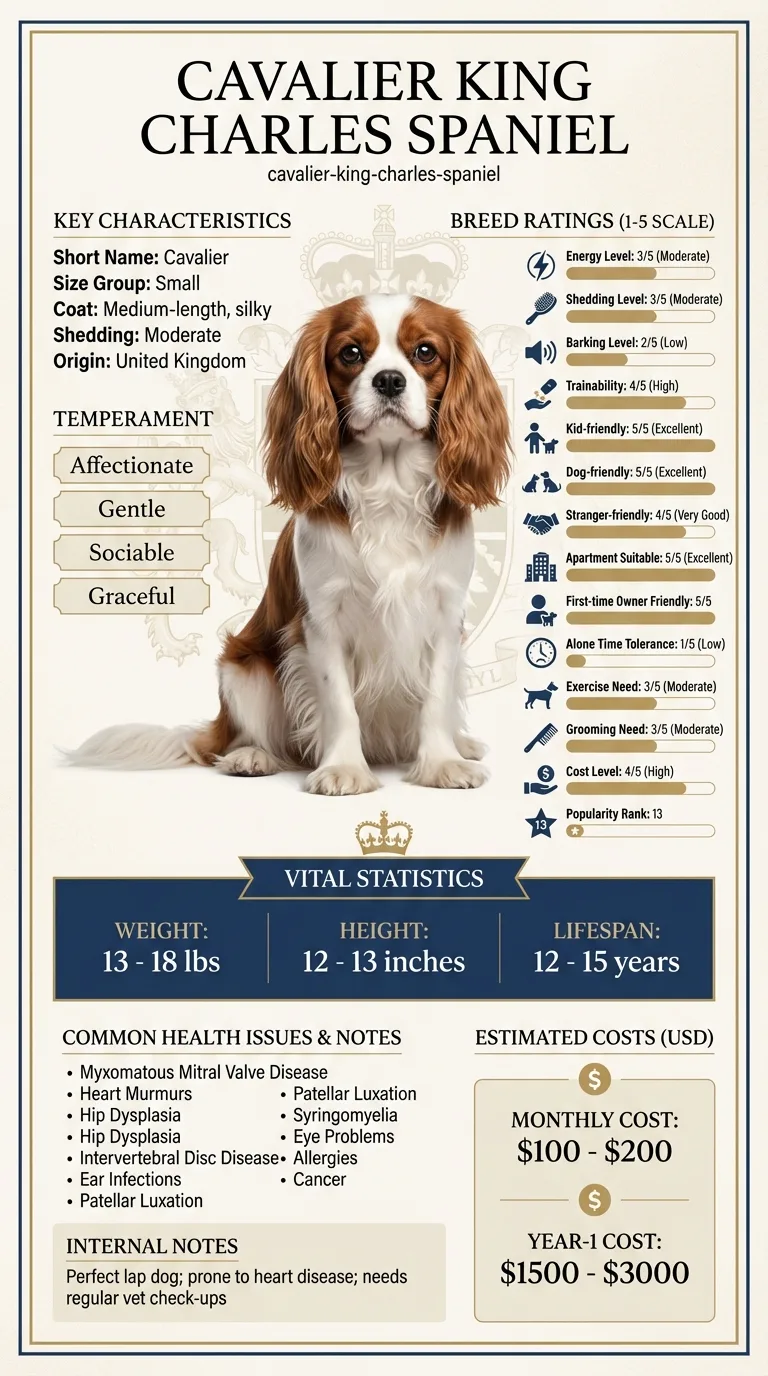
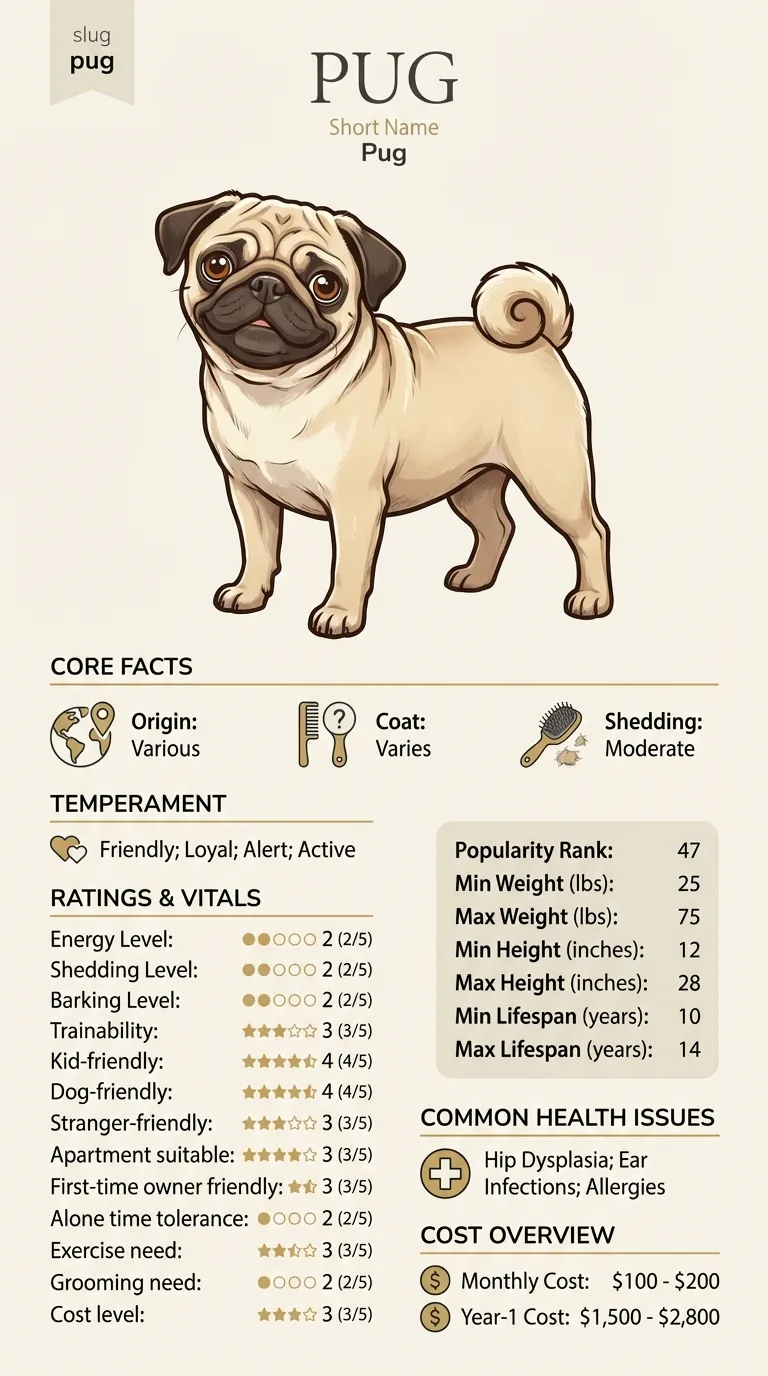
This is for someone already down to Cavalier King Charles Spaniel and Pug and deciding between them. Because the two are so evenly matched, the page works through every axis rather than leading with one. Both rate 5/5 for flats, so housing does not settle this one. It is written for the decision rather than the breed history.
Between Cavalier King Charles Spaniel and Pug, they are closer than most pairings, and the choice comes down to temperament, and Pug is the lower-effort dog of the two to keep.
Choose Cavalier King Charles Spaniel if shedding is a problem in your house, you already have another dog and you want a dog that picks up training quickly.
Choose Pug if you do not want a standing grooming appointment and your walking routine is modest.
| Feature | cavalier king charles spaniel | pug | Winner |
|---|---|---|---|
| Size class | small | small | Equal |
| Weight | 13–18 lbs | 14–18 lbs | Equal |
| Height | 12–13 in | 10–13 in | Equal |
| Lifespan | 12–15 years | 13–15 years | pug |
| Exercise need | Moderate (3/5) | Low (2/5) | pug |
| Grooming need | Moderate (3/5) | Low (2/5) | pug |
| Shedding | Moderate (3/5) | High (4/5) | cavalier king charles spaniel |
| Energy level | Moderate (3/5) | Low (2/5) | Equal |
| Barking | Low (2/5) | Low (2/5) | Equal |
| Apartment suitability | Very high (5/5) | Very high (5/5) | Equal |
| Good for first-time owners | Very high (5/5) | Very high (5/5) | Equal |
| Tolerates being alone | Very low (1/5) | Low (2/5) | pug |
| Trainability | High (4/5) | Moderate (3/5) | cavalier king charles spaniel |
| Good with kids | Very high (5/5) | Very high (5/5) | Equal |
| Good with other dogs | Very high (5/5) | High (4/5) | cavalier king charles spaniel |
| Friendly to strangers | High (4/5) | Very high (5/5) | pug |
| Cost level | High (4/5) | Moderate (3/5) | pug |
| Coat | Medium-length, silky | Short, smooth double coat | Equal |
| Origin | United Kingdom | Various | Equal |
| Typical monthly cost | $100–$200 | $80–$150 | Equal |
| Typical first-year cost | $1,500–$3,000 | $1,100–$2,300 | Equal |
These two are close enough in size that a scale barely settles an argument: 13-18 lbs and 12-13 inches for the Cavalier against 14-18 lbs and 10-13 inches for the Pug. The real structural difference is build rather than size - the Cavalier is a leaner, longer-muzzled spaniel while the Pug is a compact, brachycephalic breed with a flat face and stockier frame. That facial structure matters more than the shared weight range, since it shapes everything from breathing to heat tolerance in ways the numbers alone don't capture.
Exercise need rates Moderate (3/5) for the Cavalier against Low (2/5) for the Pug, and the Pug's charming, mischievous, even-tempered personality tends to prefer a short waddle and a nap over a long walk. Both are low-key by companion-breed standards, but the Pug's brachycephalic airway means its exercise ceiling is a genuine limit, not just a preference - overheating and breathing distress are real risks on hot days or after brisk play. The Cavalier can handle a longer walk or a game of fetch without the same physical constraint.
Grooming tips toward the Pug at Low (2/5) against the Cavalier's Moderate (3/5), since the Pug's short coat needs less brushing than the Cavalier's silky feathering. Shedding flips the advantage back, though - Moderate (3/5) for the Cavalier against High (4/5) for the Pug, whose dense double coat blows out steadily year-round despite its short length. Pug owners often find themselves vacuuming more than they expected given how short the coat looks, while Cavalier owners deal with fewer loose hairs but more mats and tangles requiring regular brushing sessions.
Apartment suitability and first-time-owner scores tie at Very high (5/5) for both breeds, and barking ties at Low (2/5) too, making this one of the closer match-ups on the noise-and-space front. The real divergence is tolerating time alone: Very low (1/5) for the Cavalier against Low (2/5) for the Pug, a small but meaningful gap for anyone working long hours. Both breeds were bred as companion dogs first, so neither is naturally suited to extended solo time regardless of how well they'd otherwise fit a small apartment.
Trainability favors the Cavalier, High (4/5) against Moderate (3/5) for the Pug, whose mischievous streak can turn training sessions into a negotiation. Both breeds tie at Very high (5/5) for suitability to first-time owners, though, so neither requires prior dog experience to raise successfully. The practical difference shows up in consistency: a Cavalier tends to pick up commands and settle into routines a bit faster, while a Pug's charm can mask a stubborn streak that benefits from short, food-motivated training sessions rather than long drills.
Good with kids ties at Very high (5/5), and both breeds are described as affectionate, so either fits a family looking for a lap-sized companion. The Cavalier edges ahead with other dogs, Very high (5/5) against High (4/5), while the Pug actually rates higher with strangers, Very high (5/5) against High (4/5) for the Cavalier - a difference that tracks with the Pug's famously charming, even-tempered approach to new people. Neither breed makes a good watchdog given their low barking and eagerness to befriend nearly everyone who walks through the door.
The Pug edges out the Cavalier on lifespan, 13-15 years against 12-15, but both breeds carry serious inherited risks that shape their health-care bills. The Cavalier's list is heart- and spine-driven - Myxomatous Mitral Valve Disease, heart murmurs, and syringomyelia - while the Pug's is defined by its flat face: Brachycephalic Airway Syndrome (BOAS), Pug Dog Encephalitis, and Corneal Ulcers are the conditions that most often bring pugs to specialty vets. Obesity is a distinct Pug risk too, since its low exercise need and food motivation make weight gain easy, which in turn worsens breathing problems.
Cost level rates High (4/5) for the Cavalier against Moderate (3/5) for the Pug, with monthly costs of $100-200 versus $80-150 and first-year costs of $1,500-3,000 versus $1,100-2,300. Some of the Pug's savings can evaporate quickly if BOAS surgery or an emergency overheating episode is needed, since brachycephalic emergency care tends to be expensive and urgent. The Cavalier's higher baseline cost is driven more by routine cardiac monitoring as it ages, a predictable expense rather than the acute emergencies a Pug's airway can produce.
Cavalier King Charles Spaniel weighs 13–18 lbs and lives 12–15 years; Pug weighs 14–18 lbs and lives 13–15 years. No rated axis separates them by more than a single point, which makes this one of the closer pairings on the site. They are level on apartment suitability, barking and good for first-time owners, so those cannot decide it. In the table, a "winner" means easier for an ordinary household — not better. Size, coat and origin are recorded without a verdict. Because both breeds are scored the same way, the gaps are reliable even where the absolute numbers are rough.

Yes, very close - 13-18 lbs and 12-13 inches for the Cavalier against 14-18 lbs and 10-13 inches for the Pug.
The Cavalier. The Pug is brachycephalic and rates Low (2/5) for exercise need, with real overheating and breathing risk from BOAS.
The Pug, rated High (4/5) against the Cavalier's Moderate (3/5), despite its much shorter coat.
The Pug, rated Very high (5/5) against the Cavalier's High (4/5).
Yes, both tie at Very high (5/5) for apartment suitability.
The Cavalier's cost level rates higher overall (High 4/5 versus Moderate 3/5), though the Pug's BOAS-related emergencies can be costly and sudden.
The Cavalier, rated High (4/5) against the Pug's Moderate (3/5).
Pug.
Pug.
Cavalier King Charles Spaniel.
Pug.
See every pug comparison.
Secure checkout on Stripe. We never see your card.
7-day money-back guarantee. Instant access.
Health information here is general and is not veterinary advice. If your dog shows pain, sudden behaviour change, or worsening symptoms, consult a licensed veterinarian.
Some links on this site are affiliate links. We may earn a commission at no extra cost to you, and we only suggest products we believe are helpful for dog owners.
We research and check what we publish, but we do not warrant that any figure, date, price, or statement is accurate, complete, or current, and we accept no liability for any loss, cost, injury, or other harm arising from the use of this site. Use it as one reference among several. You remain responsible for your own decisions and for your dog's care - confirm anything that matters with a licensed veterinarian or another qualified professional before you act on it. Full disclaimer.
Match your lifestyle to the right dog.
Take quizNot sure which breed is right for you? Take our 2-minute quiz to find out.
Take the quiz