Akita or Sheltie: Two Wary Breeds, One That Says So
Quick answer
Akita vs Shetland Sheepdog: which should I choose?
The Sheltie if you want a small, brilliant, trainable dog and can manage 5/5 barking. The Akita if noise is a constraint — it is one of the quietest breeds here and needs no mental work at all.
The Shetland Sheepdog rates 2/5 with strangers, exactly as the Akita does. That surprises people, because a Sheltie looks like the friendliest dog imaginable. It is a genuinely reserved breed — and unlike the Akita, which says nothing, it rates 5/5 for barking and tells you about everything.
This page is for someone weighing a small, brilliant, vocal herding breed against a large guardian. It covers barking honestly, the reserve both breeds share, two genetic tests every Sheltie buyer should ask for, coat work, and cost.
Quick verdict
The Sheltie is the more trainable and more affordable dog and it is loud; the Akita is quiet, self-contained and far harder to influence.
Choose akita if...
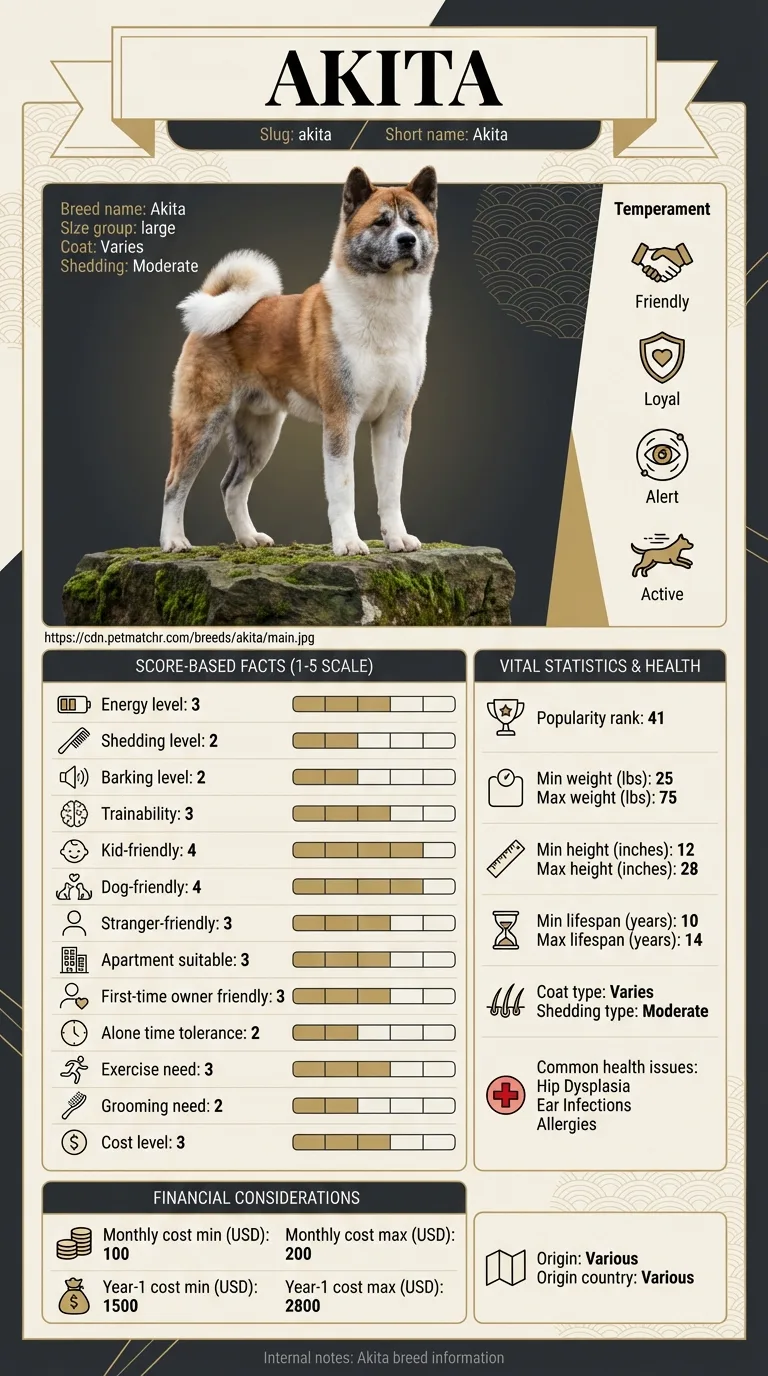
Choose the Akita if noise is a constraint. It barks at 2/5 against the Sheltie's 5/5, needs 3/5 exercise against 4/5, grooms at 3/5 against 4/5, and tolerates being alone at 3/5 against 2/5. You are accepting 5/5 shedding, 1/5 for first-time owners, 2/5 with other dogs, and $110–$240 a month.
Choose shetland sheepdog if...
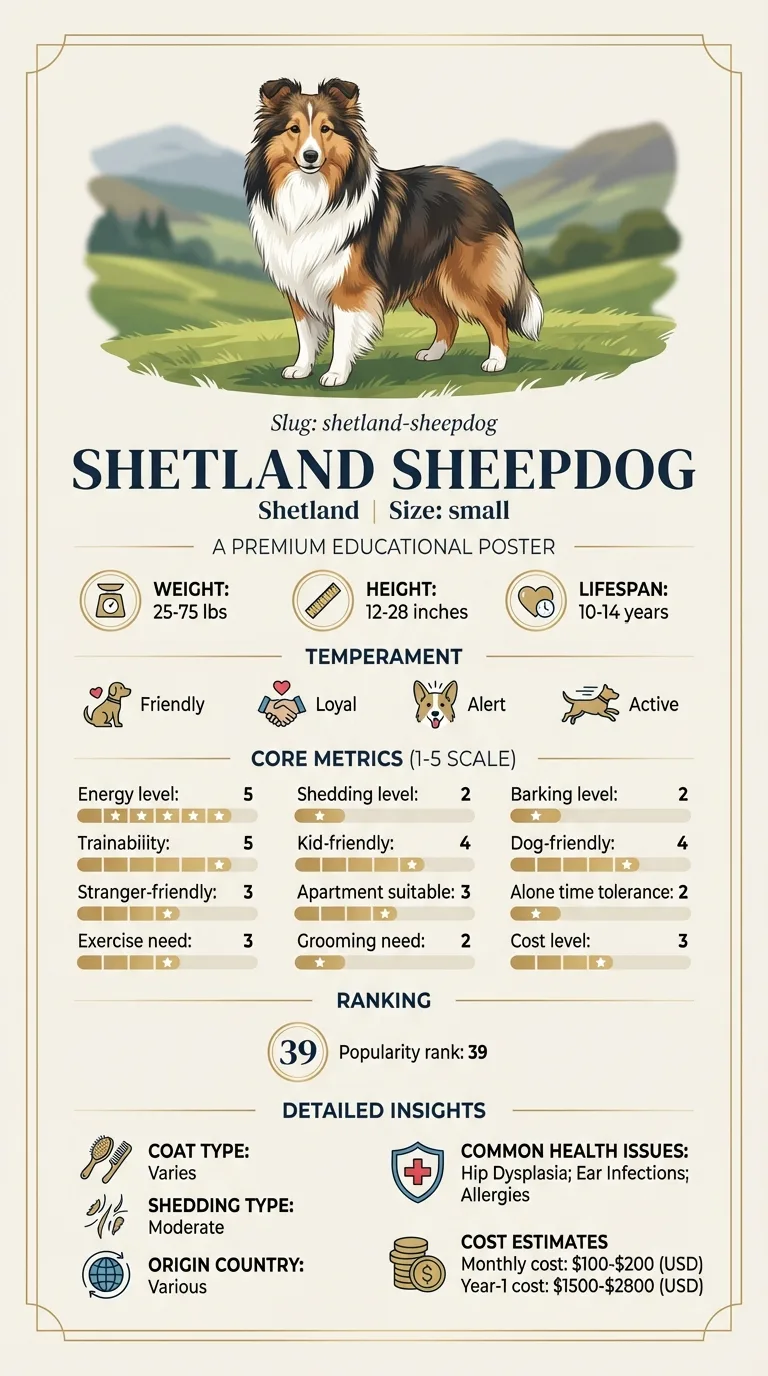
Choose the Shetland Sheepdog if you want a small, brilliant, sensitive dog and can manage the noise. It rates 5/5 for trainability, 4/5 with children and other dogs, 4/5 for first-time owners, lives 12 to 14 years and costs $80–$150 a month. You are accepting 5/5 barking, 4/5 grooming and genuine sound sensitivity.
Head-to-head comparison
Feature
akita
shetland sheepdog
Winner
Weight
70–130 lbs
15–25 lbs
Equal
Height
24–28 in
13–16 in
Equal
Lifespan
10–13 years
12–14 years
shetland sheepdog
Coat
Dense double coat
Long dense double coat
Equal
Grooming need
Moderate (3/5)
High (4/5)
akita
Shedding
Very high (5/5)
High (4/5)
shetland sheepdog
Energy level
Moderate (3/5)
High (4/5)
Equal
Exercise need
Moderate (3/5)
High (4/5)
akita
Trainability
Moderate (3/5)
Very high (5/5)
shetland sheepdog
Barking
Low (2/5)
Very high (5/5)
akita
Good with kids
Moderate (3/5)
High (4/5)
shetland sheepdog
Good with other dogs
Low (2/5)
High (4/5)
shetland sheepdog
Friendly to strangers
Low (2/5)
Low (2/5)
Equal
Apartment suitability
Low (2/5)
Moderate (3/5)
shetland sheepdog
Good for first-time owners
Very low (1/5)
High (4/5)
shetland sheepdog
Tolerates being alone
Moderate (3/5)
Low (2/5)
akita
Typical monthly cost
$110–$240
$80–$150
shetland sheepdog
Typical first-year cost
$1,700–$3,200
$1,100–$2,300
shetland sheepdog
Deep dive
5/5 barking, and how much of it you can change
The Sheltie's barking rating is the joint highest on this site, and it is functional in origin: a small farm dog on a Shetland croft used its voice to move stock and to see off birds and intruders.
What it means in a modern house is a dog that comments on the doorbell, the post, passing dogs, the television, sudden movement outside a window, and the excitement of its own family coming home. Shelties also bark while doing things they enjoy — herding a ball, running an agility course — which is not distress but is still noise.
A great deal of it responds to work. Blocking window sightlines, teaching a settled behaviour on a mat, rewarding quiet, and — most effective of all — giving a 5/5 trainable dog something to do with its brain. A properly occupied Sheltie is much quieter than an under-worked one.
What will not happen is a silent Sheltie. If a flat with thin walls is the plan, that needs facing honestly before purchase.
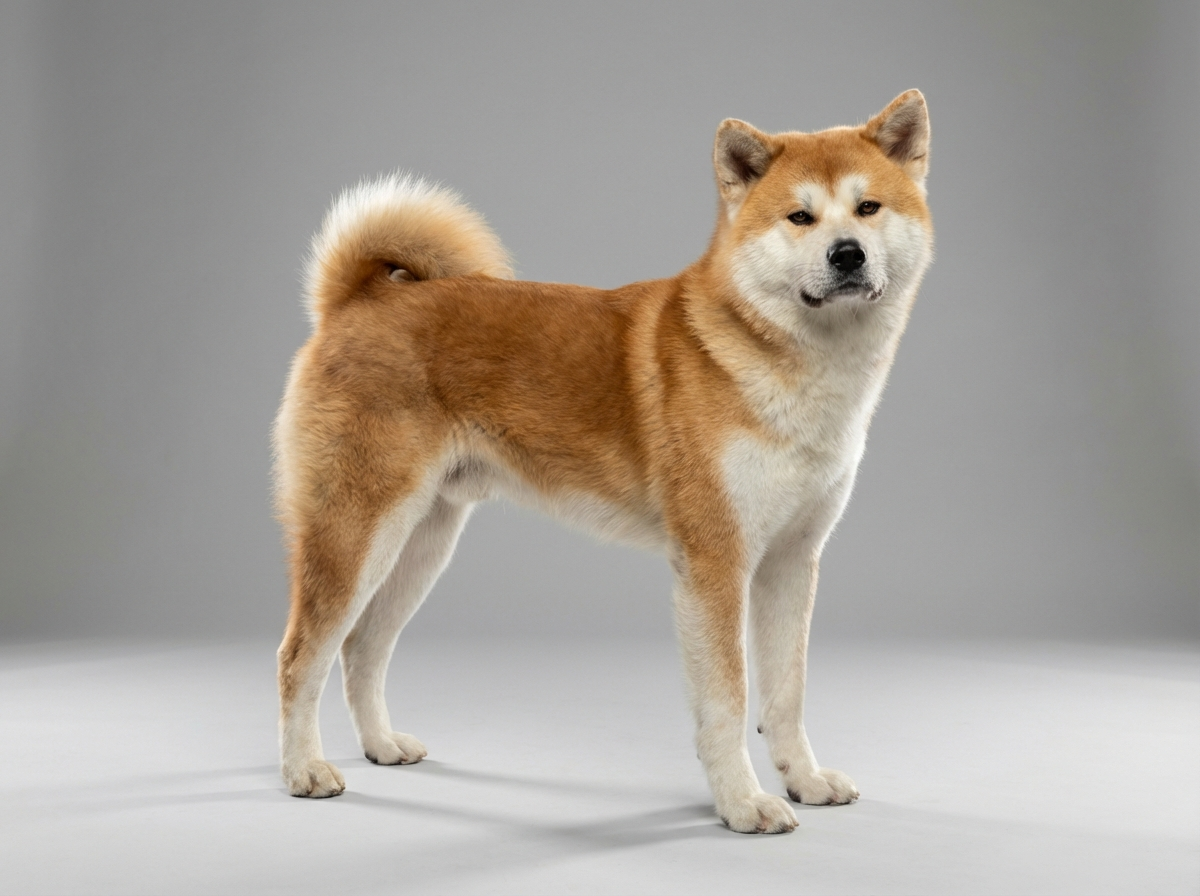
The Akita at 2/5 is one of the quietest breeds here. Its neighbour problem is size in a corridor, not sound.
5/5 trainability and a sensitive temperament
The Sheltie is among the most trainable breeds in existence and it dominates small-dog agility and obedience. It learns fast, retains reliably and works enthusiastically.
The qualifier is sensitivity. Shelties are soft dogs — sharp voices, harsh corrections and household tension all set them back, and many are noise-phobic, with thunderstorm and firework fear common in the breed. A calm, consistent, cheerful handler gets an extraordinary dog; a shouty household gets an anxious one.
Exercise is 4/5 and it wants a job as much as a walk. Herding-style games, agility, trick chains and scent work all suit it, and an hour a day plus training is a realistic requirement.
Herding behaviour persists: circling and nipping at running children or joggers is common and needs interrupting early rather than being found charming.
At 2/5 for solitude it is closely bonded and prefers company, so absence training from the first week matters.
The Akita is not sensitive in this way at all. It does not read the room, does not need occupying, and does not mind an empty afternoon.
Two tests every Sheltie buyer should ask for
Collie eye anomaly heads the Sheltie's condition list. It is an inherited developmental abnormality of the eye, present from birth, ranging from mild and stable to causing retinal detachment and blindness. Puppies can and should be examined by an ophthalmologist at six to eight weeks, and there is a DNA test as well. Ask to see the results.
MDR1 drug sensitivity is the second and it is the one that will matter in an emergency. Many herding-breed dogs carry a mutation affecting a protein that keeps certain drugs out of the brain, and affected dogs can react severely to normal doses of some common medications, including particular wormers and sedatives. The test is cheap, done once, and the result should be on your vet's file permanently and volunteered at every new practice.
Dermatomyositis is the third and it is specific to Shelties and Collies — an inherited inflammatory condition affecting skin and, in some dogs, muscle, showing as crusting and hair loss on the face, ear tips and legs in a young dog.
Hypothyroidism and patellar luxation complete the list.
The Akita's burden is autoimmune and endocrine, with hip dysplasia and bloat.
Coat work and running costs
The Sheltie's long dense double coat rates 4/5 for grooming and 4/5 for shedding. It mats behind the ears, in the ruff, on the trousers and behind the elbows, and brushing has to reach the skin in sections rather than skimming the top.
A proper session two or three times a week is the routine, with far more during the two heavy shedding periods. The volume of undercoat from a 20-pound dog is genuinely startling.
Neither coat should be clipped — a double coat insulates against heat as well as cold — and both breeds are more comfortable in cold than in heat.
On money the Sheltie is much the cheaper dog: $80–$150 a month against $110–$240, and $1,100–$2,300 against $1,700–$3,200 in the first year.
The costs to plan for are the eye examinations, the one-off MDR1 test, and periodic professional grooming if you would rather not do the shedding seasons yourself.
The Akita's expensive risks are autoimmune disease and bloat: less frequent, larger, and not certainties. Lifespan runs 12 to 14 years against 10 to 13.
Akita vs Shetland Sheepdog: the shared 2/5 nobody expects
Strangers ties at 2/5. That is the most interesting row on this table, because it puts a 20-pound Sheltie in the same bracket as a guardian breed.
Shelties are genuinely reserved. A well-bred, well-socialised one is polite but uninterested in visitors, and a poorly socialised one is properly shy — backing away, hiding, and barking from a distance. That shyness is the breed's most common temperament fault and it is worth asking a breeder about directly.
The Akita's 2/5 is territorial rather than nervous. It assesses and settles. The Sheltie's is closer to caution, and it does not settle so much as comment.
Everything else diverges. The Sheltie is 5/5 trainable against 3/5, 4/5 with children and other dogs against 3/5 and 2/5, and 4/5 for first-time owners against 1/5.
And it barks at 5/5, which is the row most likely to end a tenancy.
Akita or Sheltie: Two Wary Breeds, One That Says So - Akita vs Shetland Sheepdog: the shared 2/5 nobody expects
Frequently asked questions
Do Shelties really bark that much?
Yes — 5/5, the joint highest rating on this site, against the Akita's 2/5. It is functional in origin: a small farm dog used its voice to move stock and see off intruders. Occupation, blocked sightlines and a trained settle reduce it a great deal, but a silent Sheltie is not an achievable outcome.
Are Shelties friendly with strangers?
Less than they look — 2/5, the same as the Akita. A well-socialised Sheltie is polite but uninterested in visitors; a poorly socialised one is properly shy, backing away and barking from a distance. Shyness is the breed's most common temperament fault, so ask a breeder about it directly.
What is MDR1 and why does it matter?
A mutation common in herding breeds affecting a protein that keeps certain drugs out of the brain. Affected dogs can react severely to normal doses of some common medications, including particular wormers and sedatives. The test is cheap and done once — put the result on your vet's file and volunteer it at every new practice.
What is Collie eye anomaly?
An inherited developmental abnormality of the eye, present from birth, ranging from mild and stable to causing retinal detachment and blindness. Puppies should be examined by an ophthalmologist at six to eight weeks and there is a DNA test as well. Ask to see the results before buying.
How much exercise does a Sheltie need?
4/5 — around an hour a day plus mental work, which suits its 5/5 trainability. Agility, herding games, trick chains and scent work all land well. An under-worked Sheltie is noisier, and much of the breed's barking reputation comes from dogs with nothing to do.
Which is better for a first-time owner?
The Sheltie at 4/5 against the Akita's 1/5, provided noise is not a constraint. It is small, sensitive and extremely trainable, and it responds badly to harshness. The Akita is an independent guardian whose adult views on other dogs arrive at around two years old.
How much grooming does a Sheltie need?
4/5 — a proper session two or three times a week, brushing to the skin in sections, and considerably more during the two heavy shedding periods. The amount of undercoat that comes out of a 20-pound dog surprises most new owners. The coat should never be clipped.
Akita vs Shetland Sheepdog: which should I choose?
The Sheltie if you want a small, brilliant, trainable dog and can manage 5/5 barking. The Akita if noise is a constraint — it is one of the quietest breeds here and needs no mental work at all.
Costs
How much does each cost per month?
The Sheltie runs $80–$150 a month and the Akita $110–$240, with first-year totals of $1,100–$2,300 and $1,700–$3,200. Add eye testing, a one-off MDR1 test and periodic grooming for the Sheltie.
Behavior
Are Shelties good with children?
Yes, at 4/5 against the Akita's 3/5, with two caveats: herding behaviour around running children needs interrupting early, and the breed is noise-sensitive, so a very loud household suits it poorly.
Health
What should I ask a Sheltie breeder?
Eye examination results from six to eight weeks for Collie eye anomaly, the MDR1 result, thyroid testing and patella scores. Ask specifically about temperament and shyness in the parents.
Related DogBreedCompass guides
Akita breed guide – The Akita profile covers guardian temperament and the long socialisation window the breed needs.
Shetland Sheepdog breed guide – The Sheltie profile covers coat work, training outlets and the breed's genetic testing.
Akita vs Collie – The Rough Collie is the larger relative with the same eye and drug-sensitivity concerns.
Akita vs Border Collie – The Border Collie is the higher-drive herding alternative worth weighing against it.
Shetland Sheepdog genetic disorders – The inherited conditions worth screening for before buying a Sheltie puppy.
Akita autoimmune diseases – Autoimmune disease is the Akita's most distinctive burden and the first question for a breeder.
Health information here is general and is not veterinary advice. If your dog shows pain, sudden behaviour change, or worsening symptoms, consult a licensed veterinarian.
Some links on this site are affiliate links. We may earn a commission at no extra cost to you, and we only suggest products we believe are helpful for dog owners.
We research and check what we publish, but we do not warrant that any figure, date, price, or statement is accurate, complete, or current, and we accept no liability for any loss, cost, injury, or other harm arising from the use of this site. Use it as one reference among several. You remain responsible for your own decisions and for your dog's care - confirm anything that matters with a licensed veterinarian or another qualified professional before you act on it. Full disclaimer.