Akita or Border Collie: Stillness or Relentless Work?
Quick answer
Akita vs Border Collie: which should I choose?
The Border Collie only if you will genuinely work its brain daily — agility, herding, obedience or serious training. The Akita if your week has no room for that and you want a quiet guardian. Both rate 1/5 for first-time owners.
Both rate 1/5 for first-time owners, and for opposite reasons. The Border Collie is widely considered the most trainable dog on earth, rating 5/5, and that is precisely the problem — a 5/5 brain with 5/5 energy and no job becomes obsessive rather than merely naughty. The Akita rates 3/5 and simply lies down.
This is for someone attracted to two very capable dogs who needs to understand what each demands from an ordinary week. It covers the drive gap, what obsessive behaviour in an under-worked Collie actually looks like, the size and coat differences, the eye and neurological conditions to ask a breeder about, and cost.
Quick verdict
The Border Collie is the right dog only if you will work its brain every day; the Akita is the right dog if your week has no room for that and you want a guardian.
Choose akita if...
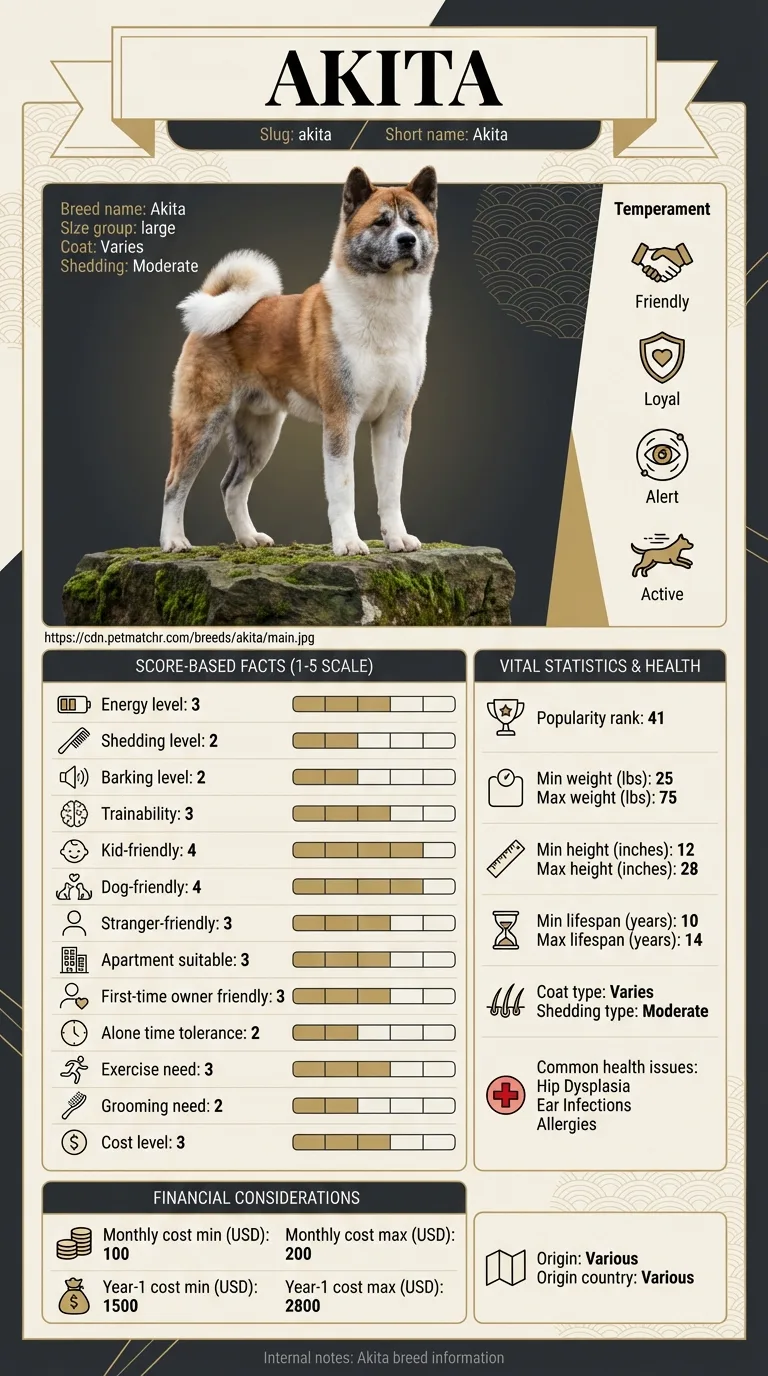
Choose the Akita if you want a calm, near-silent, low-drive house dog — 3/5 exercise, 3/5 energy, 2/5 barking, 3/5 for time alone. You are taking on a guardian temperament rating 2/5 with strangers and other dogs, a coat that sheds at 5/5, and up to 130 pounds of dog.
Choose border collie if...
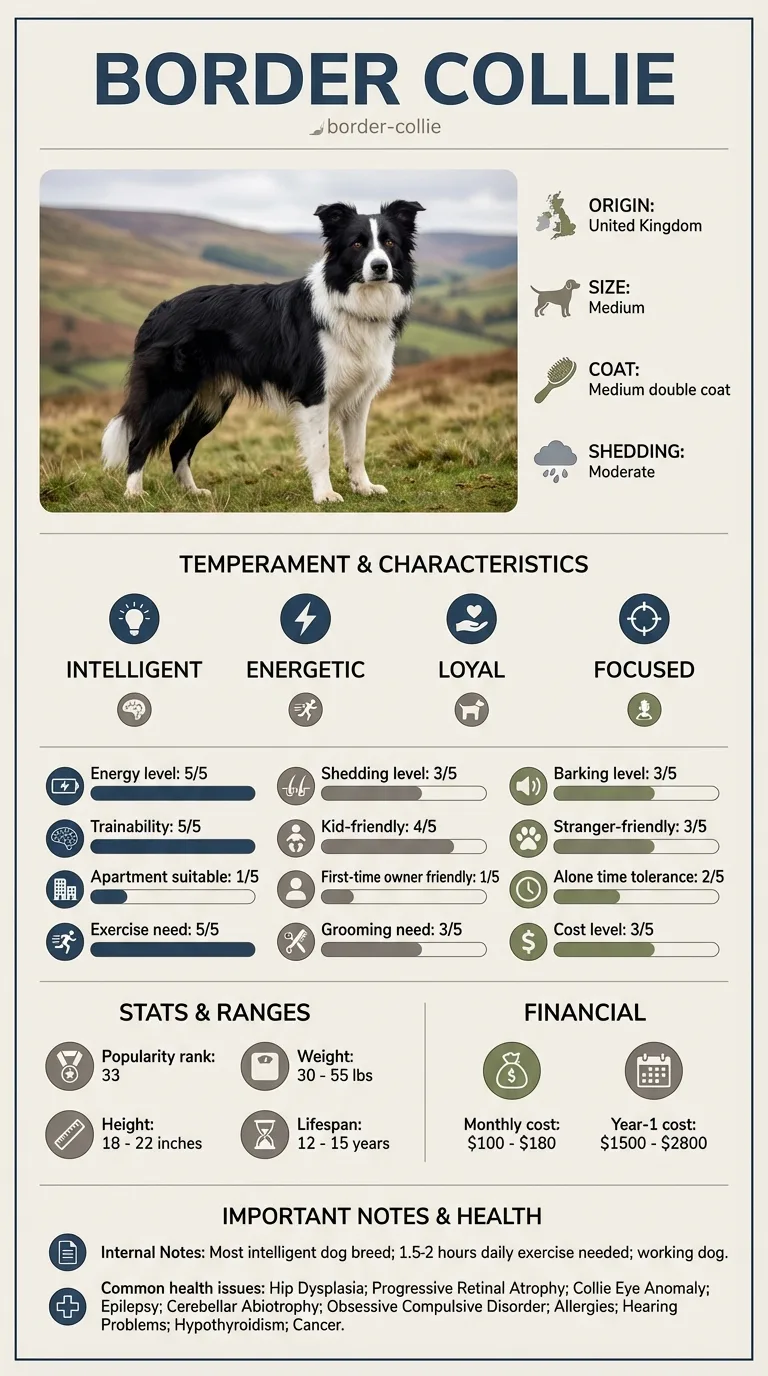
Choose the Border Collie if you genuinely want a working partner — agility, obedience, herding, flyball, scent work — and will provide it most days. It rates 5/5 for trainability, 4/5 with children and other dogs, lives 12 to 15 years, and costs $100–$180 a month. It rates 1/5 for apartments, and an under-employed Collie develops compulsive behaviours that are hard to undo.
Head-to-head comparison
Feature
akita
border collie
Winner
Weight
70–130 lbs
30–55 lbs
Equal
Height
24–28 in
18–22 in
Equal
Lifespan
10–13 years
12–15 years
border collie
Coat
Dense double coat
Medium double coat
Equal
Grooming need
Moderate (3/5)
Moderate (3/5)
Equal
Shedding
Very high (5/5)
Moderate (3/5)
border collie
Energy level
Moderate (3/5)
Very high (5/5)
Equal
Exercise need
Moderate (3/5)
Very high (5/5)
akita
Trainability
Moderate (3/5)
Very high (5/5)
border collie
Barking
Low (2/5)
Moderate (3/5)
akita
Good with kids
Moderate (3/5)
High (4/5)
border collie
Good with other dogs
Low (2/5)
High (4/5)
border collie
Friendly to strangers
Low (2/5)
Moderate (3/5)
border collie
Apartment suitability
Low (2/5)
Very low (1/5)
akita
Good for first-time owners
Very low (1/5)
Very low (1/5)
Equal
Tolerates being alone
Moderate (3/5)
Low (2/5)
akita
Typical monthly cost
$110–$240
$100–$180
border collie
Typical first-year cost
$1,700–$3,200
$1,500–$2,800
border collie
Deep dive
What an under-worked Border Collie becomes
Obsessive compulsive disorder appears on the Border Collie's condition list, and that is unusual enough to be worth pausing on. Most breeds' lists are structural or systemic. This one includes a behavioural disorder because the breed genuinely develops it.
An under-employed Collie does not simply get naughty. It develops repetitive behaviours: shadow chasing, light chasing, flank sucking, spinning, obsessive fixation on wheels, water or reflections. These start as boredom and become genuinely compulsive, at which point they are hard to extinguish and sometimes need medication alongside behaviour work.
The requirement is mental more than physical. A Collie that runs for two hours is a fitter Collie with the same unmet need. What satisfies it is being told what to do and doing it well — agility, herding, competitive obedience, flyball, scent work, or serious daily training at home.
The Akita at 3/5 wants a decent walk and then lies down heavily somewhere inconvenient. In a household with a full-time job, that difference is the entire decision.
5/5 against 3/5: instruction versus negotiation
The Border Collie's 5/5 is the highest rating on this site and it is deserved. Collies learn in remarkably few repetitions, work at distance on whistled or hand signals, and are the dominant breed in nearly every canine sport for good reason.
The corollary is that they learn wrong things equally fast and generalise them widely. A Collie that has decided cars must be herded has learned that lesson thoroughly, and reactivity to movement — bikes, joggers, cars, running children — is the most common behavioural complaint in the breed.
The Akita at 3/5 is not slow. It is independent: it understands the request, considers it, and forms a view. Guardian breeds were selected to make decisions without a handler present, and that is what you are working with. Early, consistent, positive training works; heavy-handed correction of a hundred-pound dog does not, and is a bad idea for obvious reasons.
What the Akita needs most is not obedience but socialisation, sustained from eight weeks well past two years.
Children, other dogs and visitors
The Collie rates 4/5 with children and 4/5 with other dogs against the Akita's 3/5 and 2/5, so on paper it is the easier household dog.
The Collie's caveat is herding rather than temperament. A working-bred dog with no stock may try to gather running children, and heel-nipping and circling are common. It is correctable but needs interrupting early rather than being found charming.
With strangers the Collie rates 3/5 and the Akita 2/5. Collies are often naturally reserved and can be noise-sensitive — a startle-prone Collie in a busy house is a real thing, and thunderstorm or firework fear is common in the breed.
The Akita's reserve is territorial rather than nervous. It assesses and settles. Its dog intolerance, frequently same-sex, typically arrives at social maturity around two years old and catches owners out.
On noise the Akita takes it at 2/5 against 3/5, and Collie barking rises sharply when the dog is under-worked.
Coat and the physical difference
Grooming rates 3/5 for both. The Akita sheds at 5/5, blowing a dense double coat in clumps twice a year — an undercoat rake and bin bags. The Collie sheds at 3/5, more steadily, with feathering on the legs and tail that picks up mud and burrs and needs brushing through.
Neither coat should ever be clipped; both insulate against heat as well as cold.
On size the difference is large: 70 to 130 pounds against 30 to 55. The Collie is easy to lift, transport and physically manage. The Akita is not, at the top of its range.
Counter-intuitively the smaller dog is the worse apartment fit, 1/5 against 2/5. That is entirely about drive rather than footprint, and it is a good illustration of why the exercise row matters more than the weight row for a flat.
Eyes and nerves against autoimmune disease
The Border Collie's health questions are mostly ocular and neurological, and most have DNA tests. Collie eye anomaly and progressive retinal atrophy should both be cleared in the parents. Epilepsy appears in the breed. So does cerebellar abiotrophy, a progressive inherited condition affecting coordination that presents in young dogs and has a test available.
Many Collies also carry the MDR1 drug-sensitivity mutation shared with other herding breeds, which affects how certain common medications are handled. It is a cheap test and the result belongs on your vet's file.
Hip dysplasia appears in both breeds and both should come from hip-scored parents.
The Akita's burden is autoimmune and endocrine — immune-mediated conditions affecting skin, eyes and blood, hypothyroidism, progressive retinal atrophy — plus bloat as a deep-chested breed and a known sensitivity to anaesthesia.
The Collie lives longer, 12 to 15 years against 10 to 13.
Akita vs Border Collie: two 1/5 ratings, opposite causes
Both breeds rate 1/5 for first-time owners. That is the only place these two meet.
The Akita is difficult because of what it thinks about strangers and other dogs, and because the guarding instinct arrives at maturity in a dog that by then weighs a hundred pounds. Its daily demands are modest: 3/5 exercise, 3/5 energy, 2/5 barking.
The Border Collie is difficult because of what it needs from you. 5/5 energy, 5/5 exercise, 5/5 trainability, 1/5 for apartments. It is the most biddable dog in the world and that is not a convenience — it is a requirement, because a brain built to take instruction all day will invent instructions if none arrive.
The Collie is better on almost every sociability row and lives longer. The Akita is better on everything that concerns your calendar.
Akita or Border Collie: Stillness or Relentless Work? - Akita vs Border Collie: two 1/5 ratings, opposite causes
Frequently asked questions
Which needs more exercise, an Akita or a Border Collie?
The Border Collie, at 5/5 against the Akita's 3/5, with energy at 5/5 against 3/5. The requirement is mental as much as physical — a Collie that runs for two hours is fitter with the same unmet need. Agility, herding, obedience or serious daily training is what actually satisfies it. The Akita wants a good walk and then lies down.
What happens to a Border Collie that is not worked enough?
It develops compulsive behaviours, which is why obsessive compulsive disorder appears on the breed's condition list — unusual for a health list. Shadow and light chasing, spinning, flank sucking and fixation on wheels or water start as boredom and become genuinely compulsive, at which point they are hard to extinguish and sometimes need medication alongside behaviour work.
Which is easier to train?
The Border Collie at 5/5, the highest rating on this site, against the Akita's 3/5. Collies learn in very few repetitions and work at distance. The catch is that they learn unwanted behaviour just as fast — reactivity to bikes, cars and running children is the most common complaint in the breed. The Akita is independent rather than slow.
Which is better with children?
The Collie at 4/5 against the Akita's 3/5, with the caveat that a herding dog may try to gather running children and nip at heels. That needs interrupting early. The Akita's caveat is size and a guardian temperament that needs managing around visiting friends.
Why does the smaller dog rate worse for apartments?
Because the apartment rating is about drive, not footprint. The Border Collie rates 1/5 against the Akita's 2/5 despite weighing a third as much, because a 5/5 exercise and 5/5 energy dog in a flat is unworkable unless the owner's whole routine is built around it. The Akita is quiet at 2/5 barking and needs 3/5 exercise.
What should I ask a Border Collie breeder?
Ask for eye testing covering Collie eye anomaly and progressive retinal atrophy, hip scores, and DNA results for cerebellar abiotrophy. Ask about MDR1 drug-sensitivity status too — many herding-breed dogs carry it and the result should be on your vet's file before certain common medications are given.
Which lives longer?
The Border Collie, at 12 to 15 years against the Akita's 10 to 13, reflecting both its smaller size and the Akita's heavier autoimmune and endocrine disease burden.
The Border Collie only if you will genuinely work its brain daily — agility, herding, obedience or serious training. The Akita if your week has no room for that and you want a quiet guardian. Both rate 1/5 for first-time owners.
Costs
How much does each cost per month?
The Akita runs $110–$240 a month and the Border Collie $100–$180, with first-year totals of $1,700–$3,200 and $1,500–$2,800.
Living
Which sheds more?
The Akita at 5/5 against the Collie's 3/5, blowing a dense double coat twice a year. Grooming rates 3/5 for both, and neither coat should ever be clipped.
Health
What is the main health test for a Border Collie?
Eye testing for Collie eye anomaly and progressive retinal atrophy, plus DNA tests for cerebellar abiotrophy and MDR1 drug sensitivity. Hip scores apply to both breeds.
Related DogBreedCompass guides
Akita breed guide – The Akita profile covers guardian temperament and the socialisation window the breed needs.
Border Collie breed guide – The Border Collie profile covers working outlets and what under-employment produces.
Australian Shepherd vs Border Collie – The Australian Shepherd is the breed most often weighed against the Collie, with slightly less intensity.
Akita vs Alaskan Malamute – The Malamute is the large northern alternative to the Akita and is far more sociable.
Border Collie anesthesia sensitivity – Anaesthesia sensitivity is worth raising with any vet before a procedure for either breed.
Akita autoimmune diseases – Autoimmune disease is the Akita's most distinctive burden and the first question for a breeder.
Health information here is general and is not veterinary advice. If your dog shows pain, sudden behaviour change, or worsening symptoms, consult a licensed veterinarian.
Some links on this site are affiliate links. We may earn a commission at no extra cost to you, and we only suggest products we believe are helpful for dog owners.
We research and check what we publish, but we do not warrant that any figure, date, price, or statement is accurate, complete, or current, and we accept no liability for any loss, cost, injury, or other harm arising from the use of this site. Use it as one reference among several. You remain responsible for your own decisions and for your dog's care - confirm anything that matters with a licensed veterinarian or another qualified professional before you act on it. Full disclaimer.