Akita or Rough Collie: Two Big Coats, Two Different Minds
Quick answer
Akita vs Collie: which should I choose?
The Rough Collie if you want a large, gentle, highly trainable family dog and will do the grooming. The Akita if you want a guardian, would rather handle two shedding seasons than weekly brushing, and have the experience to manage it.
Both are large, both carry heavy double coats, both need around the same amount of walking, and both cope reasonably with a working day. Then the temperament rows arrive and split them completely: the Collie is 5/5 for trainability and 4/5 with strangers, the Akita is 3/5 and 2/5.
This page is for someone who wants a large dog with a proper coat and needs to know how differently the two behave. It covers trainability and sensitivity, the eye and drug-sensitivity testing every Collie buyer should ask about, the coat work involved in each, and what they cost.
Quick verdict
The Collie gives you a large dog that is easy to live with and needs serious weekly grooming; the Akita gives you a large dog that needs almost no grooming and a great deal more judgement.
Choose akita if...
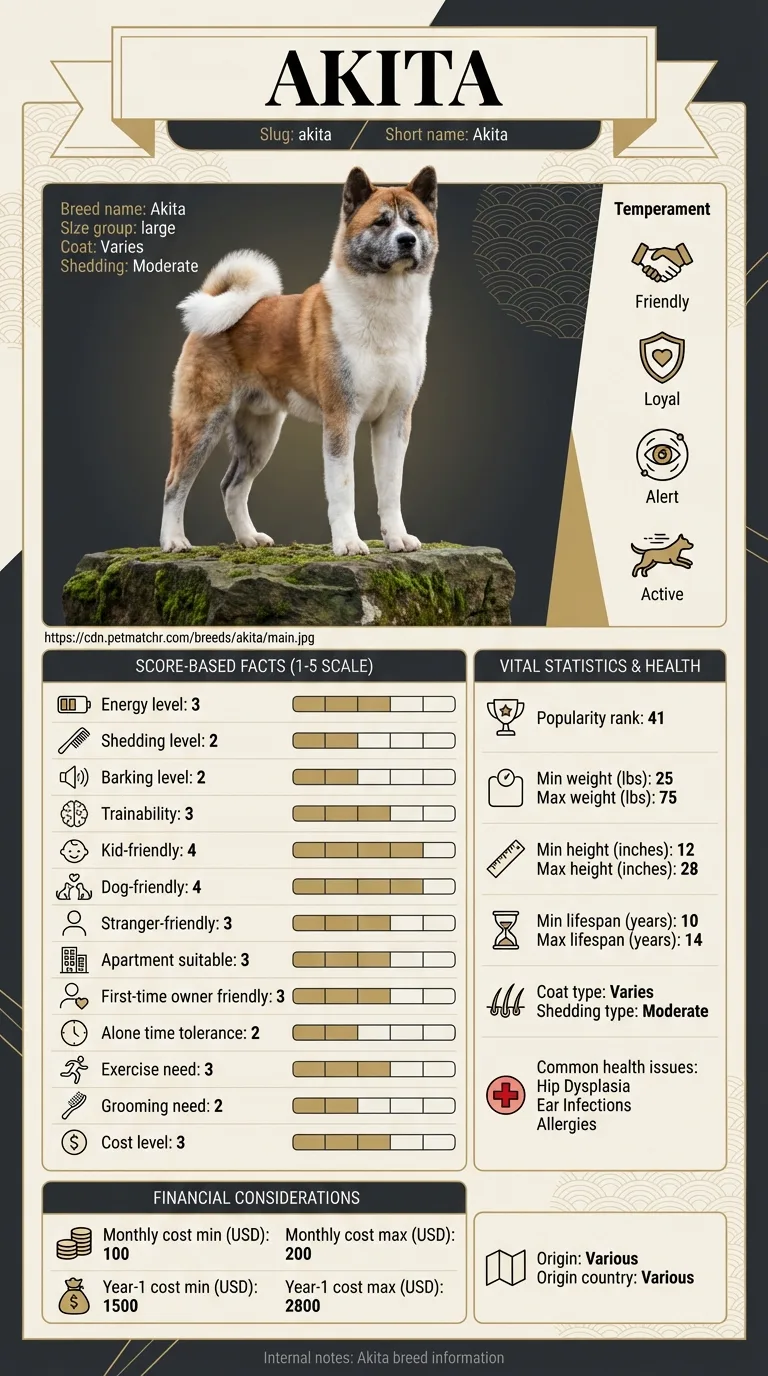
Choose the Akita if you want a guardian and would rather deal with two shedding seasons than a weekly brushing routine. It grooms at 3/5 against the Collie's 4/5 and barks at 2/5 against 3/5. You are accepting 1/5 for first-time owners, 2/5 with other dogs and strangers, 5/5 shedding and up to 130 pounds of dog.
Choose collie if...
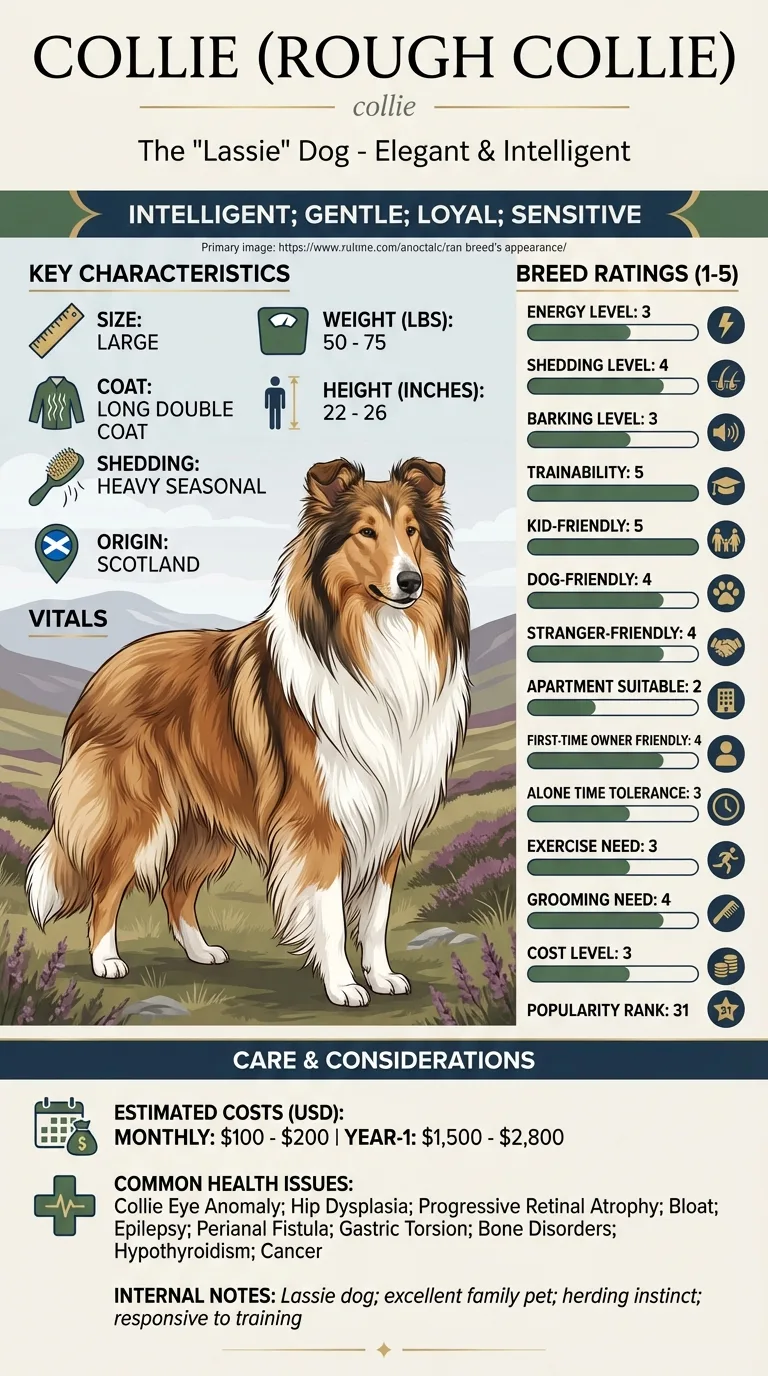
Choose the Rough Collie if you want a large, gentle, highly trainable family dog. It rates 5/5 for trainability, 5/5 with children, 4/5 with other dogs and strangers, and 4/5 for first-time owners, lives 11 to 14 years and costs $100–$200 a month. You are accepting 4/5 grooming, noise sensitivity and a breed that needs specific genetic testing.
Head-to-head comparison
Feature
akita
collie
Winner
Weight
70–130 lbs
50–75 lbs
Equal
Height
24–28 in
22–26 in
Equal
Lifespan
10–13 years
11–14 years
collie
Coat
Dense double coat
Long double coat
Equal
Grooming need
Moderate (3/5)
High (4/5)
akita
Shedding
Very high (5/5)
High (4/5)
collie
Energy level
Moderate (3/5)
Moderate (3/5)
Equal
Exercise need
Moderate (3/5)
Moderate (3/5)
Equal
Trainability
Moderate (3/5)
Very high (5/5)
collie
Barking
Low (2/5)
Moderate (3/5)
akita
Good with kids
Moderate (3/5)
Very high (5/5)
collie
Good with other dogs
Low (2/5)
High (4/5)
collie
Friendly to strangers
Low (2/5)
High (4/5)
collie
Apartment suitability
Low (2/5)
Low (2/5)
Equal
Good for first-time owners
Very low (1/5)
High (4/5)
collie
Tolerates being alone
Moderate (3/5)
Moderate (3/5)
Equal
Typical monthly cost
$110–$240
$100–$200
collie
Typical first-year cost
$1,700–$3,200
$1,500–$2,800
collie
Deep dive
5/5 without the drive that usually comes with it
Most breeds rated 5/5 for trainability also rate 4/5 or 5/5 for exercise, because the biddability was selected alongside the working drive. The Rough Collie is the exception: 5/5 trainability at 3/5 exercise.
What that means practically is a dog that learns quickly, retains reliably, works well at distance, and is then content with an hour's walk and an evening on the floor. For a household that wants a trainable large dog without organising its life around it, that combination is rare and worth understanding.
The caveat is sensitivity. Collies are soft dogs and noise-sensitive ones. Sharp correction stops progress, and thunderstorm and firework fear are common in the breed. A Collie in a chaotic household can become anxious rather than merely unsettled.
Barking is 3/5 and it rises when the dog is worried. The herding instinct also persists: some Collies circle and gather running children, which needs interrupting early rather than being found endearing.
The Akita at 3/5 is not slow; it is independent. It hears the request, weighs it, and decides. Correction does not work and force is a bad idea in a hundred-pound dog.
Two tests every Collie buyer should ask for
Collie eye anomaly heads the breed's condition list and it is exactly what it sounds like: an inherited developmental abnormality of the eye, ranging from mild and stable to causing retinal detachment and blindness. It is present from birth, so puppies can and should be examined by an ophthalmologist at six to eight weeks. Ask to see those results.
Progressive retinal atrophy also appears in the breed, and both Collie eye anomaly and PRA have DNA tests available.
The second test is MDR1. Many herding-breed dogs carry a mutation affecting a protein that keeps certain drugs out of the brain, and affected dogs can react severely to normal doses of some common medications, including particular wormers and sedatives. The test is cheap, done once, and the result belongs on your vet's file permanently. This is the single most useful piece of paperwork a Collie owner can hold.
The rest of the Collie's list is hip dysplasia, epilepsy, bloat, perianal fistula, thyroid disease and cancer.
The Akita's is autoimmune disorders, hypothyroidism, progressive retinal atrophy, hip dysplasia and bloat — and both breeds are deep-chested enough that gastric dilatation-volvulus is a real emergency risk in each.
Two heavy coats on different schedules
The Rough Collie's coat is long, standing, and heaviest around the neck and hindquarters. It mats behind the ears, in the ruff, in the trousers and around the tail, and brushing has to reach the skin in sections rather than skimming the top.
In practice that means a proper session two or three times a week, more when the coat is dropping. Collies shed heavily twice a year on top of a steady year-round loss, and a Collie in full blow produces an amount of hair that surprises even people who expected it.
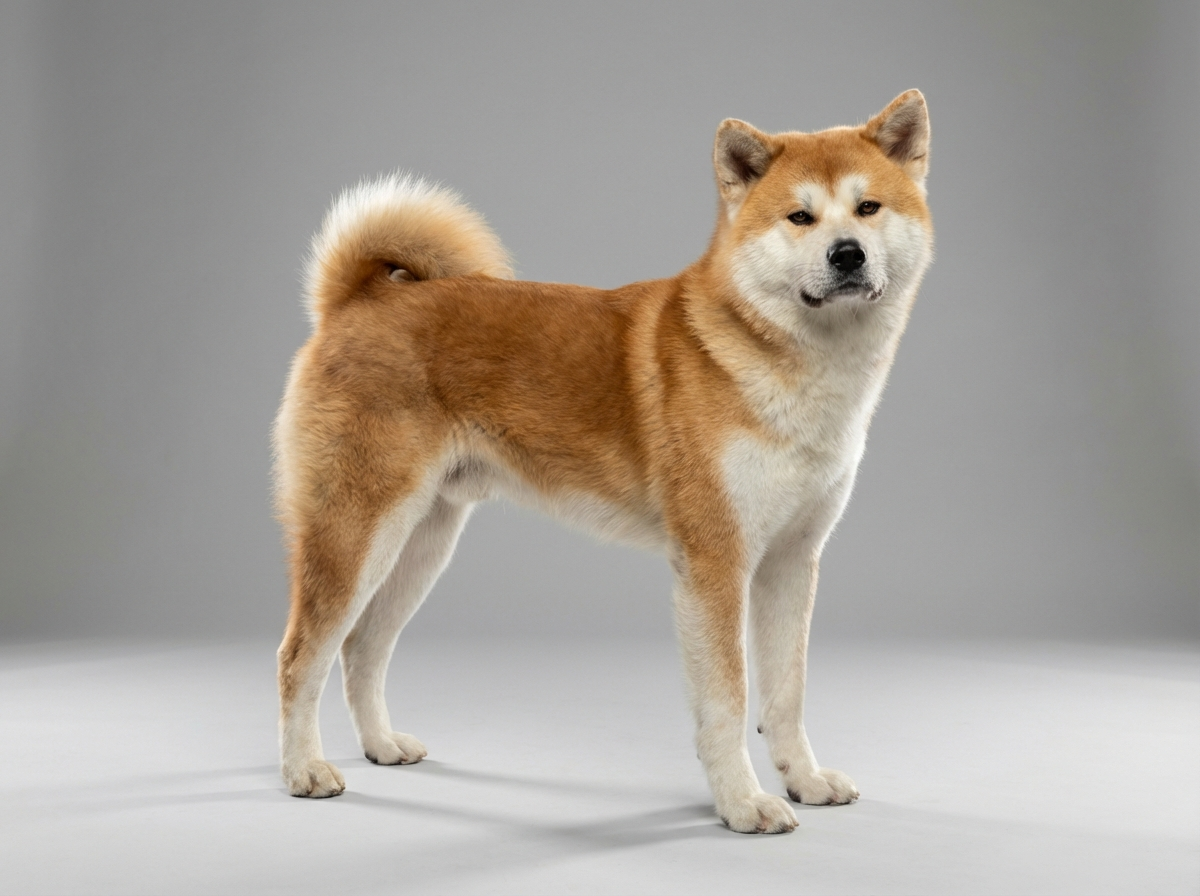
The Akita's coat is denser but shorter, and the maintenance is concentrated. For most of the year a weekly brush is enough. Twice a year, for two or three weeks, an undercoat rake and patience are the whole job.
Neither coat should ever be clipped. Both insulate against heat as well as cold, and clipped double coats frequently regrow with a coarser, less functional texture.
Both breeds are more comfortable in cold than in heat, and both should have summer exercise moved to the cooler ends of the day.
Family life and running costs
The Collie rates 5/5 with children and 4/5 with other dogs, and both hold up in practice — it is gentle, tolerant and physically careful in a way many large breeds are not. The two caveats are herding behaviour around running children and noise sensitivity in a loud house.
The Akita's 3/5 and 2/5 reflect size, limited patience for rough handling and a guardian temperament that needs supervision around visitors. Its dog intolerance is often same-sex and typically appears at social maturity around two years old.
On money the Collie is slightly cheaper: $100–$200 a month against $110–$240, and $1,500–$2,800 against $1,700–$3,200 in the first year.
The adjustment is grooming. Many Collie owners use a professional groomer periodically, and that is a recurring cost the Akita does not have. Against that, the Akita's autoimmune and bloat risks are expensive when they arrive.
Lifespan runs 11 to 14 years against 10 to 13.
Akita vs Collie: the practical rows agree, the social ones do not
Energy ties at 3/5. Exercise ties at 3/5. Time alone ties at 3/5. Apartment suitability ties at 2/5. On the mechanics of fitting a large dog into a week, these two breeds ask for almost exactly the same thing.
What separates them is what happens when something arrives at the door. The Collie rates 4/5 with strangers and 4/5 with other dogs. The Akita rates 2/5 and 2/5.
And what separates them at home is trainability: 5/5 against 3/5. The Collie is one of the most biddable large breeds available, and unlike its Border cousin it does not come with a 5/5 exercise requirement attached — this is the unusual combination that makes the Rough Collie such a practical family dog.
The coat trade runs the other way. The Collie grooms at 4/5 and sheds at 4/5; the Akita grooms at 3/5 and sheds at 5/5.
Akita or Rough Collie: Two Big Coats, Two Different Minds - Akita vs Collie: the practical rows agree, the social ones do not
Frequently asked questions
Is a Rough Collie easier to train than an Akita?
Considerably — 5/5 against 3/5. The Collie learns quickly, retains reliably and works well at distance, and unusually for a 5/5 breed it only needs 3/5 exercise. The Akita is not slow; it is independent, and was selected to make decisions without a handler present. It will consider a request before agreeing to it.
What is MDR1 and why does it matter for a Collie?
It is a mutation common in herding breeds that affects a protein keeping certain drugs out of the brain. Affected dogs can react severely to normal doses of some common medications, including particular wormers and sedatives. The test is cheap and done once, and the result should be on your vet's file permanently.
What is Collie eye anomaly?
An inherited developmental abnormality of the eye that ranges from mild and stable to causing retinal detachment and blindness. It is present from birth, so puppies should be examined by an ophthalmologist at six to eight weeks — ask to see those results before buying. A DNA test is also available for the breed.
How much grooming does a Rough Collie need?
4/5 — a proper session two or three times a week, brushing to the skin in sections rather than skimming the top. It mats behind the ears, in the ruff, in the trousers and around the tail. The Akita at 3/5 needs a weekly brush most of the year and two intensive shedding periods.
Which is better with children?
The Collie at 5/5 against the Akita's 3/5. It is gentle, tolerant and physically careful around small people. The two things to watch are herding behaviour — circling and gathering running children, which should be interrupted early — and noise sensitivity, since Collies do not thrive in a chaotic house.
Which sheds more?
The Akita at 5/5 against the Collie's 4/5, but the Collie's is spread across the year as well as concentrated twice a year. The Akita is undemanding for ten months and then blows its undercoat in handfuls. Neither coat should ever be clipped, since both insulate against heat as well as cold.
Do they need the same amount of exercise?
Yes — both rate 3/5, around forty-five to sixty minutes a day, and both rate 3/5 for energy. That surprises people who expect a herding breed to need more, but the Rough Collie is not its Border cousin. The difference is that an Akita needs securely fenced space and a route planned to avoid unfamiliar dogs.
The Rough Collie if you want a large, gentle, highly trainable family dog and will do the grooming. The Akita if you want a guardian, would rather handle two shedding seasons than weekly brushing, and have the experience to manage it.
Costs
How much does each cost per month?
The Collie runs $100–$200 a month and the Akita $110–$240, with first-year totals of $1,500–$2,800 and $1,700–$3,200. Add periodic professional grooming for the Collie.
Health
What should I ask a Collie breeder?
Eye examination results from six to eight weeks covering Collie eye anomaly, DNA results for progressive retinal atrophy, hip scores, and the MDR1 drug-sensitivity result. Ask about epilepsy in the line too.
Behavior
Which is quieter?
The Akita at 2/5 against the Collie's 3/5. Collie barking rises when the dog is anxious, and the breed is noise-sensitive — thunderstorm and firework fear are common, and a loud household tends to make it worse.
Related DogBreedCompass guides
Akita breed guide – The Akita profile covers guardian temperament and the long socialisation window the breed needs.
Rough Collie breed guide – The Collie profile covers coat maintenance, eye testing and the breed's sensitivity.
Akita vs Border Collie – The Border Collie is the working cousin with far higher drive and the same MDR1 concern.
Akita vs Shetland Sheepdog – The Shetland Sheepdog is the smaller herding breed most often weighed against the Collie.
Collie eye problems – Eye disease is the Collie's defining inherited problem and is testable before purchase.
Akita autoimmune diseases – Autoimmune disease is the Akita's most distinctive burden and the first question for a breeder.
Health information here is general and is not veterinary advice. If your dog shows pain, sudden behaviour change, or worsening symptoms, consult a licensed veterinarian.
Some links on this site are affiliate links. We may earn a commission at no extra cost to you, and we only suggest products we believe are helpful for dog owners.
We research and check what we publish, but we do not warrant that any figure, date, price, or statement is accurate, complete, or current, and we accept no liability for any loss, cost, injury, or other harm arising from the use of this site. Use it as one reference among several. You remain responsible for your own decisions and for your dog's care - confirm anything that matters with a licensed veterinarian or another qualified professional before you act on it. Full disclaimer.