Behavior
Which breed fits most households better?
The Bulldog for low-key, quiet-building living; the Sheltie for active owners who don't mind a vocal dog and want an easier trainee.

Quick answer
Which breed fits most households better?
The Bulldog for low-key, quiet-building living; the Sheltie for active owners who don't mind a vocal dog and want an easier trainee.
Bulldog (English) or Shetland Sheepdog? On paper they differ most on barking, and on the scales Bulldog (English) is the heavier at 40–50 lbs. Here is how the two compare on everything that shapes an ordinary week.
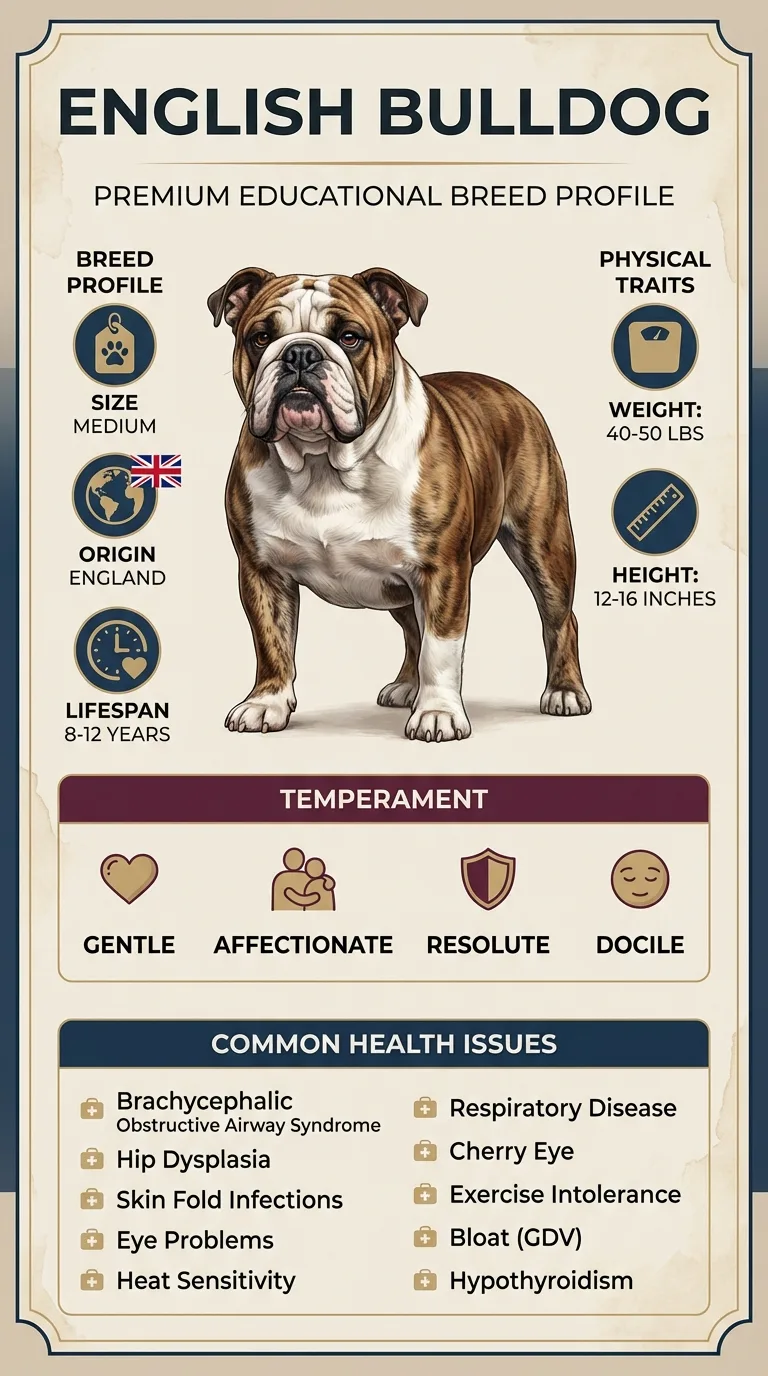
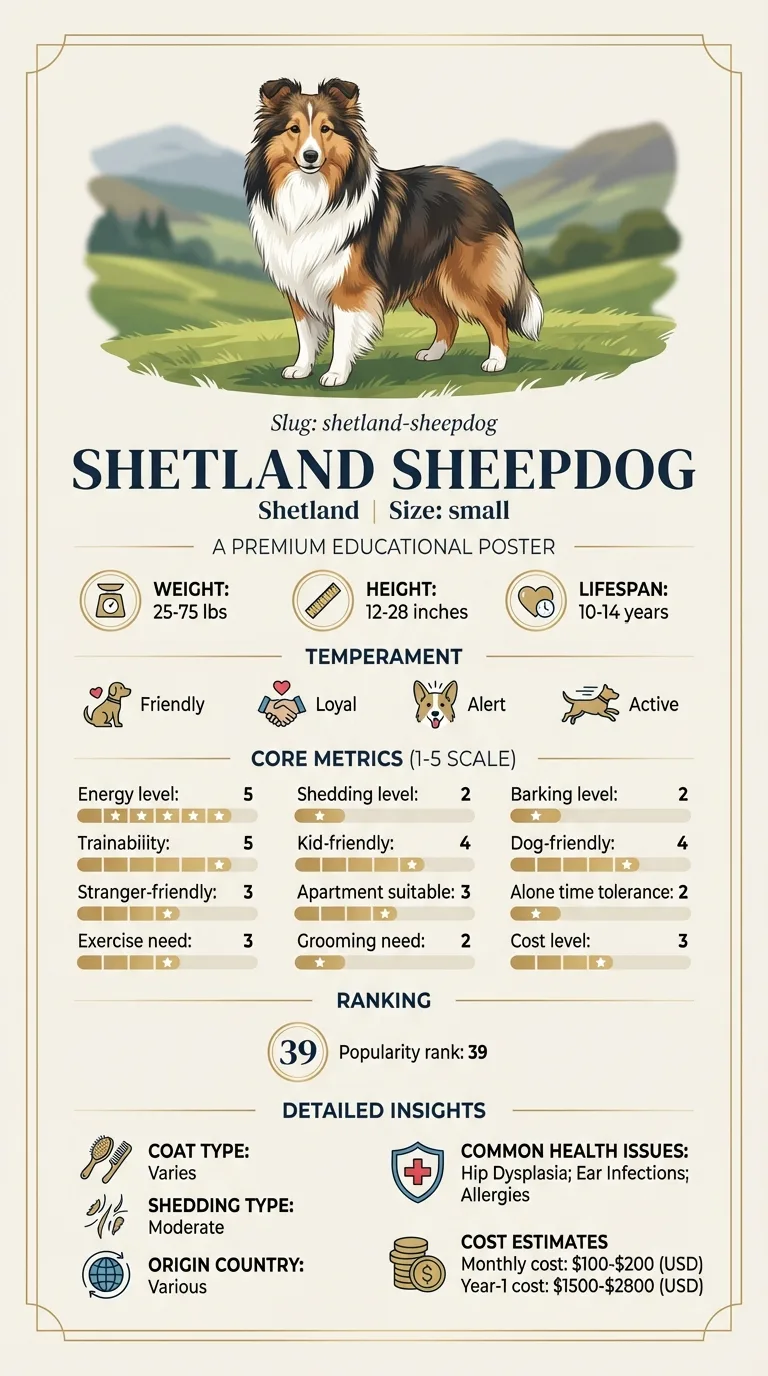
This is for someone already down to Bulldog (English) and Shetland Sheepdog and deciding between them. For this pair the decision usually turns on barking and exercise need, so those are covered first and in most detail. Anyone choosing from a flat has a clear answer here: Bulldog (English) rates 5/5 against 3/5. The focus throughout is on daily consequences rather than breed background.
Between Bulldog (English) and Shetland Sheepdog, barking is what separates them, and Bulldog (English) is the lower-effort dog of the two to keep.
Choose Bulldog (English) if you are in a flat or a smaller home, you do not want a standing grooming appointment and shedding is a problem in your house.
Choose Shetland Sheepdog if this is your first dog, you want a dog that picks up training quickly and a smaller dog suits your car, your home or your back.
| Feature | bulldog | shetland sheepdog | Winner |
|---|---|---|---|
| Size class | medium | small | Equal |
| Weight | 40–50 lbs | 15–25 lbs | Equal |
| Height | 12–16 in | 13–16 in | Equal |
| Lifespan | 8–12 years | 12–14 years | shetland sheepdog |
| Exercise need | Low (2/5) | High (4/5) | bulldog |
| Grooming need | Moderate (3/5) | High (4/5) | bulldog |
| Shedding | Moderate (3/5) | High (4/5) | bulldog |
| Energy level | Low (2/5) | High (4/5) | Equal |
| Barking | Low (2/5) | Very high (5/5) | bulldog |
| Apartment suitability | Very high (5/5) | Moderate (3/5) | bulldog |
| Good for first-time owners | Moderate (3/5) | High (4/5) | shetland sheepdog |
| Tolerates being alone | Moderate (3/5) | Low (2/5) | bulldog |
| Trainability | Moderate (3/5) | Very high (5/5) | shetland sheepdog |
| Good with kids | Very high (5/5) | High (4/5) | bulldog |
| Good with other dogs | High (4/5) | High (4/5) | Equal |
| Friendly to strangers | High (4/5) | Low (2/5) | bulldog |
| Cost level | Very high (5/5) | Moderate (3/5) | shetland sheepdog |
| Coat | Short, smooth | Long, dense double coat | Equal |
| Origin | England | Various | Equal |
| Typical monthly cost | $150–$350 | $80–$150 | Equal |
| Typical first-year cost | $2,500–$5,000 | $1,100–$2,300 | Equal |
The Sheltie is the smaller dog on paper — 15-25 lbs to the Bulldog's 40-50 — but the height numbers are surprisingly close, 13-16 inches against 12-16. What that means in practice is a lean, light-framed herding dog standing about as tall as a heavy, low-slung bully breed that outweighs it by nearly double. Picking these up tells you more about the size difference than looking at them side-on.
Exercise need is a clean split: 2/5 for the Bulldog, 4/5 for the Sheltie. Shelties were bred to herd all day and still carry that drive — daily walks plus mental work like agility or obedience games keep one satisfied. A Bulldog's idea of exercise is a short walk followed by a nap. Match the dog to how much you actually want to move each day, not how much you'd like to in theory.
Both numbers favor the Bulldog here, which surprises people who assume the fluffier dog is the lower-maintenance one. Grooming need runs 3/5 for the Bulldog against 4/5 for the Sheltie, and shedding is 3/5 versus 4/5 — that long double coat blows out seasonally and needs regular brushing to keep the house manageable. The Bulldog trades that for wrinkle care instead of a brush.
This is where the Sheltie struggles: barking rates a very high 5/5 against the Bulldog's 2/5, and apartment suitability drops to 3/5 versus the Bulldog's 5/5. Shelties are natural herders and will vocalize at movement, sound, and boredom alike. The Bulldog also tolerates being alone slightly better, 3/5 to the Sheltie's 2/5 — Shelties tend to bond tightly and struggle more with solitude.
The Sheltie is rated very high for trainability (5/5) against the Bulldog's moderate 3/5, and it also scores better for first-time owners, 4/5 versus 3/5. That combination — eager to learn, easier to raise — makes the Sheltie the more forgiving choice for a novice, provided you can manage the barking that comes with an alert, reactive herding brain. The Bulldog asks less in the way of training sessions but more in the way of patience with a dog that has learned it can simply wait you out.
Both do well with kids, with the Bulldog slightly ahead at 5/5 to the Sheltie's 4/5, and they tie with other dogs at 4/5. The real gap is with strangers: 4/5 for the Bulldog against just 2/5 for the Sheltie, which tracks a temperament built around watchfulness and sensitivity rather than open friendliness to anyone who walks in. If you host frequently or live somewhere with a lot of foot traffic, expect to put more socialization work into a Sheltie than a Bulldog typically needs.
The Sheltie's 12-14 year lifespan beats the Bulldog's 8-12 by a comfortable margin. Its health list is shorter and more breed-specific — Collie Eye Anomaly and MDR1 drug sensitivity are herding-dog quirks the Bulldog doesn't carry — while the Bulldog's list is weighted toward its flat face and folded skin. Hypothyroidism is the one condition both share. A Sheltie owner should ask a breeder about MDR1 status before starting the dog on certain medications, since a positive result changes how some common drugs are dosed.
The gap here is one of the largest in this comparison: $150-350 monthly and $2,500-5,000 in year one for the Bulldog against $80-150 and $1,100-2,300 for the Sheltie — roughly half. Cost level scores the Bulldog very high (5/5) to the Sheltie's moderate (3/5), consistent with a breed more prone to vet visits. Food costs also favor the Sheltie simply on portion size, since it's the smaller dog by a wide margin even with similar height.
Bulldog (English) weighs 40–50 lbs and lives 8–12 years; Shetland Sheepdog weighs 15–25 lbs and lives 12–14 years. The two diverge most on barking, exercise need and energy level and 4 other rated axes. Almost every rated axis separates them at least slightly. The table below marks a winner only where one breed is genuinely easier for a typical owner; size and origin are facts rather than merits and stay level. Ratings come from one source applied to both breeds, so they are meaningful against each other rather than as absolute scores.

In weight, yes — 15-25 lbs versus 40-50. In height they're actually close, 13-16 inches to the Bulldog's 12-16, since the Bulldog is a heavy dog built low to the ground.
The Sheltie, at 4/5 against the Bulldog's 3/5. Its long double coat blows out seasonally and needs regular brushing to keep loose hair under control.
The Sheltie edges it, scoring 4/5 to the Bulldog's 3/5 for first-time owners, and it's also far more trainable (5/5 vs 3/5). The catch is managing its barking, which rates a very high 5/5.
The Bulldog, clearly — 5/5 versus the Sheltie's 3/5. The Sheltie's very high barking tendency (5/5) is the main reason it drops, along with a higher exercise requirement.
The Sheltie by a wide margin: $80-150 a month and $1,100-2,300 in year one, versus $150-350 and $2,500-5,000 for the Bulldog.
Only hypothyroidism appears on both lists. The Sheltie's other risks — Collie Eye Anomaly, MDR1 drug sensitivity, dermatomyositis — are specific to herding breeds and don't overlap with the Bulldog's structural issues.
The Bulldog, though neither is great at it — it rates 3/5 to the Sheltie's 2/5. Shelties tend to bond closely and can struggle more with long stretches alone.
The Bulldog for low-key, quiet-building living; the Sheltie for active owners who don't mind a vocal dog and want an easier trainee.
The Sheltie, at $80-150 versus the Bulldog's $150-350 — roughly half the cost.
The Sheltie, rated 4/5 to the Bulldog's 2/5, reflecting its herding-dog background.
The Sheltie, at 12-14 years against 8-12 for the Bulldog.
Secure checkout on Stripe. We never see your card.
7-day money-back guarantee. Instant access.
Health information here is general and is not veterinary advice. If your dog shows pain, sudden behaviour change, or worsening symptoms, consult a licensed veterinarian.
Some links on this site are affiliate links. We may earn a commission at no extra cost to you, and we only suggest products we believe are helpful for dog owners.
We research and check what we publish, but we do not warrant that any figure, date, price, or statement is accurate, complete, or current, and we accept no liability for any loss, cost, injury, or other harm arising from the use of this site. Use it as one reference among several. You remain responsible for your own decisions and for your dog's care - confirm anything that matters with a licensed veterinarian or another qualified professional before you act on it. Full disclaimer.
Match your lifestyle to the right dog.
Take quizNot sure which breed is right for you? Take our 2-minute quiz to find out.
Take the quiz