Behavior
Which breed is quieter indoors?
The Great Dane, rated low (2/5) for barking versus the Sheltie's very high (5/5).

Quick answer
Which breed is quieter indoors?
The Great Dane, rated low (2/5) for barking versus the Sheltie's very high (5/5).
Great Dane or Shetland Sheepdog? On paper they differ most on grooming need, and on the scales Great Dane is the heavier at 110–175 lbs. Here is how the two compare on everything that shapes an ordinary week.
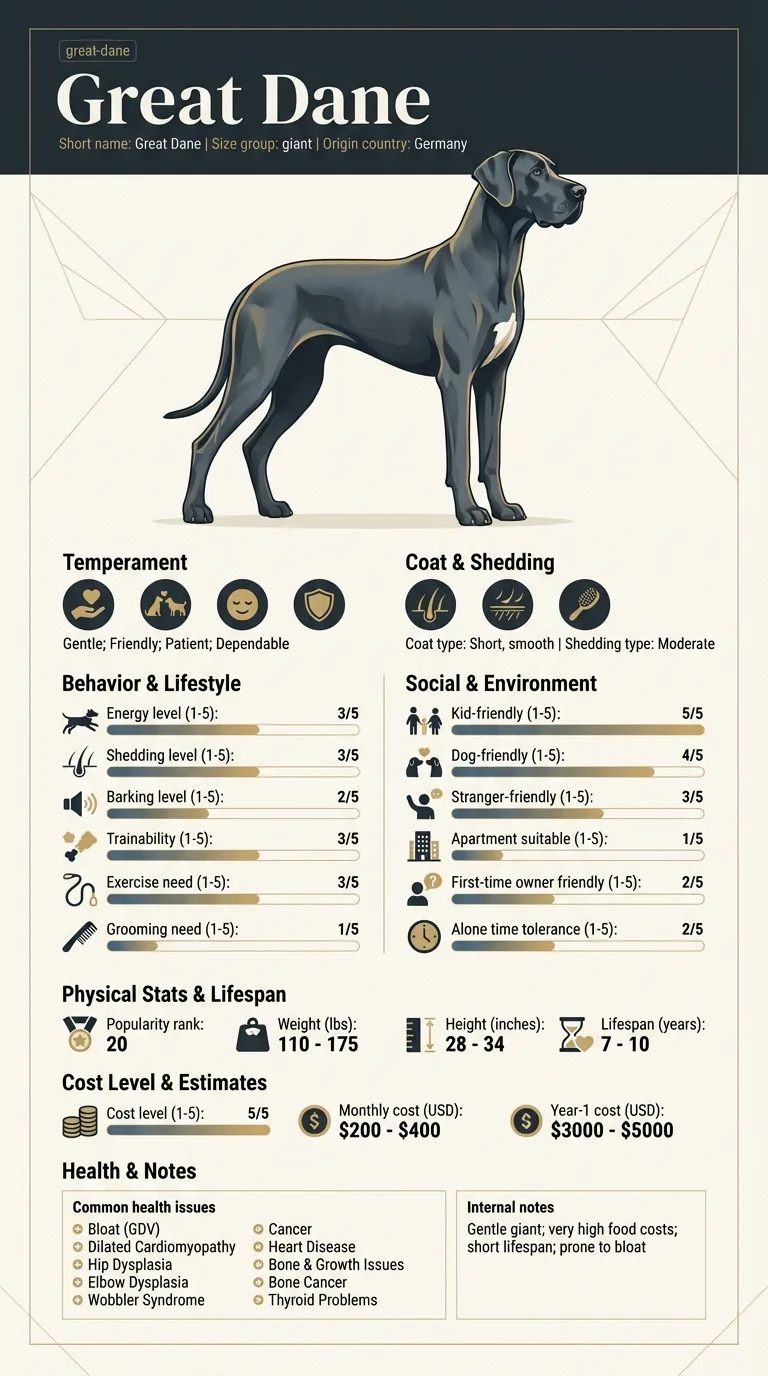
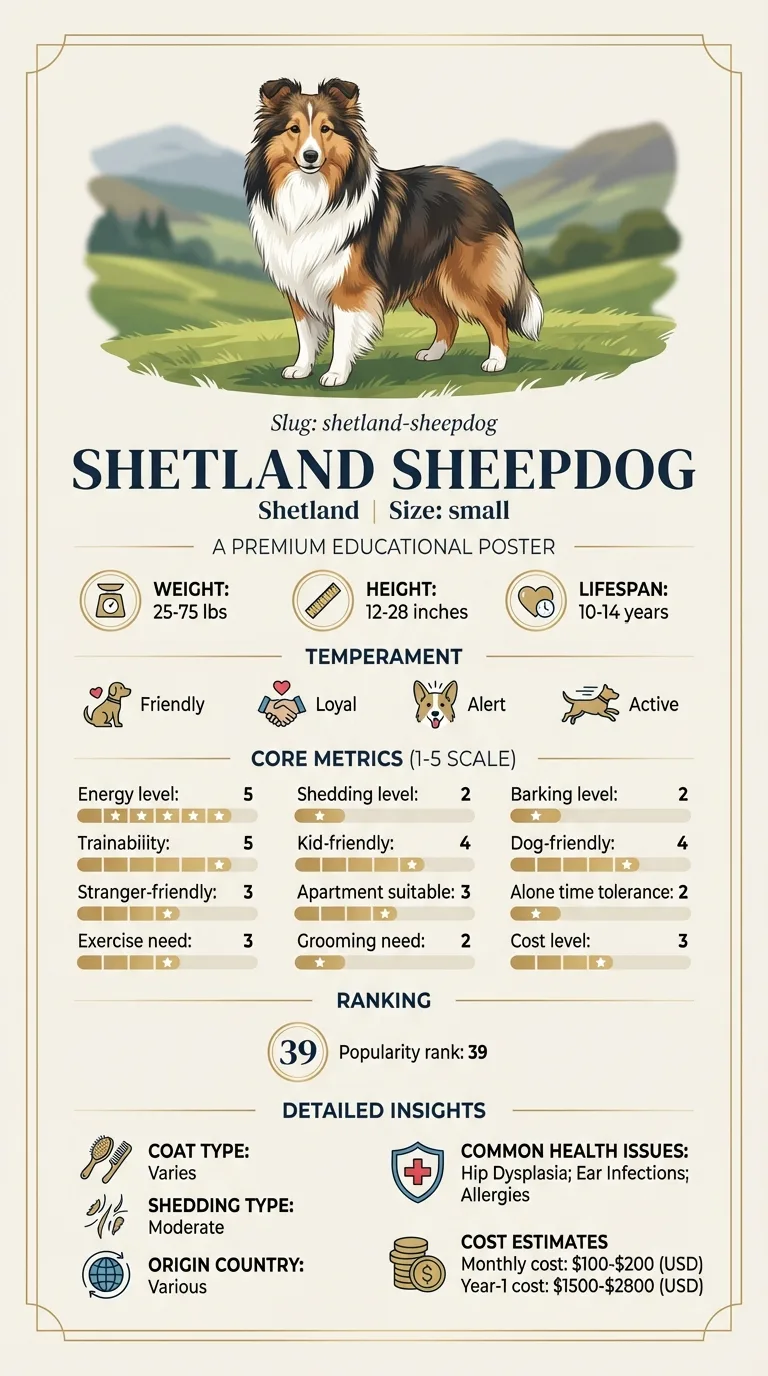
This is for someone already down to Great Dane and Shetland Sheepdog and deciding between them. For this pair the decision usually turns on grooming need and barking, so those are covered first and in most detail. Anyone choosing from a flat has a clear answer here: Shetland Sheepdog rates 3/5 against 1/5. Breed history is left out; what follows is what you will actually live with.
Between Great Dane and Shetland Sheepdog, grooming need is what separates them; neither is the lower-effort dog overall.
Choose Great Dane if you do not want a standing grooming appointment, shedding is a problem in your house and your walking routine is modest.
Choose Shetland Sheepdog if you are in a flat or a smaller home, this is your first dog and you want a dog that picks up training quickly.
| Feature | great dane | shetland sheepdog | Winner |
|---|---|---|---|
| Size class | giant | small | Equal |
| Weight | 110–175 lbs | 15–25 lbs | Equal |
| Height | 28–34 in | 13–16 in | Equal |
| Lifespan | 7–10 years | 12–14 years | shetland sheepdog |
| Exercise need | Moderate (3/5) | High (4/5) | great dane |
| Grooming need | Very low (1/5) | High (4/5) | great dane |
| Shedding | Moderate (3/5) | High (4/5) | great dane |
| Energy level | Moderate (3/5) | High (4/5) | Equal |
| Barking | Low (2/5) | Very high (5/5) | great dane |
| Apartment suitability | Very low (1/5) | Moderate (3/5) | shetland sheepdog |
| Good for first-time owners | Low (2/5) | High (4/5) | shetland sheepdog |
| Tolerates being alone | Low (2/5) | Low (2/5) | Equal |
| Trainability | Moderate (3/5) | Very high (5/5) | shetland sheepdog |
| Good with kids | Very high (5/5) | High (4/5) | great dane |
| Good with other dogs | High (4/5) | High (4/5) | Equal |
| Friendly to strangers | Moderate (3/5) | Low (2/5) | great dane |
| Cost level | Very high (5/5) | Moderate (3/5) | shetland sheepdog |
| Coat | Short, smooth | Long, dense double coat | Equal |
| Origin | Germany | Various | Equal |
| Typical monthly cost | $200–$400 | $80–$150 | Equal |
| Typical first-year cost | $3,000–$5,000 | $1,100–$2,300 | Equal |
175 pounds. That's the top of a Great Dane's weight range — nearly seven times heavier than a 25-pound Shetland Sheepdog at its heaviest. Standing up on hind legs, a full-grown Dane can look a seated adult in the eye at 28 to 34 inches tall, while the Sheltie caps out at 16 inches, roughly knee height. A doorway that feels ordinary to a Dane owner is an obstacle course of furniture legs and low tables for a Sheltie. Buying a crate, a car harness, even a dog bed means solving completely different logistics problems depending on which of these two ends up in the house.
Picture two owners leaving for work at 7am: the Sheltie owner comes home to a dog that's been pacing and needs a genuinely brisk walk, since the breed rates high (4/5) for exercise need; the Dane owner comes home to a dog that mostly wants to lie across the couch, rating just moderate (3/5). Despite the Dane's giant size, it's a famously low-key breed once past the boisterous puppy stage, content with a couple of walks a day. The Sheltie, bred to herd all day on a hillside, keeps that appetite for movement well into adulthood. Owners chasing a smaller yard-appropriate jogging partner will get more mileage out of the Sheltie than the Dane.
One (1) versus four (4) — that's the grooming-need gap on this site's five-point scale, Great Dane against Shetland Sheepdog, and it flips the usual assumption that bigger dogs mean more coat work. The Dane's short, smooth coat needs little beyond an occasional wipe-down, shedding only moderately (3/5). The Sheltie's long, dense double coat is the opposite story: high (4/5) grooming need and high (4/5) shedding, with mats forming quickly if brushing lapses for even a week or two. A household picking the Dane for perceived ease of care is right about the coat, even if wrong about everything else involving its size.
A downtown-condo owner scanning this pair for apartment fit will find the Sheltie rated moderate (3/5) and the Great Dane rated very low (1/5) — the lowest score in this comparison. But that same owner needs to weigh the Sheltie's very high (5/5) barking rating, easily the loudest breed in this matchup, against the Dane's low (2/5). A giant dog that's quiet indoors versus a small dog that announces every hallway footstep is a genuine tradeoff, not a clean win for either side. Both tolerate being alone poorly, rated low (2/5) each, so neither is suited to an owner gone ten hours a day regardless of unit size.
Five versus three: the Sheltie's trainability rating of very high (5/5) against the Dane's moderate (3/5). Sheltie intelligence is well documented — bright and sensitive, it was bred to respond instantly to a shepherd's signals across open fields. The Great Dane's gentle, patient, dependable nature makes it easy to live with but not especially quick in formal obedience work, and its sheer size means basic manners like not leaning on guests carry outsized consequences if untrained. First-time-owner ratings reverse the size stereotype entirely: the Sheltie scores high (4/5) here, the Dane just low (2/5), since managing a 150-pound dog's behavior takes more physical confidence than most beginners expect.
A toddler wobbling across the living room floor is safer, statistically, near the breed rated very high (5/5) with kids — the Great Dane — than the one rated high (4/5), the Sheltie, despite the size difference most parents instinctively worry about. Both breeds score high (4/5) with other dogs. Where they split further is strangers at the door: the Dane's moderate (3/5) friendliness beats the Sheltie's low (2/5), and Shelties are known to announce visitors loudly before warming up, if they warm up at all. A family that entertains often may find the Dane's gentle patience outweighs the intimidation of its size.
Seven to ten years. That's the full expected lifespan of a Great Dane — a Shetland Sheepdog puppy born the same week could still be alive when a same-age Dane has already passed, given the Sheltie's 12-to-14-year range. The math is brutal for giant breeds: bloat, dilated cardiomyopathy, wobbler syndrome, hip and elbow dysplasia, bone cancer, and thyroid problems fill out a ten-condition list for the Dane, with bloat alone capable of killing a healthy dog within hours if untreated. The Sheltie's five conditions — collie eye anomaly, MDR1 drug sensitivity, dermatomyositis, hypothyroidism, and patellar luxation — are comparatively survivable, though MDR1 testing before certain medications matters just as much.
Budget $3,000 to $5,000 for a Great Dane's first year and $200 to $400 every month after that — figures that put it at very high (5/5) cost level, the top rating available, against the Sheltie's moderate (3/5) and its $1,100-$2,300 first year. Food alone explains a large share of the gap: a Dane can eat several times what a 25-pound Sheltie consumes daily, and everything from crates to medication doses scales with body weight. An owner comparing these two purely on sticker price for a puppy is missing the real cost story, which unfolds over years of feeding, veterinary care, and the giant-breed conditions on the Dane's health list.
Great Dane weighs 110–175 lbs and lives 7–10 years; Shetland Sheepdog weighs 15–25 lbs and lives 12–14 years. The two diverge most on grooming need, barking and apartment suitability and 3 other rated axes. They are level on tolerates being alone and good with other dogs, so those cannot decide it. The comparison marks an easier option only where one exists. Facts like weight and country of origin are not scored. Both dogs are rated from the same dataset, which is what makes the numbers comparable with each other even though any individual dog sits somewhere inside its breed's range.

Giant breeds like the Great Dane, with a 7-10 year lifespan, tend to age faster and face higher rates of conditions like dilated cardiomyopathy and bone cancer, both on its health list. The Sheltie's 12-14 year range is typical for a small, well-proportioned breed.
By these ratings, yes — the Dane's barking level is low (2/5) versus the Sheltie's very high (5/5), and its exercise need is moderate (3/5) versus the Sheltie's high (4/5). Size doesn't predict energy level here.
The Shetland Sheepdog, rated very high (5/5) for trainability against the Dane's moderate (3/5), reflecting the Sheltie's herding-bred responsiveness to direction.
Yes, rated very high (5/5) with kids, the top score in this comparison, thanks to a gentle, patient, dependable temperament — though supervision matters given how easily a Dane's size alone can knock a toddler over.
Bloat (GDV) is a life-threatening twisting of the stomach that appears on the Great Dane's health list; deep-chested giant breeds are especially prone to it, and it can be fatal within hours without emergency surgery.
Roughly double to triple in year one — $3,000-$5,000 for the Dane versus $1,100-$2,300 for the Sheltie — driven mainly by food volume and the Dane's very high (5/5) overall cost rating.
It's a real risk — Shelties rate very high (5/5) for barking, the loudest rating in this comparison, even though they score moderate (3/5) for general apartment suitability.
The Great Dane, rated low (2/5) for barking versus the Sheltie's very high (5/5).
The Shetland Sheepdog, at 12-14 years versus the Great Dane's 7-10 years.
The Great Dane, rated very low (1/5) versus the Sheltie's high (4/5).
The Great Dane, rated very high (5/5) for cost against the Sheltie's moderate (3/5).
Secure checkout on Stripe. We never see your card.
7-day money-back guarantee. Instant access.
Health information here is general and is not veterinary advice. If your dog shows pain, sudden behaviour change, or worsening symptoms, consult a licensed veterinarian.
Some links on this site are affiliate links. We may earn a commission at no extra cost to you, and we only suggest products we believe are helpful for dog owners.
We research and check what we publish, but we do not warrant that any figure, date, price, or statement is accurate, complete, or current, and we accept no liability for any loss, cost, injury, or other harm arising from the use of this site. Use it as one reference among several. You remain responsible for your own decisions and for your dog's care - confirm anything that matters with a licensed veterinarian or another qualified professional before you act on it. Full disclaimer.
Match your lifestyle to the right dog.
Take quizNot sure which breed is right for you? Take our 2-minute quiz to find out.
Take the quiz