Akita or Pug: A Dog That Likes Everyone, or Almost No One
Quick answer
Akita vs Pug: which should I choose?
The Pug if you live in a flat and want the easiest temperament available — 5/5 with strangers, children and first-time owners. The Akita if you want a structurally sound dog that can exercise in summer and guard a door.
The Pug rates 5/5 with strangers — a rating shared on this site only with the Labrador — along with 5/5 with children and 5/5 for first-time owners. The Akita rates 2/5, 3/5 and 1/5. On temperament these two are about as far apart as breeds get, and the Pug's short face is the price of that charm.
This page is for someone weighing an easy-going small companion against a large guardian. It covers the sociability gap, breathing and heat limits, two conditions specific to the breed, the surprising amount a Pug sheds, and cost.
Quick verdict
The Pug is the easiest temperament in this batch and comes with a compromised airway and prominent eyes; the Akita is physically sound and behaviourally demanding.
Choose akita if...
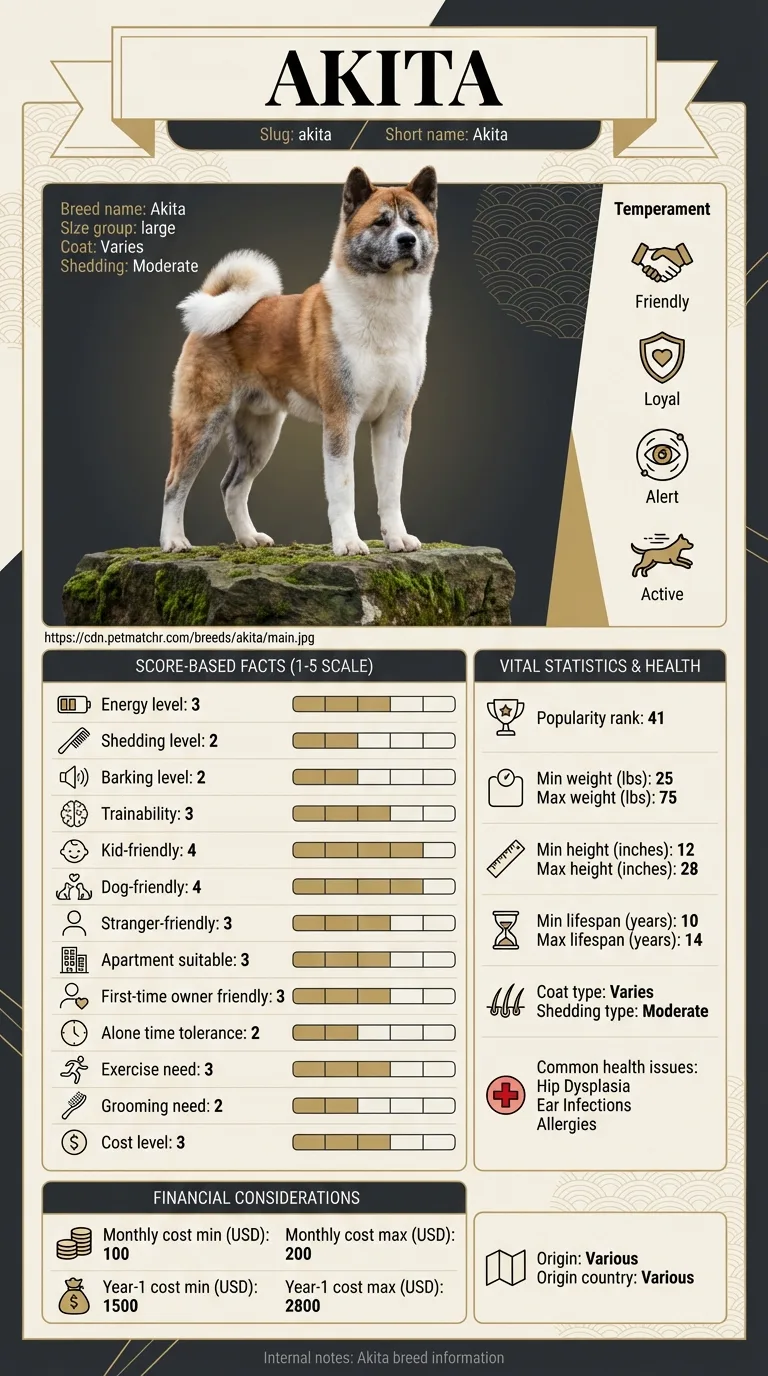
Choose the Akita if you want a structurally sound dog with no heat restrictions and a guarding presence. It can be exercised in summer, needs 3/5 exercise, tolerates being alone at 3/5 against the Pug's 2/5, and has none of the brachycephalic constraints. You are accepting 1/5 for first-time owners and up to 130 pounds.
Choose pug if...
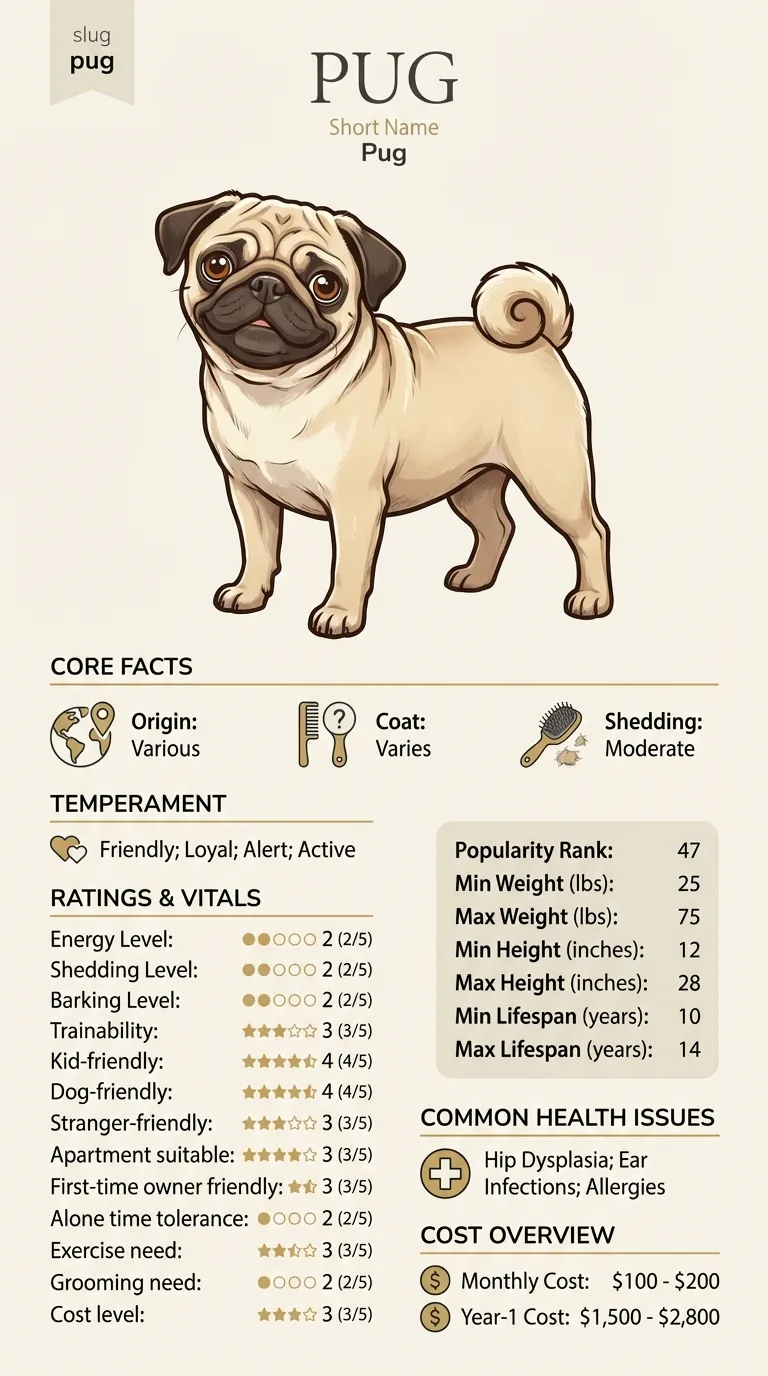
Choose the Pug if you live in a flat and want a genuinely easy companion. It rates 5/5 for apartments, first-time owners, children and strangers, 4/5 with other dogs, needs only 2/5 exercise and lives 13 to 15 years. You are accepting a short face, real heat danger, eye fragility and a surprising amount of shedding.
Head-to-head comparison
Feature
akita
pug
Winner
Weight
70–130 lbs
14–18 lbs
Equal
Height
24–28 in
10–13 in
Equal
Lifespan
10–13 years
13–15 years
pug
Coat
Dense double coat
Short double coat
Equal
Grooming need
Moderate (3/5)
Low (2/5)
pug
Shedding
Very high (5/5)
High (4/5)
pug
Energy level
Moderate (3/5)
Low (2/5)
Equal
Exercise need
Moderate (3/5)
Low (2/5)
pug
Trainability
Moderate (3/5)
Moderate (3/5)
Equal
Barking
Low (2/5)
Low (2/5)
Equal
Good with kids
Moderate (3/5)
Very high (5/5)
pug
Good with other dogs
Low (2/5)
High (4/5)
pug
Friendly to strangers
Low (2/5)
Very high (5/5)
pug
Apartment suitability
Low (2/5)
Very high (5/5)
pug
Good for first-time owners
Very low (1/5)
Very high (5/5)
pug
Tolerates being alone
Moderate (3/5)
Low (2/5)
akita
Typical monthly cost
$110–$240
$80–$150
pug
Typical first-year cost
$1,700–$3,200
$1,100–$2,300
pug
Deep dive
Air and heat: the rules a Pug lives by
Brachycephalic airway syndrome heads the Pug's condition list. The skull is shortened but the soft tissue in it is not, producing narrowed nostrils, an elongated soft palate and often a narrow windpipe.
Dogs cool themselves by moving air, so a restricted airway also restricts cooling. The practical consequences are firm rules rather than suggestions: no exercise in the heat of the day from spring onward, a harness rather than a collar, strict weight control because every extra pound loads the airway, fans or air conditioning in summer, and never a parked car even briefly.
Most airlines will not carry the breed. Many Pugs cannot swim safely.
The warning window is short. A Pug going from heavy panting to genuine distress can happen quickly, and a change in the sound of the breathing is a reason to stop immediately rather than to slow down.
Ask a breeder how the parents breathe under exertion rather than at rest, and how open the nostrils are — a wide nostril is a functional feature, not a cosmetic one.
The Akita's coat is the mirror constraint and a far milder one: walk it early and late in summer, and never clip it.
Corneal ulcers and Pug dog encephalitis
Two more items on the Pug's list need naming plainly.
Corneal ulcers are common and they are urgent. The eyes are large, prominent and set in shallow sockets, and many Pugs cannot fully close them or blink completely, so the surface dries and injures easily. A Pug squinting, holding an eye shut, or with a weeping eye needs to be seen the same day — an untreated ulcer can perforate, and eyes are lost this way every year.
Pug dog encephalitis is the rarer and more serious one. It is a breed-specific inflammatory disease of the brain, also called necrotising meningoencephalitis, and it typically appears in young adults with seizures, circling, disorientation or blindness. It progresses quickly and is usually fatal. There is no cure, though treatment can slow it. It is uncommon, and it is worth asking a breeder whether it has appeared in the line.
Hemivertebrae — malformed wedge-shaped vertebrae produced by the same process that creates the screw tail — and obesity complete the list.
The Akita's burden is autoimmune and endocrine, with hip dysplasia and bloat, and no comparable structural liability.
The amount a short-coated dog can shed
The Pug rates 4/5 for shedding, which surprises nearly everyone. It is a small dog with a short coat, and it produces an amount of hair out of all proportion to both.
The reason is that the Pug has a double coat — fawn Pugs particularly — with a dense undercoat under short stiff guard hairs. Those hairs are short, blunt and remarkably good at weaving into upholstery, car seats and clothing, and they are much harder to remove than long hair.
Grooming is only 2/5, so the work itself is easy: a rubber curry brush weekly, more during heavier periods.
The face folds need daily attention — wiping and, importantly, drying, because trapped moisture in a fold reliably becomes an infection. The tail curl needs checking too.
The Akita sheds more at 5/5 but concentrates it into two annual periods, with a weekly brush covering the other ten months. Both coats are double and neither should be clipped.
On hair alone, the honest position is that neither breed suits someone who wants a clean floor.
What each costs to keep
The Pug runs $80–$150 a month against the Akita's $110–$240, and $1,100–$2,300 against $1,700–$3,200 in the first year. On food and routine care it is much the cheaper dog.
What that figure does not carry is the airway. Corrective surgery for nostrils and soft palate is common enough in the breed to plan for rather than hope against, and it is not cheap. Eye treatment is the other recurring item — an ulcer needs prompt attention and sometimes surgery.
Insurance is priced accordingly. Short-faced breeds are frequently quoted above what their size suggests, and airway conditions are among the most commonly excluded as breed-related, which is precisely the cover you want. Insure from puppyhood and keep it unbroken.
Weight control is the cheapest intervention available. A lean Pug breathes better, moves better and lives longer, and obesity appears on its condition list for a reason.
On lifespan the Pug does well at 13 to 15 years against 10 to 13 — long for a brachycephalic breed and one of the better figures in this batch.
Akita vs Pug: the temperament gap and what it costs
The Pug's 5/5 with strangers is unusual enough to note. Most small companion breeds are wary; the Pug is not. It greets everyone, tolerates handling, and is genuinely unbothered by noise and chaos, which is why it rates 5/5 with children as well.
Barking ties at 2/5, which makes the Pug one of the quietest small breeds available and a genuinely good flat dog on that measure. Trainability also ties at 3/5 — the Pug is not slow, it is simply unconvinced that most requests are worth acting on.
What the Pug pays for its charm is anatomical. The flat face that makes the expression is the same flat face that restricts its airway and exposes its eyes, and most of its condition list follows from it.
The Akita's advantages here are structural soundness, a body that can exercise in July, and a 3/5 tolerance for solitude against 2/5.
Akita or Pug: A Dog That Likes Everyone, or Almost No One - Akita vs Pug: the temperament gap and what it costs
Frequently asked questions
Is a Pug good with strangers and children?
Exceptionally — 5/5 on both, against the Akita's 2/5 and 3/5. It greets everyone, tolerates handling, and is unbothered by household noise. It also rates 4/5 with other dogs and 5/5 for first-time owners. Temperament is the Pug's strongest quality by a wide margin.
How much can a Pug be exercised?
2/5 — two gentle walks, timed around temperature. From spring onward they should happen early and late only. A short face restricts cooling as well as breathing, and the window between heavy panting and genuine distress is short. A change in the sound of the breathing means stop, not slow down.
Why do Pugs get corneal ulcers?
Because the eyes are large, prominent and set in shallow sockets, and many Pugs cannot close or blink them fully, so the surface dries and injures easily. A squinting, closed or weeping eye needs same-day veterinary attention — an untreated ulcer can perforate and eyes are lost this way.
What is Pug dog encephalitis?
A breed-specific inflammatory disease of the brain, also called necrotising meningoencephalitis, appearing in young adults with seizures, circling, disorientation or blindness. It progresses quickly and is usually fatal, though treatment can slow it. It is uncommon — ask a breeder whether it has appeared in the line.
Do Pugs shed a lot?
Far more than people expect — 4/5, against the Akita's 5/5. The Pug has a double coat with a dense undercoat under short stiff guard hairs, and those hairs weave into upholstery and clothing and are hard to remove. Grooming effort is only 2/5: a rubber curry brush weekly.
Which lives longer?
The Pug, at 13 to 15 years against the Akita's 10 to 13 — a good figure for a short-faced breed and one of the better ones in this batch. Keeping the dog lean is the single largest thing an owner can do to protect it, since weight loads an already compromised airway.
What should I ask a Pug breeder?
How the parents breathe under exertion rather than at rest, and how open their nostrils are — a wide nostril is functional, not cosmetic. Ask whether either parent has had airway surgery, about eye health, and whether encephalitis has ever appeared in the line.
The Pug if you live in a flat and want the easiest temperament available — 5/5 with strangers, children and first-time owners. The Akita if you want a structurally sound dog that can exercise in summer and guard a door.
Costs
How much does each cost per month?
The Pug runs $80–$150 a month and the Akita $110–$240, with first-year totals of $1,100–$2,300 and $1,700–$3,200. The Pug's risk is a single large airway or eye bill rather than the running cost.
Behavior
Which is quieter?
They tie at 2/5 — the Pug is one of the quietest small breeds there is, which makes it a good flat dog on that measure. It is, however, one of the noisiest breeds alive in every other sense: snoring, snorting and wheezing are constant.
Health
What daily care does a Pug need?
Face folds wiped and dried every day, because trapped moisture reliably becomes an infection, plus a check of the tail curl. Weight control matters more than any other single habit — a lean Pug breathes better and lives longer.
Related DogBreedCompass guides
Akita breed guide – The Akita profile covers guardian temperament and the long socialisation window the breed needs.
Pug breed guide – The Pug profile covers airway care, fold hygiene and weight management.
Akita vs French Bulldog – The French Bulldog is the short-faced breed most often cross-shopped against the Pug.
Akita vs Boston Terrier – The Boston Terrier is the lighter, more athletic short-faced alternative.
Pug genetic disorders – The inherited conditions worth screening for before buying a Pug puppy.
Akita autoimmune diseases – Autoimmune disease is the Akita's most distinctive burden and the first question for a breeder.
Health information here is general and is not veterinary advice. If your dog shows pain, sudden behaviour change, or worsening symptoms, consult a licensed veterinarian.
Some links on this site are affiliate links. We may earn a commission at no extra cost to you, and we only suggest products we believe are helpful for dog owners.
We research and check what we publish, but we do not warrant that any figure, date, price, or statement is accurate, complete, or current, and we accept no liability for any loss, cost, injury, or other harm arising from the use of this site. Use it as one reference among several. You remain responsible for your own decisions and for your dog's care - confirm anything that matters with a licensed veterinarian or another qualified professional before you act on it. Full disclaimer.