Costs
Akita cost in New Orleans
About $105–$205/month, $1,600–$2,850 for year one — below average, plus a hurricane-season contingency to plan for.

See Akita price across all cities →
Quick answer
Akita cost in New Orleans
About $105–$205/month, $1,600–$2,850 for year one — below average, plus a hurricane-season contingency to plan for.
An Akita in New Orleans costs about $105–$205 a month, with the first year around $1,600–$2,850 — a below-average budget shaped by the city's older housing stock and hurricane season.
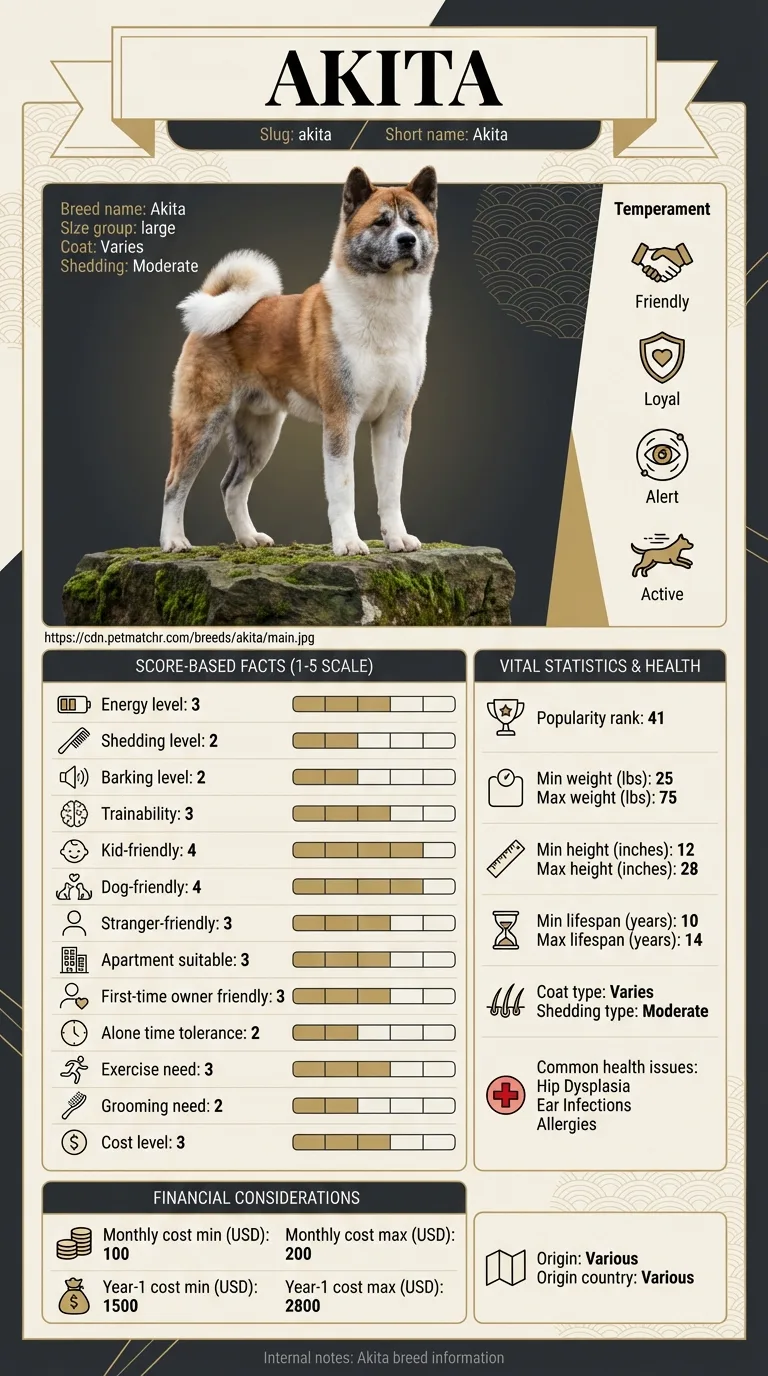
The breed's own risks apply here as anywhere — hip dysplasia and the Akita's tendency toward ear infections are the likeliest sources of an unplanned bill. Hurricane season specifically adds a cost category most cities on this site simply don't need: evacuation-ready supplies and, potentially, an unplanned boarding or travel expense if a storm requires leaving the city.
These figures reflect New Orleans's below-average general cost of living, with the region's humid climate keeping parasite prevention active most of the year and hurricane season adding a real, if irregular, contingency cost most cities on this site don't have.
Estimate · source: estimation · confidence: medium · updated 2026-09-05 · not a quote
| Item | Cost range |
|---|---|
One-time setup (initial vet visit, spay/neuter, large-breed gear) Covers the first exam, vaccinations, spay/neuter if needed, and gear sized for the breed's adult weight — priced at New Orleans's generally affordable rates. | $385 - $665 |
| Item | Cost range |
|---|---|
Food Sized for the breed's large adult frame; Louisiana's below-average general prices help keep this toward the lower end nationally. | $48 - $80 |
Grooming Akitas mostly self-groom; at-home brushing through the coat-blow seasons covers most needs without frequent professional visits. | $10 - $22 |
Flea, tick & heartworm prevention Active most of the year given the Gulf Coast's humid climate, similar to other cities in the region this site covers. | $18 - $32 |
Each range starts from a national baseline for this breed's size class and is then adjusted for local cost of living and veterinary pricing. The baselines, and the source each one came from, are listed on our sources page (dataset 2026.09). Two inputs, the purchase price and the emergency reserve, have no published national figure we could verify, so we leave them to you rather than invent them.
These are planning estimates, not quotes. Your own numbers will move with the individual dog, your vet and your insurer. Build a budget with your own figures.
For an Akita in New Orleans, insurance is mainly about the breed's hip dysplasia risk, since the local vet market itself runs below the national average.
A surgical hip procedure still runs into real money even at New Orleans's below-average rates, so buying a policy while the dog is young — before anything is on record — is worth pricing out given the breed's documented risk.
Owners who've set aside $2,000 or more specifically for a vet emergency, and who are comfortable managing that bill themselves, can reasonably self-insure instead of paying a recurring premium.
New Orleans already starts from a lower cost base than most cities on this site; the extra planning here is about hurricane season, not routine pricing.
New Orleans's older neighborhoods — the French Quarter, the Garden District, much of Uptown — are dense with historic shotgun houses and courtyard buildings, many without the kind of private yard space a large breed like the Akita benefits from. That housing pattern means more owners here rely on scheduled walks and nearby parks (City Park and Audubon Park both see heavy dog traffic) than in a city with more suburban-style housing, without necessarily needing a paid dog-walker the way a denser Northeastern city might.
The city's biggest genuinely unusual cost factor is hurricane season, which runs roughly June through November. An evacuation-ready kit for a large dog — extra food, water, medication records, a comfortable travel crate — is worth assembling before the season starts rather than during an active storm warning, when supplies and boarding availability both get harder to find. Some years pass with no direct impact; others require an actual evacuation, sometimes with boarding or pet-friendly lodging costs attached that a typical monthly budget doesn't anticipate.
Outside of those two factors, New Orleans's general costs run below the national average, consistent with Louisiana's broader affordability, and the region's humid climate keeps parasite prevention active for most of the year, similar to other Gulf Coast cities this site covers.

A New Orleans Akita owner assembled a basic hurricane kit for their dog every June, mostly out of habit after a few uneventful seasons. When a storm warning eventually did require evacuating, having food, water, medication records and a familiar crate already packed meant the actual evacuation was straightforward rather than a last-minute scramble, at a time when pet-friendly lodging along the evacuation route was filling up fast. The kit itself had cost very little to assemble and sat unused for years before it mattered.
Key takeaway: In a city with a real hurricane risk, a basic pet evacuation kit costs little and sits unused most years — but having it ready before a storm warning, rather than during one, is what actually makes a difference.
About $105–$205, covering food, routine vet care, grooming and parasite prevention. Louisiana's below-average general costs help keep most of this down, though the region's humid climate keeps parasite prevention active most of the year.
Roughly $1,600–$2,850, including the initial vet exam, spay/neuter if needed, and large-breed gear on top of ongoing monthly costs.
Potentially, yes — an evacuation-ready kit (extra food, water, medication records, a travel crate) is worth having ready before the June-through-November season starts. Some years require no action; others may mean an actual evacuation with boarding or travel costs a typical monthly budget doesn't include.
It takes more reliance on scheduled walks and nearby parks than a suburban home with a yard would, since a lot of the city's historic housing lacks private outdoor space. City Park and Audubon Park both see heavy dog use and are popular options for exercise.
Worth pricing out given the breed's hip dysplasia risk — even in a below-average-cost market like New Orleans, a surgical procedure can run into real money, and insurance is cheapest bought before the dog has anything on a vet record.
Around $650 covers a typical significant vet visit in this market. It's also worth keeping a separate, smaller reserve specifically for hurricane-season evacuation costs, since that's a real, if irregular, expense category unique to this city.
About $105–$205/month, $1,600–$2,850 for year one — below average, plus a hurricane-season contingency to plan for.
This guide is not medical advice. If your dog shows pain, sudden behavior change, or worsening symptoms, consult a licensed veterinarian.
Some links may be affiliate links. We may earn a commission at no extra cost to you. We only suggest products we believe are helpful for dog owners.
We research and check what we publish, but we do not warrant that any figure, date, price, or statement is accurate, complete, or current, and we accept no liability for any loss, cost, injury, or other harm arising from the use of this site. Use it as one reference among several. You remain responsible for your own decisions and for your dog's care - confirm anything that matters with a licensed veterinarian or another qualified professional before you act on it. Full disclaimer.
One sheet with every line item, the emergency fund and when insurance pays off - unlocks on this page.
You get: 12-month budget sheet
No spam. One-click unsubscribe. See our privacy policy.
Preview page 1 before you decide.