The Boston Terrier for most households — 5/5 for apartments, first-time owners and children. The Akita only if you have handled a powerful guardian breed before, have space, and want a dog that watches the door.
There is no sensible way to describe these two as alternatives to each other. The Akita can weigh ten times what a Boston Terrier weighs, rates 1/5 for first-time owners against the Boston's 5/5, and rates 2/5 for apartments against 5/5. If you are genuinely undecided, the honest answer is that you have not yet decided what kind of household you want.
This page is for someone comparing two breeds that appeal for completely different reasons — presence and guarding on one side, convenience and sociability on the other. It covers the size and cost gap, what the Akita's 1/5 first-time rating actually means, the Boston's brachycephalic breathing and heat limits, and which health questions matter for each.
Quick verdict
The Boston Terrier is the right dog for almost anyone with a normal job and a normal flat; the Akita is the right dog only for an experienced owner with space, time and a reason to want a guardian.
Choose akita if...
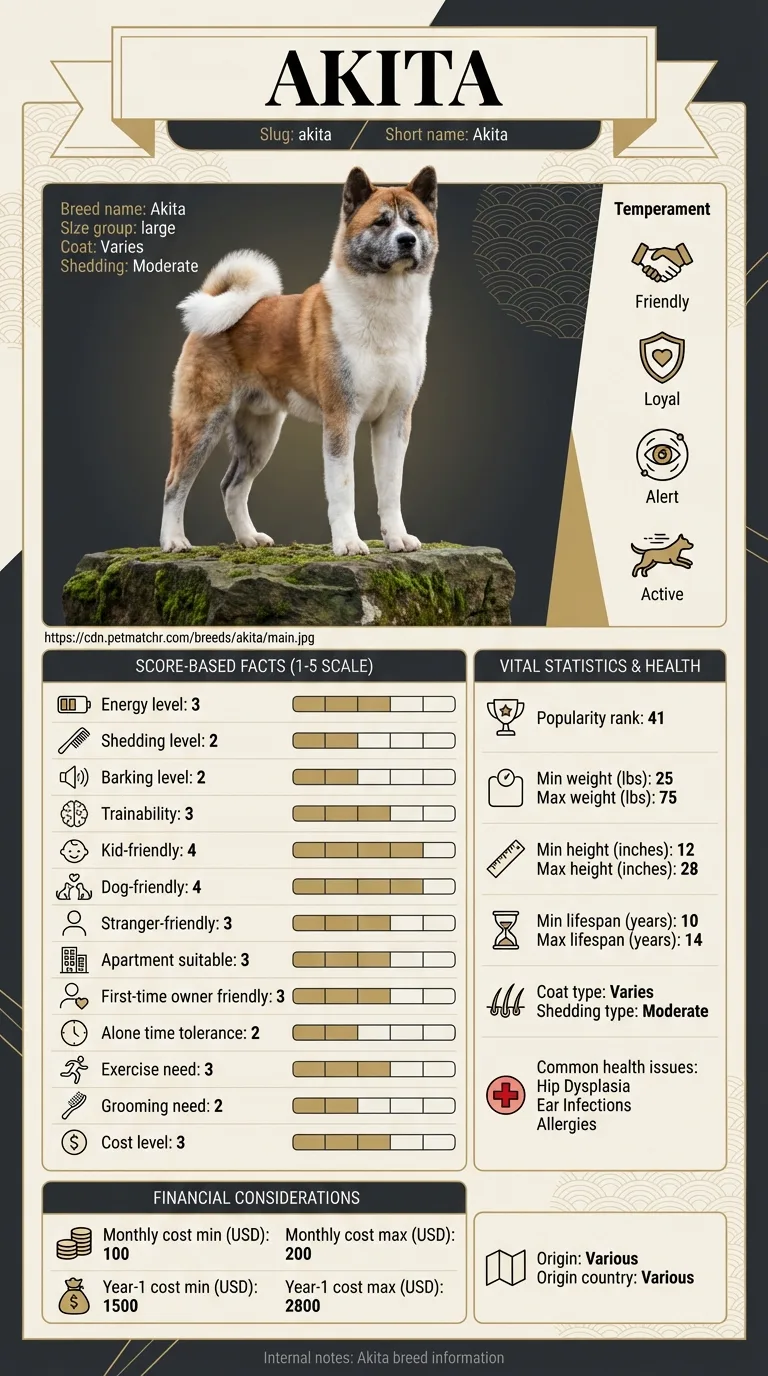
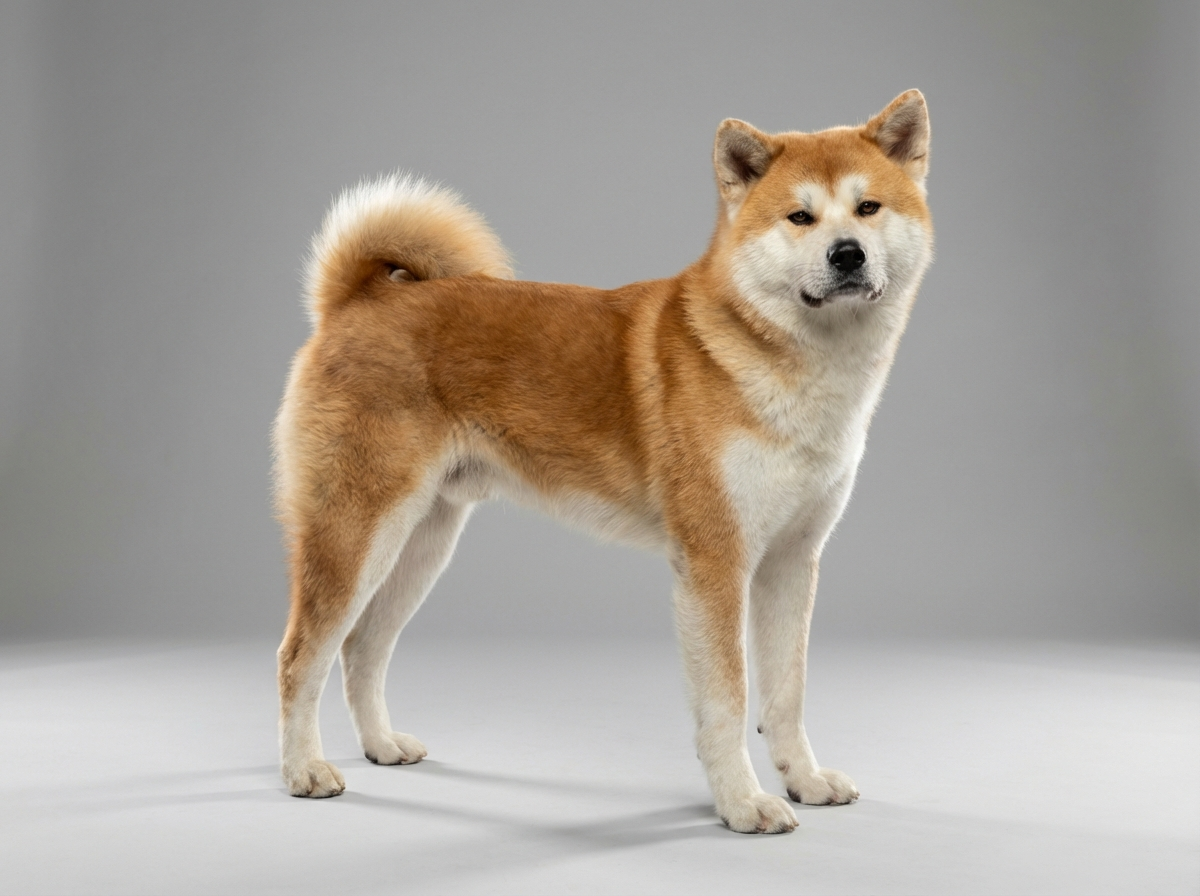
Choose the Akita if you want a large, quiet, dignified guardian and you have handled a powerful dog before. It rates 1/5 for first-time owners, 2/5 with other dogs and 2/5 with strangers, sheds at 5/5, and costs $110–$240 a month against the Boston's $80–$150. You need space and a fenced garden.
Choose boston terrier if...
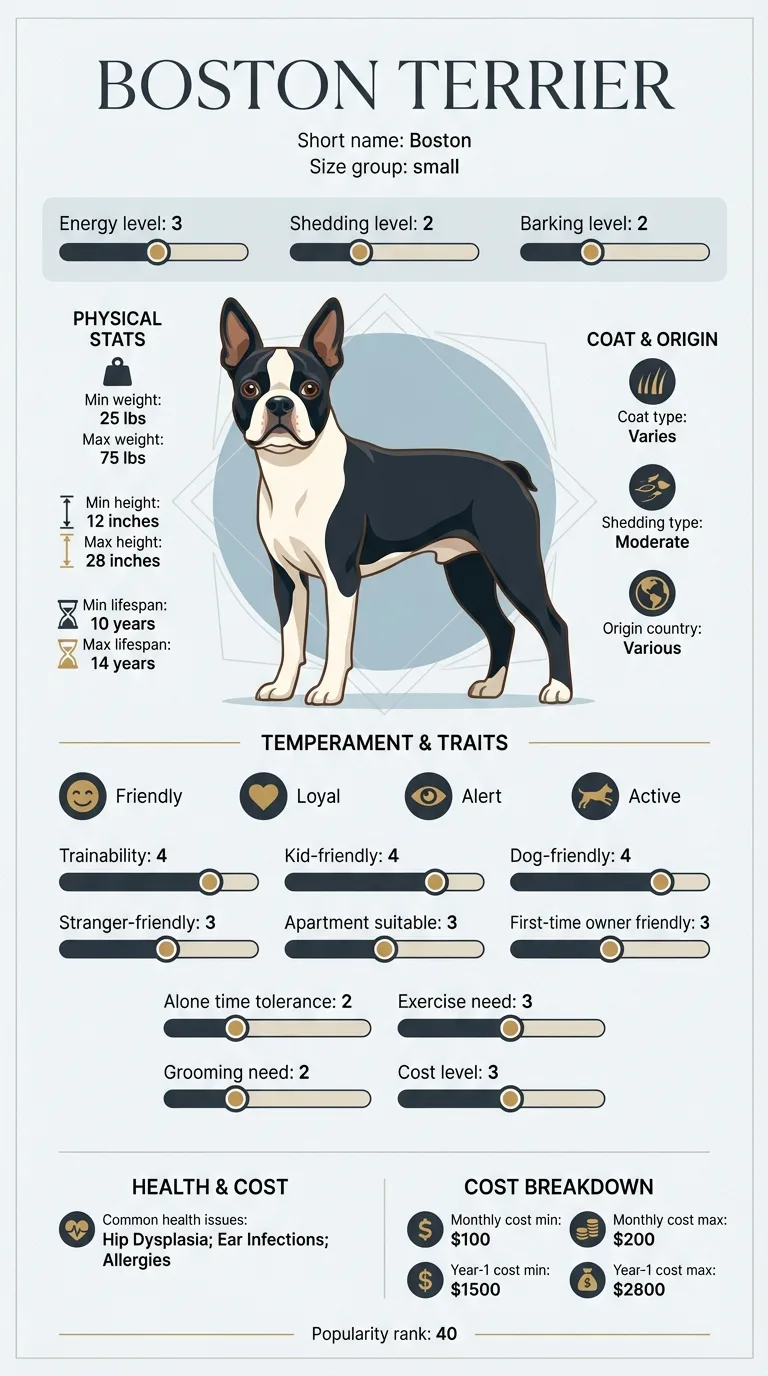
Choose the Boston Terrier if you live in a flat, want an easy first dog, or simply want a dog you can pick up. It rates 5/5 for apartments, 5/5 for first-time owners, 5/5 with children and 4/5 with other dogs, grooms at 1/5 and sheds at 2/5. The trade-off is a short face: heat, exercise in summer and air travel all need managing.
Head-to-head comparison
Feature
akita
boston terrier
Winner
Weight
70–130 lbs
12–25 lbs
Equal
Height
24–28 in
15–17 in
Equal
Lifespan
10–13 years
11–13 years
boston terrier
Coat
Dense double coat
Short and smooth
Equal
Grooming need
Moderate (3/5)
Very low (1/5)
boston terrier
Shedding
Very high (5/5)
Low (2/5)
boston terrier
Energy level
Moderate (3/5)
Moderate (3/5)
Equal
Exercise need
Moderate (3/5)
Low (2/5)
boston terrier
Trainability
Moderate (3/5)
High (4/5)
boston terrier
Barking
Low (2/5)
Low (2/5)
Equal
Good with kids
Moderate (3/5)
Very high (5/5)
boston terrier
Good with other dogs
Low (2/5)
High (4/5)
boston terrier
Friendly to strangers
Low (2/5)
High (4/5)
boston terrier
Apartment suitability
Low (2/5)
Very high (5/5)
boston terrier
Good for first-time owners
Very low (1/5)
Very high (5/5)
boston terrier
Tolerates being alone
Moderate (3/5)
Moderate (3/5)
Equal
Typical monthly cost
$110–$240
$80–$150
boston terrier
Typical first-year cost
$1,700–$3,200
$1,100–$2,300
boston terrier
Deep dive
What a 1/5 first-time rating means in practice
The Akita's 1/5 is not a comment on intelligence. It is a comment on consequence.
Guardian breeds were selected to make decisions without a handler present, and the Akita does. Its trainability sits at 3/5, which is fair: it understands what is being asked, considers it, and forms a view. When the dog forming that view weighs a hundred pounds and rates 2/5 with other dogs and 2/5 with strangers, mistakes cost more than they would with a small breed.
The part that catches owners out is timing. Akita dog-intolerance, often same-sex, typically appears at social maturity around two years old, in a dog that was fine at eight months. Socialisation therefore has to be sustained well past puppyhood rather than treated as a course you finish.
The Boston's 5/5 reflects the opposite: a 25-pound dog that trains at 4/5, wants to be liked, and whose worst-case error is embarrassing rather than serious. It is one of the more sensible first dogs available.
The short face and the double coat
Brachycephalic airway syndrome is the first item on the Boston Terrier's health list and it shapes the whole ownership experience. A shortened skull with a normal amount of soft tissue in it means narrowed nostrils, an elongated soft palate, and in some dogs a collapsing larynx.
Practically: no exercise in the heat of the day in summer, no harness-free walking on a collar that presses the throat, careful weight control because every extra pound loads a compromised airway, and a real conversation with an airline before any flight — many will not carry short-faced breeds in hold at all.
Ask a Boston breeder about the parents' breathing under exertion, not just at rest. Correction surgery for nostrils and palate is common and not cheap.
The Akita's coat is the mirror problem. A dense double coat rated 5/5 for shedding blows out in clumps twice a year and needs an undercoat rake and patience. It also insulates against heat, which is why it should never be clipped. Grooming still only rates 3/5, because the work is seasonal rather than constant.
Children, other dogs and visitors
The Boston rates 5/5 with children against the Akita's 3/5, and 4/5 with other dogs against 2/5.
Those numbers understate the difference in daily life. A Boston that makes a social mistake is a small dog being rude. An Akita that makes one is a hundred-pound dog with a guarding instinct in a situation that has already gone wrong.
The Akita's 3/5 with children is not a warning about aggression toward its own family — it is about size, tolerance for handling, and the fact that a guardian breed needs supervision around visiting friends who behave unpredictably.
With strangers the gap is 4/5 against 2/5. The Boston greets. The Akita assesses, and its reserve is territorial rather than nervous — it settles once it has decided.
On noise they are level at 2/5. Neither is a nuisance barker, which is a genuine point in the Boston's favour for flat living, since many small breeds are not.
Autoimmune disease against eyes and knees
The two health profiles have almost nothing in common.
The Akita's burden is immune and endocrine: autoimmune disorders affecting skin, eyes and blood, hypothyroidism, progressive retinal atrophy, plus hip dysplasia and bloat as a deep-chested large breed. Akitas are also known for sensitivity to some anaesthetic protocols, which is worth flagging to any vet before a procedure.
The Boston's list is structural and ocular: brachycephalic airway syndrome, patellar luxation, cataracts, corneal ulcers, and congenital deafness. The prominent eye is exposed and corneal injuries are common — a scratched eye in a Boston is a same-day vet problem, not a wait-and-see one.
Ask a Boston breeder for BAER hearing testing and eye certification on the parents. Ask an Akita breeder for hip scores, thyroid panels and eye testing.
Lifespans are close, 10 to 13 against 11 to 13, which is unusual for a size gap this wide.
What each costs to run
The Akita runs $110–$240 a month against the Boston's $80–$150, with first-year totals of $1,700–$3,200 and $1,100–$2,300.
Most of that gap is food and dose-based costs. A hundred-pound dog eats several times what a twenty-pound dog eats, and flea, worm and joint products are priced by weight. Boarding is usually banded by size too.
The Boston's costs are lower on paper but less predictable. Airway surgery, knee surgery for a luxating patella, and repeated corneal treatment are all realistic single line items in a Boston's life, and any of them can exceed a year of the difference in food.
Insurance pricing reflects this. Short-faced breeds are frequently quoted above what their size suggests, and some policies exclude airway conditions as breed-related.
If the budget is genuinely tight, the Boston is the safer choice — but budget for insurance from day one rather than treating it as optional.
Akita vs Boston Terrier: a tenfold size gap
A 25-pound Boston Terrier and a 130-pound Akita are not two versions of the same decision. They are different categories of object in a house.
The Boston wins nearly every convenience row on this page: 5/5 for apartments, 5/5 for first-time owners, 5/5 with children, 4/5 with other dogs, 4/5 with strangers, 1/5 grooming, 2/5 shedding, and $80–$150 a month against $110–$240.
The Akita's advantages are not on the table at all, because they are not the sort of thing a rating captures: presence, a genuine deterrent effect, and a temperament that watches a door rather than greeting it.
The two things they actually share are a quiet mouth — both rate 2/5 for barking — and a similar tolerance for being left alone, both 3/5. Everything else diverges.
Akita or Boston Terrier: 130 Pounds or 25? - Akita vs Boston Terrier: a tenfold size gap
Frequently asked questions
Is an Akita or a Boston Terrier better for a first-time owner?
The Boston Terrier, clearly. It rates 5/5 for first-time owners against the Akita's 1/5. The Akita is an independent guardian breed rating 2/5 with other dogs and 2/5 with strangers, and its dog-intolerance often appears at around two years old in a dog that was fine as a puppy. That combination in a hundred-pound animal is why the rating is what it is.
Which one can live in an apartment?
The Boston Terrier, at 5/5 against the Akita's 2/5. The Boston needs only 2/5 exercise, barks at 2/5 and weighs 12 to 25 pounds. The Akita needs 3/5 exercise, sheds at 5/5, and its size and guarding instinct make shared corridors and lifts a daily management problem rather than an occasional one.
Which sheds more?
The Akita, by a wide margin — 5/5 against the Boston's 2/5. It blows a dense double coat twice a year and needs an undercoat rake through those weeks. Grooming still rates only 3/5 because the work is seasonal. The Boston grooms at 1/5 and sheds a fine short hair year-round that shows on dark clothing.
What is the main health concern with a Boston Terrier?
Brachycephalic airway syndrome. The shortened skull means narrowed nostrils and an elongated soft palate, which limits exercise in heat, complicates air travel and makes weight control important. Patellar luxation, cataracts, corneal ulcers and congenital deafness are also on the list — ask a breeder for BAER hearing testing and eye certification.
How much more does an Akita cost to keep?
Roughly $30 to $90 a month more: $110–$240 against $80–$150, and $1,700–$3,200 against $1,100–$2,300 in the first year. Most of it is food and weight-dosed products. The Boston's lower running cost is offset by a higher chance of a single large surgical bill for airway, knee or eye problems.
Which is better with children?
The Boston Terrier at 5/5 against the Akita's 3/5. The Boston is sturdy for its size, sociable and unbothered by household noise. The Akita's rating reflects size, tolerance for rough handling and the need to supervise a guardian breed around visiting children rather than any hostility to its own family.
Do they get along with other dogs?
The Boston does, at 4/5. The Akita rates 2/5 and is frequently intolerant of dogs of the same sex, often from social maturity around two years old. If you already have a dog, or want off-lead park life, that difference is the deciding factor rather than a detail.
The Boston Terrier for most households — 5/5 for apartments, first-time owners and children. The Akita only if you have handled a powerful guardian breed before, have space, and want a dog that watches the door.
Costs
How much does each cost per month?
The Akita runs $110–$240 a month and the Boston Terrier $80–$150, with first-year totals of $1,700–$3,200 and $1,100–$2,300.
Living
Which needs less exercise?
The Boston Terrier at 2/5 against the Akita's 3/5, with the caveat that a short-faced dog should not be exercised in the heat of the day at all during summer.
Training
Which is easier to train?
The Boston Terrier at 4/5 against the Akita's 3/5. The Akita is independent rather than slow — it understands the request and forms its own view about it.
Related DogBreedCompass guides
Akita breed guide – The Akita profile covers guardian temperament and the long socialisation window the breed needs.
Boston Terrier breed guide – The Boston Terrier profile covers flat living and the limits a short face imposes.
Akita vs French Bulldog – The French Bulldog is the breed most often cross-shopped against the Boston and shares the airway issue.
Akita vs Alaskan Malamute – The Malamute is the large northern alternative to the Akita and is far more sociable.
Akita anesthesia sensitivity – Anaesthesia sensitivity is worth raising with a vet before any procedure on an Akita.
Akita cost breakdown – A breakdown of what an Akita actually costs to keep over a first year.
Health information here is general and is not veterinary advice. If your dog shows pain, sudden behaviour change, or worsening symptoms, consult a licensed veterinarian.
Some links on this site are affiliate links. We may earn a commission at no extra cost to you, and we only suggest products we believe are helpful for dog owners.
We research and check what we publish, but we do not warrant that any figure, date, price, or statement is accurate, complete, or current, and we accept no liability for any loss, cost, injury, or other harm arising from the use of this site. Use it as one reference among several. You remain responsible for your own decisions and for your dog's care - confirm anything that matters with a licensed veterinarian or another qualified professional before you act on it. Full disclaimer.