Akita or Newfoundland: The Water Giant or the Mountain Guardian
Quick answer
Akita vs Newfoundland: which should I choose?
The Newfoundland if you want an exceptionally gentle giant, have space and budget, and can live with drool. The Akita if lifespan and cost matter, or if you want a dog that actually guards — the Newfoundland does not.
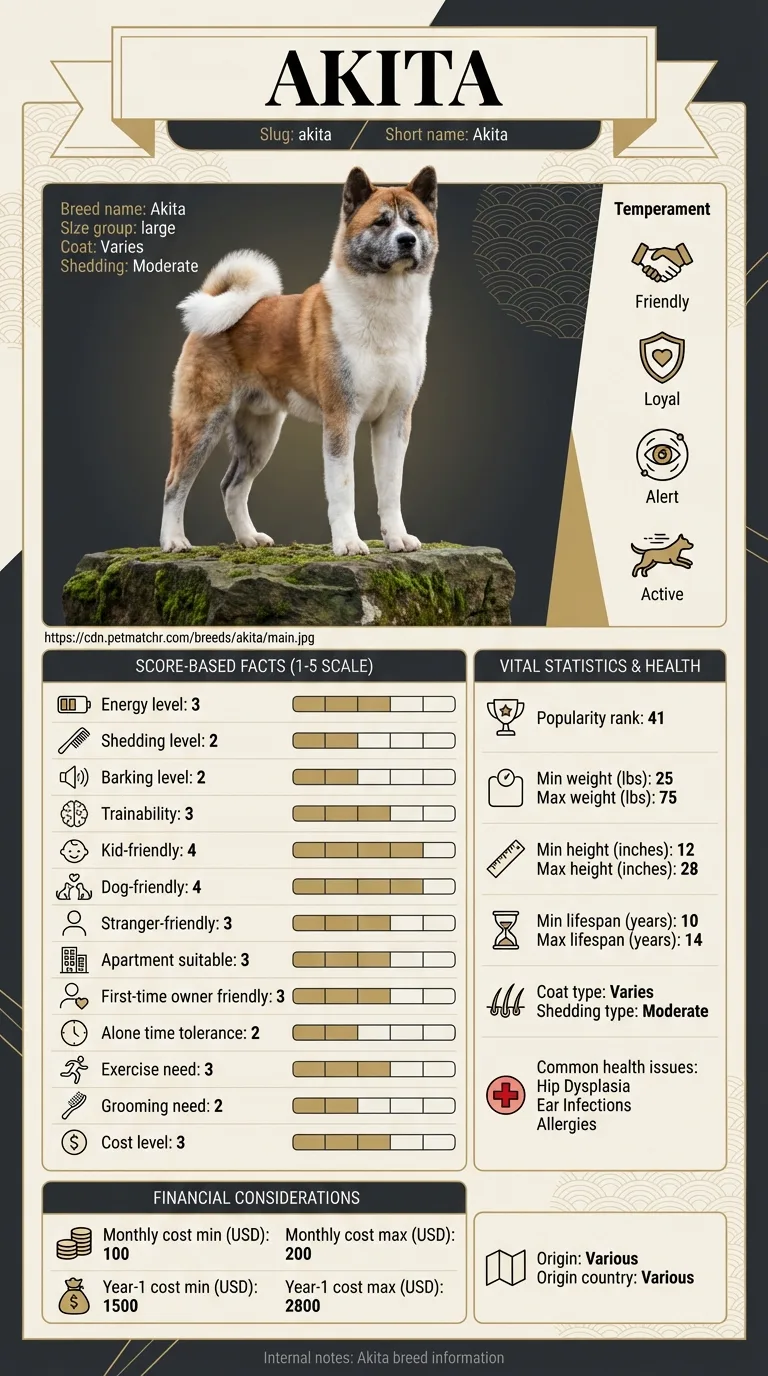
Both breeds rate 5/5 for shedding — the top of the scale — and both carry heavy double coats built for cold. Then the temperament rows separate them: the Newfoundland rates 5/5 with children and 4/5 with other dogs and strangers, where the Akita rates 3/5, 2/5 and 2/5.
This page is for someone who wants a very large, calm, thick-coated dog. It covers shedding and drool honestly, the heart screening every Newfoundland puppy needs, a breed-specific kidney stone disease, heat tolerance, and what each costs to keep.
Quick verdict
The Newfoundland is the gentler dog with the shorter life and the bigger bill; the Akita costs less, lives longer, and does the guarding the Newfoundland will not.
Choose akita if...
Choose the Akita if lifespan and cost matter, or if you want a guardian. It lives 10 to 13 years against the Newfoundland's 9 to 10, costs $110–$240 a month against $150–$310, grooms at 3/5 against 4/5, and does not drool. You are accepting 1/5 for first-time owners and 2/5 with other dogs and strangers.
Choose newfoundland if...
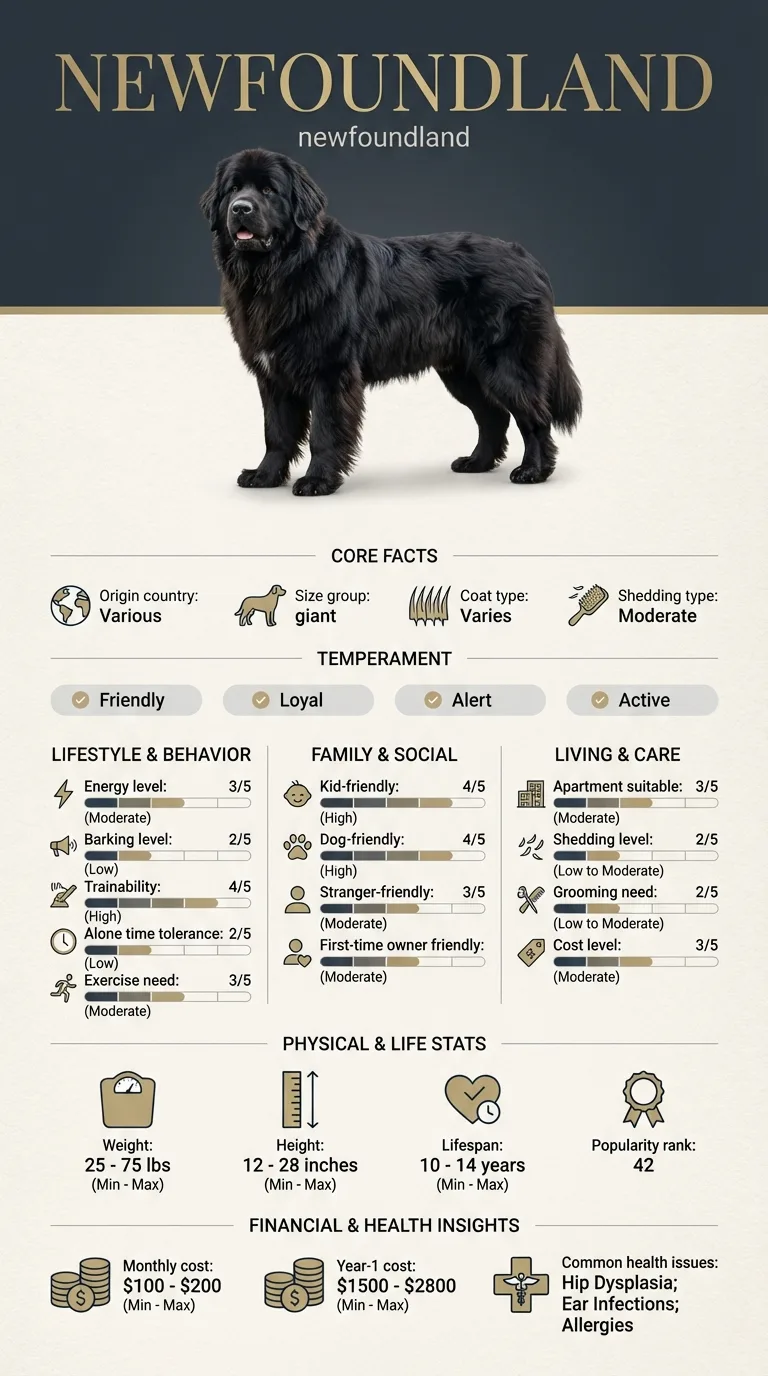
Choose the Newfoundland if you want an exceptionally gentle giant and have the space and budget. It rates 5/5 with children, 4/5 with other dogs and strangers, 4/5 for trainability, and barks at only 2/5. You are accepting up to 150 pounds, 5/5 shedding, constant drool, real heat intolerance and a 9 to 10 year life.
Head-to-head comparison
Feature
akita
newfoundland
Winner
Weight
70–130 lbs
100–150 lbs
Equal
Height
24–28 in
26–28 in
Equal
Lifespan
10–13 years
9–10 years
akita
Coat
Dense double coat
Heavy water-resistant coat
Equal
Grooming need
Moderate (3/5)
High (4/5)
akita
Shedding
Very high (5/5)
Very high (5/5)
Equal
Energy level
Moderate (3/5)
Low (2/5)
Equal
Exercise need
Moderate (3/5)
Moderate (3/5)
Equal
Trainability
Moderate (3/5)
High (4/5)
newfoundland
Barking
Low (2/5)
Low (2/5)
Equal
Good with kids
Moderate (3/5)
Very high (5/5)
newfoundland
Good with other dogs
Low (2/5)
High (4/5)
newfoundland
Friendly to strangers
Low (2/5)
High (4/5)
newfoundland
Apartment suitability
Low (2/5)
Very low (1/5)
akita
Good for first-time owners
Very low (1/5)
Moderate (3/5)
newfoundland
Tolerates being alone
Moderate (3/5)
Moderate (3/5)
Equal
Typical monthly cost
$110–$240
$150–$310
akita
Typical first-year cost
$1,700–$3,200
$2,200–$4,200
akita
Deep dive
Shedding, drool and the honest daily picture
Both coats need work and the Newfoundland's needs more of it — 4/5 grooming against 3/5.
Its coat is long, oily and water-resistant, and it mats behind the ears, in the ruff, in the trousers and on the feathering. Brushing to the skin two or three times a week is the minimum, and after a swim it needs proper drying rather than being left to dry on the dog. Neither coat should ever be clipped, since both insulate against heat as well as cold.
The drool is the part nobody puts in the brochure. Loose flews mean saliva pools and is then distributed by a head shake — walls, furniture, trousers, guests. Newfoundland households keep towels in every room and do not consider that unusual.
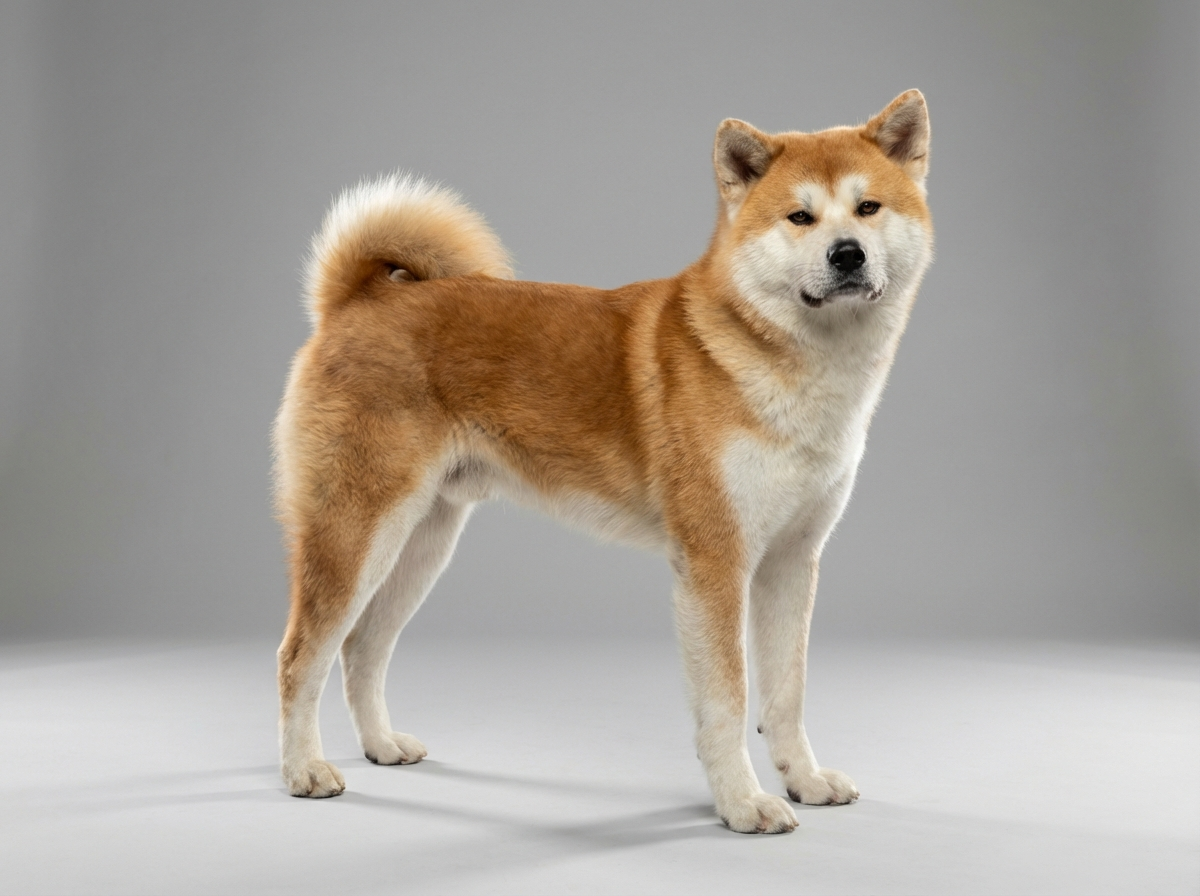
The Akita's mouth is dry and tight. Its coat is denser and shorter, and the maintenance is seasonal rather than constant: a weekly brush for ten months, then two or three weeks of raking twice a year.
If drool would genuinely bother you, that alone is a reason to choose the Akita, regardless of anything else on this page.
Subaortic stenosis and why puppies need a cardiologist
Subaortic stenosis sits second on the Newfoundland's condition list and it is the single most important thing to ask a breeder about.
It is a congenital narrowing below the aortic valve. The heart has to work harder to push blood past the obstruction, and in significant cases it causes exercise intolerance, fainting or sudden death in a young dog. Mild cases may never cause a problem.
The reason it matters at purchase is that it is detectable. Breeding dogs in this breed should be examined by a veterinary cardiologist — not a general practitioner with a stethoscope — with an echocardiogram, and the certificate should be shown to you. Puppies can also be auscultated by a cardiologist before they leave.
Dilated cardiomyopathy appears alongside it, as it does in most giant breeds, making cardiac examination from middle age sensible.
Ask for cardiologist certificates on both parents by name. A Newfoundland breeder who does not know what you are asking for is telling you something important.
The Akita carries no comparable congenital cardiac risk; its burden is autoimmune and endocrine, with hip dysplasia and bloat.
Cystinuria, hips and bloat
Cystinuria is the other breed-specific item and it is unusual enough to be worth explaining. It is an inherited defect in the kidneys' ability to reabsorb the amino acid cystine, which then crystallises in the urine and forms bladder stones.
It affects males far more seriously, because a stone that passes harmlessly in a female can lodge in the narrower male urethra and cause a complete blockage — which is a life-threatening emergency within hours. Straining to urinate, producing only drops, or crying while trying, in a male Newfoundland, means an immediate vet visit.
There is a DNA test. Affected dogs are managed with diet, increased water intake and medication, and many do well.
Hip dysplasia and bloat complete the short list. Both breeds are deep-chested and both households should recognise gastric dilatation-volvulus — unproductive retching, a distending abdomen, restlessness — as an emergency, and a preventive gastropexy at neutering is worth discussing for either.
Both breeds also grow fast, and both benefit from a lean puppy, restricted forced exercise until the growth plates close, and no calcium supplementation.
Heat, water and running costs
The Newfoundland is built for cold water and it suffers in heat more than almost any breed. A heavy oily coat, a large body and a lot of mass make heat dissipation slow. Summer walks move to early morning and late evening, shade and water need to be available, and a hot car is out of the question even briefly.
It is, in exchange, one of the great swimming breeds — webbed feet, a water-resistant coat and genuine lifesaving instinct. Access to safe water is close to a gift for this dog.
The Akita is more heat-tolerant than it looks, because a double coat insulates in both directions, though it too should be walked at the cool ends of the day in summer.
On money the Newfoundland runs $150–$310 a month and $2,200–$4,200 in the first year against $110–$240 and $1,700–$3,200. Food, weight-dosed medication, anaesthesia and boarding all scale with size, and cardiac screening adds a line the Akita does not have.
Lifespan is 9 to 10 years against 10 to 13, which is the hardest number on this page.
Akita vs Newfoundland: same coat problem, different dog
Six rows tie here: shedding at 5/5, exercise at 3/5, barking at 2/5, time alone at 3/5, and both coats are heavy doubles built for cold water and cold air.
The practical result is that both households have the same weekly chore and the same seasonal disaster. Twice a year the undercoat comes out, and in both breeds that means bin bags rather than a dustpan.
What separates them is temperament. The Newfoundland was bred to be handled by strangers in the water and to work alongside other dogs, so 4/5 with dogs and 4/5 with people is not a happy accident — it is the job description. The Akita's 2/5 and 2/5 are equally deliberate.
The other separation is cost and time. $150–$310 a month against $110–$240, and 9 to 10 years against 10 to 13. The Newfoundland is more expensive to run and you get less of it.
Akita or Newfoundland: The Water Giant or the Mountain Guardian - Akita vs Newfoundland: same coat problem, different dog
Frequently asked questions
Which sheds more, an Akita or a Newfoundland?
They tie at 5/5 — both are at the top of the scale. The Newfoundland's grooming demand is higher at 4/5 against 3/5, because its long oily coat mats behind the ears, in the ruff and on the feathering and needs brushing to the skin two or three times a week. Neither coat should ever be clipped.
How much do Newfoundlands drool?
Constantly, and it is the part of ownership most often underestimated. Loose flews pool saliva which is then distributed by a head shake onto walls, furniture and clothing. Households keep towels in every room. If this would bother you, it is a sufficient reason to choose a different breed.
What is subaortic stenosis and how do I avoid it?
A congenital narrowing below the aortic valve that makes the heart work harder, and in significant cases causes exercise intolerance, fainting or sudden death in a young dog. Ask for veterinary cardiologist certificates with echocardiograms on both parents — a general stethoscope check is not the same test.
What is cystinuria?
An inherited defect in the kidneys' handling of the amino acid cystine, which crystallises and forms bladder stones. It is far more dangerous in males, since a stone can block the narrower urethra completely — an emergency within hours. There is a DNA test, and management is diet, water intake and medication.
Which handles heat better?
The Akita, though neither is good. The Newfoundland's heavy oily coat and large mass make it one of the least heat-tolerant breeds there is, and summer walks must move to the cool ends of the day. The Akita's double coat insulates in both directions and copes better than most people expect.
Which is better with children?
The Newfoundland at 5/5 against the Akita's 3/5, and it is among the most reliably gentle giants. The caveat is physical rather than temperamental — 150 pounds moving through a room, and a wagging tail at head height, need managing around toddlers regardless of intent.
Which costs more to keep?
The Newfoundland, at $150–$310 a month against the Akita's $110–$240, and $2,200–$4,200 against $1,700–$3,200 in the first year. Food, weight-dosed medication, anaesthesia and boarding all scale with size, and cardiac screening adds a cost the Akita does not carry.
The Newfoundland if you want an exceptionally gentle giant, have space and budget, and can live with drool. The Akita if lifespan and cost matter, or if you want a dog that actually guards — the Newfoundland does not.
Costs
How much does each cost per month?
The Newfoundland runs $150–$310 a month and the Akita $110–$240, with first-year totals of $2,200–$4,200 and $1,700–$3,200. Add cardiologist screening for the Newfoundland.
Living
Do they need the same exercise?
Yes — both rate 3/5, around forty-five to sixty minutes for an adult, with the Newfoundland's timed around temperature. Swimming is ideal for a Newfoundland and genuinely satisfying for the breed.
Health
What should I ask a Newfoundland breeder?
Cardiologist certificates with echocardiograms on both parents for subaortic stenosis, the cystinuria DNA result, and hip scores. Ask what ages the grandparents reached.
Related DogBreedCompass guides
Akita breed guide – The Akita profile covers guardian temperament and the long socialisation window the breed needs.
Newfoundland breed guide – The Newfoundland profile covers coat care, cardiac screening and water work.
Akita vs Saint Bernard – The Saint Bernard is the other heavy-coated giant most often weighed against it.
Akita vs Great Dane – The Great Dane is the taller giant with similar bloat and growth considerations.
Newfoundland genetic disorders – The inherited conditions worth screening for before buying a Newfoundland puppy.
Akita autoimmune diseases – Autoimmune disease is the Akita's most distinctive burden and the first question for a breeder.
Health information here is general and is not veterinary advice. If your dog shows pain, sudden behaviour change, or worsening symptoms, consult a licensed veterinarian.
Some links on this site are affiliate links. We may earn a commission at no extra cost to you, and we only suggest products we believe are helpful for dog owners.
We research and check what we publish, but we do not warrant that any figure, date, price, or statement is accurate, complete, or current, and we accept no liability for any loss, cost, injury, or other harm arising from the use of this site. Use it as one reference among several. You remain responsible for your own decisions and for your dog's care - confirm anything that matters with a licensed veterinarian or another qualified professional before you act on it. Full disclaimer.