Behavior
Quieter breed?
The Newfoundland, rated low 2/5 for barking against the Cocker's moderate 3/5.

Quick answer
Quieter breed?
The Newfoundland, rated low 2/5 for barking against the Cocker's moderate 3/5.
English Cocker Spaniel or Newfoundland? On paper they differ most on apartment suitability, and on the scales Newfoundland is the heavier at 100–150 lbs. Here is how the two compare on everything that shapes an ordinary week.
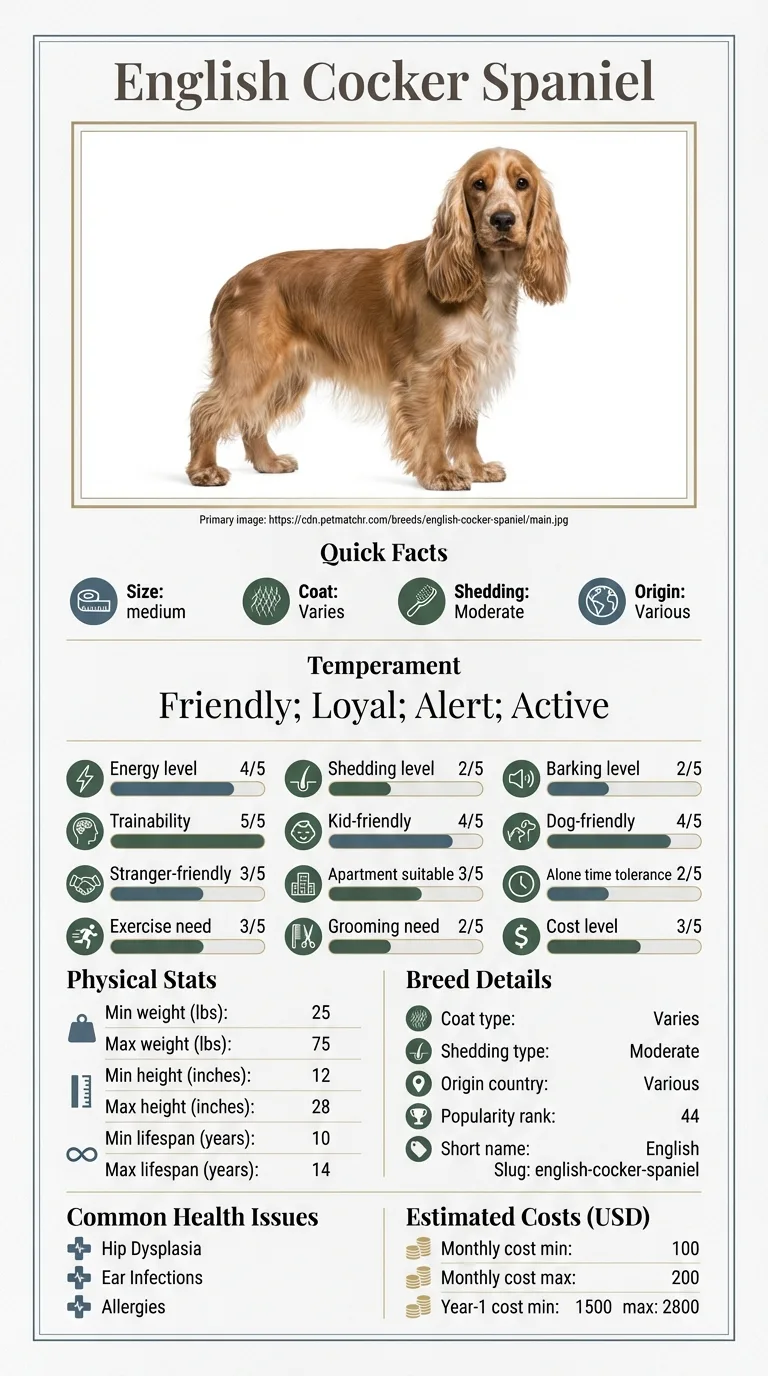
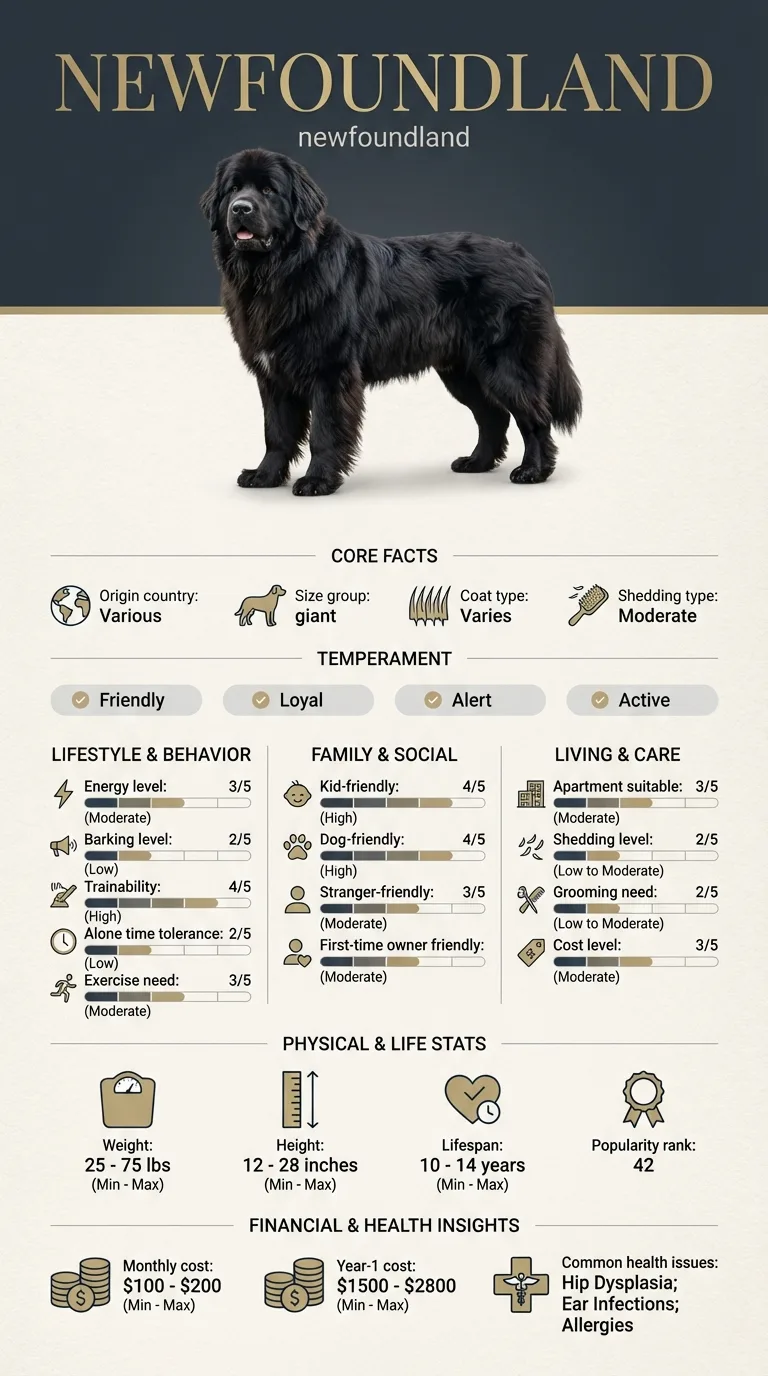
This is for someone already down to English Cocker Spaniel and Newfoundland and deciding between them. For this pair the decision usually turns on apartment suitability and energy level, so those are covered first and in most detail. Anyone choosing from a flat has a clear answer here: English Cocker Spaniel rates 4/5 against 1/5. The focus throughout is on daily consequences rather than breed background.
Between English Cocker Spaniel and Newfoundland, apartment suitability is what separates them, and English Cocker Spaniel is the lower-effort dog of the two to keep.
Choose English Cocker Spaniel if you are in a flat or a smaller home, this is your first dog and shedding is a problem in your house.
Choose Newfoundland if your walking routine is modest and the dog will be alone during the working day.
| Feature | english cocker spaniel | newfoundland | Winner |
|---|---|---|---|
| Size class | medium | giant | Equal |
| Weight | 26–34 lbs | 100–150 lbs | Equal |
| Height | 15–17 in | 26–28 in | Equal |
| Lifespan | 12–14 years | 9–10 years | english cocker spaniel |
| Exercise need | High (4/5) | Moderate (3/5) | newfoundland |
| Grooming need | High (4/5) | High (4/5) | Equal |
| Shedding | Moderate (3/5) | Very high (5/5) | english cocker spaniel |
| Energy level | High (4/5) | Low (2/5) | Equal |
| Barking | Moderate (3/5) | Low (2/5) | newfoundland |
| Apartment suitability | High (4/5) | Very low (1/5) | english cocker spaniel |
| Good for first-time owners | High (4/5) | Moderate (3/5) | english cocker spaniel |
| Tolerates being alone | Low (2/5) | Moderate (3/5) | newfoundland |
| Trainability | High (4/5) | High (4/5) | Equal |
| Good with kids | Very high (5/5) | Very high (5/5) | Equal |
| Good with other dogs | High (4/5) | High (4/5) | Equal |
| Friendly to strangers | High (4/5) | High (4/5) | Equal |
| Cost level | Moderate (3/5) | Very high (5/5) | english cocker spaniel |
| Coat | Medium, silky and feathered | Heavy water-resistant double coat | Equal |
| Origin | Various | Various | Equal |
| Typical monthly cost | $100–$200 | $150–$310 | Equal |
| Typical first-year cost | $1,400–$2,900 | $2,200–$4,200 | Equal |
One hundred pounds is roughly the low end of a Newfoundland's weight range and nearly three times the top of an English Cocker Spaniel's, which caps around 34 pounds. Height tells a similarly lopsided story: 15 to 17 inches for the Cocker against 26 to 28 for the Newfoundland — a foot of difference at the shoulder. This isn't a comparison between two dogs of adjustable scale; it's a genuinely medium breed set against a genuinely giant one, and that gap drives most of the other differences here, from exercise tolerance to what a first-year budget needs to cover.
Counterintuitively, the smaller dog needs more exercise: the English Cocker rates high, 4/5, against the Newfoundland's moderate, 3/5, and energy level splits even further apart, high 4/5 versus low 2/5. A Newfoundland's size doesn't come with a matching drive to move — it's a working water-rescue breed built more for strength and endurance in short bursts than for constant activity, and its calm, patient temperament reflects that. An English Cocker's merry, energetic nature means it actually wants more from a daily walk schedule than a dog roughly four times its weight.
Grooming need ties at high, 4/5, for both breeds, but shedding does not — moderate, 3/5, for the Cocker against very high, 5/5, for the Newfoundland's heavy, water-resistant double coat. In practical terms, that means comparable time spent brushing and coat care, but a dramatically larger volume of loose fur to manage from the Newfoundland, simply because there's so much more coat to shed from a 100-to-150-pound body. Households sensitive to visible pet hair on furniture should weight this row heavily regardless of how similar the grooming-need scores look.
Apartment suitability is about as lopsided as this table gets: high, 4/5, for the English Cocker against very low, 1/5, for the Newfoundland — a dog whose size alone makes small spaces impractical, quite apart from temperament. Barking actually favors the Newfoundland, low 2/5 against the Cocker's moderate 3/5, and tolerating time alone slightly does too, moderate 3/5 versus low 2/5. So the giant breed is the quieter, more independent one — it simply needs the square footage and yard access a small apartment can't provide.
Trainability ties at high, 4/5, for both breeds, and first-time-owner suitability favors the Cocker only modestly, high 4/5 against the Newfoundland's moderate 3/5. A Newfoundland's sweet, devoted temperament makes it genuinely easy to work with despite its size, but a first-time owner has to manage the practical reality of handling a 100-plus-pound dog through basic obedience — leash pulling from a Newfoundland is a different physical challenge than from a 30-pound Cocker, regardless of how willing either dog is to learn.
Good with kids ties at very high, 5/5, for both, and good with other dogs and friendly-to-strangers tie too, high 4/5 each — an unusually even household-fit profile for two breeds this different in size. The temperament words back it up: sweet, patient, and devoted for the Newfoundland; merry, affectionate, and biddable for the Cocker. The practical difference for families is less about temperament and more about physical scale — a Newfoundland's size means supervised interactions with small children matter even when the dog's nature is gentle.
Lifespan is the starkest gap in this comparison: 12 to 14 years for the English Cocker against just 9 to 10 for the Newfoundland, a difference typical of giant breeds generally. The health lists reflect different vulnerabilities too — the Cocker's includes progressive retinal atrophy, familial nephropathy, and adult-onset neuropathy, breed-specific conditions worth screening for, while the Newfoundland's list centers on cardiac risk, with subaortic stenosis and dilated cardiomyopathy both listed alongside bloat (GDV), a genuine emergency risk in deep-chested giant breeds. Newfoundland buyers should ask breeders specifically about cardiac screening.
Cost level rates moderate, 3/5, for the Cocker against very high, 5/5, for the Newfoundland — the top rating on this scale. Dollar figures track accordingly: $100–$200 monthly and $1,400–$2,900 first-year for the Cocker, versus $150–$310 monthly and $2,200–$4,200 for the Newfoundland. Food volume alone explains much of it — a 150-pound dog eats several times what a 34-pound one does — but veterinary costs for a giant breed, from medication dosing to potential cardiac screening, add up on top of that.
English Cocker Spaniel weighs 26–34 lbs and lives 12–14 years; Newfoundland weighs 100–150 lbs and lives 9–10 years. The two diverge most on apartment suitability, energy level and shedding and 1 other rated axes. They are level on good with other dogs, grooming need and good with kids, so those cannot decide it. The table below marks a winner only where one breed is genuinely easier for a typical owner; size and origin are facts rather than merits and stay level. Ratings come from one source applied to both breeds, so they are meaningful against each other rather than as absolute scores.

Dramatically — a Newfoundland can weigh up to 150 lbs and stand 28 inches tall, roughly four times the Cocker's top weight of 34 lbs.
The English Cocker, rated high 4/5 for exercise need against the Newfoundland's moderate 3/5 — size doesn't translate to higher activity drive here.
The Newfoundland, rated very high 5/5 for shedding versus the Cocker's moderate 3/5, owing to its heavy double coat.
No — it rates very low, 1/5, for apartment suitability, versus the Cocker's high 4/5, mainly due to sheer size.
The English Cocker Spaniel, typically 12–14 years, well ahead of the Newfoundland's 9–10 years, consistent with giant-breed lifespans generally.
The Newfoundland, at $150–$310 monthly and $2,200–$4,200 in year one, versus $100–$200 and $1,400–$2,900 for the Cocker.
Yes — both tie at very high, 5/5, for good-with-kids, though a Newfoundland's size still calls for supervision around small children.
The Newfoundland, rated low 2/5 for barking against the Cocker's moderate 3/5.
The English Cocker Spaniel, rated high 4/5 versus the Newfoundland's very low 1/5.
The English Cocker Spaniel, rated high 4/5 for energy level against the Newfoundland's low 2/5.
The English Cocker Spaniel, 12–14 years, versus the Newfoundland's 9–10 years.
Secure checkout on Stripe. We never see your card.
7-day money-back guarantee. Instant access.
Health information here is general and is not veterinary advice. If your dog shows pain, sudden behaviour change, or worsening symptoms, consult a licensed veterinarian.
Some links on this site are affiliate links. We may earn a commission at no extra cost to you, and we only suggest products we believe are helpful for dog owners.
We research and check what we publish, but we do not warrant that any figure, date, price, or statement is accurate, complete, or current, and we accept no liability for any loss, cost, injury, or other harm arising from the use of this site. Use it as one reference among several. You remain responsible for your own decisions and for your dog's care - confirm anything that matters with a licensed veterinarian or another qualified professional before you act on it. Full disclaimer.
Match your lifestyle to the right dog.
Take quizNot sure which breed is right for you? Take our 2-minute quiz to find out.
Take the quiz