Behavior
Which breed is easier to groom?
The Dachshund, rated low (2/5) for grooming against the Newfoundland's high (4/5) and heavy shedding coat.

Quick answer
Which breed is easier to groom?
The Dachshund, rated low (2/5) for grooming against the Newfoundland's high (4/5) and heavy shedding coat.
Dachshund or Newfoundland? On paper they differ most on apartment suitability, and on the scales Newfoundland is the heavier at 100–150 lbs. Here is how the two compare on everything that shapes an ordinary week.
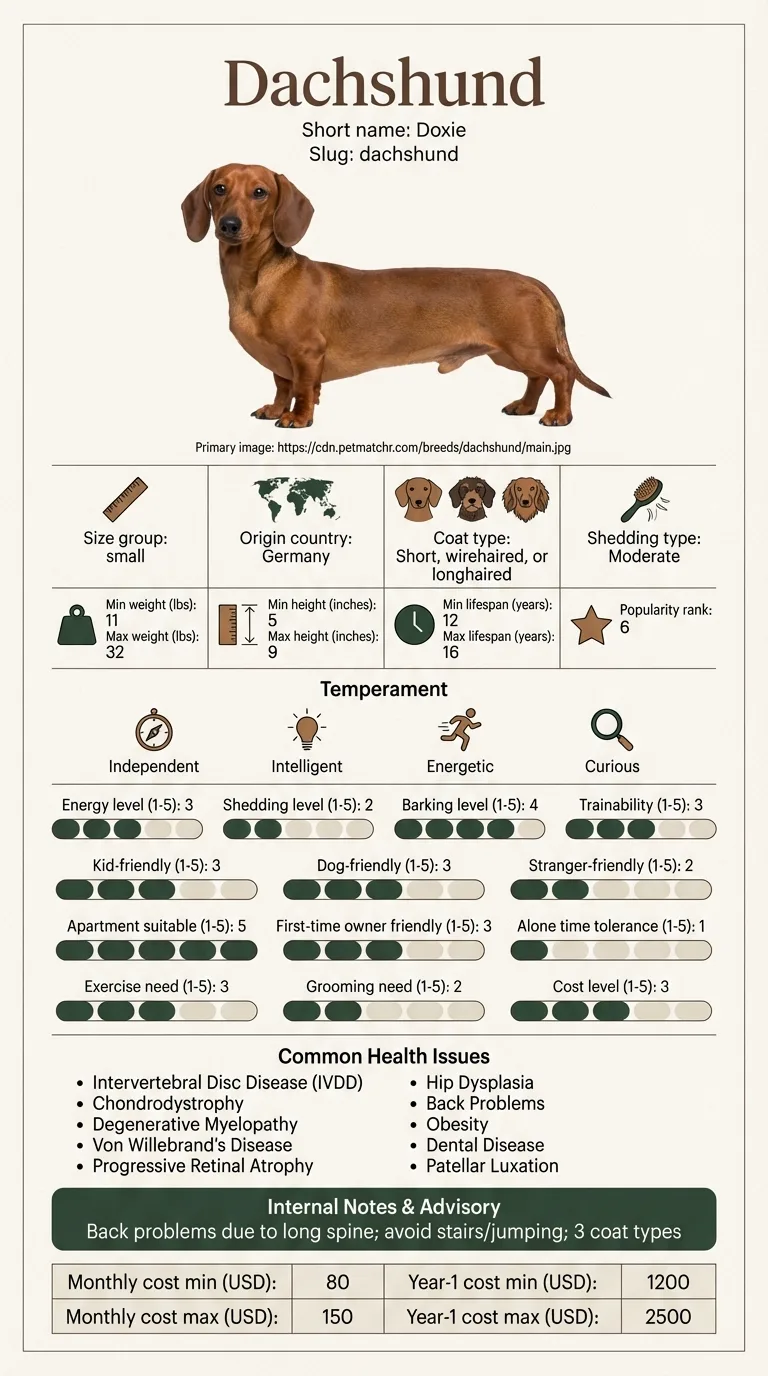
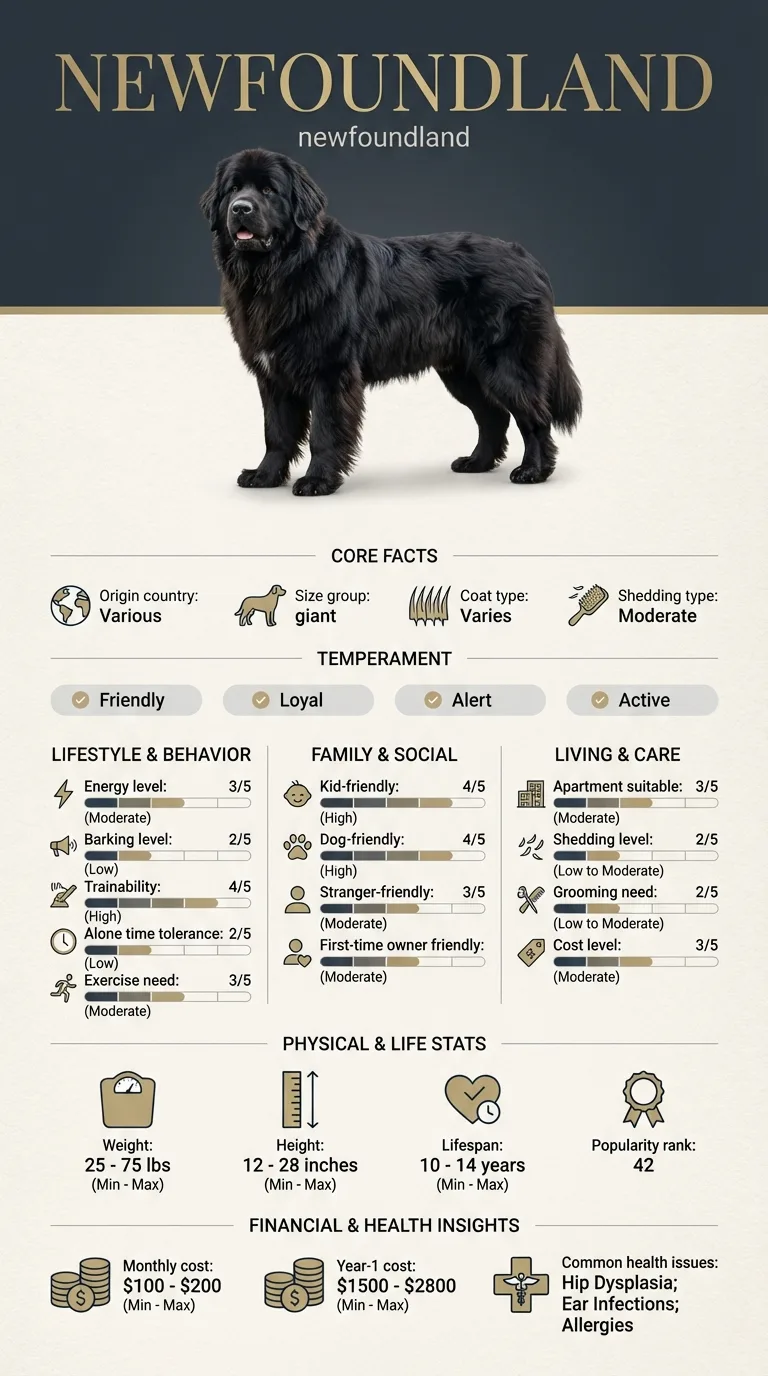
This is for someone already down to Dachshund and Newfoundland and deciding between them. For this pair the decision usually turns on apartment suitability and shedding, so those are covered first and in most detail. Anyone choosing from a flat has a clear answer here: Dachshund rates 5/5 against 1/5. It is written for the decision rather than the breed history.
Between Dachshund and Newfoundland, apartment suitability is what separates them, and Dachshund is the lower-effort dog of the two to keep.
Choose Dachshund if you are in a flat or a smaller home, you do not want a standing grooming appointment and shedding is a problem in your house.
Choose Newfoundland if the dog will be alone during the working day, there are young children at home and you already have another dog.
| Feature | dachshund | newfoundland | Winner |
|---|---|---|---|
| Size class | small | giant | Equal |
| Weight | 11–32 lbs | 100–150 lbs | Equal |
| Height | 5–9 in | 26–28 in | Equal |
| Lifespan | 12–16 years | 9–10 years | dachshund |
| Exercise need | Moderate (3/5) | Moderate (3/5) | Equal |
| Grooming need | Low (2/5) | High (4/5) | dachshund |
| Shedding | Low (2/5) | Very high (5/5) | dachshund |
| Energy level | Moderate (3/5) | Low (2/5) | Equal |
| Barking | High (4/5) | Low (2/5) | newfoundland |
| Apartment suitability | Very high (5/5) | Very low (1/5) | dachshund |
| Good for first-time owners | Moderate (3/5) | Moderate (3/5) | Equal |
| Tolerates being alone | Very low (1/5) | Moderate (3/5) | newfoundland |
| Trainability | Moderate (3/5) | High (4/5) | newfoundland |
| Good with kids | Moderate (3/5) | Very high (5/5) | newfoundland |
| Good with other dogs | Moderate (3/5) | High (4/5) | newfoundland |
| Friendly to strangers | Low (2/5) | High (4/5) | newfoundland |
| Cost level | Moderate (3/5) | Very high (5/5) | dachshund |
| Coat | Short, wirehaired, or longhaired | Heavy water-resistant double coat | Equal |
| Origin | Germany | Various | Equal |
| Typical monthly cost | $80–$150 | $150–$310 | Equal |
| Typical first-year cost | $1,200–$2,500 | $2,200–$4,200 | Equal |
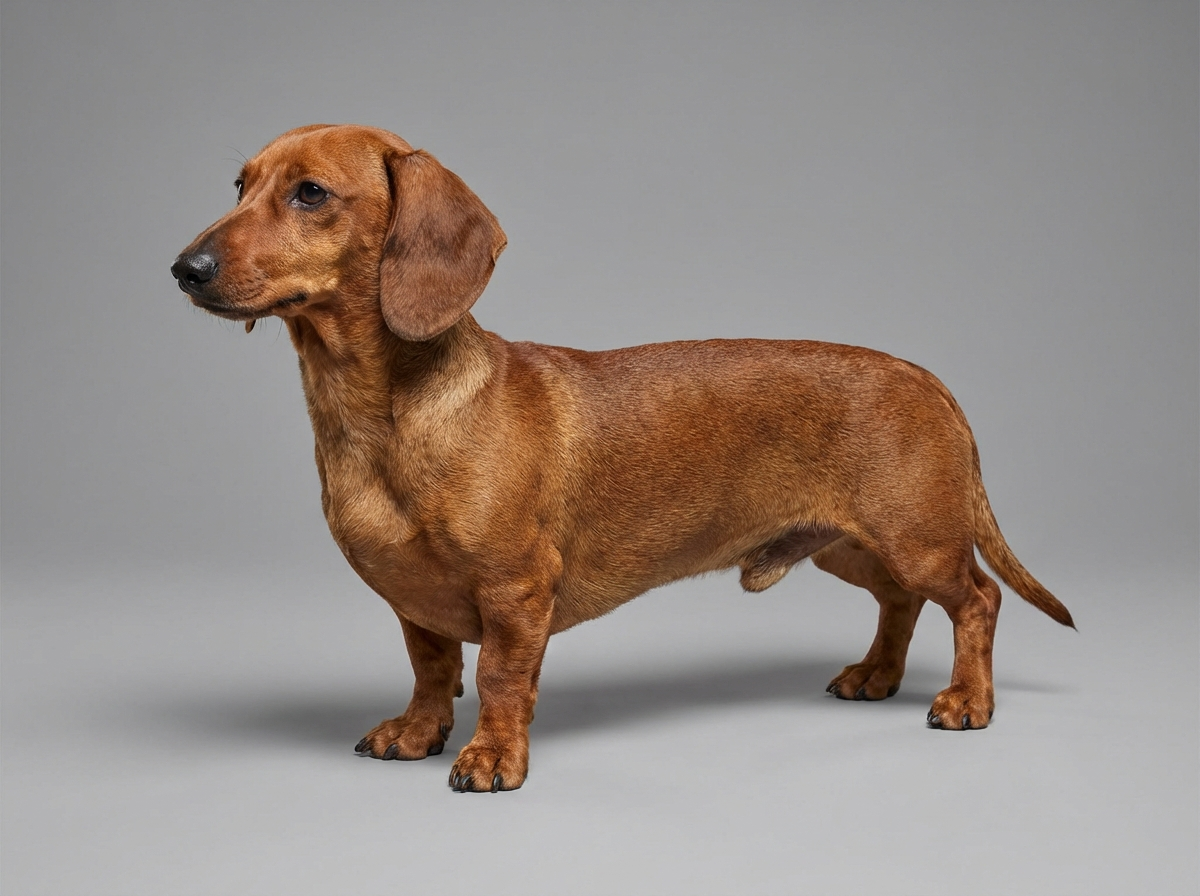
Eleven to thirty-two pounds is the entire range a Dachshund ever occupies; a Newfoundland can weigh nearly five times that at the upper end, tipping the scale at 150 pounds on a frame that stands 26 to 28 inches at the shoulder versus the Dachshund's 5 to 9 inches. That elongated, short-legged silhouette exists because of chondrodystrophy, the same genetic trait behind the breed's disc problems. The Newfoundland's mass is bone and muscle built for water rescue and hauling, with a broad chest and thick double coat adding visual bulk beyond the number on the scale. Choosing between them is less a size decision than a household-logistics one: one dog fits in a tote bag, the other needs its own section of the couch.
Both land at a moderate exercise score, three out of five, yet the resemblance stops there. A Dachshund's energy comes in short, driven bursts — digging, chasing scent, patrolling the yard — that a couple of brisk walks and some sniffing time will absorb. A Newfoundland's is slower and heavier: a plodding walk, a swim if water is available, then hours of lying across the doorway. Newfoundlands were bred to work in cold water pulling nets and rescuing swimmers, so heat tolerance is limited and exertion needs pacing. Neither dog demands a runner's mileage, but the Dachshund's stamina outlasts its size while the Newfoundland's bulk tires it faster than its calm face suggests.
Grooming need sits at 2 out of 5 for the Dachshund and 4 out of 5 for the Newfoundland, and shedding tells an even starker story: low versus a full 5 out of 5. A smooth or wirehaired Dachshund coat wipes clean in seconds; the longhaired variety needs occasional brushing, nothing more. The Newfoundland's heavy, water-resistant double coat sheds constantly and blows out twice a year in drifts of undercoat that require daily brushing to manage. Owners describe Newfoundland grooming sessions in hours, not minutes, and drool management is its own separate chore entirely. If a spotless black couch matters to you, the math here isn't close.
Apartment suitability reads 5 out of 5 for the Dachshund and 1 out of 5 for the Newfoundland — about as wide a gap as this comparison produces. Yet the Dachshund flips the script on noise, rating a high 4 on barking against the Newfoundland's low 2, so the smaller dog is the one more likely to announce every hallway footstep. Being alone is where the Newfoundland actually holds an edge: it tolerates solitude at a moderate 3 while the Dachshund sits at a very low 1, prone to separation anxiety in a dog bred to work alongside its person underground. A studio apartment can suit a Dachshund's frame but not necessarily its temperament if left alone often.
Trainability favors the Newfoundland, high at 4 out of 5 against the Dachshund's moderate 3, and the temperament words explain why. Newfoundlands are described as patient and devoted, dogs that want direction from their person; Dachshunds are independent and curious, bred originally to track badgers alone underground and decide things for themselves without waiting for instructions. Both breeds rate a moderate 3 out of 5 for suiting first-time owners, but for different reasons — the Dachshund's stubbornness tests patience in obedience work, while the Newfoundland's sheer size means a poorly managed 150-pound dog is a physical handling problem even if it wants to please. Consistency matters more than force with either one.
Good with kids splits sharply: moderate 3 for the Dachshund, very high 5 for the Newfoundland, a breed nicknamed the 'nanny dog' for its gentle patience around children. That same gap runs through sociability with other dogs (3 versus 4) and friendliness to strangers (2 versus 4) — the Dachshund's independent, alert nature makes it a more reserved, sometimes wary presence around new people and animals, while the Newfoundland's sweet, calm disposition welcomes almost everyone. A Dachshund's small size also raises accidental-injury risk during rough toddler play in ways a sturdier dog wouldn't. Families wanting an easygoing dog around a houseful of kids and visitors will find the Newfoundland the more forgiving choice on paper.
A Dachshund can be expected to live 12 to 16 years; a Newfoundland's window closes far earlier, at 9 to 10. The Dachshund's long spine is its defining vulnerability — intervertebral disc disease and chondrodystrophy sit at the top of its list, alongside degenerative myelopathy, hip dysplasia, and a tendency toward obesity that makes back injury worse. The Newfoundland's risks run cardiac and structural instead: subaortic stenosis, dilated cardiomyopathy, hip dysplasia, and bloat (GDV), a fast-moving emergency that giant, deep-chested breeds face disproportionately. Cystinuria, a urinary stone condition, rounds out the Newfoundland's list. Neither dog escapes hip dysplasia, but the underlying causes and the years each is likely to be around for differ substantially.
Monthly costs run $80 to $150 for a Dachshund and $150 to $310 for a Newfoundland, and first-year totals track the same ratio — roughly $1,200-$2,500 against $2,200-$4,200. Cost level itself is rated moderate for the Dachshund and very high for the Newfoundland, and the reasons go beyond food volume, though a 150-pound dog does eat considerably more than an 11-to-32-pound one. Grooming tools, larger-breed veterinary dosing, bigger beds and crates, and cardiac screening for a breed prone to dilated cardiomyopathy all add up. A Dachshund's back problems can also generate expensive surgical bills if IVDD strikes, so the smaller dog's lower baseline cost isn't guaranteed to stay lower in a bad year.
Dachshund weighs 11–32 lbs and lives 12–16 years; Newfoundland weighs 100–150 lbs and lives 9–10 years. The two diverge most on apartment suitability, shedding and grooming need and 5 other rated axes. They are level on exercise need and good for first-time owners, so those cannot decide it. In the table, a "winner" means easier for an ordinary household — not better. Size, coat and origin are recorded without a verdict. Because both breeds are scored the same way, the gaps are reliable even where the absolute numbers are rough.

The Dachshund, by a wide margin — it rates low (2/5) on shedding compared to the Newfoundland's very high (5/5), and a smooth-coated Dachshund needs almost no brushing at all.
Its apartment suitability score of 1 out of 5 says yes for most units; the Dachshund's 5 out of 5 makes it the far more realistic small-space dog, noise aside.
Yes — chondrodystrophy, the gene responsible for its short legs, also predisposes it to intervertebral disc disease, one of the most common and costly orthopedic emergencies in the breed.
The Newfoundland rates very high (5/5) for kids and has a long-standing reputation as a gentle family guardian, while the Dachshund's moderate (3/5) score reflects a more reserved temperament.
Around four to six years — Dachshunds commonly reach 12 to 16 years, while giant breeds like the Newfoundland average 9 to 10.
The Dachshund, rated high (4/5) on barking versus the Newfoundland's low (2/5), despite being the much smaller and quieter-looking dog on paper.
Yes — as a large, deep-chested breed, the Newfoundland is listed with Bloat (GDV) as a known health risk, a condition the small-bodied Dachshund does not share.
The Dachshund, rated low (2/5) for grooming against the Newfoundland's high (4/5) and heavy shedding coat.
The Newfoundland, at roughly $150-$310 a month versus the Dachshund's $80-$150.
The Newfoundland, rated moderate (3/5), compared to the Dachshund's very low (1/5) tolerance for solitude.
The Newfoundland, rated high (4/5), versus the Dachshund's moderate (3/5) — independence makes the smaller dog more stubborn in obedience work.
Secure checkout on Stripe. We never see your card.
7-day money-back guarantee. Instant access.
Health information here is general and is not veterinary advice. If your dog shows pain, sudden behaviour change, or worsening symptoms, consult a licensed veterinarian.
Some links on this site are affiliate links. We may earn a commission at no extra cost to you, and we only suggest products we believe are helpful for dog owners.
We research and check what we publish, but we do not warrant that any figure, date, price, or statement is accurate, complete, or current, and we accept no liability for any loss, cost, injury, or other harm arising from the use of this site. Use it as one reference among several. You remain responsible for your own decisions and for your dog's care - confirm anything that matters with a licensed veterinarian or another qualified professional before you act on it. Full disclaimer.
Match your lifestyle to the right dog.
Take quizNot sure which breed is right for you? Take our 2-minute quiz to find out.
Take the quiz