Labradoodle vs Newfoundland: Which Suits Your Home?
Quick answer
Which one should I get?
If you have serious space and a lower tolerance for shedding, the Labradoodle's 2/5 shedding score and better apartment fit make it the practical pick. If you have room, patience for a giant coat, and want a famously gentle family dog, the Newfoundland delivers on temperament.
Labradoodle or Newfoundland? On paper they differ most on energy level, and on the scales Newfoundland is the heavier at 100–150 lbs. Here is how the two compare on everything that shapes an ordinary week.
This is for someone already down to Labradoodle and Newfoundland and deciding between them. For this pair the decision usually turns on energy level and shedding, so those are covered first and in most detail. Anyone choosing from a flat has a clear answer here: Labradoodle rates 2/5 against 1/5. There is no origin story here — only what changes about your week.
Quick verdict
Between Labradoodle and Newfoundland, energy level is what separates them, and Newfoundland is the lower-effort dog of the two to keep.
Choose labradoodle if...
Choose Labradoodle if this is your first dog, shedding is a problem in your house and you want a dog that picks up training quickly.
Choose newfoundland if...
Choose Newfoundland if your walking routine is modest and the dog will be alone during the working day.
Head-to-head comparison
Feature
labradoodle
newfoundland
Winner
Size class
medium
giant
Equal
Weight
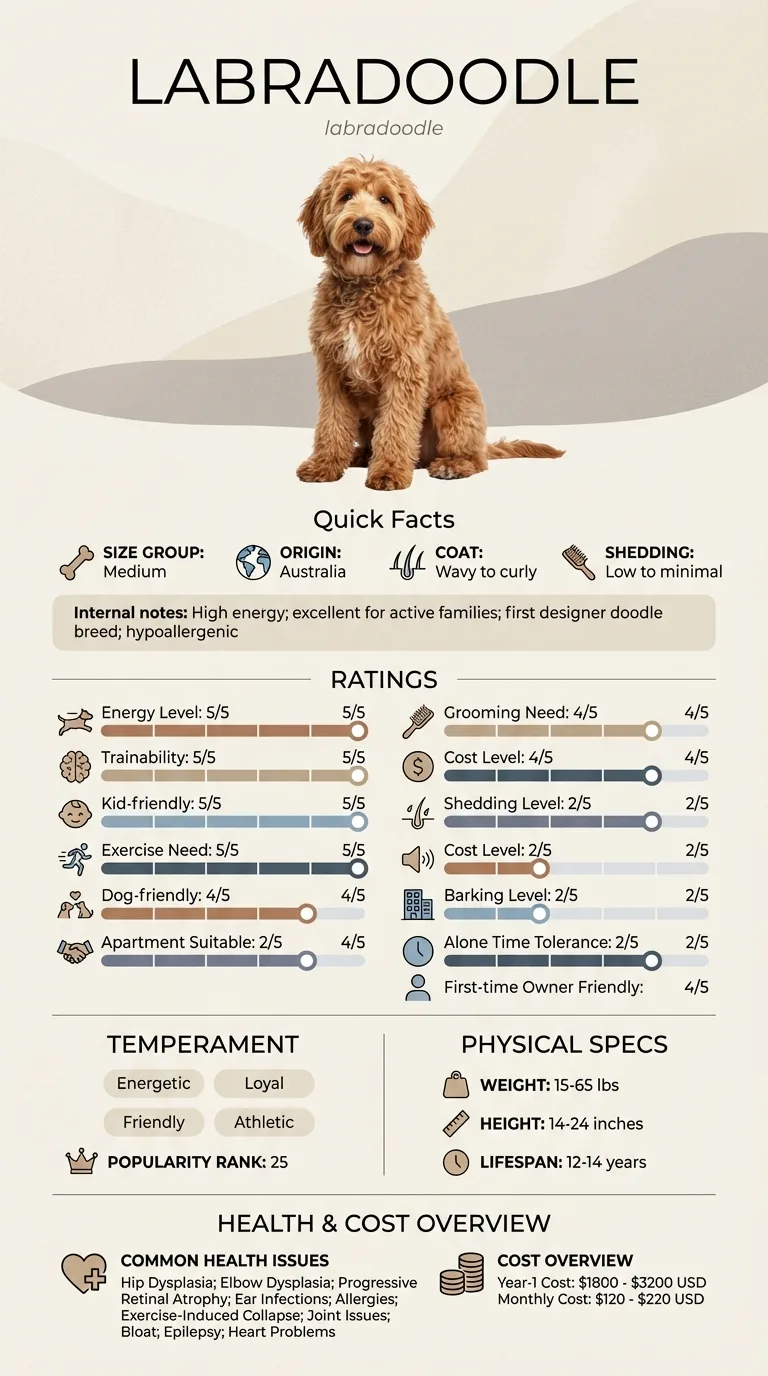
15–65 lbs
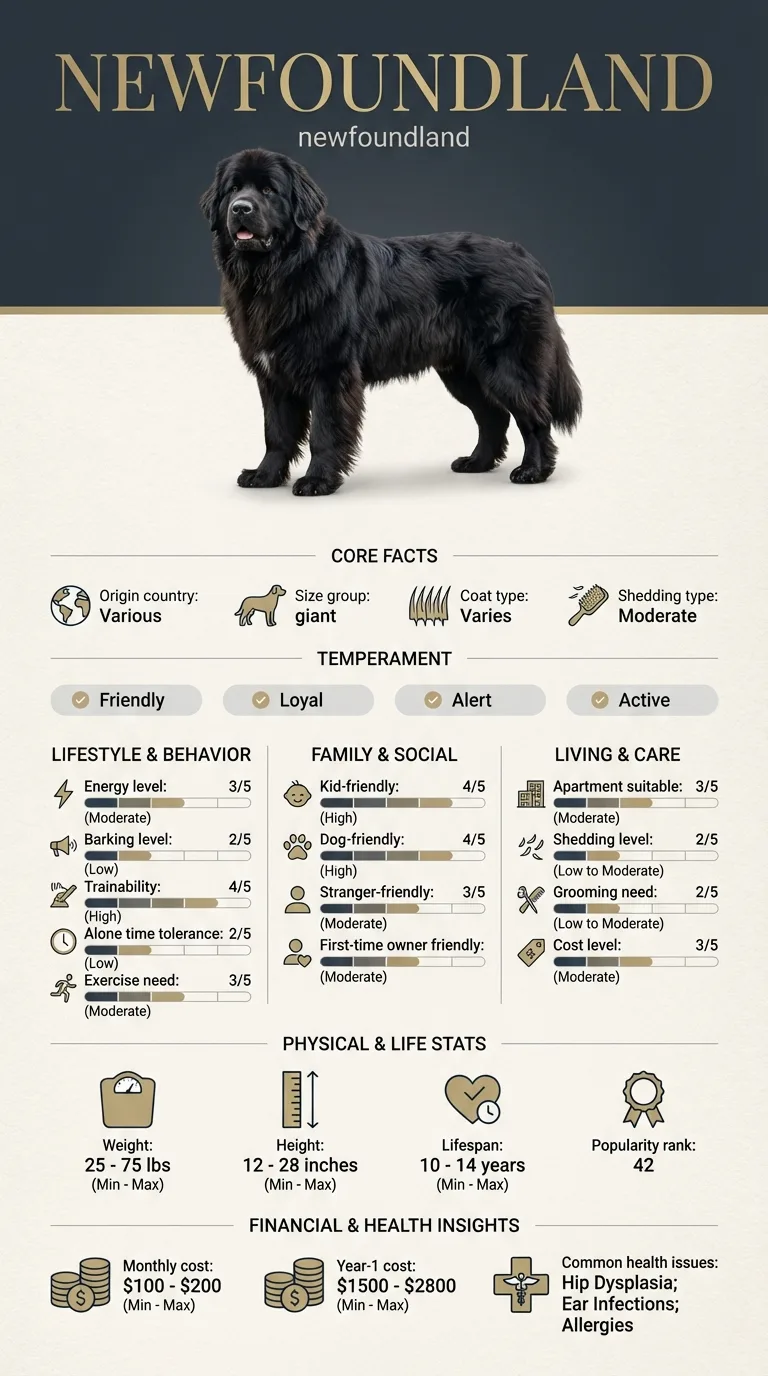
100–150 lbs
Equal
Height
14–24 in
26–28 in
Equal
Lifespan
12–14 years
9–10 years
labradoodle
Exercise need
Very high (5/5)
Moderate (3/5)
newfoundland
Grooming need
High (4/5)
High (4/5)
Equal
Shedding
Low (2/5)
Very high (5/5)
labradoodle
Energy level
Very high (5/5)
Low (2/5)
Equal
Barking
Low (2/5)
Low (2/5)
Equal
Apartment suitability
Low (2/5)
Very low (1/5)
labradoodle
Good for first-time owners
High (4/5)
Moderate (3/5)
labradoodle
Tolerates being alone
Low (2/5)
Moderate (3/5)
newfoundland
Trainability
Very high (5/5)
High (4/5)
labradoodle
Good with kids
Very high (5/5)
Very high (5/5)
Equal
Good with other dogs
High (4/5)
High (4/5)
Equal
Friendly to strangers
High (4/5)
High (4/5)
Equal
Cost level
High (4/5)
Very high (5/5)
labradoodle
Coat
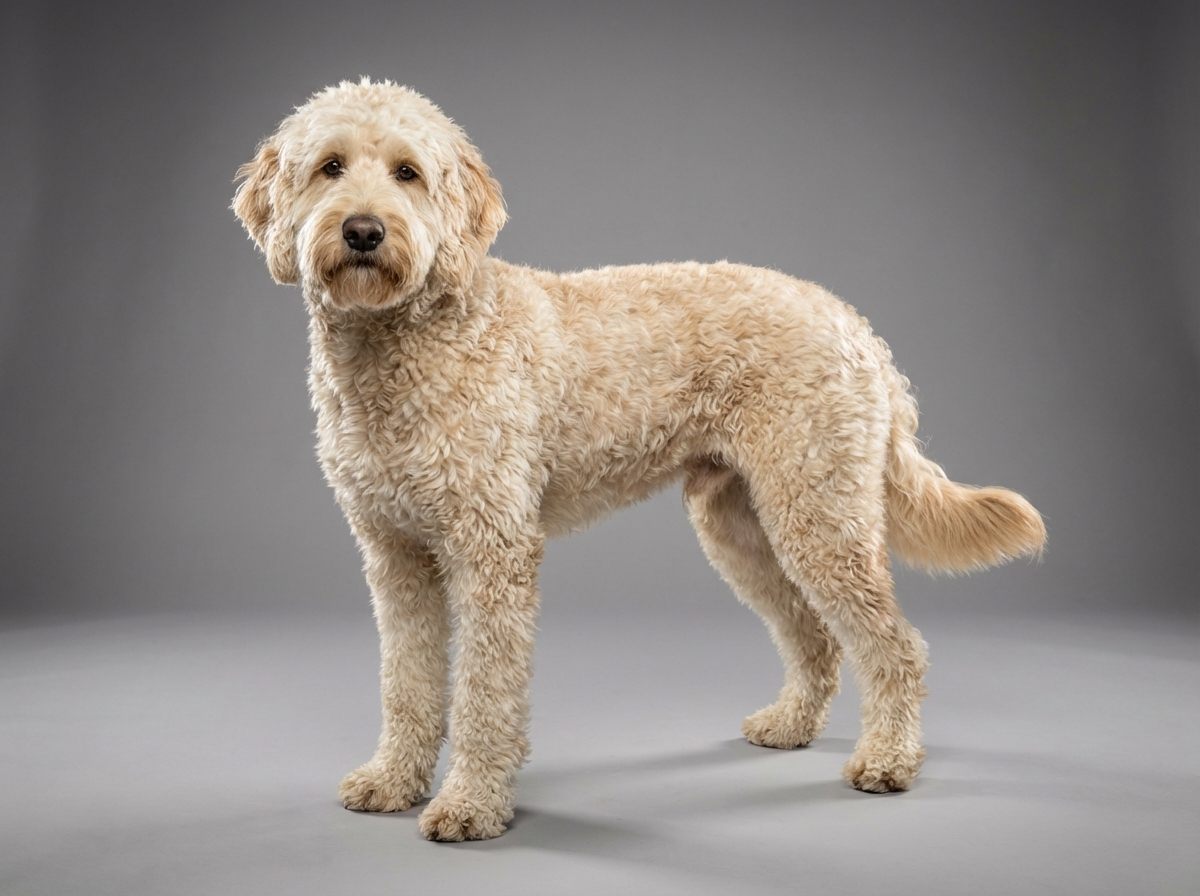
Wavy to curly
Heavy water-resistant double coat
Equal
Origin
Australia
Various
Equal
Typical monthly cost
$120–$220
$150–$310
Equal
Typical first-year cost
$1,800–$3,200
$2,200–$4,200
Equal
Deep dive
Size and build
The Newfoundland is a genuine giant: 100-150 lbs and 26-28 inches, against the Labradoodle's 15-65 lbs and 14-24 inches. Even a large standard Labradoodle sits well below a Newfoundland's typical weight, and this breed was built for hauling and water rescue work, not for fitting into tight spaces or being casually lifted into a car when it's time for a vet visit.
Energy and exercise
The Labradoodle rates 5/5 on exercise need, very high, while the Newfoundland sits at 3/5, moderate, a lower bar than its size might suggest. Both breeds are quiet, tying at 2/5 barking, so noise isn't a differentiator here even though the Newfoundland is the far larger dog and could, in theory, sound intimidating when it does bark, which in practice is rarely.
Grooming and shedding
Grooming ties at 4/5 for both, but shedding does not: the Newfoundland rates 5/5, very high, against the Labradoodle's 2/5, low. That heavy double coat is built for cold water work and sheds accordingly, especially during seasonal blowouts twice a year. If shedding is a dealbreaker, this is the single biggest number to pay attention to in this whole comparison, full stop.
Apartment living, noise and time alone
The Newfoundland scores just 1/5 on apartment suitability, the lowest score in this comparison, against the Labradoodle's 2/5. Its sheer size makes small-space living genuinely impractical, and most leases with weight limits will simply rule it out. On the plus side, it tolerates being alone better than the Labradoodle, 3/5 versus 2/5, a rare advantage for a giant breed that's otherwise demanding on space.
Training and owner experience
The Labradoodle rates higher for first-time owners, 4/5 against the Newfoundland's 3/5, and is slightly more trainable, 5/5 versus 4/5. The Newfoundland is still a fundamentally biddable, easygoing breed; it's just a lot of dog to manage physically while you're both learning leash manners and basic commands, and its strength means early training matters more than usual, ideally starting the week it comes home.
Kids, other dogs and visitors
Kids, other dogs, and strangers all tie between these two breeds, at 5/5, 4/5, and 4/5 respectively. The Newfoundland's "Sweet, Patient, Devoted" temperament traits back up its reputation as a nanny dog, matching the Labradoodle score-for-score on family-friendliness despite the enormous size gap between the two breeds and their very different builds and working histories on land and in water.
Health and lifespan
The Labradoodle's lifespan advantage is significant, 12-14 years against the Newfoundland's 9-10. The Newfoundland's health list is shorter but weighted toward cardiac risk: subaortic stenosis and dilated cardiomyopathy alongside hip dysplasia and bloat, conditions worth discussing directly with a breeder or vet given how serious they can be for a giant breed carrying this much weight on a comparatively young heart.
Cost to keep
The Newfoundland costs more to keep, 5/5 against the Labradoodle's 4/5. Monthly costs run $150-310 for the Newfoundland versus $120-220 for the Labradoodle, and first-year costs hit $2,200-4,200 against $1,800-3,200. Feeding a 100-150 lb dog is the biggest line item driving that gap, followed closely by larger medication doses and bigger everything, from crates to car harnesses to the vet's scale.
Labradoodle vs Newfoundland at a glance
Labradoodle weighs 15–65 lbs and lives 12–14 years; Newfoundland weighs 100–150 lbs and lives 9–10 years. The two diverge most on energy level, shedding and exercise need. They are level on barking, good with other dogs and grooming need, so those cannot decide it. Where the table declares a winner it means less work for the owner, nothing more; descriptive rows are left as ties on purpose. The value here is in the differences between the two columns; treat any single score as approximate.
Labradoodle vs Newfoundland: Which Suits Your Home? - Labradoodle vs Newfoundland at a glance
Frequently asked questions
Is a Newfoundland a good apartment dog?
No, it's rated 1/5, the lowest apartment suitability score in this comparison. Its size alone makes small-space living impractical, regardless of its calm, moderate exercise needs.
Which sheds more?
The Newfoundland, considerably, 5/5 against the Labradoodle's 2/5. That heavy, water-resistant double coat sheds heavily, so anyone drawn to the Labradoodle for its lower-shedding coat should know the Newfoundland is close to the opposite extreme.
Are Newfoundlands good with kids?
Yes, tying the Labradoodle at 5/5. The breed's reputation as a gentle nanny dog is backed up by its temperament traits, Sweet, Patient, and Devoted, and it scores identically to the Labradoodle on this measure despite its much larger size.
Which needs more exercise?
The Labradoodle, 5/5 versus the Newfoundland's 3/5. It's a common misconception that a bigger dog needs more exercise; here the giant breed is actually the more moderate mover.
How much more expensive is a Newfoundland to keep?
Notably more. Expect $150-310 a month against $120-220 for the Labradoodle, and $2,200-4,200 in year one against $1,800-3,200. Food costs for a 100-150 lb dog add up fast.
Which lives longer?
The Labradoodle, by a wide margin, 12-14 years against the Newfoundland's 9-10. That's typical of giant breeds generally, which trade size for a shorter lifespan.
What health issues should I watch for in a Newfoundland?
Cardiac conditions stand out on its list, specifically subaortic stenosis and dilated cardiomyopathy, alongside hip dysplasia and bloat. Ask a breeder about cardiac screening before committing to this breed.
If you have serious space and a lower tolerance for shedding, the Labradoodle's 2/5 shedding score and better apartment fit make it the practical pick. If you have room, patience for a giant coat, and want a famously gentle family dog, the Newfoundland delivers on temperament.
Costs
What's the monthly cost?
$120-220 for a Labradoodle versus $150-310 for a Newfoundland, with the giant breed's food needs driving the difference.
Behavior
How much exercise does each need?
The Labradoodle needs more, 5/5 versus the Newfoundland's 3/5, moderate. Despite its size, the Newfoundland isn't a high-mileage dog.
Health
Which lives longer?
The Labradoodle, by up to five years, 12-14 versus the Newfoundland's 9-10, a typical tradeoff for giant breeds.
Related DogBreedCompass guides
Labradoodle breed guide – Readers comparing the two usually want the full profile of Labradoodle before deciding.
Newfoundland breed guide – The same for Newfoundland, so the comparison can be checked against the detail.
Labradoodle vs Bernedoodle – Bernedoodle is the closest breed to Labradoodle on the measured axes, so it is the natural next comparison.
Newfoundland vs Saint Bernard – Saint Bernard sits closest to Newfoundland, which makes it the alternative worth ruling out.
What Labradoodle costs to keep – Anyone weighing these two is usually also pricing them, and the cost pages carry city-level figures.
Newfoundland health problems – The health pages set out what each breed is actually screened for.
Health information here is general and is not veterinary advice. If your dog shows pain, sudden behaviour change, or worsening symptoms, consult a licensed veterinarian.
Some links on this site are affiliate links. We may earn a commission at no extra cost to you, and we only suggest products we believe are helpful for dog owners.
We research and check what we publish, but we do not warrant that any figure, date, price, or statement is accurate, complete, or current, and we accept no liability for any loss, cost, injury, or other harm arising from the use of this site. Use it as one reference among several. You remain responsible for your own decisions and for your dog's care - confirm anything that matters with a licensed veterinarian or another qualified professional before you act on it. Full disclaimer.